
Why Do Funny Tempo Markings Exist?
Standard tempo words such as Allegro and Andante describe a speed and a character in one word. Some composers found that too limiting. They wanted to describe a mood, an image or an attitude, so they wrote longer, more personal directions, sometimes with a wink.
Three motives show up again and again. Some composers wanted to provoke the performer into a particular state of mind. Some were mocking the solemn conventions of concert music. And some simply preferred their own language to Italian, so their honest instructions now read as quaint or funny to modern players.
Whatever the motive, the tempo word on a score is never just decoration. Even an absurd direction usually implies a pace, a dynamic or a touch, and part of the fun is working out what the composer meant.
What Are Erik Satie's Strangest Directions?
The French composer Erik Satie is the champion of odd markings. His piano pieces are full of directions that sound like riddles or private jokes. Musicians still debate whether they are meant to be read, performed or simply enjoyed in silence by the pianist.
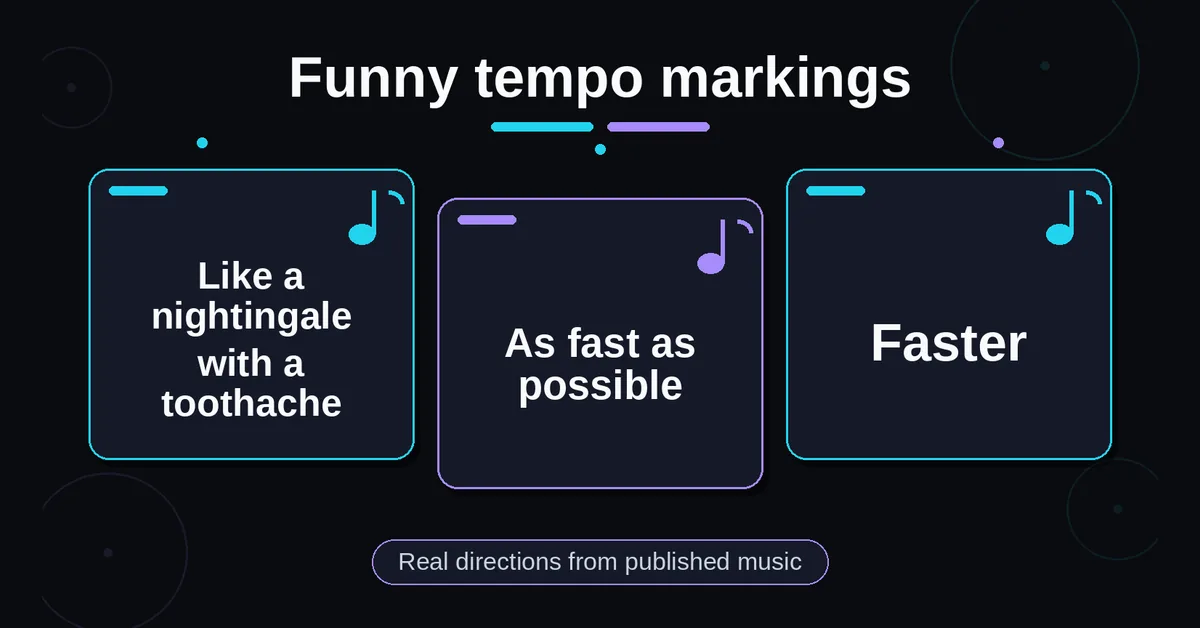
The most quoted comes from Embryons desséchés, written in 1913, which asks for a passage to be played like a nightingale with a toothache. Interlude, a classical music magazine, collects many more in English translation:
| Direction (English translation) | Where it appears |
|---|---|
| Like a nightingale with a toothache | Embryons desséchés |
| With the tip of your thought | Gnossiennes |
| Postulate within yourself | Gnossiennes |
| On the tongue | Gnossiennes |
| With surprise | Gnossiennes |
| Don't go out | Gnossiennes |
| With great kindness | Gnossiennes |
| Alone for an instant | Gnossiennes |
| To ignore one's own presence | Le Fils des étoiles |
None of these gives a number, yet they still guide the playing. "With the tip of your thought" suggests a light, detached touch. "Alone for an instant" invites a pause or a hush. Satie's famous Gnossiennes are slow, freely flowing pieces, so pianists usually read his directions as color within a calm tempo rather than as speed changes.
What Happens When a Marking Contradicts Itself?
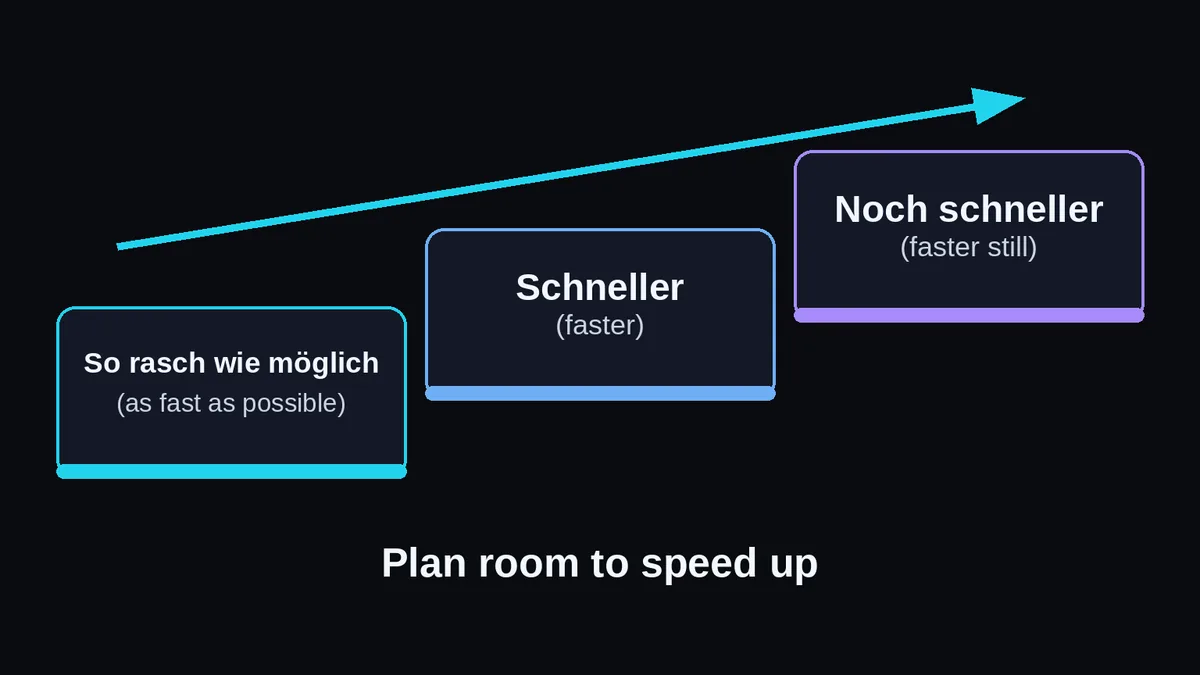
The most famous contradiction belongs to Robert Schumann. The first movement of his Piano Sonata No. 2 is marked "So rasch wie möglich," as fast as possible. Near the end, Schumann adds "Schneller," faster, and then "Noch schneller," faster still. Taken literally, it cannot be done.
Performers solve the puzzle by reading it as a description of energy rather than arithmetic. "As fast as possible" really means fast and urgent, at a speed you can sustain cleanly. The later markings ask for a final surge, so the player must leave room at the start to accelerate at the end.
This is a useful lesson for any piece. If a score asks for a sudden "faster" after an already fast passage, plan your opening tempo so the climax still has somewhere to go. For gradual speeding up, see the accelerando guide.
Which Standard Italian Terms Sound Funny in English?
Many perfectly normal Italian terms sound odd when translated word for word. They are standard vocabulary, not jokes, but their literal meanings explain why students giggle at them. Each still has a clear practical meaning.
| Term | Literal translation | What it actually asks |
|---|---|---|
| Allegro ma non troppo | Cheerful, but not too much | Fast, slightly restrained |
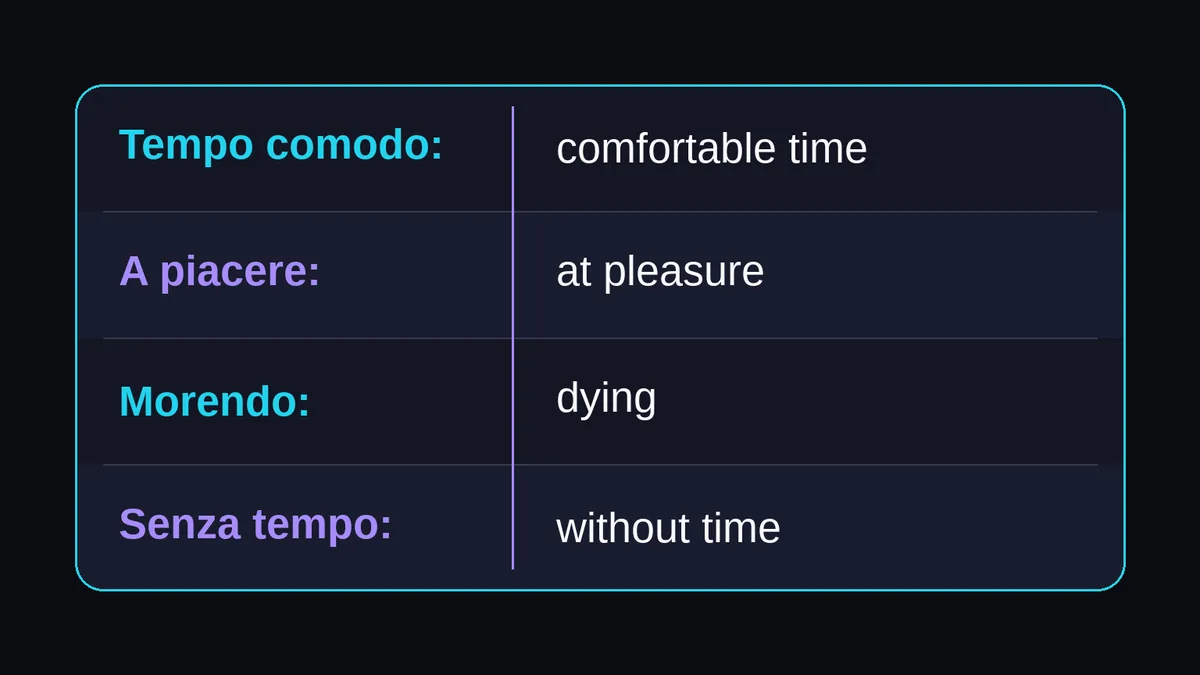
| Tempo comodo | Comfortable time | An easy, unhurried tempo |
| Tempo giusto | Fair or correct time | A strict, sensible tempo |
| A piacere | At pleasure | Freely, at the performer's choice |
| Ad libitum | At liberty | Freely; may also mean optional |
| Senza tempo | Without time | No strict beat |
| Con brio | With brightness or spirit | Lively, energetic |
| Morendo | Dying | Fading away, often slowing |
Morendo is a favorite. It literally means dying, and it asks the music to fade away, usually getting softer and a little slower at the same time. A piacere and ad libitum hand the clock to the performer, which links them to tempo rubato.
Why Did Composers Switch From Italian to Their Own Languages?
From the nineteenth century, many composers wrote directions in their native language to be more precise or more personal. Schumann and Beethoven used German, Debussy and Satie French, and Elgar leaned on an unusual Italian word of his own choosing. The results can look strange beside the usual Italian, but they often say more.
Beethoven's Piano Sonata Op. 109 is a clear example. Its final movement is headed in German, Gesangvoll, mit innigster Empfindung, singing, with the most heartfelt feeling, alongside the Italian Andante molto cantabile ed espressivo. The German adds an emotional precision that the Italian alone cannot.
Edward Elgar favored nobilmente, nobly, a word you will not find on most tempo charts. His Symphony No. 1 opens Andante. Nobilmente e semplice, and Elgar described that theme as simple and, in intention, noble and elevating. These directions are serious, but they show how personal tempo instructions became.
How Do You Play a Funny Tempo Marking?
Treat an unusual direction as a clue to mood, touch and tempo. First find any metronome mark or standard tempo word nearby; that sets the basic speed. Then let the odd direction shape how you play within it. Recordings by respected performers show how others have solved the same puzzle.
- Look for a number or an ordinary tempo word. If there is one, set your basic tempo from it with the online metronome.
- Translate the direction literally, then ask what it suggests: lighter or heavier, faster or slower, louder or softer.
- Decide whether it changes the speed or only the character. Most of Satie's directions affect character, not speed.
- For contradictory markings, plan the whole span. Start below your limit if the score later asks for more speed.
- Listen to two or three recordings to see the range of reasonable readings.
If you want to know the tempo a recording actually uses, tap along on the tap tempo tool with the spacebar, a letter or a number key. Free, rubato style passages will give uneven readings, which is itself a sign that the marking asks for flexibility.
Are the Viral Lists of Joke Markings Real?
Not usually. Lists of joke terms circulate online, with invented Italian sounding words that pun on English. They are fun, but they are not real directions and you will not find them in published scores. The examples on this page come from actual works and named sources.
When you see a funny marking quoted, check where it comes from. Real directions can be traced to a specific piece and edition. If a list gives no composer or work, treat it as humor rather than history. For the genuine, standard ladder of tempo words and their BPM ranges, see the tempo markings chart.