
What Is Tempo?
Tempo is the speed of a piece's underlying pulse, meaning how quickly its beats go by. So what is tempo in practice? It is the thing you tap your foot to. Musicians write it as a number of beats per minute, as a word such as Andante or Allegro, or both. A tempo word can also hint at mood, which a bare number never does.
A performance can hold one steady tempo for four minutes, bend the pulse for expression, or jump to a new speed halfway through. Some music has no regular pulse at all. A chant sung in free time, or a cadenza where the soloist takes over, is better described by timing instructions than by one number.
The word comes from Italian, where it means time, and traces back to the Latin tempus, as the American Heritage Dictionary's entry notes. Both tempos and tempi are accepted plurals.
How Is Tempo Different From BPM?
Tempo is the speed itself. BPM is one way of measuring it. "Allegro" gives you a broad direction, while "quarter note = 132" pins the speed down and also tells you which note gets the count. Our BPM guide covers the number and where it falls short.
Two BPM numbers only compare cleanly when they count the same note. The examples on this page assume BPM counts quarter notes. At quarter note = 120, two quarter notes pass every second, and each one lasts 500 milliseconds.
A few worked values:
| BPM (quarter note) | Beats per second | Milliseconds per beat |
|---|---|---|
| 60 | 1 | 1,000 |
| 90 | 1.5 | 667 (rounded) |
| 120 | 2 | 500 |
| 150 | 2.5 | 400 |
If you need delay times or note lengths at a given speed, the BPM to ms converter and the note duration calculator do the arithmetic for every note value.
How Is Tempo Different From Rhythm and Meter?
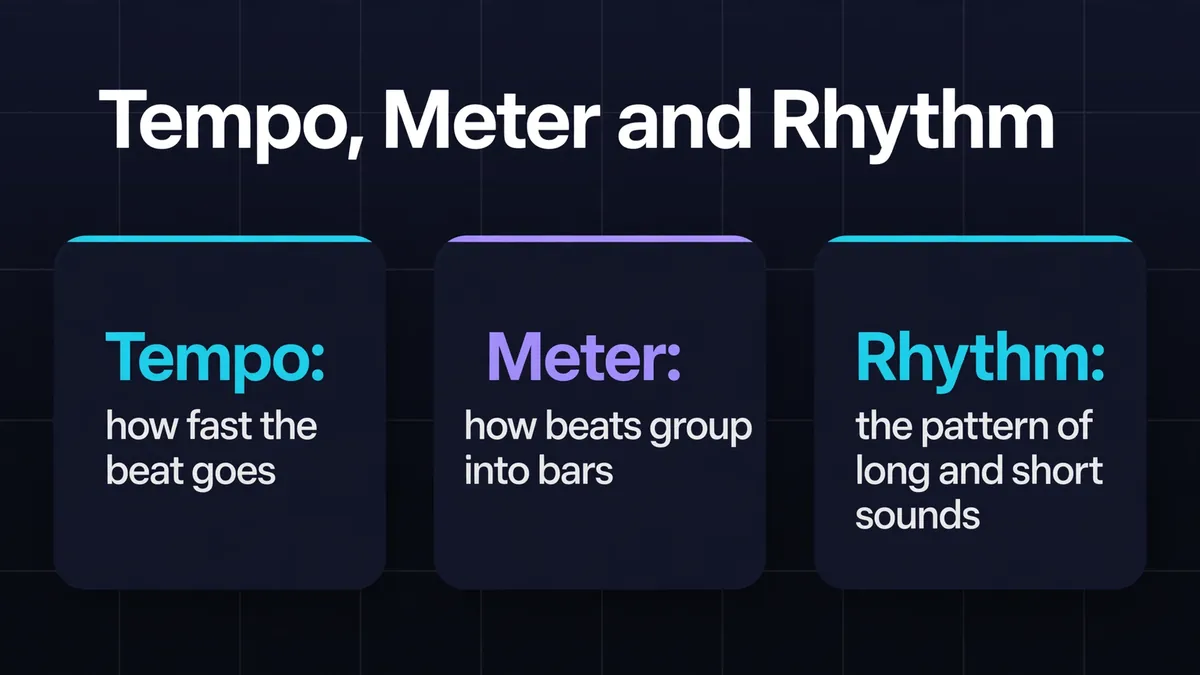
Tempo sets how fast a pattern unfolds. Rhythm is the pattern itself: which notes are long, which are short, where the rests sit. Meter groups the beats into bars. Slow a passage from 120 to 80 BPM and the rhythm on the page stays exactly the same; only the clock changes.
A few related ideas often get mixed in:
- Subdivision splits a beat into smaller equal parts, such as two eighths or four sixteenths.
- Syncopation puts weight on positions you would not expect, like the "and" of a beat.
- Swing stretches the first note of each pair and shortens the second.
- Meter, written as a time signature such as 3/4 or 6/8, tells you how beats group into bars.
None of these, on their own, changes the tempo. They change the feel inside it. Our time signatures guide explains how meter and BPM interact, especially in 6/8, where the felt beat is a dotted quarter.
What Do Italian Tempo Words Mean?
Italian tempo words describe a speed area and a character, not one exact BPM. Largo means broad and slow, Adagio means slow and at ease, Andante suggests a walking pace, Moderato means moderate, Allegro means fast and lively, and Presto means very fast. Context and the composer's era shape how each is played.
Where each band starts and ends varies by source, and these are this site's approximations. The full comparison lives in our tempo markings chart.
| Marking | Approximate BPM on this site | Character |
|---|---|---|
| Largo | 40 to 60 | Broad and slow |
| Adagio | 66 to 76 | Slow, at ease |
| Andante | 76 to 108 | At a walking pace |
| Moderato | 108 to 120 | Moderate speed |
| Allegro | 120 to 156 | Fast, lively or cheerful |
| Presto | 168 to 200 | Very fast |
Modifiers matter too. "Allegro ma non troppo" means fast but not too much, so a pianist might settle near the low end of the Allegro band. "Più mosso" means more motion, so you move faster than what came before.
Why Italian? Influential Italian composers helped set notation habits, and the vocabulary stuck. Symphony Nova Scotia explains that history and points out that composers also write tempo directions in French, German and English.
How Do You Read a Metronome Mark?
A metronome mark pairs a note symbol with a number, such as quarter note = 96. It sits above the staff at the start of the piece or wherever the tempo changes. Older scores add M.M., short for Maelzel's metronome. The note symbol tells you what the number counts.
This is where people trip. Most metronome apps, including ours, count quarter notes. If the score says dotted quarter = 60, as many 6/8 pieces do, a dotted quarter equals three eighths and a quarter equals two, so the quarter note rate is 60 × 3 / 2 = 90.
Worked examples:
- Dotted quarter = 60 becomes quarter = 90.
- Dotted quarter = 80 becomes quarter = 120.
- Half note = 72 (common in cut time) becomes quarter = 144.
A student who types 60 into a quarter note metronome for that 6/8 piece will practice it at two thirds of the intended speed and wonder why the recording sounds so fast. Set 90 on the online metronome and choose 6/8; it clicks each eighth note, and you feel every three clicks as one big beat.
Can Tempo Change Inside a Piece?
Yes. A tempo can drift gradually, switch suddenly or breathe freely, so one average BPM may not describe a whole piece. Scores mark these changes with Italian terms, and DAWs store them in a tempo map that tells the grid where the speed moves.
| Instruction | What to do |
|---|---|
| Accelerando | Gradually speed up |
| Ritardando or rallentando | Gradually slow down |
| Rubato | Use expressive flexibility in timing |
| A tempo | Return to the tempo before a temporary change |
| Tempo primo | Return to the first tempo |
Musicca defines a tempo as a return to the preceding tempo and tempo primo as a return to the first one. The difference only bites when a piece has already set up more than one tempo. Say a movement opens at quarter = 100, moves to a faster section at 132, then slows with a ritardando. "A tempo" sends you back to 132. "Tempo primo" sends you all the way back to 100.
Producers meet the same idea differently. In Ableton Live, Logic Pro or FL Studio, a tempo automation lane draws the changes so clips and plugins stay aligned. Before building one for a live recording, check that you simply measured the wrong BPM or misplaced the first downbeat. The why BPM detectors disagree guide covers the usual suspects.
How Does Tempo Feel Different From Its Number?
The number on the metronome and the speed you feel do not always match. A trap beat at 140 BPM with hi hats rolling in sixteenths and a snare on beat 3 feels like 70. Drum and bass at 174 can feel relaxed if the bass moves in half notes. Feel depends on where the strong hits land.
That is half time and double time. Same tempo, different emphasis. A DJ mixing a 70 BPM track into a 140 BPM set does not need to speed anything up; the two already line up, one beat against two. Our half time vs double time guide walks through it with drum patterns.
Tempo also changes song length in a predictable way. A song of 90 bars in 4/4 holds 360 beats. At 120 BPM it runs 3 minutes. At 90 BPM, the same 360 beats take 4 minutes. A band that drops from 120 to 90 for a slower live version adds a full minute without adding a note. The tempo calculator handles these conversions and percentage changes.
What Mistakes Do People Make With Tempo?
Most tempo problems come from three habits: ignoring the beat unit, treating tempo words as exact numbers, and trusting one measurement of an unsteady recording. A few minutes of checking avoids hours of practicing at the wrong speed.
The errors I see most often:
- Reading dotted quarter = 60 as 60 on a quarter note metronome. The fix is × 1.5, giving 90.
- Assuming a tempo word has one correct BPM. Two good editions can suggest different marks.
- Measuring a live recording once and treating it as fixed. Tap through several sections; the band may push the chorus.
- Reporting the half time or double time number by accident. A detector that says 87 for a 174 track is not wrong about the pulse, just about the counting level.
- Practicing only at the target tempo. Control at a slower speed builds the target tempo; forcing it builds tension.
When you need a number for a song you are hearing, tap along on the tap tempo tool for a few bars or use the BPM finder on an audio file. For printed music, read the mark and convert the beat unit if needed.