
What BPM Is House Music?
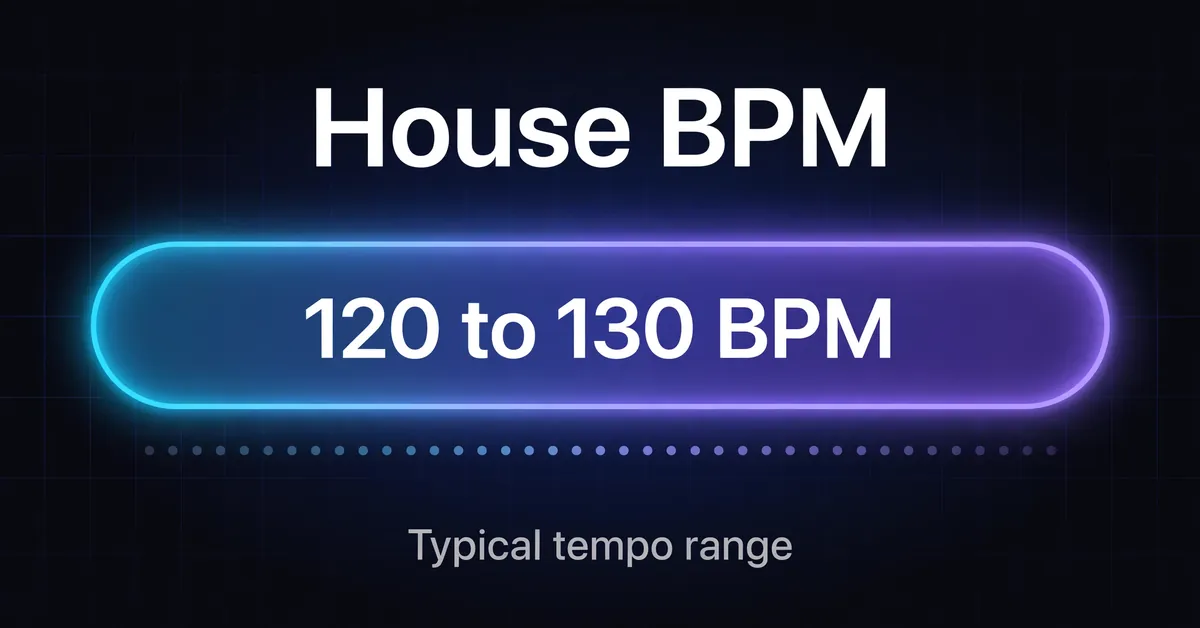
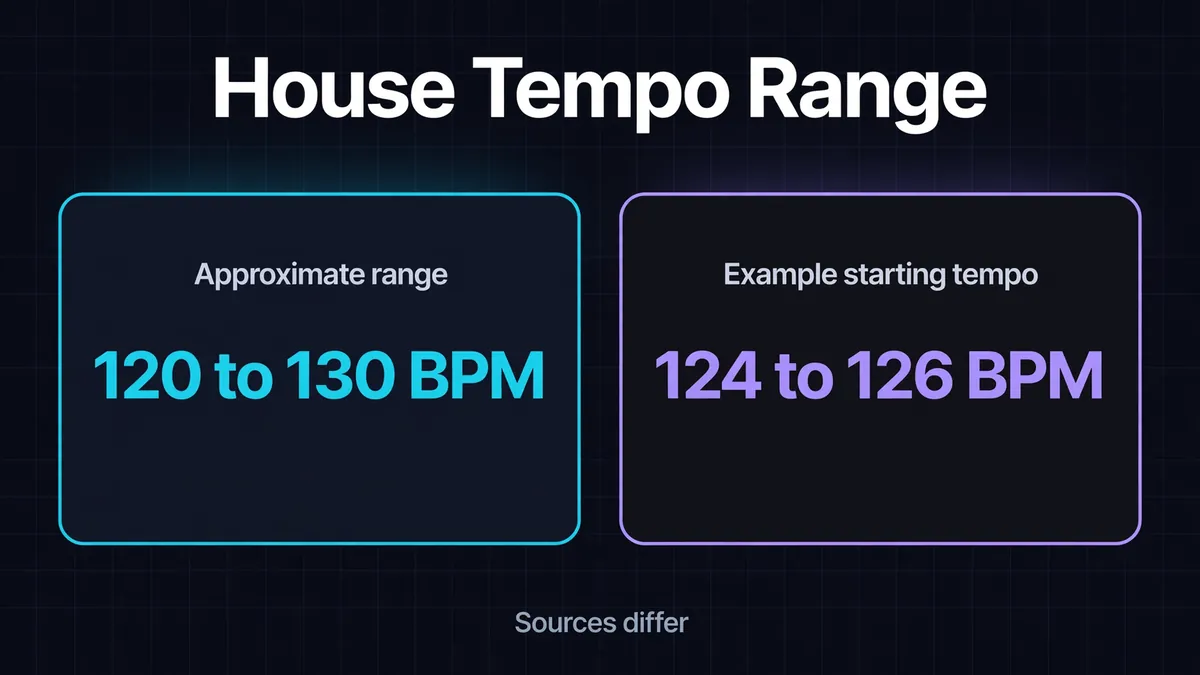
House music BPM sits at approximately 120 to 130 BPM on this page, with 124 to 126 BPM as an example starting band. Deep house and tech house overlap in tempo. Use the four on the floor kick to follow the pulse, then listen to how the offbeat hats shape the groove.
The kick lands on every quarter note, so in house the beat you tap and the beat the kick plays are usually the same. That makes the genre one of the easier styles to measure by ear. Tap along with the kick on tap tempo for eight or more beats and the reading settles quickly. A familiar example: SongBPM lists Daft Punk's "One More Time" at 126 BPM, inside the band but above the 124 preset, which shows why a reference range is more useful than a single number.
BPM by Subgenre
House subgenres share the same pulse but sit at slightly different speeds. The table below gives starting bands for production practice. They overlap on purpose, because a deep house record at 124 BPM and a tech house record at 124 BPM can exist side by side; the difference lives in the sounds and arrangement.
| Subgenre | Approximate BPM reference | How to use the example |
|---|---|---|
| Nu disco and slow house | 115 to 120 | Try a slower version of the groove |
| Deep house | 118 to 124 | Compare sustained chords and shorter bass notes |
| Classic and soulful house | 120 to 125 | Explore chord stabs over a steady kick |
| Tech house | 124 to 128 | Test a percussion focused arrangement |
| Electro house | 126 to 130 | Try brighter synth layers |
| Bass house and hard house examples | 128 to 134 | Suggested exercise band; these styles have wider ranges |
Ableton's tempo and genre lesson gives a house reference of 115 to 130 BPM, broader than the approximate 120 to 130 band used here.
ZIPDJ's subgenre chart gives deep house 110 to 125 BPM, while PromoLink's guide gives around 118 to 124. These are published reference bands; this page's narrower deep house exercise band does not exclude slower recordings. The same ZIPDJ chart lists acid house at 120 to 130 BPM and hard house at 135 to 165, which is why the bass house and hard house row above is labeled an exercise band rather than a limit.
How Do You Choose a House Tempo?
Start at 124 BPM and play the bassline with the kick. Compare slower and faster versions before adding more percussion. Listen for whether bass notes finish cleanly before the next kick and whether chord stabs leave room for the vocal. Tempo is one arrangement choice, alongside note length and sound selection.
A practical method is to loop four bars and change only the tempo in your DAW, whether that is Ableton Live, Logic Pro or FL Studio. Try 120, 124 and 128 in turn.
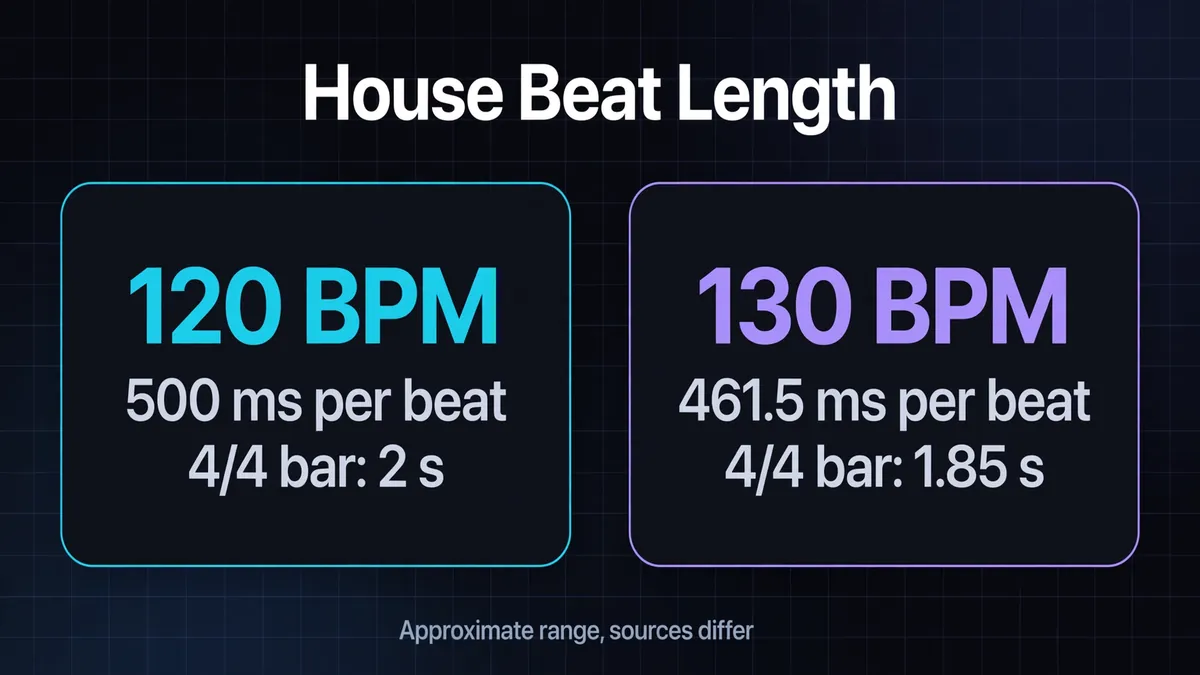
- At 120 BPM a quarter note lasts 500.00 ms. Long bass notes and sustained pads have room to breathe, which suits deeper material.
- At 124 BPM the quarter note shrinks to 483.87 ms. Most grooves on this page start here.
- At 128 BPM it is 468.75 ms, and a sixteenth is 117.19 ms. Busy percussion and short plucks feel tighter, which is useful for tech house exercises.
A singer may push the decision. If a topline feels rushed at 126, drop two BPM before rewriting the melody; the change is only 1.61 percent, small enough to keep the energy while giving syllables more space.
How Does House Feel at 124 BPM?
Use this one bar exercise in 4/4. Each beat has four sixteenth note steps, counted 1 e and a. Beats 1, 2, 3 and 4 begin on steps 1, 5, 9 and 13.
| Voice | Steps | Placement |
|---|---|---|
| Kick | 1, 5, 9, 13 | Every quarter note beat |
| Clap or snare | 5, 13 | Beats 2 and 4, layered with the kick |
| Open hi hat | 3, 7, 11, 15 | The and of each beat |
| Closed hi hat | All 16 steps | Sixteenths; vary the velocity |
The open hats answer the kicks halfway between beats. If the open and closed hats overlap, try a mute group in your drum sampler or remove the overlapping closed hits. This changes articulation without changing the BPM.
Attack Magazine's Chicago house tutorial gives 50 to 55 percent swing for its example. Its stripped deep house example uses 50 to 60, and its 1990s house example uses 55 to 60. These are tutorial settings. Compare them on hats and shakers while keeping the kick steady.
To hear what swing does in time, take the straight sixteenth at 124 BPM: two sixteenths form an eighth of 241.94 ms, split evenly as 120.97 ms each. At 55 percent swing the first sixteenth takes 55 percent of that pair, about 133.07 ms, so the second note arrives roughly 12 ms late. At 60 percent the delay grows to about 24 ms. Those few milliseconds are the whole difference between a stiff and a loose hat line.
Note Values at 124 BPM
The figures treat each four on the floor kick as one quarter note beat at 124.
| Note value | Length in ms |
|---|---|
| Quarter note | 483.87 |
| Eighth note | 241.94 |
| Sixteenth note | 120.97 |
| Dotted eighth note | 362.90 |
| Eighth note triplet | 161.29 |
Try a dotted eighth delay at 362.90 ms on a short chord stab. Where the repeats land against the hats depends on when you play the stab. Compare subdivisions with the delay calculator.
For sidechain release, a common starting point is to let the pumping recover just before the next kick. At 124 BPM that means a release shorter than 483.87 ms, often around an eighth note of 241.94 ms for a clear pump. Use the BPM to MS converter for other tempos.
How Long Are House Phrases in Seconds?
House arrangements usually move in 8, 16 and 32 bar sections. In 4/4, one bar is four quarter notes, so bar length in seconds equals 240 ÷ BPM. Knowing this helps DJs plan a blend and helps producers time an intro for mixing.
| BPM | One bar | 16 bars | 32 bars |
|---|---|---|---|
| 120 | 2.00 s | 32.00 s | 64.00 s |
| 124 | 1.94 s | 30.97 s | 61.94 s |
| 128 | 1.88 s | 30.00 s | 60.00 s |
At 128 BPM a 32 bar intro lasts exactly 60 seconds, a neat check you can confirm with a stopwatch. At 124 BPM the same intro runs 61.94 seconds. A DJ who wants a minute long overlap between two 124 BPM tracks needs just under 32 bars.
Practicing and Mixing at House Tempos
Players: Practice the bassline and chord stabs separately at 124 BPM, then combine them. Record a short passage and check whether the offbeat stabs stay evenly spaced between clicks. For an exercise with alternating sounding and silent bars, use a DAW or another metronome with that control. The online metronome at 124 BPM with eighth note subdivision gives a click on every offbeat, which makes a useful guide for stab timing.
DJs: Use tap tempo to estimate a recording's pulse, then check its beat grid and phrase starts. After matching two kick pulses, listen for clashing bass notes and overlapping vocals. Shared BPM helps with beatmatching; arrangement determines where the transition works.
Here is the arithmetic for a common move. Mixing a 124 BPM deep house track into a 128 BPM tech house track means speeding the first one by 3.23 percent. Without key lock, that raises pitch by about 0.55 semitone, enough for a sustained chord to sound slightly off against the next record. With key lock on, pitch stays put, though heavy stretching can color the sound. Moving from 126 to 128 is only 1.59 percent, roughly 0.27 semitone.
Which House Tempo Mistakes Should You Avoid?
The most common error is treating one number as the genre. 128 BPM appears often in charts and DJ advice, but it is a point inside a band, not a definition. A few other traps catch producers and DJs alike.
- Reading a half value. Some analyzers report 62 for a 124 BPM track. Double it and check against the kick; the half time vs double time guide explains why this happens.
- Judging subgenre from BPM. A 124 BPM reading cannot tell deep house from tech house. Listen to the bassline and percussion.
- Swinging the kick. Apply swing to hats and shakers first; a shifted kick blurs the four on the floor pulse.
- Rounding too early. 362.90 ms rounded to 363 is fine for a delay, but rounding 124 to 125 BPM changes every bar by about 15 ms and adds up over a long loop.