
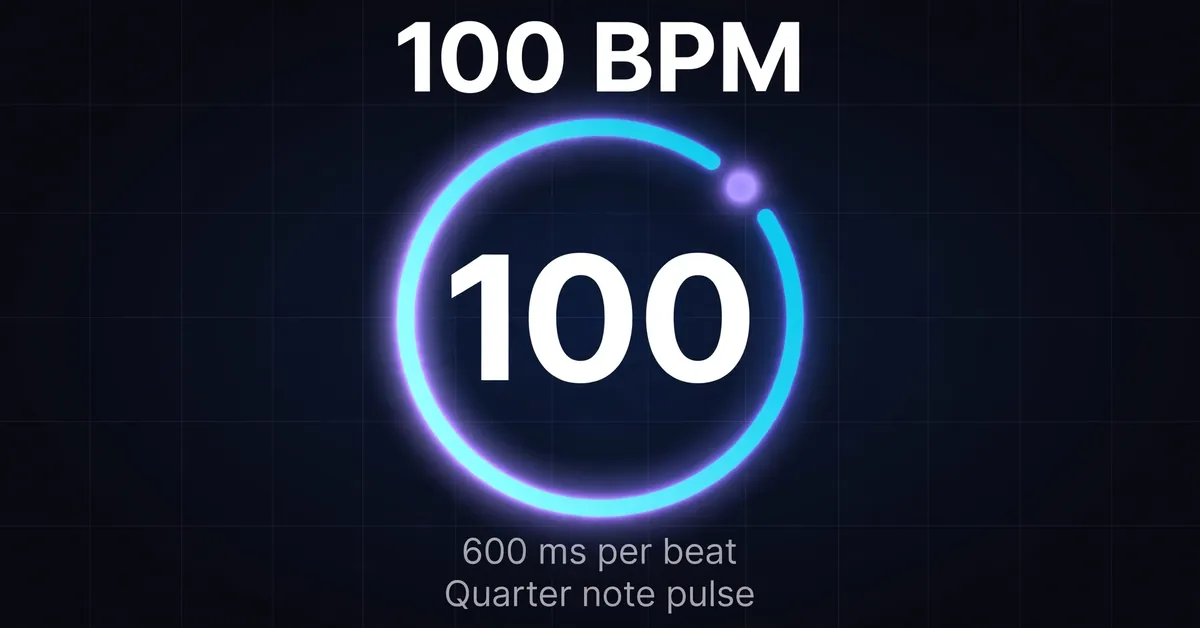
What Is 100 BPM?
A 100 BPM metronome clicks 100 beats per minute, so one beat lasts exactly 600 milliseconds and you hear 1.67 clicks per second. It is a moderate pulse that suits funk, pop and Afrobeats rhythm exercises. Start the metronome, keep your count steady through rests, and use the tables below for subdivisions and effect timing.
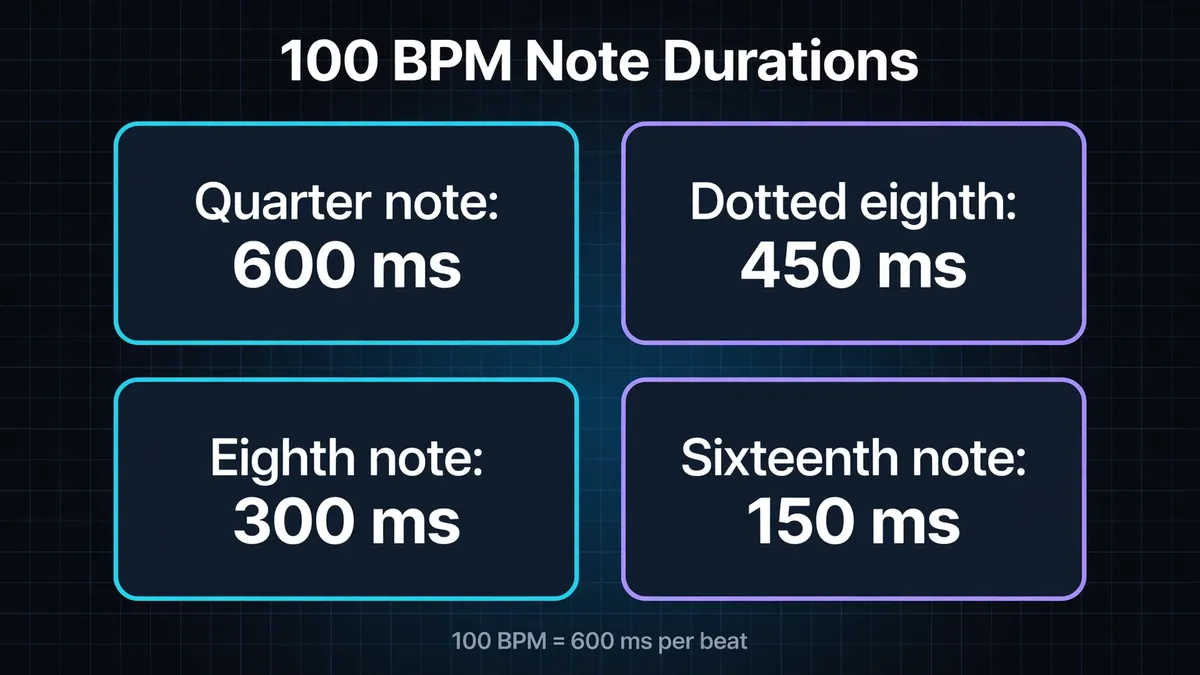
How Long Is Each Note Value at 100 BPM?
At 100 BPM a quarter note lasts 600 ms, an eighth note 300 ms, a sixteenth 150 ms and an eighth note triplet 200 ms. Dotted values add half again: a dotted eighth is 450 ms and a dotted quarter is 900 ms. All of these come from one formula and need no rounding.
All of these lengths count the quarter note as the beat. For a 6/8 score, multiply the dotted quarter mark by 1.5 first: dotted quarter = 60 means 90, and dotted quarter = 70 means 105.
| Note value | Multiplier of the beat | Duration (ms) | Hz (repeats per second) |
|---|---|---|---|
| Whole note | 4 | 2400.00 | 0.42 |
| Dotted half | 3 | 1800.00 | 0.56 |
| Half note | 2 | 1200.00 | 0.83 |
| Dotted quarter | 1.5 | 900.00 | 1.11 |
| Quarter note | 1 | 600.00 | 1.67 |
| Quarter note triplet | 2/3 | 400.00 | 2.50 |
| Dotted eighth | 0.75 | 450.00 | 2.22 |
| Eighth note | 0.5 | 300.00 | 3.33 |
| Dotted sixteenth | 0.375 | 225.00 | 4.44 |
| Eighth note triplet | 1/3 | 200.00 | 5.00 |
| Sixteenth note | 0.25 | 150.00 | 6.67 |
| Sixteenth note triplet | 1/6 | 100.00 | 10.00 |
| Thirty second note | 0.125 | 75.00 | 13.33 |
| Sixty fourth note | 0.0625 | 37.50 | 26.67 |
Worked example for triplets: three eighth note triplets fill one beat, so 600 ÷ 3 = 200 ms each. Two dotted eighths plus one eighth fill two beats in a common syncopated rhythm: 450 + 450 + 300 = 1,200 ms, exactly one half note. For any other value, the note duration calculator and BPM to ms converter use the same math.
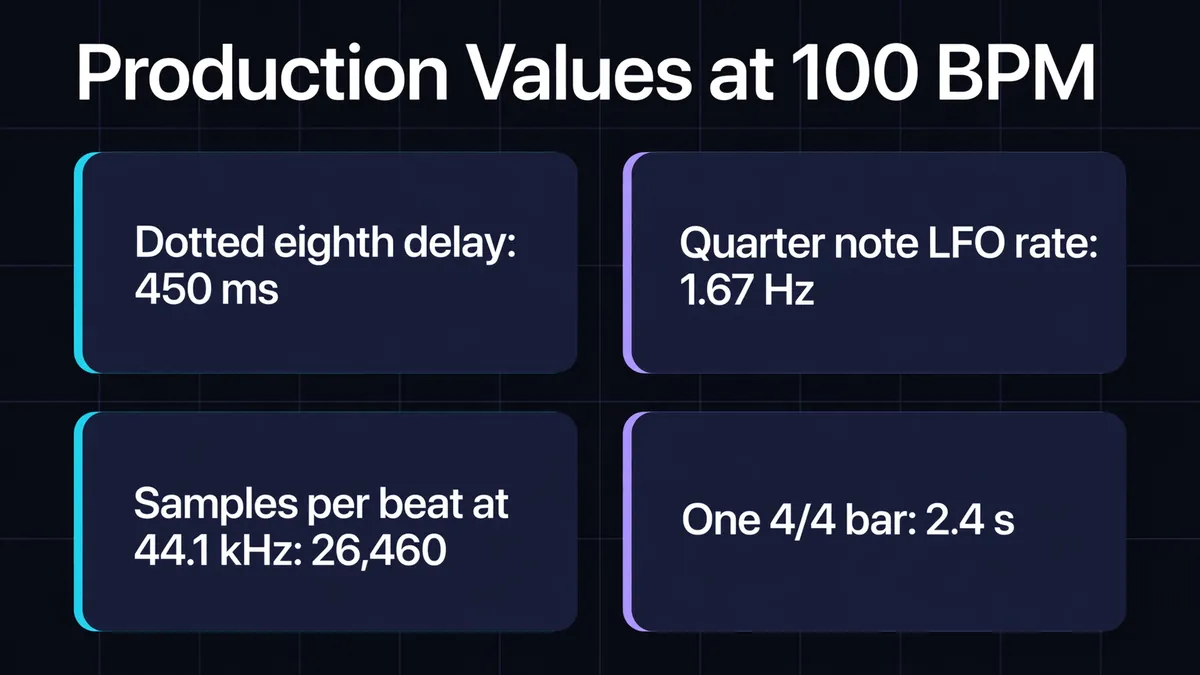
If you work in samples, one beat at 100 BPM is 0.6 seconds, which is 26,460 samples at 44.1 kHz and 28,800 samples at 48 kHz (0.6 × 44,100 and 0.6 × 48,000). The BPM to samples tool covers other rates.
How Long Are Bars and Phrases at 100 BPM?
One bar of 4/4 at 100 BPM lasts 2.4 seconds, a bar of 3/4 lasts 1.8 seconds, and an 8 bar phrase in 4/4 lasts 19.2 seconds. Multiply 0.6 seconds by the number of beats you need. Because 100 divides evenly into 60,000, every bar length here is exact.
| Length (4/4 unless noted) | Beats | Duration |
|---|---|---|
| 1 bar of 3/4 | 3 | 1.8 s |
| 1 bar | 4 | 2.4 s |
| 4 bars | 16 | 9.6 s |
| 8 bars | 32 | 19.2 s |
| 16 bars | 64 | 38.4 s |
| 32 bars | 128 | 76.8 s |
A practical use: a three minute song at 100 BPM contains 300 beats, which is 75 bars of 4/4. A dancer counting in eights covers one eight count every 4.8 seconds, since 8 × 0.6 = 4.8. For other meters, see time signatures and BPM.
What Tempo Marking Is 100 BPM?
This site's interactive BPM chart labels 100 BPM as Andante Moderato, and the tempo also sits inside the site's broader Andante band of 76 to 108 BPM. Other charts put the Andante ceiling elsewhere, so a printed metronome mark in a score always takes priority.
The next band up on the same chart is Moderato, 108 to 120 BPM, so 100 is a little below it. The tempo markings BPM chart lists every band the site uses, and what is tempo explains why the words describe character as much as speed.
What Does 100 BPM Feel Like?
100 BPM feels relaxed but not slow: walking pace for many people, with enough space between beats to hear sixteenth note detail clearly. At 150 ms per sixteenth, ghost notes and muted guitar strokes are easy to place, which is why the tempo works well for funk and groove study.
Try a funk exercise with muted guitar strokes or quiet drum ghost notes around a clear backbeat on beats 2 and 4. Remove the quieter notes and check whether the main pulse stays steady. This separates the groove's rhythmic detail from its tempo.
The same click supports other styles. 100 BPM falls inside this site's approximate Afrobeats band of 95 to 115 BPM and its approximate pop band of 90 to 130 BPM. The pattern, the instrumentation and the swing amount supply the style; the number alone does not. For genre depth, read the Afrobeats BPM guide or the pop BPM guide.
How Should You Practice With a 100 BPM Metronome?
Start with the click on every quarter note, count aloud for two bars, then play. Once a passage is clean, set the subdivision to eighths or sixteenths to expose rushing. If you cannot hold it yet, drop to 90 BPM and climb back in 5 BPM steps.
A simple ladder for a drummer or guitarist:
- 90 BPM, four clean repetitions with the click on quarters (about 666.67 ms per beat).
- 95 BPM, same passage, click still on quarters.
- 100 BPM, click on eighths so each 300 ms gap is audible.
- 100 BPM, click on beats 2 and 4 only by counting the other beats yourself.
- 105 BPM as an overshoot, then return to 100, which now feels roomy.
The online metronome runs from 20 to 360 BPM, offers 4 subdivisions and a speed trainer, and accents beat 1 only. A student working on a 6/8 piece marked dotted quarter equals 100 should enter 150, because in x/8 meters the site's BPM counts quarter notes and each eighth clicks.
If you are not sure a track is really at 100, tap along on the tap tempo page with the spacebar or a letter or number key. It averages your last 8 gaps and starts fresh after a 2.5 second pause.
Which Songs Are Reported at 100 BPM?
Two well known recordings have linked database reports at or next to 100 BPM. Tunebat lists Charlie Puth's "Attention" at 100. "Kiss Me" by Sixpence None The Richer shows 100 on SongBPM and 99 on GetSongBPM. These are attributed reports, not independent audio measurements.
The linked databases report the tempos below. Nearby matches and alternative counts are labeled separately. Use the named version where one is given; a counting option does not establish the recording's intended feel.
| Song | Artist | Recording version | Reported BPM | Counting option | Sources |
|---|---|---|---|---|---|
| Attention | Charlie Puth | Version unspecified | 100 | 100 BPM count | Tunebat |
| Kiss Me | Sixpence None The Richer | Version unspecified | 100 (SongBPM); 99 (GetSongBPM) | Exact or nearby match, depending on source | SongBPM, GetSongBPM |
A one BPM gap is small but real: over a three minute song, 99 and 100 BPM differ by 3 beats. Before practicing along with a fixed click, check the recording yourself. Why BPM detectors disagree explains where such gaps come from.
How Do Producers Use 100 BPM?
At 100 BPM, an eighth note delay is 300 ms, a dotted eighth is 450 ms and a quarter note delay is 600 ms. An LFO synced to one cycle per beat runs at 1.67 Hz. These round numbers make 100 a quick tempo for checking whether a plugin's sync setting matches its ms readout.
An eighth note delay lasts 300 ms. Compare it with a dotted eighth at 450 ms on a short guitar part. For a slow modulation experiment, the quarter note rate is about 1.67 Hz; adjust the depth separately from the speed. Use the delay calculator and reverb calculator to compare timings.
Scenario: a producer in Ableton Live, Logic Pro or FL Studio sets the project to 100 BPM and wants a sidechain pump that recovers before the next kick. With kicks on every quarter note, the release must finish inside 600 ms; a release around 300 ms, one eighth note, leaves half the beat at full level. A sixty fourth note, 37.5 ms, is a starting point to try for vocal reverb pre delay, then adjust by ear. The BPM to Hz tool gives other synced rates.
What Are Half Time and Double Time at 100 BPM?
Half time of 100 BPM is 50 BPM, with 1,200 ms per counted beat; double time is 200 BPM, with 300 ms per counted beat. The audio does not change speed. You are simply counting a slower or faster pulse level over the same music.
Half the rate is 50 BPM, and double the rate is 200 BPM. You can follow those pulse levels without changing playback speed. A half time or double time drum feel depends on the pattern and accents as well as the count. Compare the numbers with the half time calculator and double time calculator, or use the half time vs double time guide for the musical distinction.
This matters when a detector reports 200 for a track you hear at 100: the detector may be counting eighth notes. Neighboring presets are the 90 BPM metronome one step down and the 110 BPM metronome one step up.
What Mistakes Do People Make at 100 BPM?
The most common errors at 100 BPM are reading a dotted quarter mark as a quarter note, trusting one song database value as exact, and confusing a double time count with a faster recording. Each produces numbers that are off by a factor of 1.5 or 2.
- Entering 100 for a 6/8 piece marked dotted quarter equals 100. Enter 150 instead.
- Rounding 600 ms to "about half a second." Half a second is 120 BPM, a 20 percent faster pulse.
- Treating a 200 BPM detector reading as a different song. It is usually the same 100 BPM pulse counted in eighths.