
What Is 72 BPM?
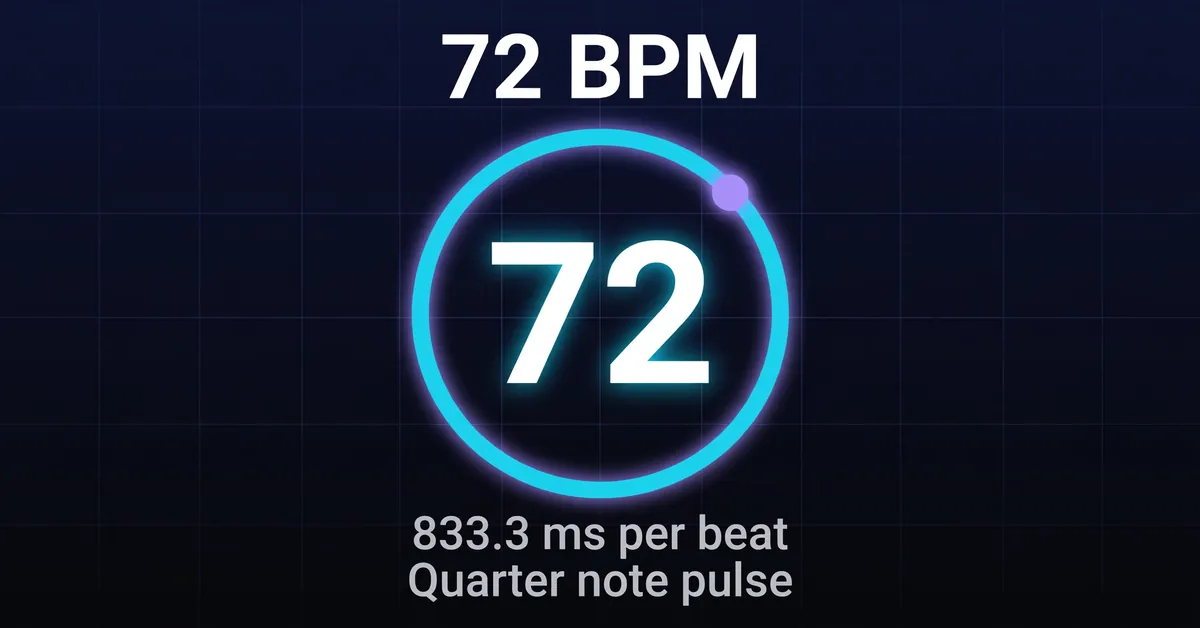
72 BPM means 72 beats per minute, with a beat about every 833.33 milliseconds, or 1.2 beats each second. It falls within this site's approximate Adagio band. Start the 72 BPM metronome for a slow rhythm exercise, check the song examples, or count twice as often at 144 BPM while the music keeps its playback speed.
The number 72 divides neatly in useful places. A dotted eighth comes out at exactly 625 ms, a dotted quarter at exactly 1250 ms, and a bar of 3/4 at exactly 2.5 seconds. The plain quarter note is the awkward one, because 60,000 does not divide evenly by 72, which is why DAWs display it as 833.333 and so on.
Frequency check: 72 ÷ 60 = 1.2 Hz for the quarter note pulse. The BPM to Hz converter gives the same reading for other rates.
How Long Is Each Note Value at 72 BPM?
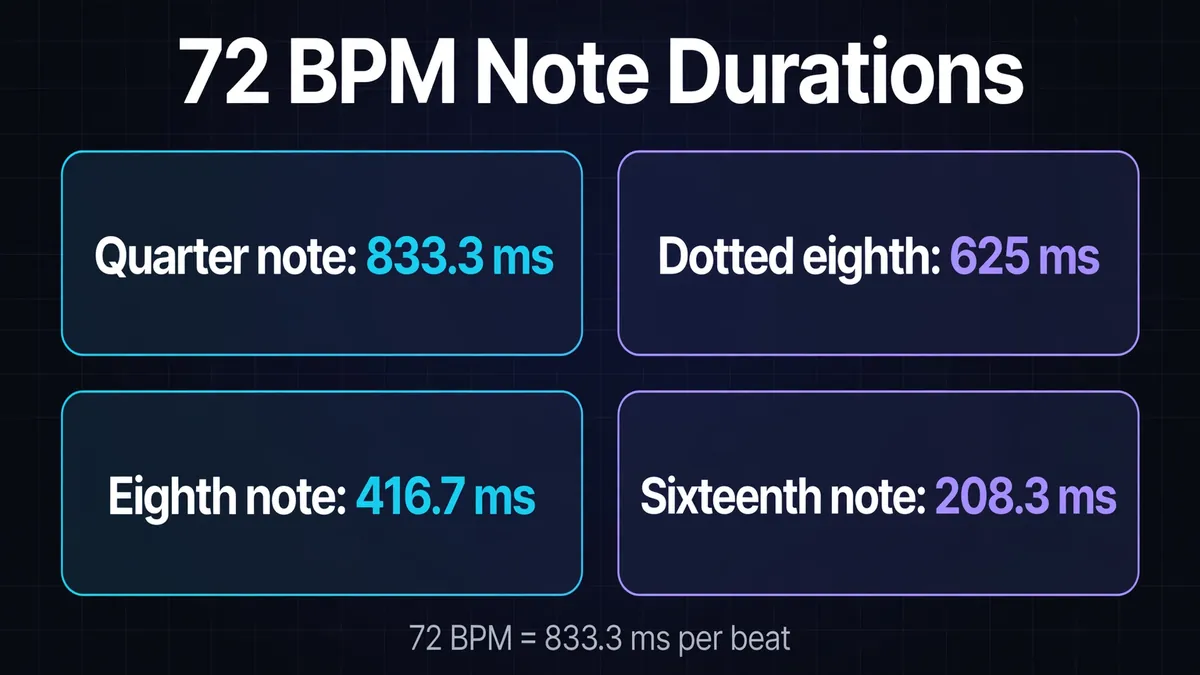
At 72 BPM a quarter note lasts 833.33 ms, an eighth note 416.67 ms, a sixteenth 208.33 ms and an eighth note triplet 277.78 ms. Dotted values add half again: a dotted quarter is 1250 ms and a dotted eighth is 625 ms. Every value comes from 833.33 ms multiplied by the note's share of a beat.
Each figure is built on a 72 BPM quarter note beat. A 6/8 piece marked dotted quarter = 48 asks for exactly this setting, because 48 × 1.5 = 72.
| Note value | Beats | Duration (ms) | Rate (Hz) |
|---|---|---|---|
| Whole note | 4 | 3333.33 | 0.30 |
| Half note | 2 | 1666.67 | 0.60 |
| Dotted quarter | 1.5 | 1250.00 | 0.80 |
| Quarter note | 1 | 833.33 | 1.20 |
| Quarter note triplet | 2/3 | 555.56 | 1.80 |
| Dotted eighth | 0.75 | 625.00 | 1.60 |
| Eighth note | 0.5 | 416.67 | 2.40 |
| Dotted sixteenth | 0.375 | 312.50 | 3.20 |
| Eighth note triplet | 1/3 | 277.78 | 3.60 |
| Sixteenth note | 0.25 | 208.33 | 4.80 |
| Sixteenth note triplet | 1/6 | 138.89 | 7.20 |
| Thirty second note | 0.125 | 104.17 | 9.60 |
| Sixty fourth note | 0.0625 | 52.08 | 19.20 |
Worked example: an eighth note triplet splits one beat into three, so 833.33 ÷ 3 = 277.78 ms. A dotted eighth is three sixteenths, so 208.33 × 3 = 625 ms. For any value not listed, the note duration calculator and BPM to ms converter do the same arithmetic.
How Long Is a Bar at 72 BPM?
One bar of 4/4 at 72 BPM lasts 3.33 seconds, so 18 bars pass every minute. A 3/4 bar lasts exactly 2.5 seconds. An 8 bar phrase in 4/4 runs 26.67 seconds, a 16 bar verse 53.33 seconds, and a 32 bar form 1 minute 46.67 seconds.
| Length | Beats | Duration |
|---|---|---|
| 1 bar of 3/4 | 3 | 2.50 s |
| 1 bar of 4/4 | 4 | 3.33 s |
| 1 bar of 6/8 (three quarter note beats) | 3 | 2.50 s |
| 4 bars of 4/4 | 16 | 13.33 s |
| 8 bars of 4/4 | 32 | 26.67 s |
| 16 bars of 4/4 | 64 | 53.33 s |
| 32 bars of 4/4 | 128 | 106.67 s |
The 6/8 row follows the site metronome's rule: in x/8 meters the BPM counts quarter notes and each eighth clicks, so a 6/8 bar holds six eighths, the same span as three quarter notes. A songwriter planning a three minute track at 72 BPM in 4/4 has room for 54 bars, because 180 s ÷ 3.33 s = 54.
What Does 72 BPM Feel Like?
72 BPM feels unhurried but not frozen. The gap between clicks is long enough to hear your own timing drift, yet short enough that a groove still carries forward.
Try a rap or neo soul exercise: keep a spoken count steady while moving a short phrase earlier or later between clicks. Listen for whether the phrase returns cleanly to the next downbeat. Straight and swung placements are different rhythmic choices at the same tempo. With swing, the second eighth of each pair lands later than the straight 416.67 ms point, which you can hear clearly at this speed.
Compared with neighbors, 72 is 2 BPM faster than 70 BPM, so each beat is 23.81 ms shorter (857.14 minus 833.33). Moving up to 80 BPM shortens the beat to 750 ms, a change of 83.33 ms that most listeners notice at once.
How Should You Practice at 72 BPM?
Use 72 BPM to expose uneven subdivisions. Set the online metronome to 72 in 4/4 with the accent on beat 1, then play eighths, triplets and sixteenths over the same click. Because each beat lasts 833.33 ms, any rushed note stands out against the long silence before the next click.
- Drummer: play sixteenth notes on the hi hat (208.33 ms apart) with a backbeat on 2 and 4. Turn on the subdivision click for four bars, then turn it off and check that the backbeat still lands on the click.
- Guitarist or pianist: hold a chord for a full 4/4 bar (3.33 seconds) and change exactly on the downbeat. Then fill the same bar with eighth note arpeggios.
- Student: alternate one bar of eighths with one bar of eighth note triplets. The switch from 416.67 ms to 277.78 ms spacing trains the shift between duple and triple feel.
- Vocalist: sing a phrase that starts on the "and" of beat 4, 416.67 ms before the downbeat, so the pickup is placed rather than guessed.
The metronome's speed trainer can step a passage up from 72 toward 80 once it is clean. If you only have a recording, tap along on the tap tempo tool to confirm the pulse first.
Which Songs Are Reported at 72 BPM?
The linked databases report "Arcade" by Duncan Laurence, "Rehab" by Amy Winehouse and "Money Trees" by Kendrick Lamar featuring Jay Rock at 72 BPM. These figures are attributed database reports, not independent audio measurements, and Money Trees also has a 144 BPM double count reported, which is the same pulse counted twice as often.
| Song | Artist | Recording version | Reported BPM | Counting option | Sources |
|---|---|---|---|---|---|
| Arcade | Duncan Laurence | Small Town Boy (Track By Track) | 72 | 72 BPM count | Tunebat |
| Rehab | Amy Winehouse | Version unspecified | 72 | 72 BPM count | SongBPM |
| Money Trees | Kendrick Lamar featuring Jay Rock | good kid, m.A.A.d city | 72 | 144 BPM double count also reported by SongBPM | SongData, SongBPM |
Use the named version where one is given; a counting option does not establish the recording's intended feel. If your detector shows 144 for a track you hear at 72, read why BPM detectors disagree before changing anything.
How Do Producers Use 72 BPM?
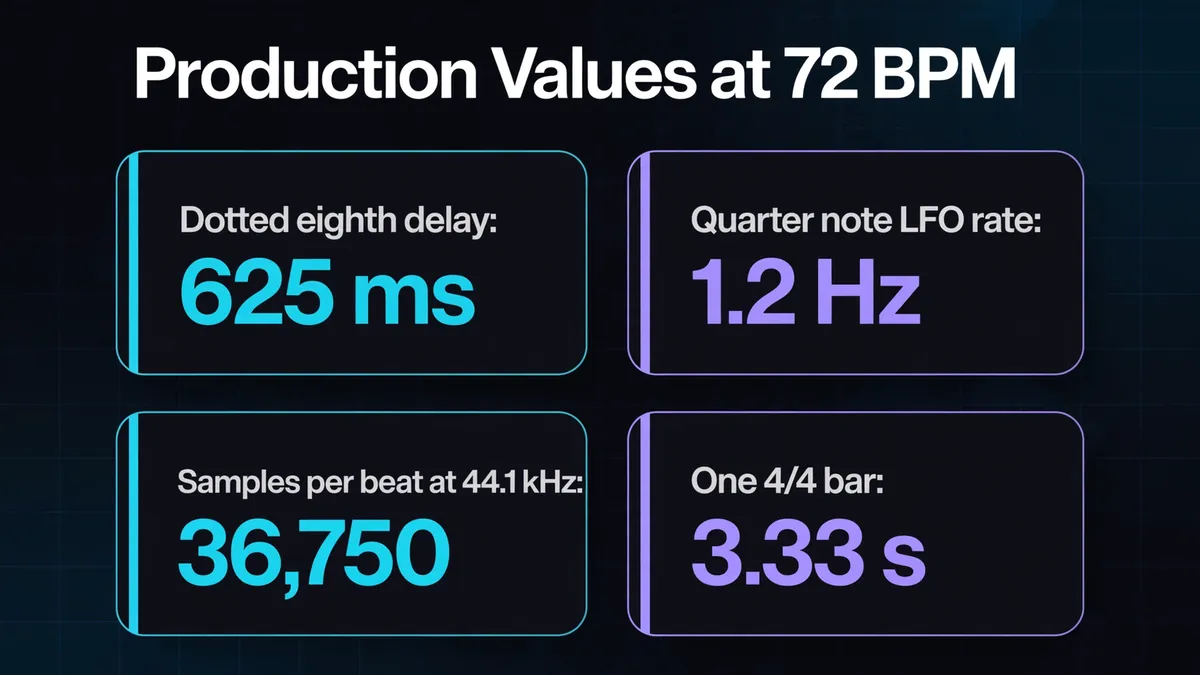
Producers at 72 BPM often sync delays and modulation to the long beat. A dotted eighth delay lasts exactly 625 ms, a quarter note delay 833.33 ms, and an eighth note LFO cycles every 416.67 ms, or 2.4 Hz. Ableton Live, Logic Pro, FL Studio and Pro Tools all accept 72 as a project tempo.
Worked scenario: a producer building a slow hip hop or R&B beat sets the session to 72. A vocal throw on a dotted eighth repeats every 625 ms, which leaves room between words. For a reverb pre delay starting point, a sixty fourth note gives 52.08 ms; a thirty second gives 104.17 ms for a wider gap. Rate sets the cycle length; phase and retrigger settings decide where the cycle begins relative to the part.
| Use | Note value | Time |
|---|---|---|
| Slap style delay | Sixteenth | 208.33 ms |
| Rhythmic vocal throw | Dotted eighth | 625.00 ms |
| Wide echo | Quarter | 833.33 ms |
| Tremolo or filter LFO | Eighth | 416.67 ms (2.40 Hz) |
| Sidechain pump per beat | Quarter | 833.33 ms (1.20 Hz) |
| Reverb pre delay start | Sixty fourth | 52.08 ms |
At 44.1 kHz one beat holds 36,750 samples, and at 48 kHz exactly 40,000 samples (60 × 48,000 ÷ 72). The BPM to samples converter covers other rates, and the delay calculator and reverb calculator list every synced time.
What Are Half Time and Double Time at 72 BPM?
Half time of 72 BPM is 36 BPM, with a 1666.67 ms beat, and double time is 144 BPM, with a 416.67 ms beat. You can follow either pulse level without changing playback speed. A real half time or double time drum feel also depends on where the kick and snare accents fall.
The 144 reading matters most in practice. A trap or drill style hi hat pattern written at 144 can sit over a 72 BPM vocal pocket, and a DJ may see either number for the same file. Neither count is wrong; they describe the same playback at two pulse levels. Compare the numbers with the half time calculator and double time calculator, or read the half time vs double time guide for the musical distinction.
Which Mistakes Happen Most at 72 BPM?
The most common mistake at 72 BPM is rushing the space between clicks, so phrases arrive early on the downbeat. Others are rounding 833.33 ms to 833 ms in a delay field, confusing 72 with 144 from a detector, and reading a dotted quarter score mark as a quarter note BPM.
- Rounding drift: a delay set to 833 ms instead of 833.33 ms loses about 0.33 ms per repeat, which is small but adds up over long feedback tails. Use tempo sync when the plugin offers it.
- Compound meter mix up: if a 6/8 score says dotted quarter equals 72, the quarter note setting is 108 (72 × 1.5), not 72.
- Wrong neighbor: 70 and 72 sound close, but 54 bars of 4/4 take 180 seconds at 72 and about 185.14 seconds at 70, a gap of about 5.14 seconds. Tap the track to confirm with the BPM counter.