
What Is 120 BPM?
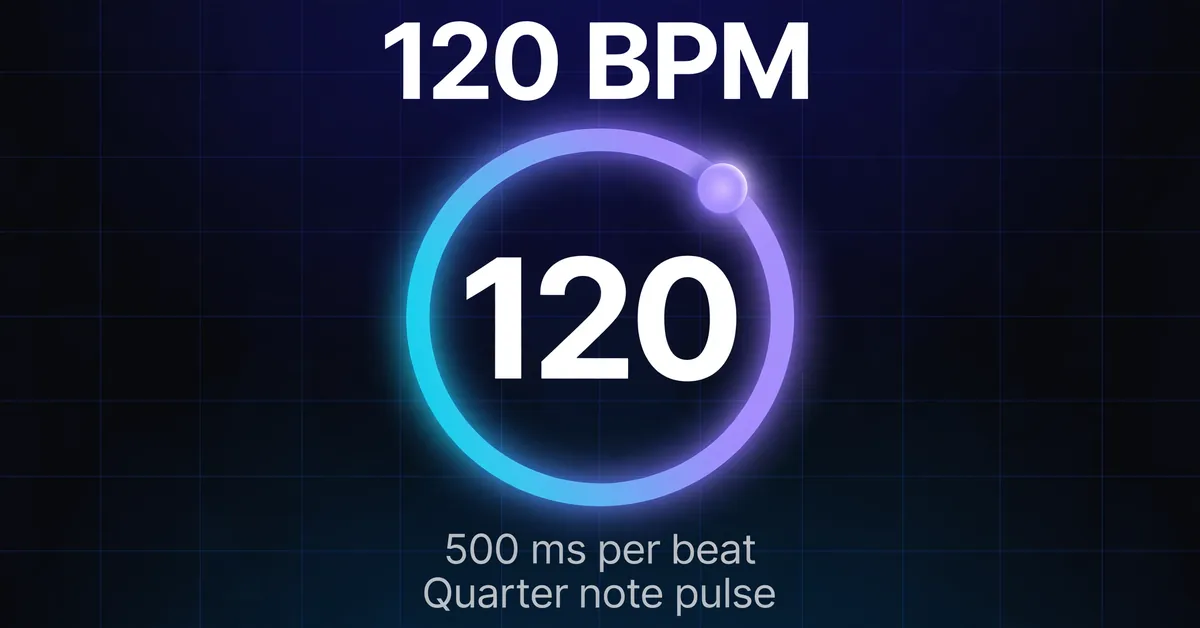
120 BPM stands for 120 beats per minute, so the pulse arrives exactly twice every second and each quarter note lasts 500 milliseconds. Switch on the 120 BPM metronome and you will hear one click on every tick of a clock plus one halfway between. Almost every timing value at this tempo comes out as a tidy number.
The arithmetic is what makes this tempo handy. A 4/4 bar is 2 seconds, a minute holds exactly 30 bars, and 32 bars take 64 seconds. When you want to sanity check a calculator or a delay plugin, 120 is the tempo where a wrong answer jumps out.
How Long Is Each Note Value at 120 BPM?
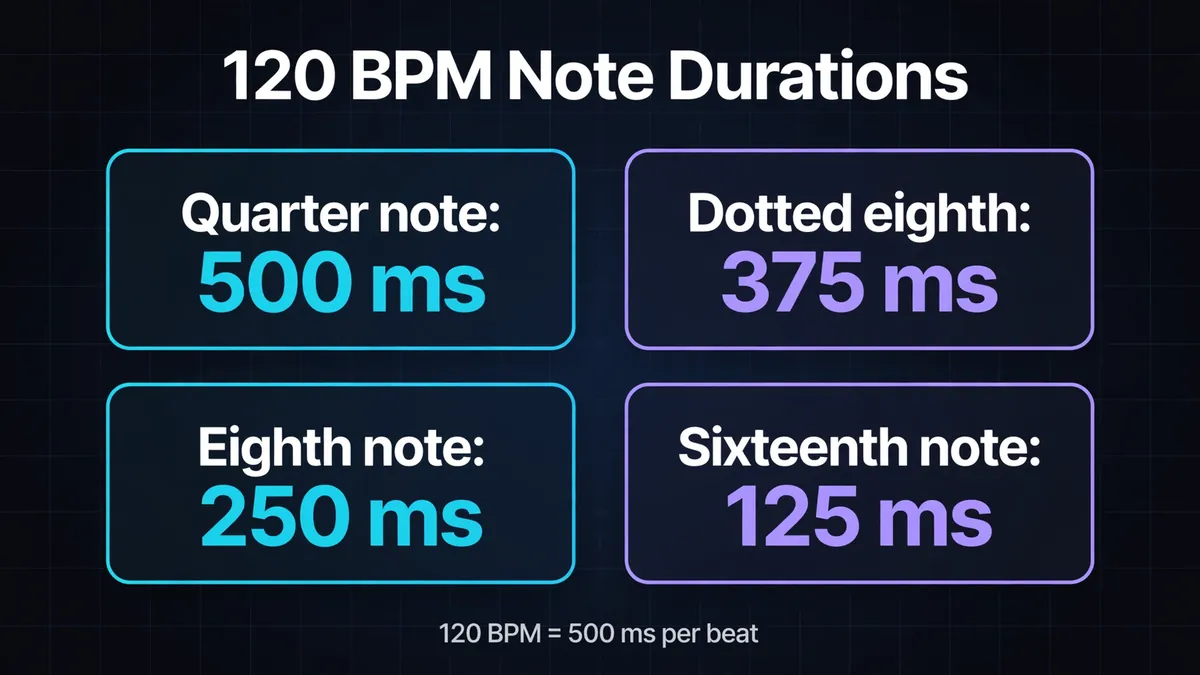
At 120 BPM a quarter note lasts 500 ms, an eighth note 250 ms, a sixteenth note 125 ms and a thirty second note 62.5 ms. Divide 60,000 by 120 to get the beat, then multiply by the note's share of a beat. The Hz column is simply 1000 divided by the duration.
Durations count the quarter note as the beat. A 6/8 score marked dotted quarter = 80 is the same pulse as 120 here, since 80 × 1.5 = 120. Values round to two decimals.
| Note value | Beats | ms at 120 BPM | Hz |
|---|---|---|---|
| Whole note | 4 | 2000.00 | 0.50 |
| Dotted half note | 3 | 1500.00 | 0.67 |
| Half note | 2 | 1000.00 | 1.00 |
| Dotted quarter | 1.5 | 750.00 | 1.33 |
| Quarter note | 1 | 500.00 | 2.00 |
| Dotted eighth | 0.75 | 375.00 | 2.67 |
| Quarter note triplet | 2/3 | 333.33 | 3.00 |
| Eighth note | 0.5 | 250.00 | 4.00 |
| Dotted sixteenth | 0.375 | 187.50 | 5.33 |
| Eighth note triplet | 1/3 | 166.67 | 6.00 |
| Sixteenth note | 0.25 | 125.00 | 8.00 |
| Sixteenth note triplet | 1/6 | 83.33 | 12.00 |
| Thirty second note | 0.125 | 62.50 | 16.00 |
| Thirty second triplet | 1/12 | 41.67 | 24.00 |
| Sixty fourth note | 0.0625 | 31.25 | 32.00 |
Worked example: a dotted quarter is a quarter plus an eighth, so 500 + 250 = 750 ms. Triplets are the odd ones out. An eighth note triplet is 500 ÷ 3 = 166.666... ms, which rounds to 166.67, while its frequency is a clean 6 Hz because six of them fit in one second.
The note duration calculator and BPM to ms converter give the same figures for any other tempo, and the BPM to Hz converter handles the frequency side.
How Long Are Bars and Phrases at 120 BPM?
One bar of 4/4 at 120 BPM lasts 2 seconds, a bar of 3/4 lasts 1.5 seconds, and a bar of 6/8 also lasts 1.5 seconds when the BPM counts quarter notes. A 16 bar verse in 4/4 runs 32 seconds, and a 32 bar section runs 64 seconds.
| Bars | 4/4 | 3/4 | 6/8 (quarter note = 120) |
|---|---|---|---|
| 1 | 2 s | 1.5 s | 1.5 s |
| 4 | 8 s | 6 s | 6 s |
| 8 | 16 s | 12 s | 12 s |
| 16 | 32 s | 24 s | 24 s |
| 32 | 64 s | 48 s | 48 s |
A 6/8 bar holds six eighths, which equals three quarter notes, so 3 × 0.5 s = 1.5 s. The online metronome keeps the BPM on the quarter note in x/8 meters and clicks every eighth, so 6/8 at 120 gives six clicks of 250 ms. If your chart reads dotted quarter = 120, the matching quarter note setting is 180. The time signatures and BPM guide explains why.
How Many Samples Is a Beat at 120 BPM?
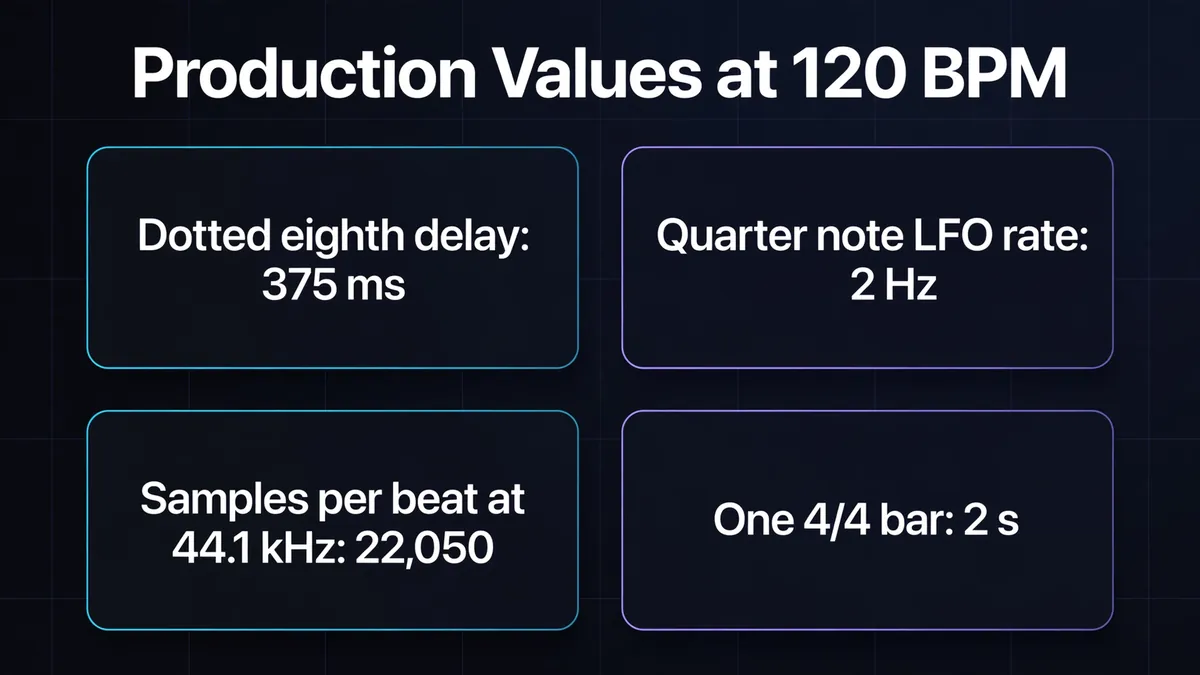
A quarter note at 120 BPM lasts 22,050 samples at 44.1 kHz and 24,000 samples at 48 kHz. Multiply the duration in seconds by the sample rate. At 48 kHz every value down to the sixty fourth note is a whole number of samples.
| Note value | 44.1 kHz | 48 kHz |
|---|---|---|
| 4/4 bar | 88,200 | 96,000 |
| Half note | 44,100 | 48,000 |
| Quarter note | 22,050 | 24,000 |
| Dotted eighth | 16,537.5 | 18,000 |
| Eighth note | 11,025 | 12,000 |
| Eighth note triplet | 7,350 | 8,000 |
| Sixteenth note | 5,512.5 | 6,000 |
| Thirty second note | 2,756.25 | 3,000 |
| Sixty fourth note | 1,378.13 | 1,500 |
At 44.1 kHz the dotted eighth and sixteenth land on half samples, so a loop cut by hand at that rate has to round. The BPM to samples converter lists other rates such as 96 kHz.
Which Tempo Marking Fits 120 BPM?
On this site's chart, 120 BPM is the Moderato to Allegro boundary. It is the top of Moderato (108 to 120), the bottom of Allegro (120 to 156) and inside Allegretto (112 to 124). Treat these as this site's boundaries; other references move them by a few BPM, which is exactly why 120 gets claimed by several words.
That overlap is normal. An Italian word describes character as well as speed, so a piece marked Allegretto at quarter note = 120 should sound lighter than a heavy Allegro at the same number. When a score prints a metronome mark, trust the number and its note symbol over the word. The tempo markings chart compares several published sources.
How Can You Practice With a 120 BPM Metronome?
Use 120 BPM as a checkpoint tempo. It is quick enough to feel like real playing yet slow enough that sixteenths, at 125 ms each, stay controllable for most intermediate players. Practice one subdivision at a time, and only move on once two clean repetitions in a row feel easy.
- Drummer: play a four on the floor kick with a snare backbeat on 2 and 4, then add closed hi hat eighths at 250 ms. Drop the hi hat for a bar and see if the kick stays put.
- Guitarist: strum straight sixteenths on one chord for 8 bars, which is 16 seconds. Then accent only the "a" of each beat to test control of the fourth sixteenth.
- Dancer or fitness instructor: count "5, 6, 7, 8" over two bars, which takes 4 seconds, so an eight count phrase always starts on a downbeat.
- Runner checking cadence: 120 is a walking or easy pace reference, not a running target. Double it mentally to 240 if you count both feet as separate beats.
- Student building speed: learn a passage at 100, then use the speed trainer on the online metronome to climb toward 120 in small steps.
To check your own steadiness, tap along on tap tempo for at least eight beats. A reading that drifts between 117 and 123 tells you where to focus.
Which Songs Are Reported at 120 BPM?
Linked databases report "Dreams" by Fleetwood Mac (2004 Remaster), "Call Me Maybe" by Carly Rae Jepsen, "TiK ToK" by Kesha and "DARE" by Gorillaz at 120 BPM. These are database readings tied to the listed versions, not independent measurements, and a shared number does not mean a shared groove.
Nearby matches and alternative counts are labeled separately. Use the named version where one is given; a counting option does not establish the recording's intended feel.
| Song | Artist | Recording version | Reported BPM | Counting option | Sources |
|---|---|---|---|---|---|
| Dreams | Fleetwood Mac | 2004 Remaster | 120 | 120 BPM count | SongBPM |
| Call Me Maybe | Carly Rae Jepsen | Version unspecified | 120 | 120 BPM count | SongBPM |
| TiK ToK | Kesha | Animal; recording ID 6nYoTBmGFNgfTyRC8x1Fvp | 120 | 120 BPM count | Tunebat |
| DARE | Gorillaz featuring Shaun Ryder and Roses Gabor | Demon Days | 120 | 120 BPM count | SongBPM, AcousticBrainz |
A Musicnotes arrangement of "DARE" marks quarter note equals 120, which names the counted beat directly. "Dreams" and "TiK ToK" make a useful pair: same reported tempo, yet one feels laid back and the other pushes forward, because the drum pattern and accents differ. If your own count comes out at 60 or 240, see why BPM detectors disagree, or check a local file with the BPM finder.
How Do Producers Use 120 BPM?
Producers lean on 120 BPM timings because they are round: a 250 ms eighth note delay, a 375 ms dotted eighth delay, and a 2 Hz quarter note LFO. In Ableton Live, Logic Pro, FL Studio or Pro Tools, synced note settings at 120 match these values exactly.
| Setting | Note value | Value at 120 BPM |
|---|---|---|
| Slapback style delay | Thirty second note | 62.5 ms |
| Straight delay | Eighth note | 250 ms |
| Dotted delay | Dotted eighth | 375 ms |
| Triplet delay | Eighth note triplet | 166.67 ms |
| Reverb pre delay experiment | Sixty fourth note | 31.25 ms |
| Sidechain release starting point | Eighth note | 250 ms |
| LFO rate | Quarter note | 2.00 Hz |
Worked example: over a four on the floor kick, a sidechain compressor that recovers in about 250 ms lets the bass swell back right on the offbeat eighth, which is where the hi hat usually sits. Treat that as a starting point and adjust by ear. A dotted eighth delay at 375 ms on a sixteenth note synth line puts repeats three sixteenths late, which fills gaps between notes. Pre delay values are experiments too. The delay calculator and reverb calculator list full sets.
What Are Half Time and Double Time at 120 BPM?
Half time of 120 BPM is 60 BPM, with 1000 ms per beat, and double time is 240 BPM, with 250 ms per beat. You can count the same recording at either level without changing playback speed. A real half time or double time feel comes from the drum pattern and accents.
| Pulse level | BPM | ms per beat | 4/4 bar |
|---|---|---|---|
| Half time count | 60 | 1000 | 4 s |
| As written | 120 | 500 | 2 s |
| Double time count | 240 | 250 | 1 s |
Moving the snare from beats 2 and 4 to beat 3 alone makes a 120 groove feel like 60 while the hi hats keep running at 250 ms. The 60 BPM page covers that slower level. Compare numbers with the half time calculator and double time calculator, or read the half time vs double time guide. Nearby number pages are 110 BPM and 125 BPM, and the BPM chart shows the full range.
What Goes Wrong at 120 BPM?
The most common mistake at 120 BPM is assuming every song reported at 120 feels the same, then copying a groove that does not fit. Other frequent slips are setting 120 when a 6/8 score means dotted quarter = 120, and rounding 44.1 kHz sample counts without noticing.
- Wrong beat unit: dotted quarter = 120 needs a quarter note setting of 180, not 120.
- Rounding triplets: typing 167 ms for an eighth note triplet adds 1 ms per repeat, so 24 repeats drift 8 ms late. Use the synced setting instead.
- Half sample loops: a sixteenth at 44.1 kHz is 5,512.5 samples, so loops trimmed to 5,512 lose half a sample every cut.
- Relaxing too much: because 120 feels familiar, players stop listening and start rushing fills into beat 1.
- Trusting one database: a reading of 60 or 240 for the same track is often a pulse level choice, not an error.