
What Is a Time Signature?
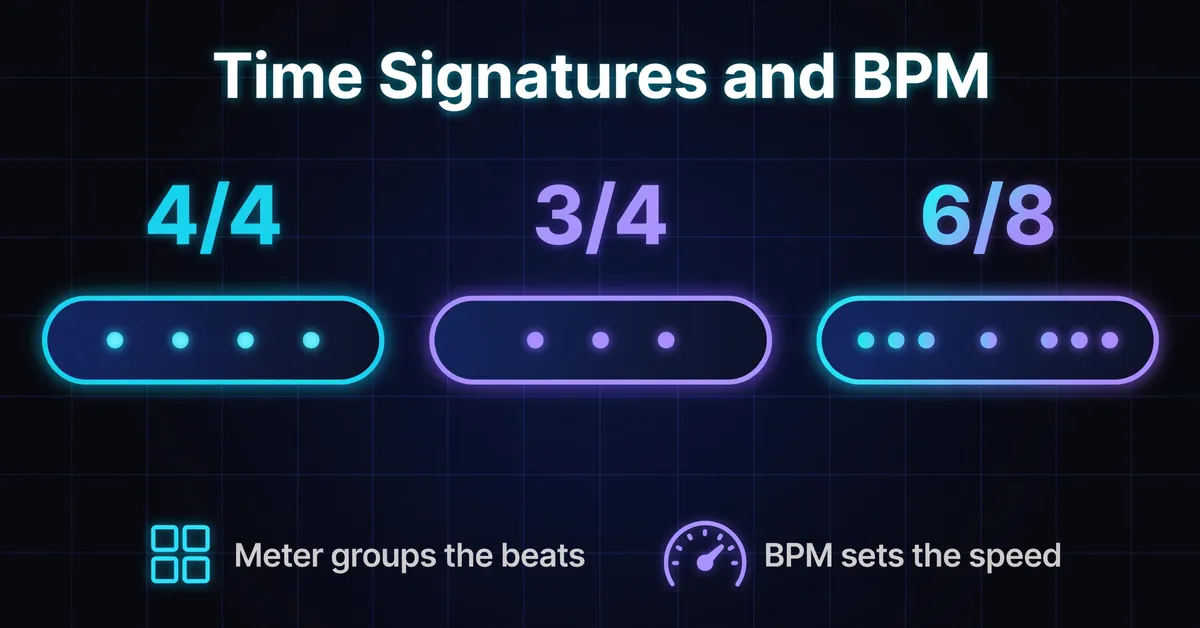
A time signature shows how note values fit into each bar. The bottom number names a note value and the top number says how many of them fill a bar. In simple meters those units are usually the beats; in compound meters they're usually the subdivisions. Time signatures describe grouping, and a tempo mark supplies the speed.
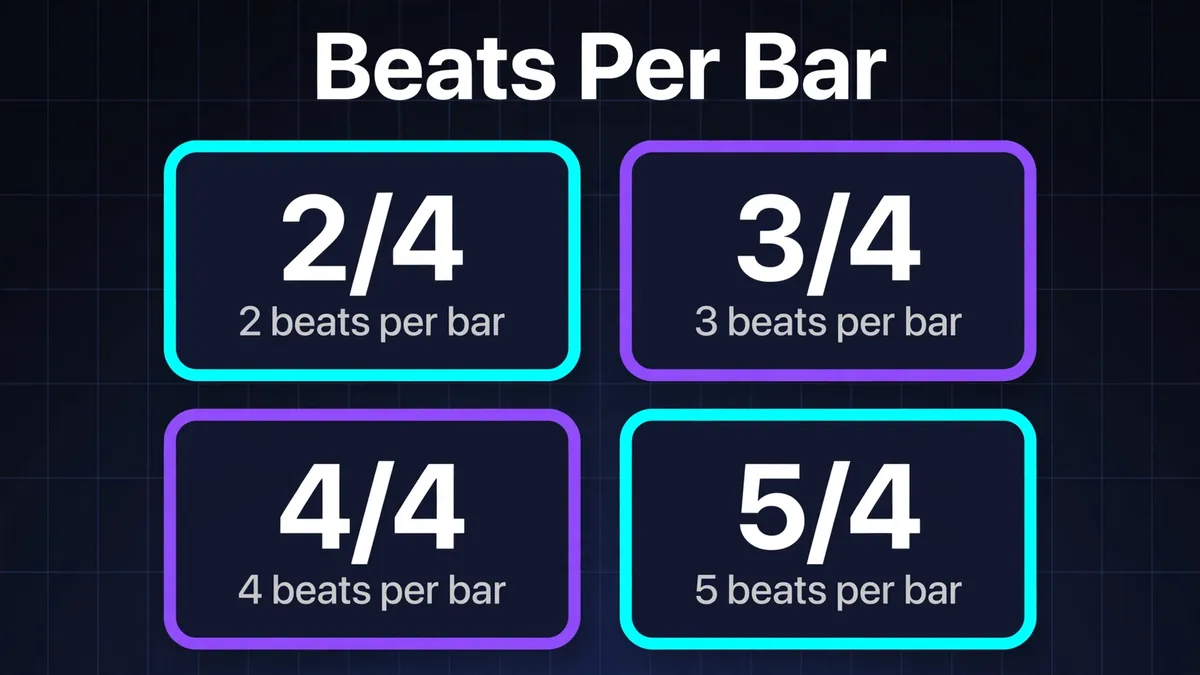
A bottom number of 4 means quarter notes, 8 means eighth notes and 2 means half notes. So 3/4 holds three quarter notes' worth of time per bar and 6/8 holds six eighth notes' worth. Any mix of notes and rests can fill that space.
Open Music Theory's simple meter chapter walks through the notation. The University of Puget Sound's meter lesson separates simple beats, which split in two, from compound beats, which split in three. That one distinction explains most of the confusion people have with 6/8.
| Signature | Type | Main beats per bar | Beat unit | Each beat splits into |
|---|---|---|---|---|
| 2/4 | Simple duple | 2 | Quarter note | 2 eighths |
| 3/4 | Simple triple | 3 | Quarter note | 2 eighths |
| 4/4 | Simple quadruple | 4 | Quarter note | 2 eighths |
| 2/2 | Simple duple | 2 | Half note | 2 quarters |
| 6/8 | Compound duple | 2 | Dotted quarter | 3 eighths |
| 9/8 | Compound triple | 3 | Dotted quarter | 3 eighths |
| 12/8 | Compound quadruple | 4 | Dotted quarter | 3 eighths |
What Is the Difference Between Meter and Tempo?
Meter organizes the pulse into repeating groups; tempo sets how fast that pulse moves. Switching time signatures doesn't make a note faster or slower on its own. A BPM number only means something once you know its beat unit, which is where most metronome mix ups start.
These examples assume BPM counts quarter notes. At 120 BPM a bar of 4/4 lasts 2 seconds and a bar of 3/4 lasts 1.5 seconds, giving 30 and 40 bars per minute. Compound meters need one extra step, covered in the 6/8 section below.
The part in brackets converts any signature into quarter notes per bar, so eighth note meters work too. Mixgraph documents the same bar duration formula. It assumes a steady tempo.
| Signature | Quarter note BPM | Quarter notes per bar | Seconds per bar | Bars per minute |
|---|---|---|---|---|
| 4/4 | 120 | 4 | 2 | 30 |
| 3/4 | 120 | 3 | 1.5 | 40 |
| 6/8 | 90 | 3 | 2 | 30 |
| 7/8 | 120 | 3.5 | 1.75 | about 34.3 |
| 12/8 | 75 | 6 | 4.8 | 12.5 |
A worked case: a 32 bar section of 4/4 at 120 BPM lasts 32 × 2 = 64 seconds. Put the same 32 bars in 3/4 at the same BPM and it lasts 48 seconds. Handy when you're cutting a song to a deadline. For bar lengths in milliseconds, the BPM to ms calculator does the division for you.
4/4: Common Time
4/4 has four quarter note beats per bar. Count ONE two three four, or 1 and 2 and 3 and 4 and when the eighths matter. The C symbol also means 4/4, and a C with a line through it means cut time, usually 2/2.
A backbeat on 2 and 4 is one groove among many, not part of the meter's definition. Cut time trips people up. If a chart in 2/2 says half note = 80, the quarter notes move at 160, so enter 160 in a quarter note metronome, choose 4/4, and feel two big beats per bar instead of four. In our metronome, pick 4/4 and the first beat of each bar gets the accent.
3/4: Waltz Time
3/4 has three quarter note beats per bar. Count ONE two three, or 1 and 2 and 3 and with eighths, keeping the three main beats evenly spaced.
Waltzes use this grouping, but plenty of ballads, hymns and folk songs do too. A common student slip is rushing beat 3 into the next downbeat, so the bar shrinks. Saying the count out loud with the accented click on beat 1 fixes that quickly. Choose 3/4 in the metronome to hear the accent once per bar.
2/4: March and Polka Time
2/4 has two quarter note beats per bar. Count ONE two, or 1 and 2 and with eighths. Marches and polkas are the familiar homes for this strong weak swing, though the signature itself doesn't set any BPM.
At the same quarter note BPM a 2/4 bar comes around twice as often as a 4/4 bar. A drummer reading a march in 2/4 at 120 hears the accent every second, so long rests count up fast. Keep counting through them rather than waiting for the next big hit.
6/8: Compound Time in Two
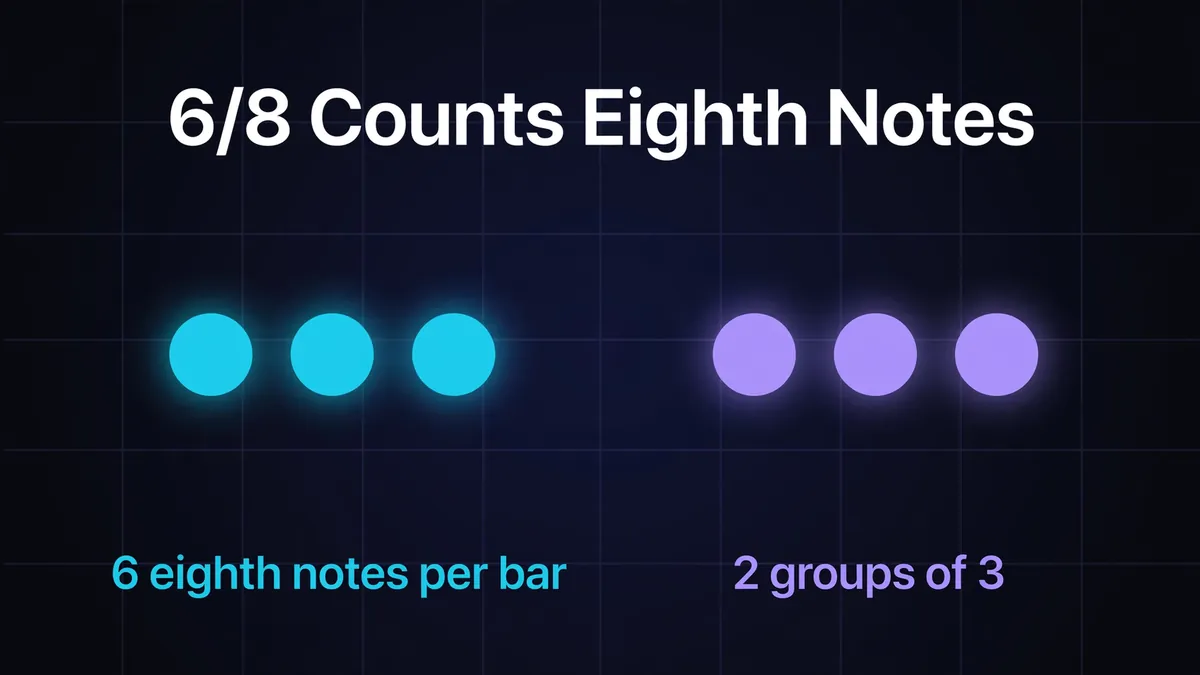
6/8 usually groups six eighth notes into two dotted quarter beats. Count ONE two three FOUR five six, leaning on the start of each group, or count the two big beats as 1 and a 2 and a.
Metallica's "Nothing Else Matters" is a familiar 6/8 example; Yousician's lesson identifies that meter for its riff exercise. Follow the grouping in the passage you're learning rather than assuming a whole arrangement stays in one signature.
Our metronome clicks all six eighth notes in 6/8 and accents only the first. Its BPM setting counts quarter notes, so a mark of dotted quarter = 60 becomes 90. You'll hear eighth clicks at 180 per minute. Lean on the fourth click yourself to feel the second big beat. A fast 6/8 jig marked dotted quarter = 116 needs 174 in the BPM box, with eighths at 348 per minute, which is still inside the 20 to 360 BPM range of the tool.
12/8: Four Beats With Three Subdivisions Each
12/8 usually has four dotted quarter beats per bar, each split into three eighth notes. Count 1 and a 2 and a 3 and a 4 and a. Four groups instead of two is what separates it from 6/8.
It often carries the rolling triplet feel of slow blues and soul ballads. Arranger Kerry Marsh describes the 12/8 feel of Etta James' "At Last". The same feel can also be written as 4/4 with triplets, so check how your score is notated.
In our 12/8 setting you hear twelve eighth note clicks per bar with the first accented. BPM still counts quarter notes. For a dotted quarter pulse of 50, enter 75 and count the clicks in four groups of three. Each bar then lasts 4.8 seconds, as the table above shows.
5/4 and 7/8: Odd Meters
5/4 holds five quarter notes per bar. Try 3 plus 2: ONE two three FOUR five. Or 2 plus 3: ONE two THREE four five. Listen to the phrase before choosing. The Dave Brubeck Quartet's "Take Five" is a 5/4 example documented by the Library of Congress.
7/8 holds seven eighth notes per bar. Common groupings include 2 plus 2 plus 3, 3 plus 2 plus 2 and 2 plus 3 plus 2. For the first, count ONE two THREE four FIVE six seven. The group lengths are the meter; a flat count to seven hides the shape.
Choose 5/4 or 7/8 in the metronome and say the groups over the clicks. Only the first click is accented, so the internal accents are up to you. In 7/8 each click is an eighth note while the BPM counts quarters, so at 120 BPM a bar lasts 1.75 seconds. A drummer learning a 7/8 groove can start at 80 BPM, say the groups until they feel automatic, then raise the tempo with the speed trainer.
How Do You Set a Time Signature in a Metronome?
Pick the signature, check the score's beat unit and enter a matching quarter note tempo. The settings below assume BPM counts quarter notes with no extra subdivision. Our tool offers 2/4, 3/4, 4/4, 5/4, 6/8, 7/8 and 12/8 and accents only the first click of each bar.
| Signature | Clicks per bar | Unit of each click | How to follow the bar |
|---|---|---|---|
| 2/4 | 2 | Quarter note | Two main beats |
| 3/4 | 3 | Quarter note | Three main beats |
| 4/4 | 4 | Quarter note | Four main beats |
| 5/4 | 5 | Quarter note | Count the chosen groups |
| 6/8 | 6 | Eighth note | Two groups of three |
| 7/8 | 7 | Eighth note | Count the chosen groups |
| 12/8 | 12 | Eighth note | Four groups of three |
In the x/8 settings the eighth clicks run at twice the quarter note BPM. A dotted quarter equals three eighths, so multiply a score's dotted quarter number by 1.5 to get the setting. Dotted quarter = 60 becomes 90, with eighth clicks at 180 per minute grouped into main pulses at 60 per minute. Dotted quarter = 72 becomes 108.
Open the online metronome and count the grouping aloud before you play. In x/8 settings the BPM box and the clicks you hear are different units, which is normal. If you only have a recording, tap along to the main pulse with tap tempo first; a 6/8 song tapped on the big beats gives the dotted quarter rate, which you then multiply by 1.5.
Common Mistakes When Counting Meters
Nearly every meter mistake comes back to one of two things: the wrong beat unit or the wrong grouping. These show up constantly in lessons.
- Entering the dotted quarter number straight into a quarter note metronome. The 6/8 piece then runs at two thirds of the intended speed.
- Counting 6/8 as six equal beats at a fast tempo, which flattens the lilt of two big beats.
- Treating 3/4 and 6/8 as the same because both hold six eighths. The grouping differs.
- Waiting for the accent in 5/4 or 7/8 to tell you the inner groups. It only marks beat 1.
- Reading cut time as 4/4 at the half note number, which halves the intended speed.
- Assuming a song never changes meter. Check each section.