
What Is 130 BPM?
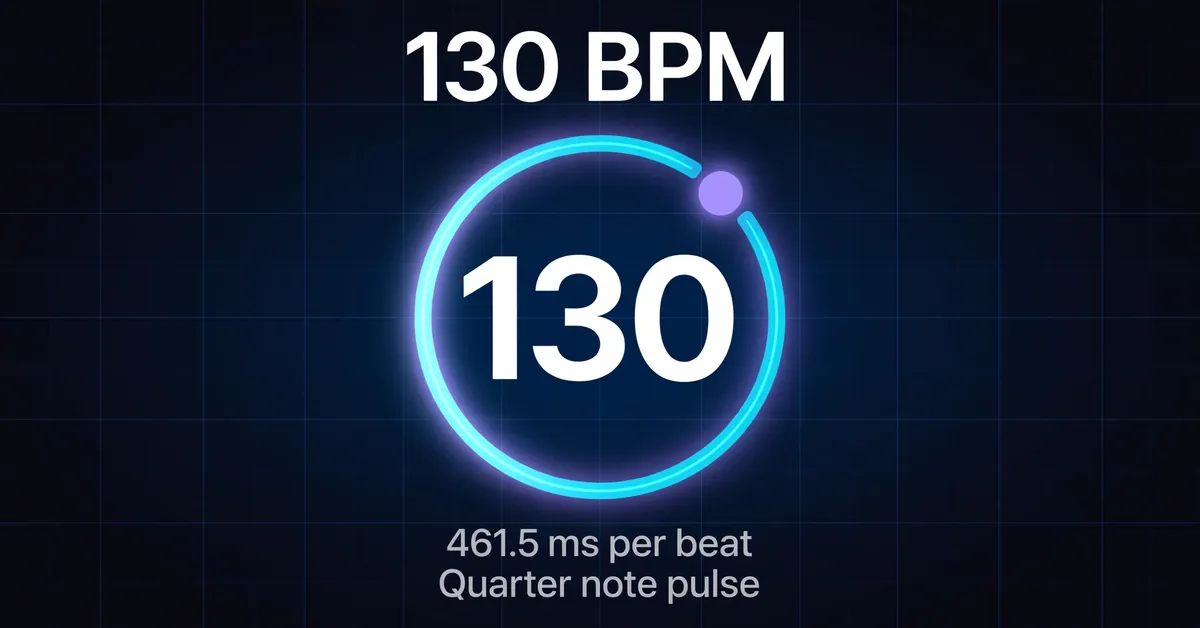
A 130 BPM metronome plays 130 beats per minute, leaving about 461.54 milliseconds from one click to the next, or roughly 2.17 clicks per second. On this site's approximate chart that is Allegro. It is a brisk pulse for house and techno rhythm drills, though the number alone never decides the genre or how intense a set feels.
How Long Is Each Note Value at 130 BPM?
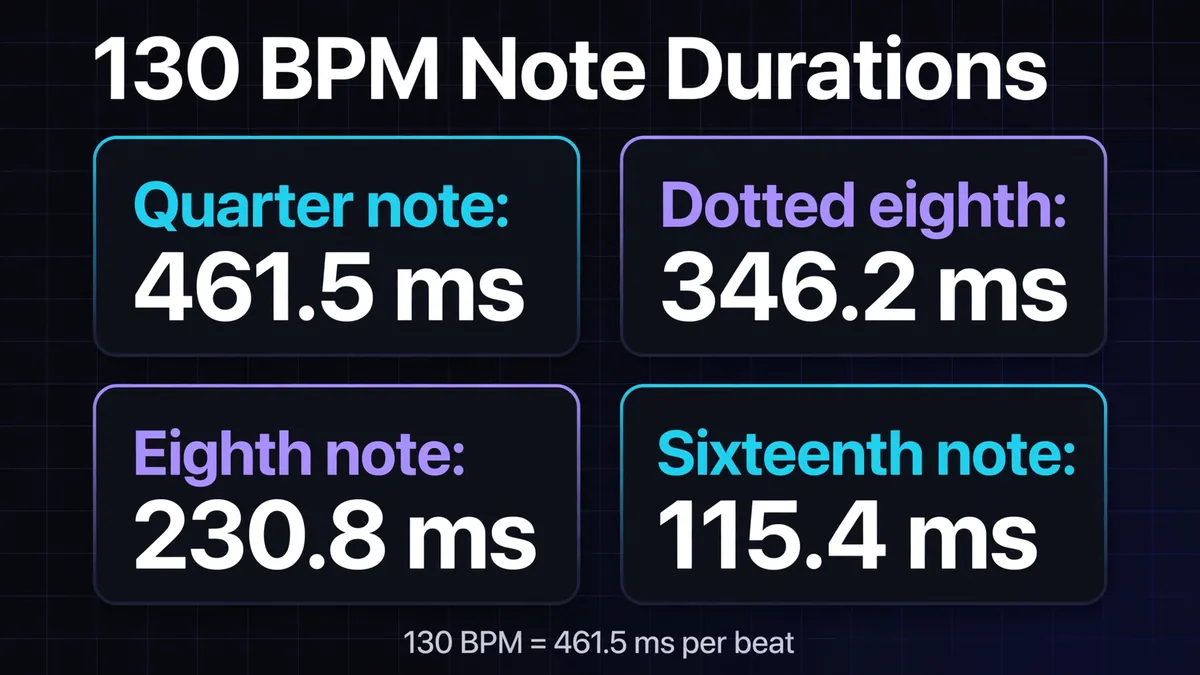
At 130 BPM a quarter note lasts about 461.54 ms, an eighth about 230.77 ms, a sixteenth about 115.38 ms and an eighth note triplet about 153.85 ms. None of these is a whole millisecond figure, because 60,000 ÷ 130 repeats as a decimal, so keep the full value until the final step.
Quarter notes are the counted beat throughout this table. A dotted quarter marking converts at 1.5 to 1, so a 6/8 groove at dotted quarter = 86 sits at 129 on a quarter note click.
| Note value | Beats | Duration (ms) | Hz (repeats per second) |
|---|---|---|---|
| Whole note | 4 | 1846.15 | 0.54 |
| Dotted half | 3 | 1384.62 | 0.72 |
| Half note | 2 | 923.08 | 1.08 |
| Dotted quarter | 1.5 | 692.31 | 1.44 |
| Quarter note | 1 | 461.54 | 2.17 |
| Quarter note triplet | 2/3 | 307.69 | 3.25 |
| Dotted eighth | 0.75 | 346.15 | 2.89 |
| Eighth note | 0.5 | 230.77 | 4.33 |
| Dotted sixteenth | 0.375 | 173.08 | 5.78 |
| Eighth note triplet | 1/3 | 153.85 | 6.50 |
| Sixteenth note | 0.25 | 115.38 | 8.67 |
| Sixteenth note triplet | 1/6 | 76.92 | 13.00 |
| Thirty second note | 0.125 | 57.69 | 17.33 |
| Sixty fourth note | 0.0625 | 28.85 | 34.67 |
Here is why the order of operations matters. A whole note computed properly is 240,000 ÷ 130 = 1,846.15 ms. If you round the beat to 461.54 first and multiply by 4, you get 1,846.16, already a hundredth off after one bar. The note duration calculator and BPM to ms converter keep full precision for you.
How Long Are Bars and Phrases at 130 BPM?
A bar of 4/4 at 130 BPM lasts about 1.846 seconds, 16 bars about 29.54 seconds and 32 bars about 59.08 seconds. A 3/4 or 6/8 bar lasts about 1.385 seconds when the metronome counts quarter notes. Multiply the beats by 60, then divide by 130.
| Bars | 4/4 (4 beats) | 3/4 (3 beats) | 6/8 (3 quarter beats) |
|---|---|---|---|
| 1 | 1.846 s | 1.385 s | 1.385 s |
| 4 | 7.385 s | 5.538 s | 5.538 s |
| 8 | 14.769 s | 11.077 s | 11.077 s |
| 16 | 29.538 s | 22.154 s | 22.154 s |
| 32 | 59.077 s | 44.308 s | 44.308 s |
Compared with 128 BPM, where 32 bars of 4/4 fill exactly 60 seconds, the same phrase at 130 finishes about 0.92 seconds sooner. For 6/8 written as dotted quarter equals 130, a bar holds two pulses and lasts 2 × 60 ÷ 130 = 0.923 seconds, and you would set the site metronome to 195. Meter conversions are covered on time signatures and BPM.
How Many Samples Is One Beat at 130 BPM?
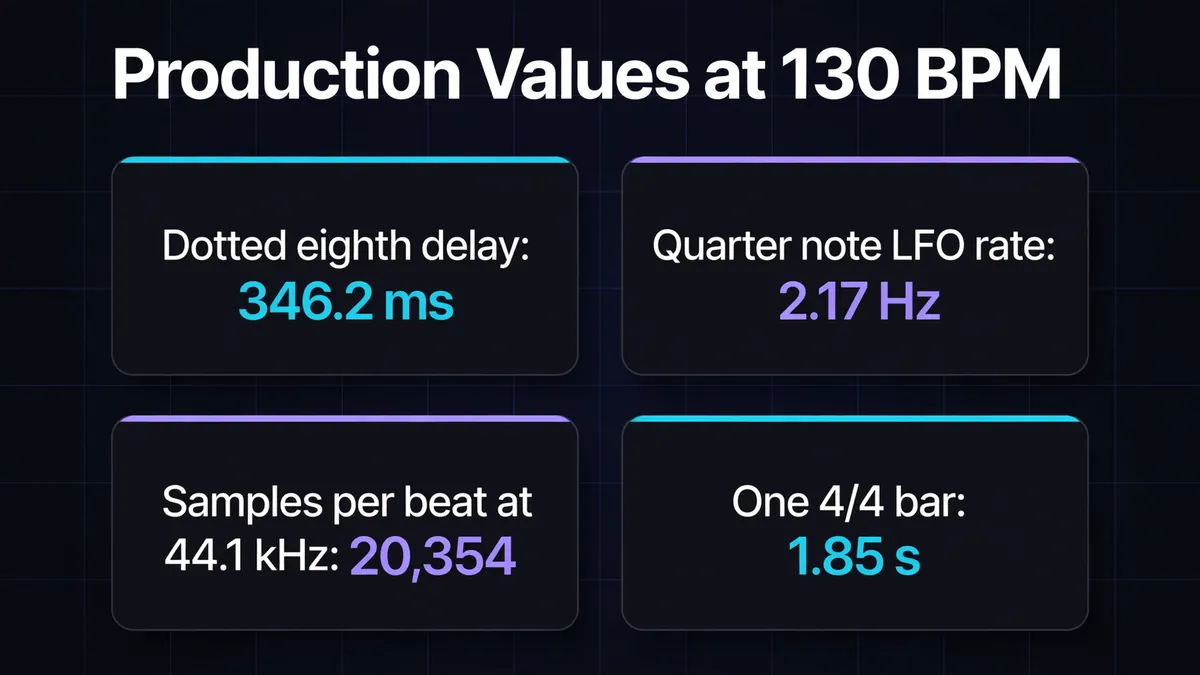
At 48 kHz one beat at 130 BPM spans about 22,153.85 samples, and at 44.1 kHz about 20,353.85. Neither rate gives whole numbers at this tempo, for the beat or for any subdivision in the table below. That is ordinary and a DAW handles it without trouble.
| Note | Samples at 44.1 kHz | Samples at 48 kHz |
|---|---|---|
| Whole note | 81,415.38 | 88,615.38 |
| Quarter note | 20,353.85 | 22,153.85 |
| Eighth note | 10,176.92 | 11,076.92 |
| Sixteenth note | 5,088.46 | 5,538.46 |
| Thirty second note | 2,544.23 | 2,769.23 |
If you cut loops by hand in a sample editor, snap to the bar grid in your host rather than typing sample counts. The BPM to samples calculator lists other sample rates.
What Tempo Marking Is 130 BPM?
130 BPM is labeled Allegro on this site's tempo chart, which places Allegro at roughly 120 to 156 BPM. That puts 130 in the lower part of the band, clear of the Allegretto band of 112 to 124 BPM. Sources vary on these edges, so take the bands as this site's working approximation.
Italian terms describe character as much as speed, so an Allegro movement may be played well away from 130. When a printed metronome mark gives a note symbol and a number, follow it. The tempo markings BPM chart lists every band the site uses.
How Can You Practice Dance Rhythms at 130 BPM?
Set the click to quarters and play a steady kick, then place even percussion in the 230.77 ms gaps between clicks. Add layers one at a time while the tempo stays fixed. If a pattern starts to wobble, strip it back and rebuild before pushing the speed.
Here is a short routine for a drummer, pad player or producer finger drumming on a controller:
- 120 BPM, kick on all four beats and closed hats on the offbeats (500 ms per beat).
- 125 BPM, add a clap on 2 and 4 (480 ms per beat).
- 130 BPM, move the click to eighths and add a sixteenth shaker part, each note about 115.38 ms.
- 130 BPM, return the click to quarters and drop the kick for four bars, then bring it back on the downbeat.
- 134 BPM briefly, then settle back to 130.
Step 4 is the real test: if the kick returns early or late after four silent bars (about 7.38 seconds), your internal pulse is drifting. A dancer can run the same exercise counting in eights, with each eight count lasting about 3.69 seconds. Use the online metronome, which covers 20 to 360 BPM with 4 subdivisions, a speed trainer and an accent on beat 1 only. To measure a recording first, tap along on the tap tempo page with the spacebar or a letter or number key; it averages the last 8 gaps, and Esc resets it.
Which Songs Are Reported at 130 BPM?
Linked entries report "On the Floor" by Jennifer Lopez featuring Pitbull and the Play Deep version of The Outfield's "Your Love" at 130 BPM. New Order's "Blue Monday" is listed at 130 by SongBPM and 128 by GetSongBPM. These are database reports, not independent audio measurements.
The linked databases report the tempos below. Nearby matches and alternative counts are labeled separately. Use the named version where one is given; a counting option does not establish the recording's intended feel.
| Song | Artist | Recording version | Reported BPM | Counting option | Sources |
|---|---|---|---|---|---|
| On the Floor | Jennifer Lopez featuring Pitbull | Version unspecified | 130 | 130 BPM count | SongBPM |
| Your Love | The Outfield | Play Deep | 130 | 130 BPM count | Tunebat |
| Blue Monday | New Order | Linked 7:29 entries; edition not established | 130 (SongBPM); 128 (GetSongBPM) | Conflicting estimates; not a half or double pair | SongBPM, GetSongBPM |
A dance pop single, a 1980s rock song and a synth pop track share this tempo, so the number cannot sort music into genres. The "Blue Monday" split is small but real: over its 7:29 running time, 128 and 130 BPM differ by about 15 beats, nearly four bars of 4/4. Before syncing to it, test your copy against the click. Why BPM detectors disagree covers the usual causes.
How Do Producers Use 130 BPM?
At 130 BPM a quarter note delay is about 461.54 ms, a dotted eighth about 346.15 ms and a sixteenth about 115.38 ms. An LFO synced to one cycle per beat runs at about 2.17 Hz. Because these values never come out whole, use tempo sync wherever a plugin offers it.
A sixteenth note delay lasts about 115.38 ms. A sixty fourth note gives about 28.85 ms for a reverb pre delay experiment. These timings place events on a musical grid, but feedback, decay and the source material still determine how much the effect overlaps the next phrase. Use the delay calculator and reverb calculator to compare timings.
Scenario: a techno producer in Ableton Live or Pro Tools sets a 130 BPM loop and wants a pumping bass using sidechain compression from the kick. Kicks fall about every 461.54 ms. A release around one eighth note, about 230.77 ms, lets the bass recover by the offbeat. A 16 bar breakdown lasts about 29.54 seconds, useful when planning a riser. 130 sits at the top of this site's approximate house band of 120 to 130 BPM and inside its techno band of 125 to 150 BPM, so drum sounds and arrangement do the genre work. The BPM to Hz tool converts other synced rates.
What Are Half Time and Double Time at 130 BPM?
Half time of 130 BPM is 65 BPM, with about 923.08 ms per counted beat. Double time is 260 BPM, with about 230.77 ms per counted beat. The track does not change speed; you are simply counting a slower or faster layer of the same rhythm.
Half the rate is 65 BPM, and double the rate is 260 BPM. You can follow those pulse levels without changing playback speed. A half time or double time drum feel depends on the pattern and accents as well as the count. Compare the numbers with the half time calculator and double time calculator, or use the half time vs double time guide for the musical distinction.
The "Blue Monday" listings are not a half or double case, since 128 and 130 are separate estimates; a half reading would show 65. The neighboring presets are the 128 BPM metronome and the 140 BPM metronome.
What Mistakes Do People Make at 130 BPM?
Frequent errors at 130 BPM include rounding the beat to 462 ms, treating the number as a genre label, and swapping 128 and 130 as if they match. Each causes drift or confusion that the exact values on this page prevent.
- Typing 462 ms into an unsynced delay. Each repeat runs about 0.46 ms late, so 20 repeats drift about 9.2 ms behind the beat.
- Deciding a track is techno or house because it reads 130. Both styles, plus pop and rock recordings, use this tempo.
- Mixing a 130 track against a 128 track without pitch adjustment. The beats separate by about 7.21 ms each, a full beat in about 64 beats.
- Treating 130 BPM as a running cadence. One step per beat gives 130 steps per minute, but the song does not prescribe that.
- Setting 130 for a 6/8 piece marked dotted quarter equals 130. Enter 195 instead.