
What Is 140 BPM?
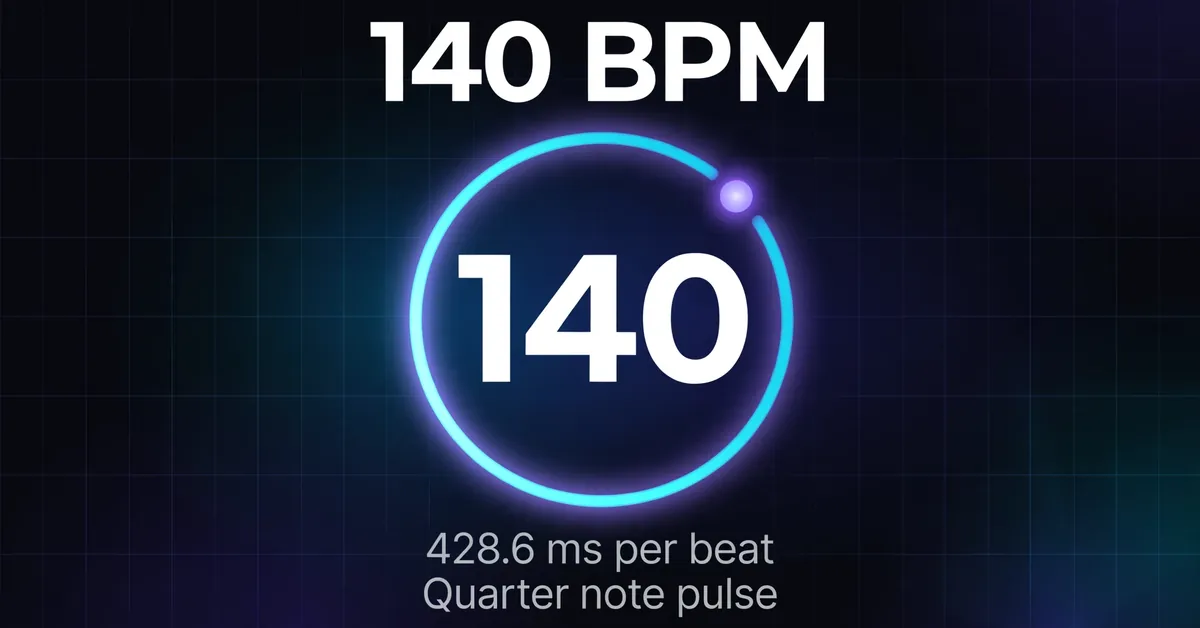
A 140 BPM metronome sounds 140 beats per minute, so one beat lasts about 428.57 milliseconds and roughly 2.33 clicks pass every second. Many trap and dubstep producers build at this tempo but feel the groove at 70, one counted beat for every two clicks. Playback speed is identical either way.
How Long Is Each Note Value at 140 BPM?
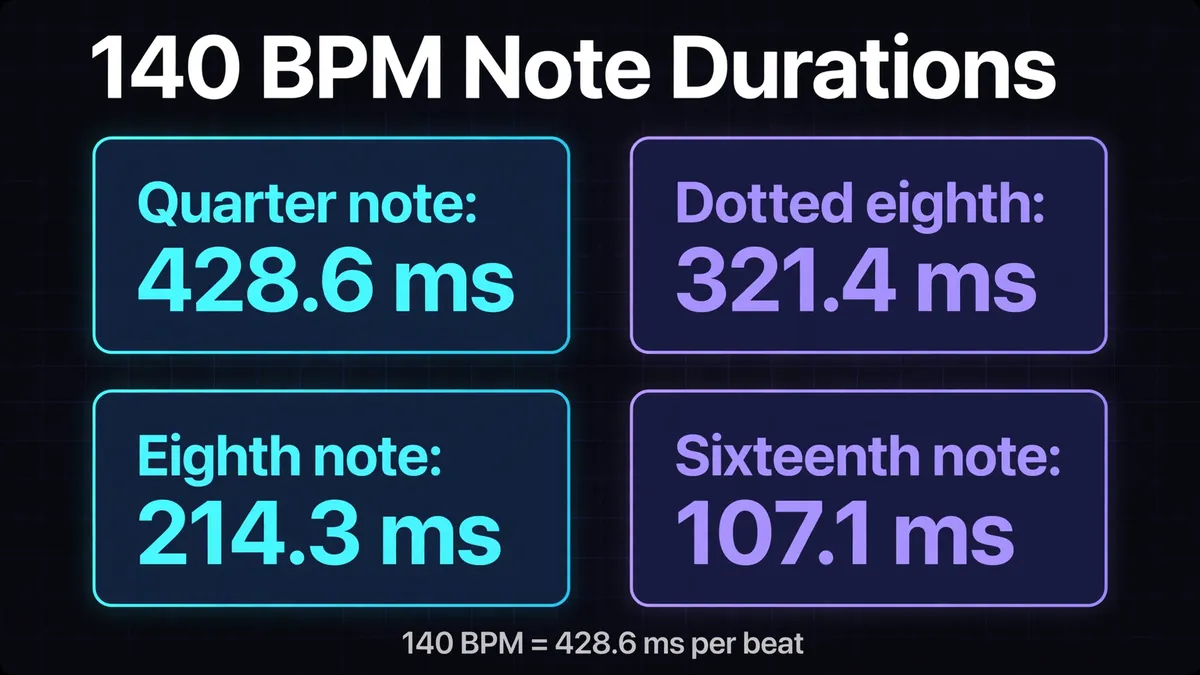
At 140 BPM the quarter note is 428.57 ms, the eighth 214.29 ms, the sixteenth 107.14 ms and the eighth note triplet 142.86 ms, which repeats at exactly 7 Hz. Every figure below comes from the unrounded quarter note, then rounds to two decimals.
Every number here counts quarter notes. If a 6/8 chart marks the dotted quarter instead, multiply by 1.5: dotted quarter = 90 lands at 135, and dotted quarter = 94 at 141.
| Note value | Beats | Duration (ms) | Hz (repeats per second) |
|---|---|---|---|
| Whole note | 4 | 1714.29 | 0.58 |
| Dotted half | 3 | 1285.71 | 0.78 |
| Half note | 2 | 857.14 | 1.17 |
| Half note triplet | 4/3 | 571.43 | 1.75 |
| Dotted quarter | 1.5 | 642.86 | 1.56 |
| Quarter note | 1 | 428.57 | 2.33 |
| Dotted eighth | 0.75 | 321.43 | 3.11 |
| Quarter note triplet | 2/3 | 285.71 | 3.50 |
| Eighth note | 0.5 | 214.29 | 4.67 |
| Dotted sixteenth | 0.375 | 160.71 | 6.22 |
| Eighth note triplet | 1/3 | 142.86 | 7.00 |
| Sixteenth note | 0.25 | 107.14 | 9.33 |
| Sixteenth note triplet | 1/6 | 71.43 | 14.00 |
| Thirty second note | 0.125 | 53.57 | 18.67 |
| Thirty second triplet | 1/12 | 35.71 | 28.00 |
| Sixty fourth note | 0.0625 | 26.79 | 37.33 |
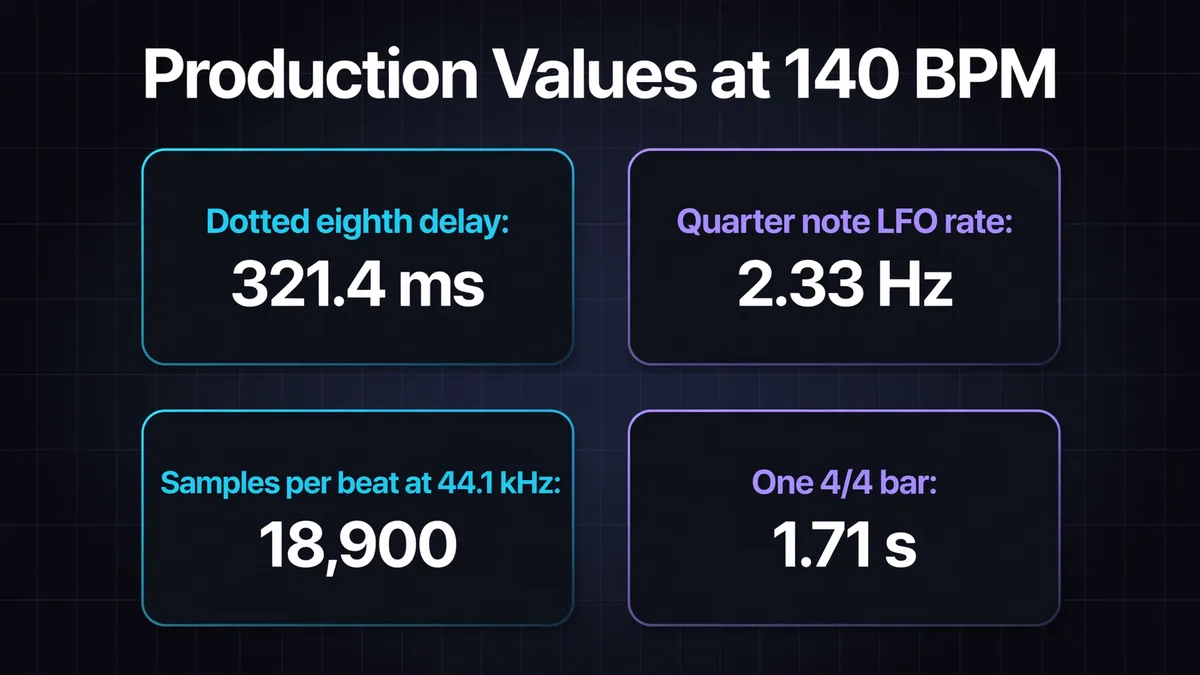
Here is a tidy surprise for anyone working in samples. At 44.1 kHz one beat equals exactly 18,900 samples (0.428571... s × 44,100), and a 4/4 bar is exactly 75,600. At 48 kHz the beat is about 20,571.43 samples, so a grid edit at that rate never lands on a whole sample. The BPM to samples page covers other rates, and the note duration calculator handles any value not listed.
How Long Are Bars and Phrases at 140 BPM?
A 4/4 bar at 140 BPM lasts about 1.714 seconds, a 3/4 bar about 1.286 seconds, and a 16 bar section in 4/4 about 27.43 seconds. Multiply the beats by 60, divide by 140, and round only the final answer so long sections stay honest.
| Bars | 4/4 | 3/4, or 6/8 with quarter = 140 | 6/8 with dotted quarter = 140 |
|---|---|---|---|
| 1 | 1.714 s | 1.286 s | 0.857 s |
| 4 | 6.857 s | 5.143 s | 3.429 s |
| 8 | 13.714 s | 10.286 s | 6.857 s |
| 16 | 27.429 s | 20.571 s | 13.714 s |
| 32 | 54.857 s | 41.143 s | 27.429 s |
The 6/8 columns differ because the meter can be counted two ways. On this site's metronome, x/8 meters treat BPM as quarter notes and click each eighth. If the chart says dotted quarter equals 140, enter 210 (140 × 1.5) so the eighths run at the right speed. More on that choice lives in time signatures and BPM.
Three minutes at 140 hold 420 beats, or 105 bars of 4/4. A dancer counting eights reaches the end of each eight count every 3.43 seconds.
What Tempo Marking Is 140 BPM?
140 BPM falls in the Allegro row of this site's tempo chart, which spans roughly 120 to 156 BPM. That span is this site's approximation; other charts end Allegro sooner or later. A printed metronome mark with its note symbol always outranks the Italian word.
Vivace begins at 156 on the same chart, so 140 sits comfortably mid band rather than near an edge. The tempo markings BPM chart lists every row.
Why Is 140 BPM Often Counted as 70?
In trap and dubstep the snare usually lands once per bar on beat 3 rather than on beats 2 and 4, so the ear locks onto a pulse half as fast. Musicians then call the track 70 BPM even though the session grid reads 140.
Try it yourself in 4/4. Put a kick on beat 1 and a snare on beat 3 while the click keeps all four beats at 140. Now count only beats 1 and 3: that slower pulse, 857.14 ms apart, is the 70 BPM reading. Move the snare to beats 2 and 4 and the same click suddenly feels quick. The pattern changed; the tempo did not. This is one practice pattern, not a description of how the songs below are arranged.
This site's approximate bands put dubstep at 138 to 145 BPM and trap at 130 to 160 BPM, and 140 lands inside both. Rhythm, sound and arrangement define those styles, not the number. See the trap BPM guide and dubstep BPM guide for depth.
How Should You Practice With a 140 BPM Metronome?
Begin below the target, keep each step small, and only climb after a clean pass. Hi hat rolls and fast strumming fall apart quickly at 140, so a slower start costs less time than untangling a sloppy habit later.
A ladder for a drummer working on sixteenths, or a guitarist on fast eighths:
- 120 BPM, quarter note click, four clean repetitions (500 ms per beat).
- 130 BPM, same passage (about 461.54 ms per beat).
- 135 BPM, click on eighths so each 222.22 ms gap is audible.
- 140 BPM, click on eighths, then switch the click back to quarters and keep the subdivisions in your head.
- 140 BPM with the click on beats 1 and 3 only in your counting, to rehearse the 70 feel.
The online metronome runs from 20 to 360 BPM, offers 4 subdivisions and 5 sounds, accents beat 1 only, and includes a speed trainer that can automate the ladder. To check a recording against 140, tap along on the tap tempo page with the spacebar or a letter or number key; it averages your last 8 gaps, sets outliers aside, and resets after a 2.5 second pause.
Which Songs Are Reported at 140 BPM?
Linked databases list Arctic Monkeys' "505," Coldplay's "Paradise" and Skrillex's "Scary Monsters and Nice Sprites" at 140 BPM. Ariana Grande's "7 rings" is reported at 70 and appears here only as a 140 double count. These are attributed reports, not independent audio measurements.
The linked databases report the tempos below. Nearby matches and alternative counts are labeled separately. Use the named version where one is given; a counting option does not establish the recording's intended feel.
| Song | Artist | Recording version | Reported BPM | Counting option | Sources |
|---|---|---|---|---|---|
| 505 | Arctic Monkeys | Favourite Worst Nightmare | 140 | 140 BPM count | SongData |
| Paradise | Coldplay | Version unspecified | 140 | 140 BPM count | SongBPM |
| 7 rings | Ariana Grande | Version unspecified | 70 | 140 BPM double count | SongBPM |
| Scary Monsters and Nice Sprites | Skrillex | Version unspecified | 140 | 140 BPM count | SongBPM |
Notice how the same click serves very different records: an indie rock single, a stadium pop ballad and a dubstep track. That spread is the clearest proof that 140 on its own names no genre. If a tool reads one of these at 70 or 280, it has picked another pulse level, and why BPM detectors disagree explains how that happens.
How Do Producers Use 140 BPM?
Producers lean on three numbers at 140: a 214.29 ms eighth for sidechain release, a 142.86 ms eighth note triplet for bouncing delays, and a 53.57 ms thirty second for hi hat rolls. Sync mode in the DAW keeps those values exact; typed milliseconds are rounded.
The eighth note triplet delay of about 142.86 ms has a 7 Hz rate if you assign it to an LFO instead. A thirty second note, about 53.57 ms, is one spacing to try for a hat roll, and sixteenth triplets at 71.43 ms give the rolling, skipping version. Treat the number as a starting point and shape the sound and density by ear. The delay calculator and reverb calculator compare timings side by side.
Scenario: a producer opens FL Studio, Ableton Live or Logic Pro at 140 BPM with a kick on beat 1 and an 808 under it. A sidechain on the pad releasing over one eighth (214.29 ms) is fully recovered before the next eighth note hat. A dotted eighth vocal throw at 321.43 ms lands between hats, which keeps it out of the way of the snare on beat 3. For other synced rates, the BPM to Hz converter does the math.
What Are Half Time and Double Time at 140 BPM?
Half time of 140 BPM is 70 BPM, 857.14 ms per counted beat. Double time is 280 BPM, 214.29 ms per counted beat. Both describe how you count the same audio; neither speeds up nor slows down the recording itself.
The 70 reading has its own page at 70 BPM, handy if a beat maker hands you a project labeled 70 and your DAW insists on 140. Turning a straight groove into a half time or double time feel is an arrangement change involving drum placement and accents, not just a new number. Run the figures with the half time calculator or double time calculator, and read the half time vs double time guide for the musical difference.
What Mistakes Do People Make at 140 BPM?
The usual slips are setting a DAW to 70 when collaborators work at 140, typing 429 ms instead of syncing a delay, and assuming 140 means trap. Each one is easy to avoid once you know the arithmetic behind it.
- Mixing pulse levels in one session. If one person exports stems at 70 and another at 140, loops line up only by luck. Agree on the grid number first.
- Typing rounded delays. 429 ms is 0.43 ms late per repeat; after 16 repeats the echo trails by about 6.86 ms, enough to blur a tight hat pattern.
- Reading 6/8 wrongly. A dotted quarter mark of 140 needs 210 on a quarter note metronome, not 140.
- Treating the tempo as a style. "Paradise" and "Scary Monsters and Nice Sprites" share a reported 140 and little else.