
How Do You Calculate Double Time BPM?
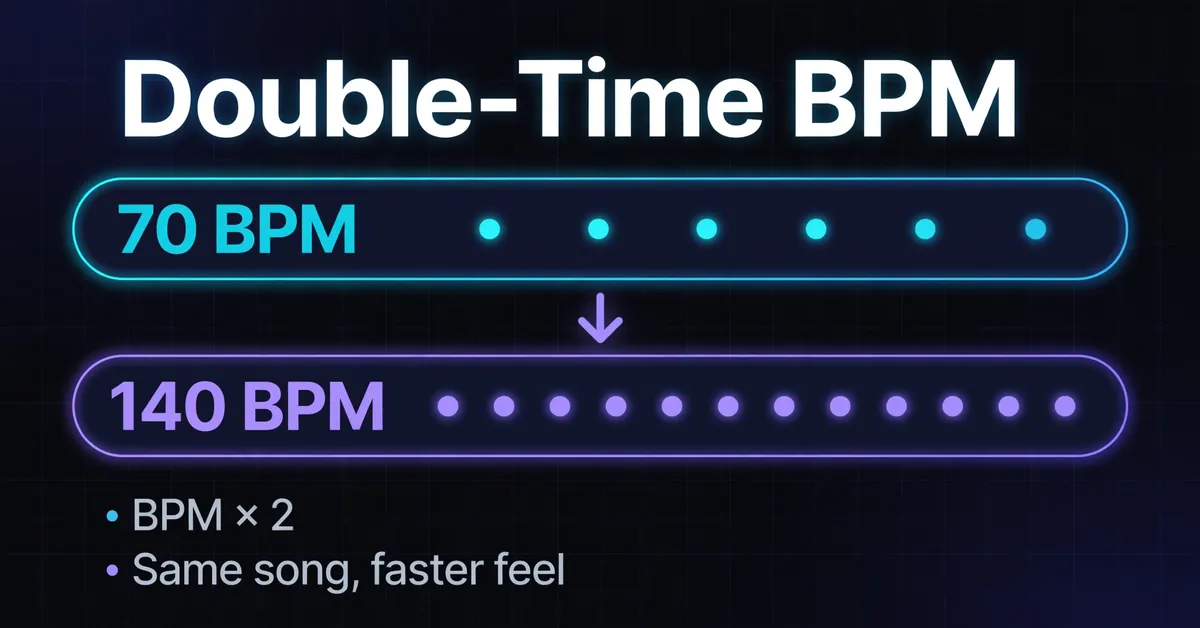
Calculate double time BPM by multiplying the original tempo by two. An 85 BPM reference becomes 170 BPM, with half as much time between counted beats. This double time calculator shows the faster tempo and beat interval in milliseconds. Doubling the count does not by itself speed up the recording.
Formulas: Double time BPM = original BPM × 2. Beat interval (ms) = 60,000 ÷ BPM.
Enter the original BPM, then compare the two intervals. At 85 BPM, a beat lasts about 705.88 ms; at 170 BPM, it lasts about 352.94 ms. The faster count places one additional pulse halfway between each pair of original beats.
These beat lengths assume BPM counts quarter notes. For a score marked dotted quarter = 60, enter 90 here. The distinction matters in compound meters; the written beat can contain three eighth notes, as Open Music Theory explains.
Use milliseconds to check spacing, rather than treating the result as an instruction to change playback. A musician rehearsing over an 85 BPM backing track can count at 170 while the track continues at its original speed.
What Is Double Time Feel?
Double time feel makes the rhythmic reference move at twice its earlier rate while chord changes and bar lines can keep their timing. In a simple 4/4 drum pattern, moving the main snare accents from beats 2 and 4 to the original eighth note offbeats outlines a faster backbeat.
Count one original bar as "1 and 2 and 3 and 4 and." Try this exercise:
| Part | Original groove | Double time exercise |
|---|---|---|
| Kick | Beats 1 and 3 | Beats 1, 2, 3 and 4 |
| Snare | Beats 2 and 4 | The and of every beat |
| Chord change | Next original bar | Same original bar line |
The table assumes quarter note BPM and straight eighths. For dotted quarter = 60, enter 90. Soundbrenner's explanation describes this offbeat accent approach. It is one playable pattern, not a requirement for every passage.
Keep the original count steady as you switch. A guitarist can hold the same chord while the drummer changes the pattern beneath it. Merely counting eighth notes aloud does not rearrange the accompaniment; playing the new groove does. A soloist can also outline faster subdivisions while the rhythm section holds its earlier pattern.
Double Time BPM Conversion Table
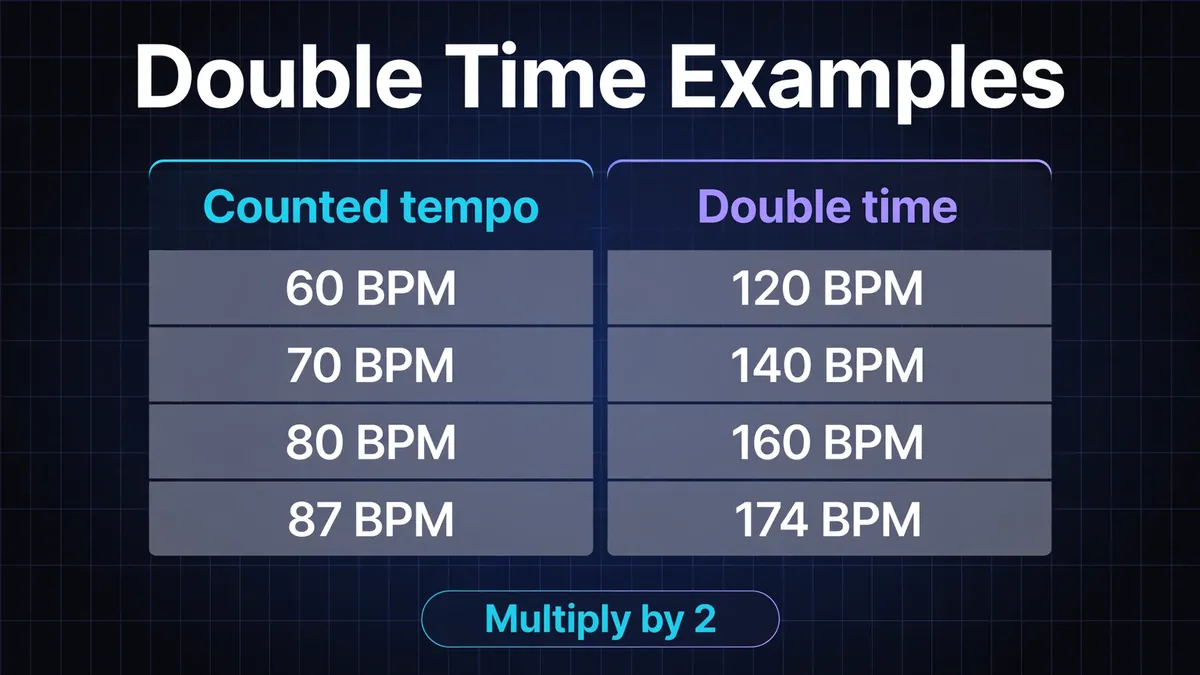
Each pair below gives two counting rates for the same playback. The faster pulse fits twice inside each original beat, so its interval is half as long. Use the table to check a conversion or compare a detector reading with the pulse you hear.
These reference values count quarter notes. For a score marked dotted quarter = 60, enter 90 here. Milliseconds are rounded to two decimal places.
| Original pulse | Double time pulse | Original interval | Faster interval |
|---|---|---|---|
| 60 BPM | 120 BPM | 1,000 ms | 500 ms |
| 75 BPM | 150 BPM | 800 ms | 400 ms |
| 85 BPM | 170 BPM | 705.88 ms | 352.94 ms |
| 87 BPM | 174 BPM | 689.66 ms | 344.83 ms |
| 90 BPM | 180 BPM | 666.67 ms | 333.33 ms |
| 100 BPM | 200 BPM | 600 ms | 300 ms |
The 87 and 174 pair illustrates slower and faster drum and bass references, not a rule for every track. The drum and bass guide covers the site's approximate genre bands.
How Do You Practice With a Double Time Click?
Set the click to twice your reference tempo and treat each click as one original eighth note. Keep your phrase length fixed while you change the counting rate. This gives you a way to rehearse faster subdivisions without asking the whole band to accelerate.
Try a four bar riff in 4/4 at 90 quarter note BPM. Its 16 beats take 16 × 60 ÷ 90 ≈ 10.67 seconds. A 180 BPM click supplies 32 pulses during those same seconds. Play the riff against both settings and land its ending at the same elapsed time.
On the online metronome, a 4/4 setting at 180 accents every four fast clicks. Your original bar spans eight clicks, so expect two accented groups per original bar. Count across them instead of restarting the riff at each accent.
For a band rehearsal, agree on a cue such as "double time at the next chorus, same chord lengths." Keep the bass part unchanged on the first pass so everyone can hear the drum transition.
How Does Double Time Rap Flow Fit the Beat?
Double time rap flow describes delivery moving at roughly twice an established rhythmic reference while the instrumental can keep its BPM. One exercise moves from eighth note syllables to sixteenth note syllables. The relationship is relative; no fixed syllable count defines every double time verse.
At 90 quarter note BPM, evenly spaced eighth notes are about 333.33 ms apart; sixteenths are about 166.67 ms apart. Across one 4/4 bar, that gives eight possible eighth note positions or sixteen sixteenth note positions. Cole Mize's subdivision lesson explains how rappers locate these beats within beats.
Speak a neutral syllable on the eighths, then use "1 e and a" for the sixteenths. Keep the stressed word on the same beat when trying a lyric. Leave rests where the line needs them. Filling every position can obscure the accent pattern you meant to emphasize.
When exchanging a verse with a producer, identify the project BPM as well as the flow: "90 BPM session, sixteenth note delivery" gives a clearer starting point than "double time" alone.
When Do Producers Set the DAW to Double Time?
A faster grid can simplify note entry in a new project. Sixteenth notes at 150 BPM occupy the same intervals as thirty second notes at 75 BPM. Choose the reference that makes detailed percussion and phrase lengths easier to read, then label your arrangement in that grid.
These examples assume BPM counts quarter notes. For dotted quarter = 60, enter 90. Puget Sound's subdivision lesson explains the quarter, eighth and sixteenth relationships used in these calculations.
| Timing reference | 75 BPM grid | 150 BPM grid |
|---|---|---|
| 100 ms note spacing | Thirty second notes | Sixteenth notes |
| 3.2 seconds | One 4/4 bar | Two 4/4 bars |
| 25.6 second phrase | Eight 4/4 bars | Sixteen 4/4 bars |
The phrase calculation is 8 × 4 × 60 ÷ 75 = 25.6 seconds. If a collaborator requests an eight bar stem, confirm the grid: eight bars at 150 last only 12.8 seconds.
Changing an existing project's tempo needs more care. MIDI playback, stretched audio and synced effects may change. Save a version first and compare the vocal entry, loop ending and effect timing after the edit. FL Studio documents how Stretch and Resample modes respond differently to tempo changes.
A drummer or rapper can perform a double time passage while project tempo stays fixed. If that is the goal, record the new part against the existing arrangement. Use the note duration calculator for additional subdivision lengths.
How Can DJs Use a Double Time BPM Reading?
A double time reading can help reconcile a track analyzed at a slower pulse with a faster counting grid. For example, 87 BPM and 174 BPM can refer to the same recording. Compare the grid against audible beats and phrase starts before adjusting the displayed reference.
Algoriddim's djay manual documents separate controls for doubling BPM and setting the downbeat. After a grid change, check beat 1 as well as the spacing between grid lines.
For a practice transition, align an 87 BPM passage with a 174 BPM passage so two fast beats fit each slow beat. Sixteen 4/4 bars at 87 and thirty two at 174 both last about 44.14 seconds. Mark the intended phrase endings, then audition the overlap for conflicting drum accents.
Doubling does not erase a tempo difference: 86 × 2 = 172, still 2 BPM below 174. Use the half time vs double time guide when the question is which counting reference suits your mix.
Which Mistakes Cause Double Time Confusion?
Check what actually changed: your count, the performed rhythm or playback speed. Those operations have different consequences. A denser drum part can leave the recording's length intact. A recording played at twice its original speed takes half the time, and its pitch changes unless pitch preservation is applied.
Ableton's Re-Pitch documentation confirms that doubling playback speed raises pitch by an octave. A three minute recording then lasts 90 seconds; calculating a faster pulse leaves it three minutes long. Use the tempo calculator for playback duration ratios.
Keep decimals until the final calculation. A reference of 87.5 BPM doubles to 175, not 174 or 176. Also keep the beat unit consistent: in 6/8, a dotted quarter pulse of 60 corresponds to quarter note BPM of 90. Doubling that quarter note reference gives 180, equivalent to dotted quarter = 120.
For a passage with changing tempo, double each local value rather than expecting one number to describe the whole performance. A change from 80 to 84 BPM corresponds to faster references of 160 to 168. The time signatures and BPM guide explains beat units in more detail.