
What Is 92 BPM?
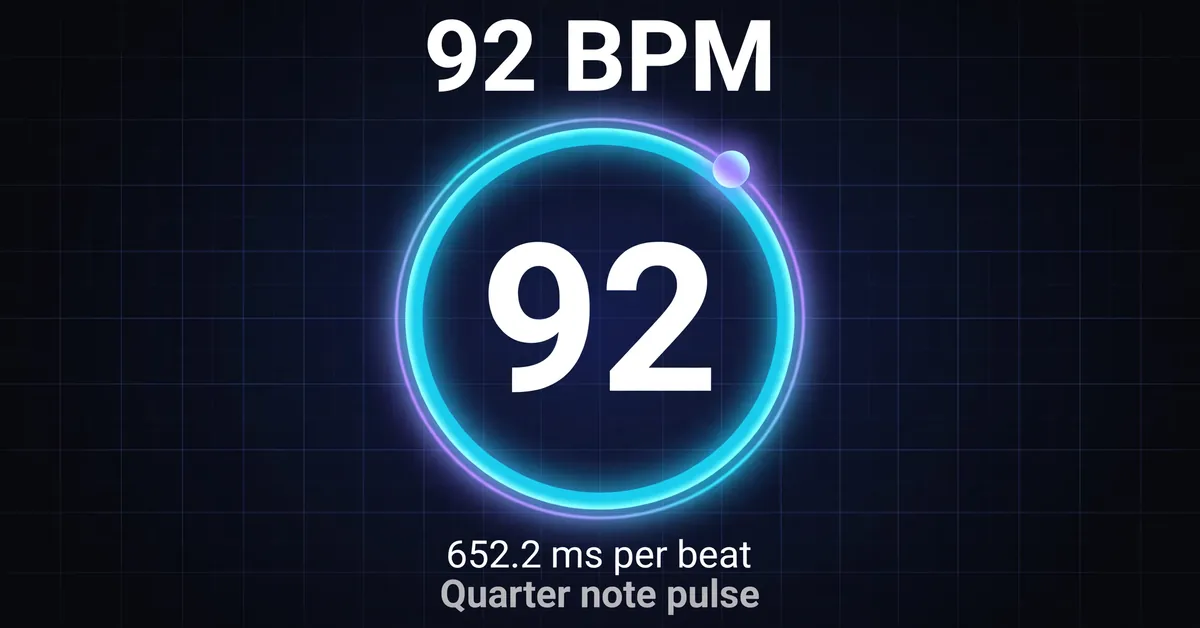
92 BPM means 92 beats per minute, so a 92 BPM metronome clicks once every 652.17 milliseconds, or 1.53 times per second. On this site's tempo chart it falls inside the Andante band of 76 to 108 BPM. It is a relaxed but steady pulse that sits in the middle of the hip hop and reggaeton ranges this site uses.
The number 92 does not divide 60,000 evenly, so most values on this page are rounded to two decimals. The exact quarter note is 652.173913 ms. That small remainder matters only when you type values into a plugin by hand; a DAW synced to 92 BPM keeps the full precision internally. Any tempo word quoted on this page follows this site's own bands; the tempo markings chart shows how other sources set them.
How Long Is Each Note at 92 BPM?
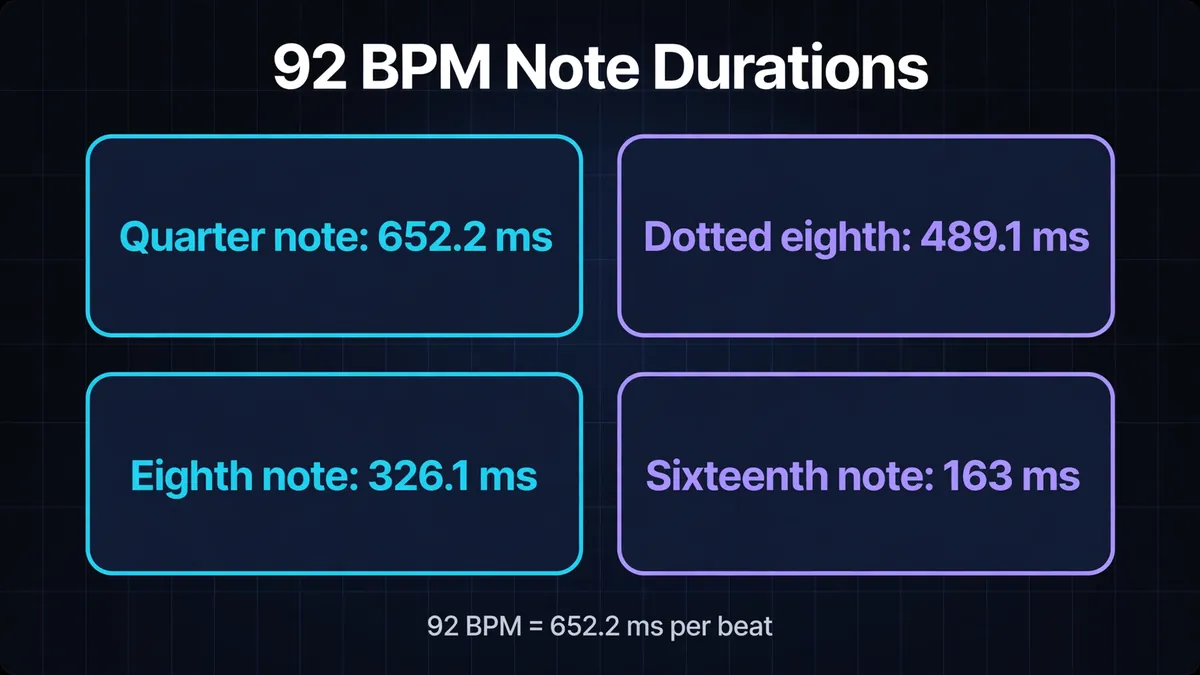
At 92 BPM a quarter note lasts 652.17 ms, an eighth note 326.09 ms, a sixteenth note 163.04 ms and an eighth note triplet 217.39 ms. A dotted eighth lasts 489.13 ms and a dotted quarter 978.26 ms. Every value comes from multiplying 652.17 ms by the note's length in beats.
Every duration below counts 92 quarter notes per minute. A compound meter mark converts with a factor of 1.5, so a 6/8 marking near dotted quarter = 61 rounds to roughly this tempo.
| Note value | Beats | Duration (ms) |
|---|---|---|
| Whole note | 4 | 2608.70 |
| Dotted half | 3 | 1956.52 |
| Half note | 2 | 1304.35 |
| Dotted quarter | 1.5 | 978.26 |
| Quarter note | 1 | 652.17 |
| Quarter note triplet | 2/3 | 434.78 |
| Dotted eighth | 0.75 | 489.13 |
| Eighth note | 0.5 | 326.09 |
| Eighth note triplet | 1/3 | 217.39 |
| Sixteenth note | 0.25 | 163.04 |
| Sixteenth note triplet | 1/6 | 108.70 |
| Thirty second note | 0.125 | 81.52 |
Worked example: a dotted eighth is three sixteenths. 163.04 × 3 = 489.13 ms (using the unrounded 163.0435 ms). The eighth note triplet is a quarter split in three: 652.17 ÷ 3 = 217.39 ms. For other values, the note duration calculator and BPM to ms converter do the same math.
How Long Is a Bar at 92 BPM?
A 4/4 bar at 92 BPM lasts 2.61 seconds (2,608.70 ms), and a 3/4 bar lasts 1.96 seconds (1,956.52 ms). Eight bars of 4/4 take 20.87 seconds and sixteen bars take 41.74 seconds. At this tempo you play exactly 23 bars of 4/4 per minute, since 92 ÷ 4 = 23.
| Length | 4/4 | 3/4 |
|---|---|---|
| 1 bar | 2.61 s | 1.96 s |
| 4 bars | 10.43 s | 7.83 s |
| 8 bars | 20.87 s | 15.65 s |
| 16 bars | 41.74 s | 31.30 s |
| 32 bars | 83.48 s | 62.61 s |
Those whole numbers help with planning. A two minute section at 92 BPM is 46 bars of 4/4, which is not a multiple of eight, so an arranger who wants an even 48 bar section ends up at 2 minutes 5.2 seconds (48 × 2.6087). In 6/8 with a quarter note click of 92, one bar holds three quarter note beats and lasts the same 1.96 seconds as 3/4. The time signatures and BPM guide covers how meters change the count.
What Does 92 BPM Feel Like?
92 BPM feels like an unhurried walk with a firm step. The gap between clicks is long enough to place sixteenth notes and ghost notes comfortably, yet short enough that the groove keeps moving. Drummers often find it a forgiving tempo for working on backbeat placement and swing.
Try one exercise two ways. First play a hip hop backbeat: kick on beat 1, snare on beats 2 and 4, closed hats on every eighth note (326.09 ms apart). Then keep the same click and play a dembow pattern, which puts the snare on the "and" of beat 2 and on beat 4 with a kick on each beat. The tempo stays at 92 the whole time; only the accent placement changes. Dembow names a rhythm, not a tempo, and the reggaeton BPM guide places it in a reference band of 88 to 100 BPM.
For a boom bap variation, swing the sixteenth notes and add quiet snare ghost notes between the backbeats. The hip hop BPM guide uses 80 to 115 BPM as its approximate range, with a dense cluster from 88 to 94 BPM, so 92 lands near its center.
Which Songs Are 92 BPM?
The databases linked below report these recordings at 92 BPM. Check the named version before you use a value for a playlist or a practice session, because remasters, radio edits and live takes can differ, and databases sometimes list the same song twice with different counts.
<a id="songs-at-92-bpm"></a>
| Song | Artist | Recording version | Reported BPM | Source |
|---|---|---|---|---|
| Cinnamon Girl | Lana Del Rey | Version unspecified | 92 | Tunebat |
| C.R.E.A.M. | Wu-Tang Clan | Enter the Wu-Tang: 36 Chambers | 92 | GetSongBPM |
| Creep | Radiohead | Version unspecified | 92 | SongBPM |
These are database reports, not an independent analysis. If a track you own seems faster or slower, tap along with the tap tempo tool or run the file through the BPM finder, and read why BPM detectors disagree before trusting a single number.
How Do You Practice With a 92 BPM Metronome?
Set the online metronome to 92 BPM, count four clicks out loud, then play. Use subdivisions to hear eighth notes at 326.09 ms or sixteenths at 163.04 ms. If 92 feels rushed, start at 80 and use the speed trainer to climb in small steps until 92 feels settled.
A drummer working on a groove might follow this routine:
- Play quarter notes on the hi hat for one minute, which is 23 bars.
- Add the backbeat and listen for the snare landing right on beats 2 and 4.
- Switch the metronome to eighth note subdivision and add ghost notes on the "e" and "a".
- Turn the click to sound only on beat 1 using the accent, and check that you still meet it after each bar.
A rapper or vocalist can use the same click to rehearse a 16 bar verse, which runs 41.74 seconds. A student practicing scales in sixteenth notes at 92 is playing 368 notes per minute (92 × 4), a useful number to track progress. A dancer counting in eights covers one eight count every two bars of 4/4, or 5.22 seconds.
How Do You Use 92 BPM in Production?
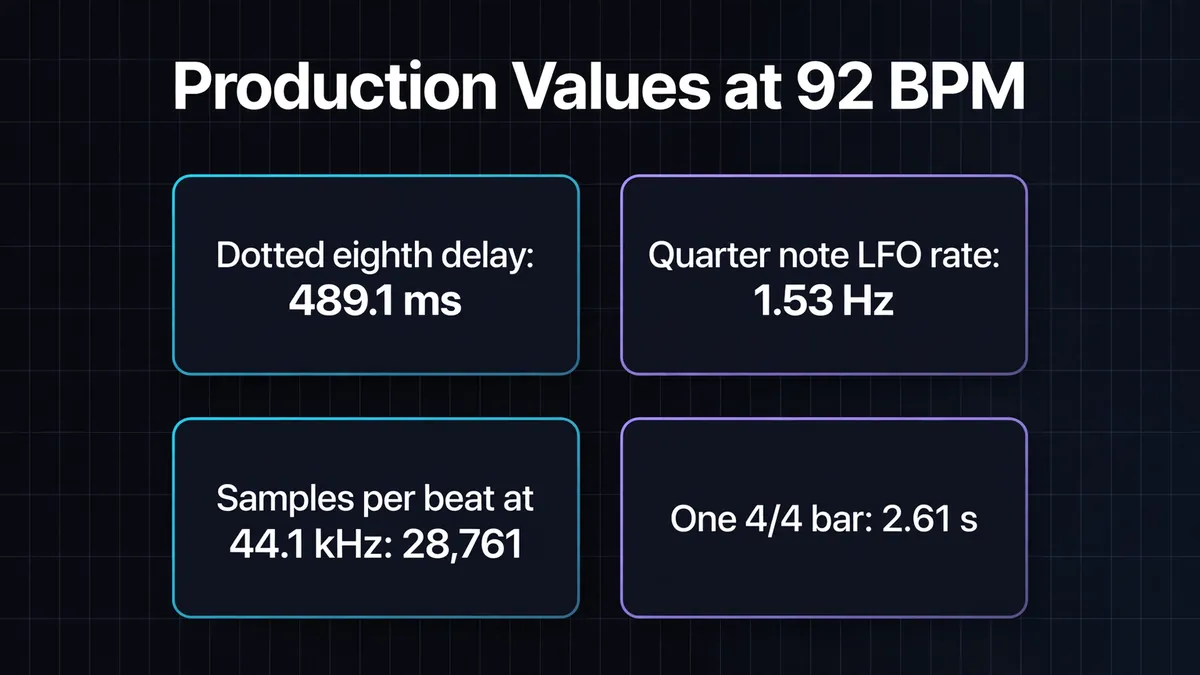
In a project set to 92 BPM, an eighth note delay is 326.09 ms, a dotted eighth delay 489.13 ms and a quarter note delay 652.17 ms. A one beat LFO runs at 1.53 Hz and an eighth note LFO at 3.07 Hz. Most DAWs, including Ableton Live, Logic Pro, FL Studio and Pro Tools, can sync these automatically.
Manual values matter when a hardware unit or plugin has no tempo sync. Compare a straight eighth repeat with a dotted eighth on the same percussion phrase: the dotted version (489.13 ms) lands between the grid lines and creates a rolling counter rhythm. For pre delay on a vocal reverb, a sixty fourth note gives 40.76 ms (652.17 ÷ 16), a starting point to try by ear.
| Use | Note value | Value at 92 BPM |
|---|---|---|
| Delay | Quarter | 652.17 ms |
| Delay | Dotted eighth | 489.13 ms |
| Delay | Eighth | 326.09 ms |
| Delay | Eighth triplet | 217.39 ms |
| LFO | 1 beat | 1.53 Hz |
| LFO | Eighth | 3.07 Hz |
| Sample count | Quarter at 44.1 kHz | 28,760.87 samples |
| Sample count | Quarter at 48 kHz | 31,304.35 samples |
For a sidechain pump that releases before the next kick, start with a release shorter than one beat, such as an eighth note of 326.09 ms, and adjust. The delay calculator, reverb calculator, BPM to Hz converter and BPM to samples calculator give these values for any tempo.
What Are Half Time and Double Time of 92 BPM?
Half time of 92 BPM is 46 BPM and double time is 184 BPM. Counting at a different pulse level does not change playback speed: 46 BPM means one beat every 1,304.35 ms, and 184 BPM means one beat every 326.09 ms, which equals the eighth note at 92.
A drum and bass producer at 184 BPM shares exactly the same bar grid as a hip hop beat at 92, because two bars at 184 last as long as one bar at 92 (2.61 seconds). That is why a 92 BPM sample can drop into a 184 BPM project without time stretching. A real half time or double time feel also depends on where the snare and kick fall, not only on the count. Check numbers with the half time calculator and double time calculator, and read the half time vs double time guide for the musical difference. The nearest neighbor pages are 90 BPM and 100 BPM.
What Mistakes Happen at 92 BPM?
The most common mistake is rounding too early. Typing 652 ms instead of 652.17 ms into an unsynced delay drifts by 0.17 ms per repeat, which adds up across long feedback tails. Others include reading a 6/8 marking as a quarter note pulse, or treating a database BPM as proof of a song's feel.
Database rounding causes confusion too. A recording measured at 92.4 BPM rounds to 92, while one at 92.5 or above rounds to 93, so neighboring listings often show 91, 92 or 93 for one track. Some sites also report double counts, so a 92 BPM song may appear as 184. If your tap reading lands near 46 or 184, divide or multiply by two before deciding the tempo is wrong. Finally, the Andante label is a guide, not a rule; a printed metronome mark on a score always takes priority.