
What Does BPM Mean in Music?
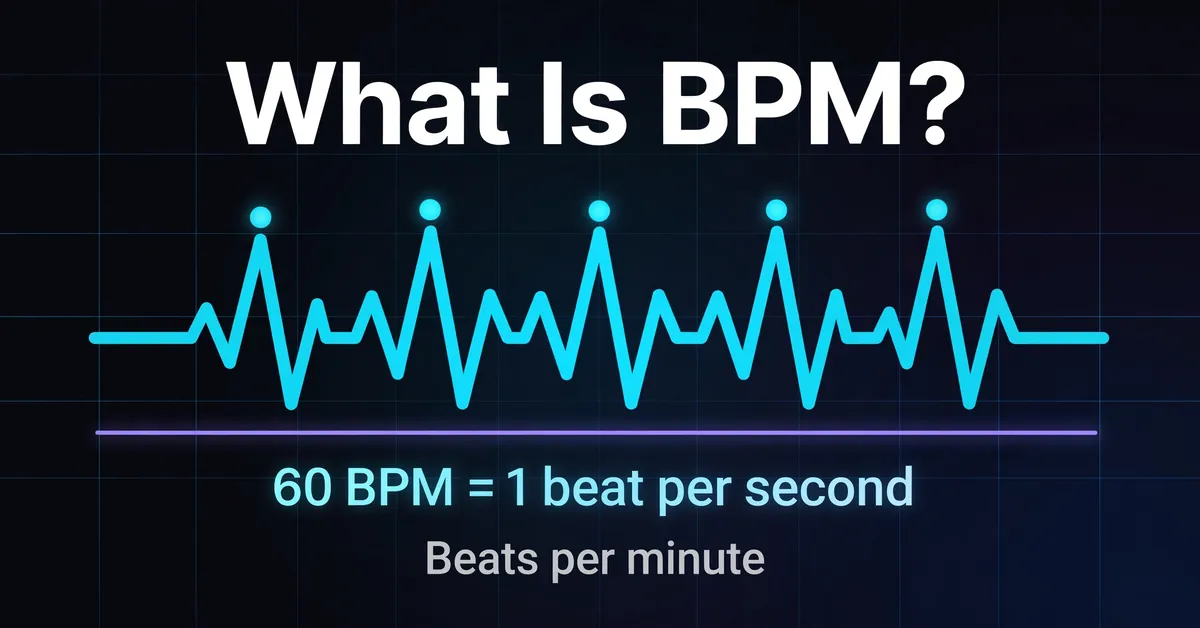
So what is BPM? It stands for beats per minute, the number of times a steady musical pulse repeats in one minute. At 60 BPM you get one beat each second; at 120 BPM, two. The number measures tempo, but to read it properly you also need to know which note value is being counted as the beat.
That last detail trips people up more than anything else on this page. "120" on its own is just a rate. Whether it describes quarter notes, dotted quarters or half notes changes how fast the music actually moves.
Tempo is the speed itself. BPM is one way to put a number on it, alongside Italian words like Andante or Allegro that describe character as well as pace.
You will also see BPM used for heart rate. On this site it always means musical beats. A song's tempo says nothing about what a normal heart rate is.
What Counts as a Beat?
A beat is the recurring pulse you would naturally clap, nod or step to. It is not every note, and it is not every drum hit. A singer can hold one long note across four beats, and a hi hat can play four notes inside one beat. The pulse keeps going underneath both.
Try this with any pop song: clap along without thinking. Those claps are almost certainly the beats the BPM refers to. If you find yourself clapping twice as fast as a friend, you have both found real pulses, just at different levels. That is why one app may call a track 85 BPM and another 170.
A metronome mark pairs a note value with a number. Quarter note equals 120 means 120 quarter notes per minute. A dotted quarter mark counts a longer note, so the same printed number gives a different quarter note rate. Symphony Nova Scotia explains this pairing of note value and BPM.
Example: a 6/8 piece marked dotted quarter equals 60 has 60 big pulses per minute. Each dotted quarter holds three eighth notes, so there are 180 eighths per minute. A quarter note is two eighths, so the quarter note rate is 90. Enter 90 in a tool that counts quarter notes. The time signatures guide goes further into compound meters.
How Do You Convert BPM Into Time?
Two formulas cover nearly everything:
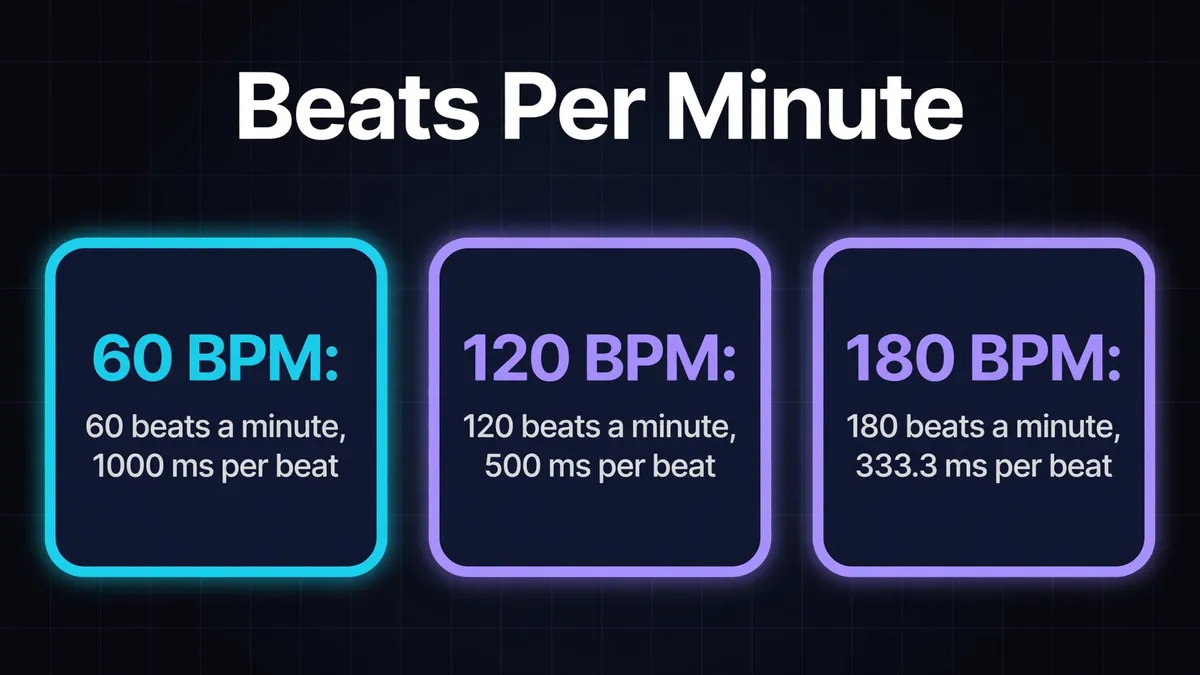
From there you can build bars and phrases. At 128 BPM, one beat lasts 60,000 ÷ 128 = 468.75 ms. A 4/4 bar is four beats, so 1,875 ms. A 16 bar phrase is 64 beats, which comes to exactly 30 seconds. DJs feel that phrase length in their hands even if they never do the math.
A few more worked numbers:
- At 120 BPM an eighth note lasts 250 ms and a 4/4 bar lasts 2 seconds.
- At 120 BPM a 3/4 bar lasts 1.5 seconds, because it holds only three beats.
- A 3 minute 30 second song at 100 BPM contains about 350 beats if the tempo holds steady (3.5 × 100).
If you are setting a delay or sizing a loop, the BPM to ms calculator and the note duration calculator save you the arithmetic.
BPM Benchmarks: Beats per Second and Beat Length
These values assume BPM counts quarter notes, and durations are rounded to the nearest millisecond. The 6/8 example above, at 60 dotted quarters, would be 90 in a quarter note tool.
| BPM | Beats per second | One beat lasts | One 4/4 bar lasts |
|---|---|---|---|
| 60 | 1 | 1,000 ms | 4.0 s |
| 90 | 1.5 | 667 ms | 2.67 s |
| 100 | About 1.67 | 600 ms | 2.4 s |
| 120 | 2 | 500 ms | 2.0 s |
| 128 | About 2.13 | 469 ms | 1.88 s |
| 140 | About 2.33 | 429 ms | 1.71 s |
| 174 | 2.9 | 345 ms | 1.38 s |
| 180 | 3 | 333 ms | 1.33 s |
Notice how the beat shrinks less and less as BPM climbs. Going from 60 to 90 cuts 333 ms off each beat. Going from 150 to 180 cuts only 67 ms. That is part of why small BPM changes feel bigger at slow tempos.
Does the Same BPM Always Feel the Same?
No. Two tracks at 140 BPM can feel completely different. A dubstep tune often puts its snare on beat 3, so the groove feels like 70. A fast punk song at the same rate hits the snare on 2 and 4 and feels frantic. Same number, different pulse emphasis.
Note density matters too. A piano ballad at 72 BPM with sixteenth note arpeggios can feel busier than a sparse hip hop beat at 90. Swing changes the feel again without touching the BPM at all, since it shifts the offbeats rather than the beat. For the relationship between these readings, see half time vs double time.
What BPM Does Not Tell You
BPM does not tell you the time signature, key, rhythm, swing or how many notes are played. Two songs can share a BPM while grouping beats in threes versus fours.
It also does not promise a steady tempo. Many recordings drift, push into a chorus or slow at the end. A single number summarizes a passage; it does not describe every moment.
Genre labels are only rough context. This site's approximate reference bands include house at 120 to 130 BPM and hip hop at 80 to 115 BPM; published references differ, and plenty of tracks sit outside these bands. The genre guides keep that context separate from the definition.
How Do Musicians, Producers and DJs Use BPM?
A guitarist learning a fast solo sets the online metronome to 80, gets clean, then climbs in small steps toward the record's 120. A drummer writes the BPM on the setlist so the band counts in at the same speed every night.
A producer sets the project tempo in Ableton Live, Logic Pro or FL Studio before recording, so loops, delays and the grid all line up. A DJ checks BPM to pick tracks that can be beatmatched without heavy pitch changes; going from 124 to 126 is a small nudge, while 124 to 140 calls for a different kind of transition.
Why does BPM sometimes come with decimals? A tempo can be any value, not just a whole number. Older records played by a live band often measure something like 97.6 BPM, while music built in a DAW usually sits on a whole number because the producer typed it in. For practice, rounding to the nearest whole BPM is fine. For syncing a loop over several minutes, it is not: at 97.6 versus 98 BPM, the gap after 64 beats is about 160 ms.
Students use it to describe practice progress in a way a teacher can check: "the etude at 96" means something specific.
To measure a recording rather than interpret a number, see how to find the BPM of a song, or tap along right now on the tap tempo tool.