
What Is 70 BPM?
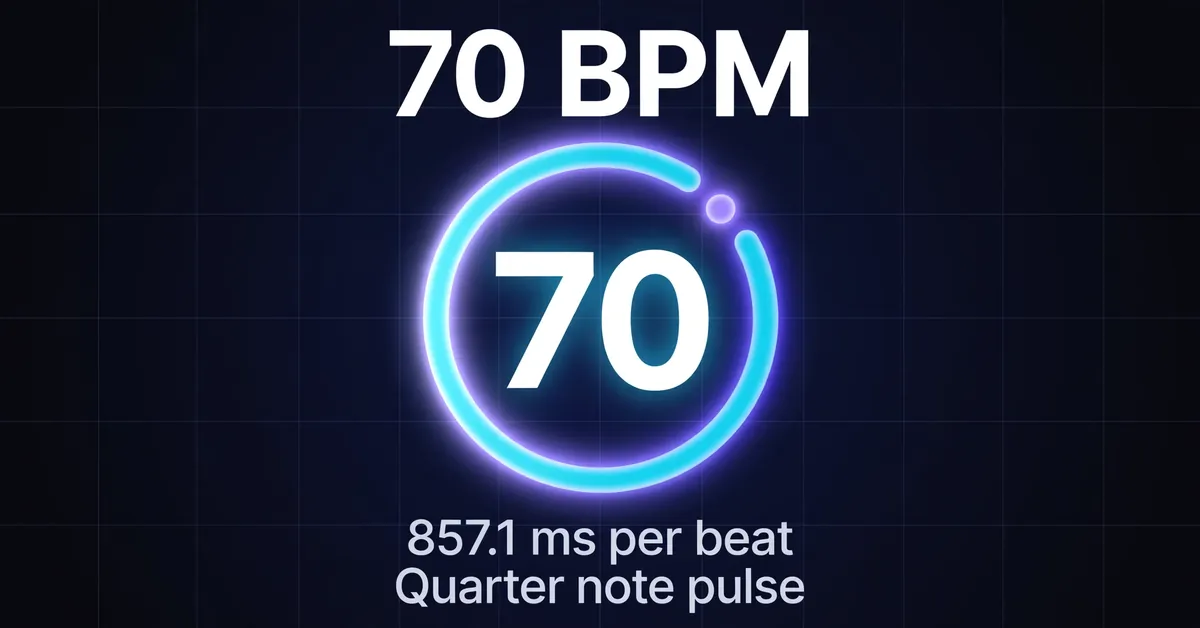
70 BPM means 70 beats per minute, with about 857.14 milliseconds between quarter note beats. Start the 70 BPM metronome for ballads, slow R&B grooves or lo fi loops. It sits in the Adagio band on this site's tempo chart, and it is exactly half of 140 BPM, the project tempo used in the trap tutorial linked below.
Unlike 60, this tempo does not divide a minute into round numbers. The exact beat length is 6000/7 ms, a repeating decimal (857.142857...), so every value on this page is rounded to two decimals from the unrounded figure. When you type a delay by hand, those decimals matter more than they seem; the mistakes section below shows why.
On this site's tempo markings chart, 70 falls inside Adagio (66 to 76) and at the bottom of Adagietto (70 to 80). Those borders are this site's reading, and other references shift Adagio up or down; a printed metronome mark on a score settles it.
How Long Is Each Note Value at 70 BPM?
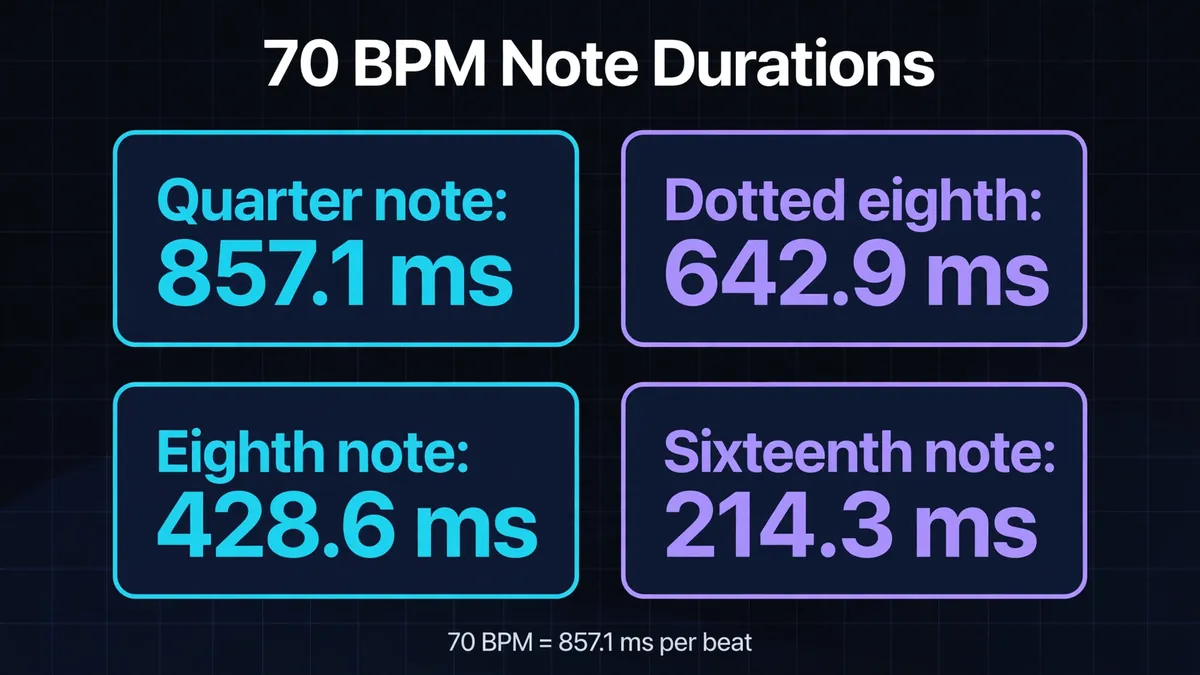
At 70 BPM a quarter note lasts 857.14 ms, an eighth note 428.57 ms, a sixteenth note 214.29 ms and a thirty second note 107.14 ms. Each value starts from 60,000 ÷ 70 for the quarter note, then multiplies by the note's fraction of a beat.
Durations treat the quarter note as one beat at 70. If your score gives a dotted quarter instead, multiply its number by 1.5 before you set the metronome. Values round to two decimals from unrounded figures.
| Note value | Fraction of a beat | Duration at 70 BPM (ms) |
|---|---|---|
| Whole note | 4 | 3428.57 |
| Dotted half note | 3 | 2571.43 |
| Half note | 2 | 1714.29 |
| Dotted quarter | 1.5 | 1285.71 |
| Quarter note | 1 | 857.14 |
| Quarter note triplet | 2/3 | 571.43 |
| Dotted eighth | 0.75 | 642.86 |
| Eighth note | 0.5 | 428.57 |
| Dotted sixteenth | 0.375 | 321.43 |
| Eighth note triplet | 1/3 | 285.71 |
| Sixteenth note | 0.25 | 214.29 |
| Sixteenth note triplet | 1/6 | 142.86 |
| Thirty second note | 0.125 | 107.14 |
| Sixty fourth note | 0.0625 | 53.57 |
Worked example: an eighth note triplet is 60,000 ÷ 70 ÷ 3 = 20,000 ÷ 70 = 285.71 ms. Three of them make 857.14 ms, one full beat.
The note duration calculator and BPM to ms converter run the same formula for any tempo.
How Long Is a Bar at 70 BPM?
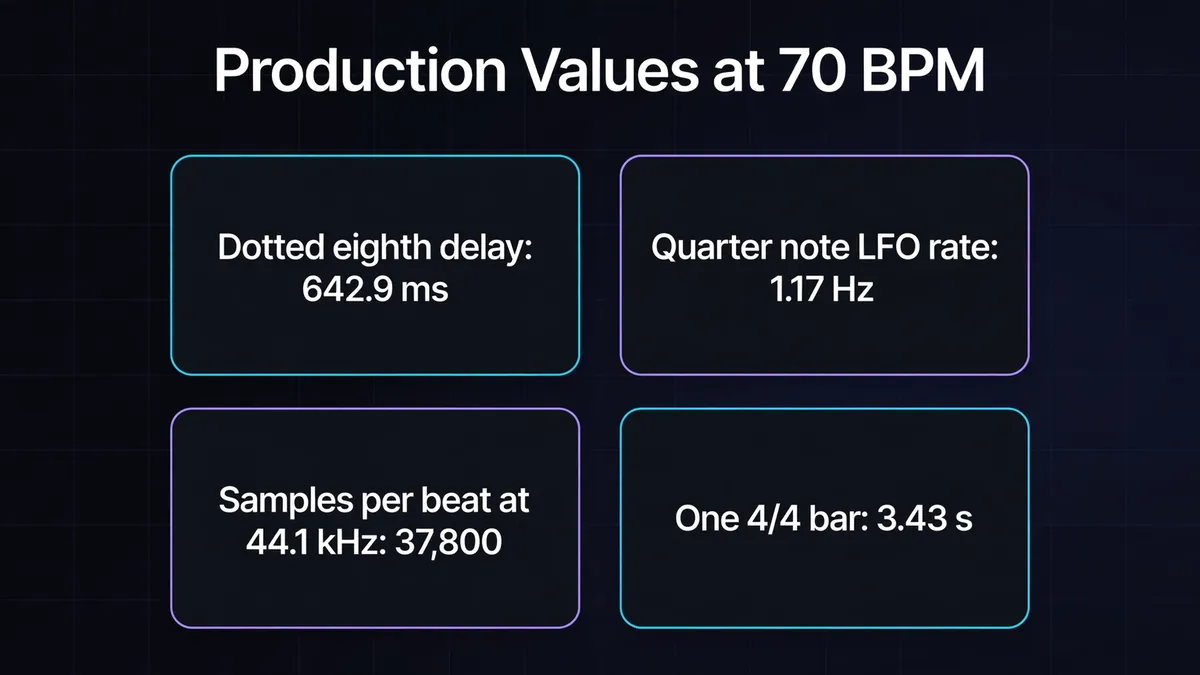
A bar of 4/4 at 70 BPM lasts about 3.43 seconds (3428.57 ms), and a bar of 3/4 or 6/8 with a quarter note count lasts about 2.57 seconds. Eight bars of 4/4 take about 27.43 seconds, and one minute holds 17.5 bars.
| Length | 4/4 | 3/4 | 6/8 (quarter note = 70) |
|---|---|---|---|
| 1 bar | 3.43 s | 2.57 s | 2.57 s |
| 4 bars | 13.71 s | 10.29 s | 10.29 s |
| 8 bars | 27.43 s | 20.57 s | 20.57 s |
| 16 bars | 54.86 s | 41.14 s | 41.14 s |
| 32 bars | 109.71 s | 82.29 s | 82.29 s |
Worked example: a 16 bar verse in 4/4 is 64 beats. 64 × 60 ÷ 70 = 54.86 seconds. A 3 minute song at 70 BPM holds 210 beats, or 52.5 bars of 4/4, which is why arrangements at this tempo often feel short on bars even when the song runs long.
On the online metronome, x/8 meters count the BPM on the quarter note and click each eighth, so 6/8 at 70 gives six clicks of 428.57 ms. The time signatures and BPM guide explains compound meters further.
What Does 70 BPM Feel Like?
70 BPM feels slow but not static: a relaxed nodding pulse with room for a melody to breathe. Each beat lasts a little under nine tenths of a second, about 143 ms shorter than at 60 BPM. Many listeners hear it as a ballad pulse, or as the half time feel of a 140 BPM track.
Its frequency is 1.17 Hz (70 ÷ 60 = 1.1667). The BPM to Hz converter shows the same rate for LFO and tremolo settings. A slow groove at this speed needs a clear pulse even when the melody rests, so the drums or the bass usually mark the beat firmly.
How Should You Practice at 70 BPM?
Practice at 70 BPM by locking the backbeat first, then filling the space between clicks. Play a chord on each downbeat while counting the other beats aloud, then add sixteenth note ghost strums or hi hats at 214.29 ms. The goal is to keep the gaps even while the parts get busier.
- Guitarist: hold a chord change on beat 1 of each bar, then add a muted strum on the "and" of every beat (428.57 ms after each click).
- Drummer: play a half time groove with the snare on beat 3 and hats on sixteenths. Then switch the snare to beats 2 and 4 on the same click to hear the 70 against 140 difference directly.
- Pianist: play a swung eighth pattern. In a triplet based swing, the long note is two triplet eighths (571.43 ms) and the short note one (285.71 ms).
- Dancer or teacher: count 8 beats per phrase. An eight count at 70 BPM lasts 6.86 seconds.
To check your own steadiness, tap along on tap tempo for eight or more beats. A reading that hovers between 69 and 71 is close; a climb to 73 or 74 usually means rushing during busy passages.
Which Songs Are Reported at 70 BPM?
Tunebat reports "Lotus Flower Bomb" by Wale featuring Miguel and "Us" by James Bay at 70 BPM, and SongBPM lists "SKINNY" by Billie Eilish at 70. These are attributed database readings, not independent measurements, so check the named recording version before comparing.
Nearby matches and alternative counts are labeled separately. Use the named version where one is given; a counting option does not establish the recording's intended feel.
| Song | Artist | Recording version | Reported BPM | Counting option | Sources |
|---|---|---|---|---|---|
| Lotus Flower Bomb | Wale featuring Miguel | Ambition | 70 | 70 BPM count | Tunebat |
| SKINNY | Billie Eilish | Version unspecified | 70 | 70 BPM count | SongBPM |
| Us | James Bay | Electric Light | 70 | 70 BPM count | Tunebat |
For a listening exercise, compare the space in "SKINNY" with the rhythm of "Lotus Flower Bomb" using the linked recordings. A tool may read either song at 140 instead; the why BPM detectors disagree guide explains why. Check any track yourself on tap tempo or with a local file in the BPM finder.
How Do Producers Use 70 BPM?
Producers at 70 BPM often start with a 428.57 ms eighth note delay, a 642.86 ms dotted eighth or a 285.71 ms triplet delay, and a 53.57 ms sixty fourth note reverb pre delay. In Ableton Live, Logic Pro, FL Studio or Pro Tools, synced note values give these timings automatically.
| Production setting | Note value | Value at 70 BPM |
|---|---|---|
| Short delay | Sixteenth note | 214.29 ms |
| Straight delay | Eighth note | 428.57 ms |
| Dotted delay | Dotted eighth | 642.86 ms |
| Triplet delay | Eighth note triplet | 285.71 ms |
| Reverb pre delay experiment | Sixty fourth note | 53.57 ms |
| Reverb pre delay experiment | Thirty second note | 107.14 ms |
| LFO rate | Quarter note | 1.17 Hz |
| Sample length at 48 kHz | Quarter note | 41,142.86 samples |
Worked example: an eighth note triplet delay at 285.71 ms gives three evenly spaced repeats inside each quarter note beat, which suits a lazy, swung vocal. Compare it with the straight eighth at 428.57 ms before adding feedback. Pre delay values are experiments; adjust them by ear. The delay calculator, reverb calculator and BPM to samples converter list complete sets.
Many beatmakers set the DAW to 140 and write a half time pattern instead of setting 70. The timing lines up because one 4/4 bar at 70 lasts 3428.57 ms, exactly as long as two 4/4 bars at 140. Native Instruments' trap tutorial sets its project to 140 BPM with claps on beat 3, which you can follow as a 70 BPM pulse; the pattern and accents create the half time feel.
What Are Half Time and Double Time at 70 BPM?
Half time of 70 BPM is 35 BPM, with 1714.29 ms per beat, and double time is 140 BPM, with 428.57 ms per beat. You can count the same recording at either level without changing playback speed. Changing the drum pattern creates a different musical feel.
| Pulse level | BPM | ms per beat | 4/4 bar |
|---|---|---|---|
| Half time count | 35 | 1714.29 | 6.86 s |
| As written | 70 | 857.14 | 3.43 s |
| Double time count | 140 | 428.57 | 1.71 s |
The 140 BPM quarter note equals the 70 BPM eighth note: 428.57 ms either way, so delay settings carry across. Compare the numbers with the half time calculator and double time calculator, or read the half time vs double time guide. Neighboring number pages are 60 BPM and 80 BPM, and the BPM chart shows every tempo the site covers.
Which Mistakes Happen at 70 BPM?
The most common mistakes at 70 BPM are truncating the repeating decimals in delay times, confusing a 70 BPM count with a 140 BPM project, and rushing during sparse grooves. Each is easy to fix once you know the exact numbers and which pulse level you are counting.
- Truncating decimals: typing 857 ms instead of 857.14 ms loses 0.14 ms per beat. Over 64 beats that adds up to about 9 ms, enough to smear a long delay tail against the grid. Use synced note values where possible.
- Mixing pulse levels: a sample labeled 140 BPM drops into a 70 BPM session at the same speed; only the count changes. Halving its playback speed is a different decision.
- Wrong beat unit: in 6/8 marked dotted quarter = 60, set 90, not 70.
- Rushing the space: with a clear gap between hits, players often push the snare early. Count the sixteenths quietly.