
What Is 80 BPM?
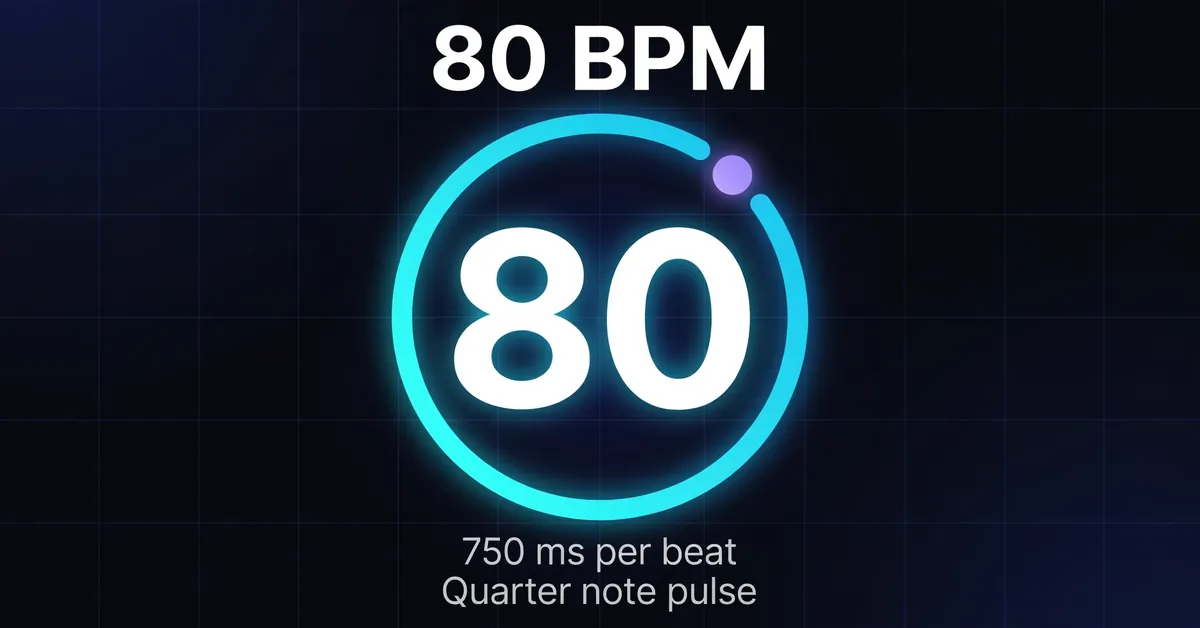
80 BPM means 80 beats per minute, so one beat lasts exactly 750 milliseconds and the pulse runs at 1.33 Hz. Start the 80 BPM metronome above for a hip hop or soul exercise, compare the song examples below, and use the note table to place smaller rhythmic divisions between the clicks.
Every figure on this page comes from one formula. Divide a minute, 60,000 ms, by the tempo, and you have the length of one beat. At 80 the result is a round number, which makes this tempo pleasant to work with in a DAW: a bar of 4/4 lasts exactly 3 seconds, and 20 bars fit into one minute.
How Long Is Each Note Value at 80 BPM?
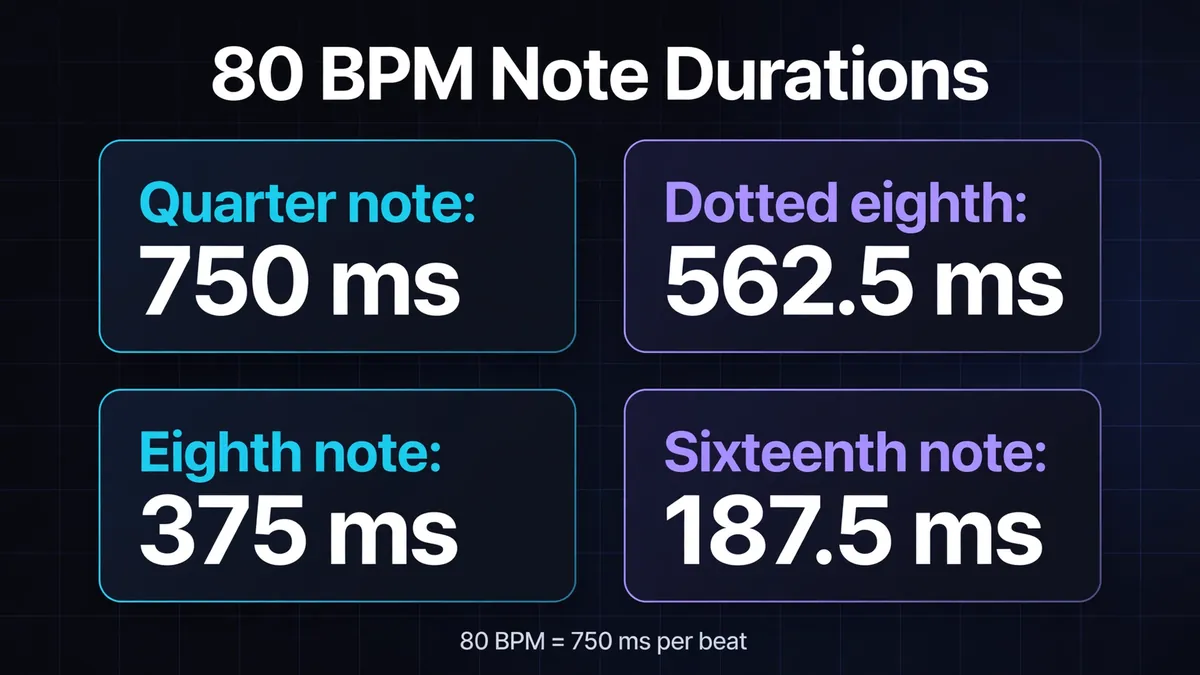
At 80 BPM a quarter note lasts 750 ms, an eighth note 375 ms, a sixteenth 187.5 ms and an eighth note triplet 250 ms. A dotted eighth is 562.5 ms. These values assume BPM counts quarter notes, which is how DAWs and the site metronome read the number.
| Note value | Fraction of a beat | Duration (ms) | Rate (Hz) |
|---|---|---|---|
| Whole note | 4 | 3000.00 | 0.33 |
| Dotted half | 3 | 2250.00 | 0.44 |
| Half note | 2 | 1500.00 | 0.67 |
| Dotted quarter | 1.5 | 1125.00 | 0.89 |
| Quarter note | 1 | 750.00 | 1.33 |
| Dotted eighth | 0.75 | 562.50 | 1.78 |
| Quarter note triplet | 2/3 | 500.00 | 2.00 |
| Eighth note | 1/2 | 375.00 | 2.67 |
| Dotted sixteenth | 3/8 | 281.25 | 3.56 |
| Eighth note triplet | 1/3 | 250.00 | 4.00 |
| Sixteenth note | 1/4 | 187.50 | 5.33 |
| Sixteenth note triplet | 1/6 | 125.00 | 8.00 |
| Thirty second note | 1/8 | 93.75 | 10.67 |
| Sixty fourth note | 1/16 | 46.88 | 21.33 |
Two neat coincidences fall out of this table. The quarter note triplet at 80 is 500 ms, the same as a plain quarter note at 120 BPM. The eighth note triplet is 250 ms, the same as a sixteenth at 60 BPM. A 6/8 score with a dotted quarter mark needs that number times 1.5 before it goes into a quarter note metronome. For other tempos, the note duration calculator and BPM to ms converter run the same math.
How Long Are Bars and Loops at 80 BPM?
One bar of 4/4 at 80 BPM lasts exactly 3 seconds, so 4 bars take 12 seconds, 8 bars 24 seconds and 16 bars 48 seconds. A 3/4 bar lasts 2.25 seconds. These round lengths make 80 BPM easy to plan when you are timing a verse or editing loops by hand.
| Length | 4/4 | 3/4 |
|---|---|---|
| 1 bar | 3.00 s | 2.25 s |
| 4 bars | 12.00 s | 9.00 s |
| 8 bars | 24.00 s | 18.00 s |
| 16 bars | 48.00 s | 36.00 s |
| 32 bars | 96.00 s | 72.00 s |
Worked example: a rapper wants a 16 bar verse plus a 4 bar hook. That is 20 bars of 4/4, and 20 × 3 s = 60 seconds, exactly one minute. At 44.1 kHz, one beat spans 33,075 samples (44,100 × 0.75); at 48 kHz it spans 36,000. The BPM to samples calculator shows the same for any rate.

What Tempo Marking Is 80 BPM?
On this site's tempo chart, 80 BPM sits inside the approximate Andante band of 76 to 108 BPM, a walking pace. It also touches the top of Adagietto (70 to 80) and the bottom of Andantino (80 to 108). Other tempo references set these borders a few BPM apart, so read the labels as this site's guide.
Because 80 sits on a border, the word on a score matters more than the number alone. An Adagietto marked at 80 will usually be played with more breadth than an Andante at the same click. When a printed metronome mark exists, follow it and its note symbol. The tempo markings chart lists the ranges side by side with other references.
What Does 80 BPM Feel Like?
At 80 BPM the gap between clicks is long enough that most listeners feel the space more than the speed. For a boom bap exercise in 4/4, keep the snare on beats 2 and 4, then vary the kick while the metronome stays steady.
Compare straight and swung hi hats over the same click. Straight sixteenths land every 187.5 ms; swung ones lean the second sixteenth of each pair later. This is one practice pattern; the number 80 alone does not define a pocket or a genre. A ballad, a slow soul groove and a sparse rap beat can all share this tempo and still feel unrelated, because accents, swing and sound choice carry the character.
Songs at 80 BPM
<a id="songs-at-80-bpm"></a>
The linked databases report the tempos below. Use the named version where one is given; a database reading does not establish the recording's intended feel.
| Song | Artist | Recording version | Reported BPM | Note | Sources |
|---|---|---|---|---|---|
| Ex-Factor | Ms. Lauryn Hill | The Miseducation of Lauryn Hill | 80 | 80 BPM count | Tunebat |
| Gangsta's Paradise | Coolio featuring L.V. | Gangsta's Paradise | 80 | 80 BPM count | GetSongBPM |
| Ho Hey | The Lumineers | Version unspecified | 80 | 80 BPM count | SongBPM |
| November Rain | Guns N' Roses | Use Your Illusion I | 80 (Tunebat); 84 (SongBPM) | Conflicting estimates; not a half or double pair | Tunebat, SongBPM |
To check a recording yourself, play it and tap along on the tap tempo page, or load a local file into the BPM finder. If a song drifts against the 80 BPM click within a few bars, its tempo is not exactly 80; why BPM detectors disagree explains readings like the 80 versus 84 split above.
How Do You Practice With an 80 BPM Metronome?
Set the metronome to 80 BPM in 4/4, count one bar out loud, then play only on the clicks for two bars before adding subdivisions. Moving from quarters to eighths to sixteenths over the same pulse trains you to fill the 750 ms gaps evenly instead of rushing toward the next click.
A short routine that works for drummers, guitarists and pianists:
- Quarters for 4 bars (12 seconds). Land each note on the click so the click disappears under your sound.
- Eighths for 4 bars, 375 ms apart. Say "one and two and" out loud.
- Eighth note triplets for 4 bars, 250 ms apart. Count "one trip let".
- Sixteenths for 4 bars, 187.5 ms apart.
- Switch on the metronome's subdivision only if you lose the pulse, then switch it off again.
Students preparing a piece marked 100 can use the speed trainer in the online metronome to start at 80 and climb in small steps.
Using 80 BPM in Production
A dotted eighth delay at 80 BPM lasts 562.5 ms and a straight eighth 375 ms, so the two settings place repeats very differently over the same groove. A sixty fourth note of about 46.88 ms is a reasonable reverb pre delay to start from, then adjust it by ear.
Delay worked example: a vocal hook ends on beat 3. With a quarter note delay of 750 ms, the first echo lands on beat 4 and the second on the next downbeat. A dotted eighth of 562.5 ms puts the first echo between beats, which fills the space without stacking on the snare at beat 4. Compare both before raising feedback. The delay calculator and reverb calculator list these values for every note length.
For modulation, an LFO synced to one cycle per beat runs at 1.33 Hz, and one cycle per eighth runs at 2.67 Hz. Sidechain release times built from note values follow the same table: an eighth note release of 375 ms recovers just before the next eighth. In Ableton Live, Logic Pro, FL Studio or Pro Tools, typing 80 into the project tempo sets these note values automatically for synced plugins, so the table matters most for plugins that only take milliseconds or hertz. The BPM to Hz converter covers the hertz side.
Swing has exact numbers too. On an MPC style swing setting, the percentage is where the second sixteenth falls inside each eighth note pair. At 80 BPM an eighth lasts 375 ms, so 54% swing places the second sixteenth at 202.5 ms instead of 187.5 ms, 15 ms late. At 62% it falls at 232.5 ms, 45 ms late. Roger Linn discusses 54% and 62% settings in his MPC timing interview.
Half Time and Double Time at 80 BPM
Half time of 80 BPM is 40 BPM, with a 1,500 ms pulse, and double time is 160 BPM, with a 375 ms pulse. You can count the same recording at any of those levels without changing playback speed; only the beat you choose to call "one" changes.
A half time or double time drum feel depends on the pattern and accents as well as the count. A trap style beat at 160 with the snare on beat 3 can sound like 80, and an 80 BPM groove with busy hi hats can be heard at 160. That is why song databases sometimes list a slow track at double its tempo. Compare the numbers with the half time calculator and double time calculator, or read the half time vs double time guide for the musical distinction. Nearby tempo pages: 70 BPM, 90 BPM and 160 BPM.
Which Mistakes Come Up at 80 BPM?
The most common mistake at 80 BPM is rushing: players start each note early because 750 ms feels long. Others include misreading a 160 BPM database value as a different song tempo, rounding delay times to 560 ms, and entering 80 for a 6/8 score marked dotted quarter equals 80.
- Rushing the gaps. Subdivide in your head so each 375 ms eighth has a place.
- Mixing up 80 and 160. If a database says 160 and your foot taps 80, both describe the same recording.
- Rounding delays. 560 ms instead of 562.5 ms drifts 2.5 ms per repeat, which adds up on long feedback tails. Use the exact value when the plugin allows it.
- Compound meter confusion. In 6/8 with dotted quarter equals 80, each eighth lasts 250 ms, so a quarter note metronome needs 120 BPM.