
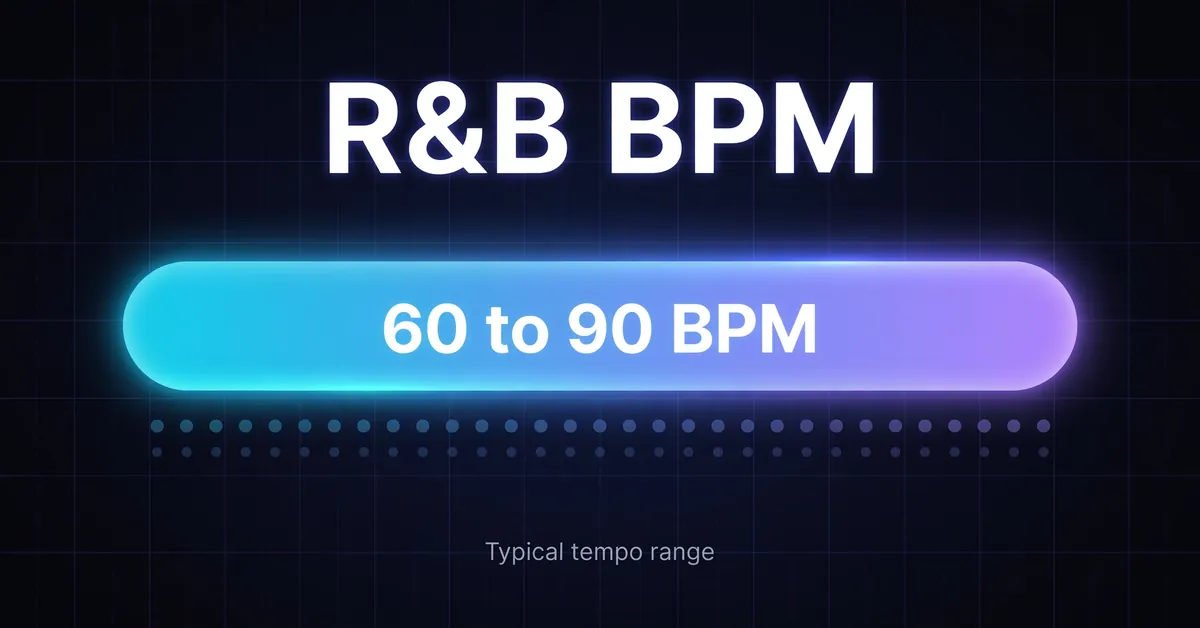
What BPM Is R&B?
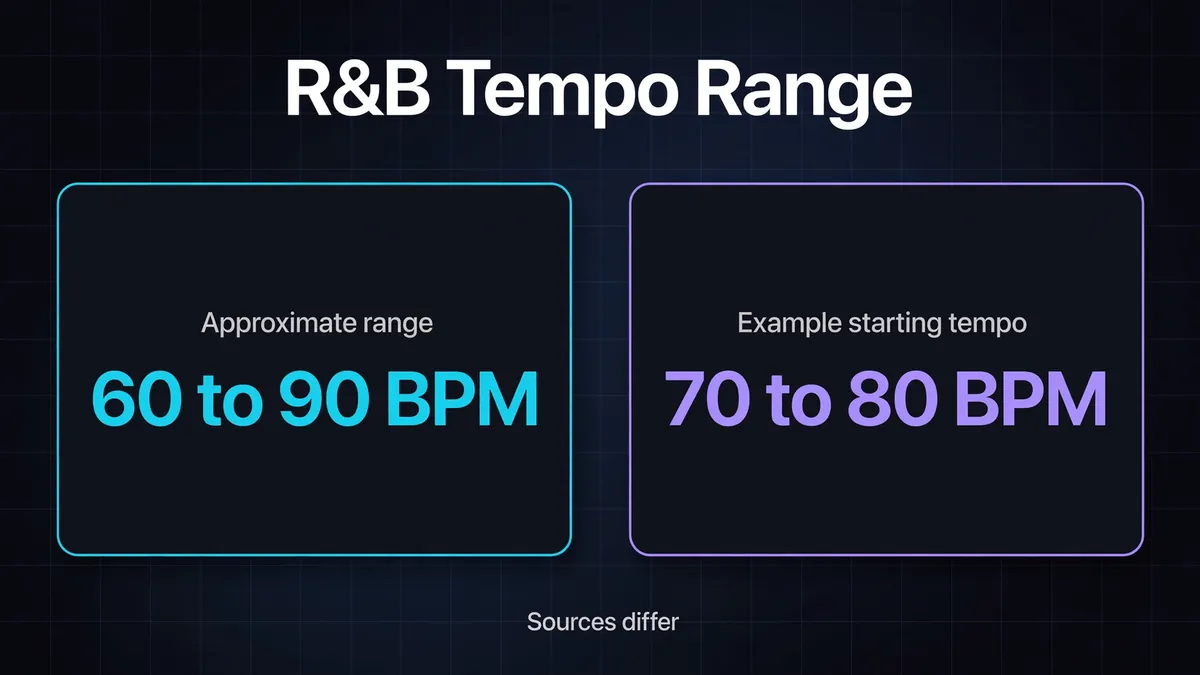
For R&B BPM, this site uses an approximate 60 to 90 BPM range covering slow jams and neo soul. Uptempo R&B and classic soul go faster and sit outside that scope. Try 70 to 80 BPM as a starting band, with 75 BPM for the example groove, and remember that note placement shapes the pocket.
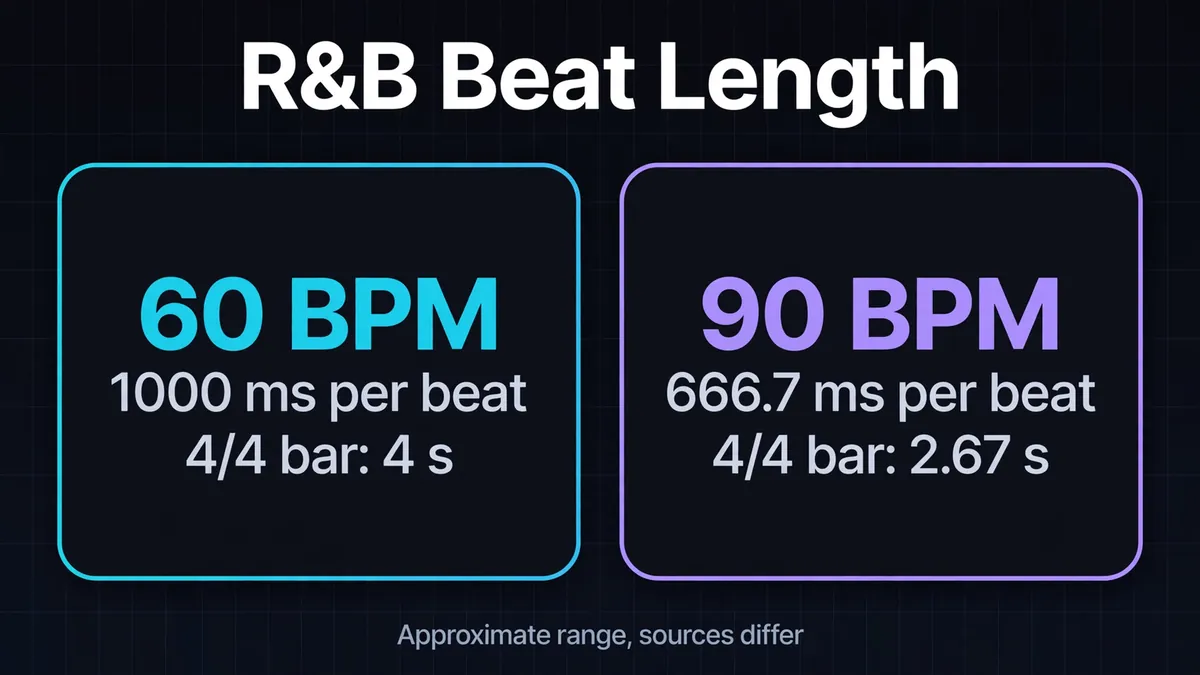
Slow tempos give each beat a lot of room. At 60 BPM a quarter note lasts a full 1,000 ms; at 90 BPM it lasts 666.67 ms. Inside those long beats, small timing choices on the snare or a vocal run become easy to hear, which is why R&B players talk about feel as much as tempo.
What BPM Does Each R&B Style Use?
This page suggests 60 to 72 BPM for slow jams, 70 to 85 for neo soul, 65 to 90 for modern R&B and 60 to 75 for quiet storm. Classic soul and Motown run from 70 to 120 BPM and above, wider than this page's slow jam scope because it includes uptempo records.
| Style | Approximate BPM reference | How to use the example |
|---|---|---|
| Slow jams | 60 to 72 | Start with the vocal and a simple accompaniment |
| Neo soul | 70 to 85 | Compare note placement around the grid |
| Classic soul and Motown | 70 to 120 and above | Wider than this page's slow jam scope; includes uptempo records |
| Modern R&B | 65 to 90 | Try a slow pulse with trap influenced subdivisions |
| Quiet storm | 60 to 75 | Explore sustained chords and sparse responses |
Neo soul references also extend beyond this page's exercise band. Orphiq's tempo chart gives 80 to 95 BPM, compared with the 70 to 85 starting band here. These are reference choices, so the table does not exclude a neo soul recording above 90 BPM.
The overlap between rows is useful. A 72 BPM ballad could be called a slow jam, quiet storm or modern R&B depending on its drums and production. Pick the row that matches the arrangement you hear, not just the number.
How Do You Choose an R&B Slow Jam Tempo?
Choose a slow jam tempo by starting with the vocal phrase and chord changes, then checking whether sustained chords and short responses both have room. Begin at 70 to 75 BPM. If a vocal run feels crowded, move the run or thin the accompaniment before slowing the whole song down.
A step by step check for a songwriter:
- Play the chord loop on keys at 75 BPM with the online metronome. Each 4/4 bar lasts 3.2 seconds.
- Sing the hook. Count how many syllables land in its busiest beat. Four sixteenth note syllables at 75 BPM get 200 ms each, which is comfortable for most phrasing.
- Try 68 BPM. The bar grows to about 3.53 seconds, and held notes feel heavier. Try 82 BPM, where the bar shrinks to about 2.93 seconds.
- Keep the tempo where the hook sounds unhurried and the chord changes still feel like they are moving forward.
Very slow tempos have a trap of their own. Below 65 BPM, a singer can start rushing because the gap between beats feels long. Subdividing the click into eighth notes on the metronome gives a reference every 461.54 ms at 65 BPM instead of every 923.08 ms.
How Does R&B Feel at 75 BPM?
At 75 BPM an R&B groove gives each quarter note 800 ms and each 4/4 bar 3.2 seconds, so a 4 bar phrase lasts 12.8 seconds. The one bar exercise below uses a sparse kick, a backbeat rimshot and sixteenth note hats, which leaves space for vocal runs and keyboard responses.
Each beat has four sixteenth note steps, counted 1 e and a. Beats 1, 2, 3 and 4 begin on steps 1, 5, 9 and 13.
| Voice | Steps | Placement |
|---|---|---|
| Kick | 1, 11 | Beat 1 and the and of 3 |
| Rimshot or snare | 5, 13 | Beats 2 and 4 before timing adjustments |
| Hi hat | All 16 steps | Sixteenths with selected velocity changes |
For this neo soul exercise, record the rimshot slightly behind the grid while keeping the hats as a reference. Compare that take with one played on the beat. The difference is note placement, not a change in BPM.
Velocity matters as much as timing. Try accenting the hats on steps 1, 5, 9 and 13 and playing the steps between them softer. The pattern then breathes in quarter notes even though all sixteen steps sound.
What Is Dilla Swing and Does It Change the BPM?
Dilla swing refers to timing associated with J Dilla's approach to groove, including unquantized playing and placement that varies by sound. It does not change the BPM. The underlying tempo stays steady while individual hits land early or late, so a tap tempo reading should still match the project grid.
MusicRadar's discussion of J Dilla describes unquantized playing and timing that varies by sound. Dilla influenced groove does not require every note to miss the grid or every snare to be late.
A worked sense of scale: at 75 BPM a sixteenth note is 200 ms. Shifting the snare 20 ms late moves it a tenth of a sixteenth, small enough to feel as laid back rather than wrong. Shifting it 100 ms moves it halfway to the next sixteenth step, which starts to sound like a different rhythm. In Ableton Live, Logic Pro or FL Studio, nudge in small steps and compare by ear.
Common mistake: applying one swing amount to every track. A behind the beat snare can sound loose and confident over steady hats, but if the bass, keys and hats all shift by the same amount, the groove simply moves late as a block.
What Are the Note Values at 75 BPM?
At 75 BPM a quarter note lasts 800 ms, an eighth note 400 ms, a sixteenth note 200 ms, a dotted eighth 600 ms and an eighth note triplet 266.67 ms. They count the quarter note as the beat, which matters for slow jams written in 6/8 or 12/8: a dotted quarter mark of 50 corresponds to this 75 BPM grid.
| Note value | Length in ms |
|---|---|
| Quarter note | 800.00 |
| Eighth note | 400.00 |
| Sixteenth note | 200.00 |
| Dotted eighth note | 600.00 |
| Eighth note triplet | 266.67 |
Try a dotted eighth delay at 600.00 ms on a guitar response between vocal lines. Adjust the feedback so the repeats support the phrase rather than mask the next entry. Use the delay calculator for other tempos.
A slow jam written in 12/8 counts the beat as a dotted quarter. If a chart marks dotted quarter equals 50, the equivalent quarter note tempo is 75 BPM (50 × 1.5 = 75), so the table above still applies. The time signatures guide covers this conversion.
How Does Trap Soul Count Its Tempo?
Trap soul usually runs on a fast grid with a slow felt pulse. A 140 BPM project with the snare on beat 3 feels like 70 BPM, which sits inside this page's R&B range. Both numbers describe the same song, so a library may list either one depending on how its detector counts.
Worked example: 140 ÷ 2 = 70 BPM. At 140 BPM a quarter note is 428.57 ms; at 70 BPM it is 857.14 ms. Sixteenth note hats on the 140 grid fall 107.14 ms apart (428.57 ÷ 4), which is why they sound rapid over a slow vocal.
For a trap soul exercise, try a 140 BPM grid with a felt 70 BPM pulse, then add an 808 and short hat rolls. That is one arrangement option. The trap tempo guide explains the two counting levels, and the half time vs double time guide helps you choose one.
How Do Singers, Producers and DJs Use R&B Tempos?
Singers use a slow click to place runs and breaths, producers set the grid and then shape timing by instrument, and DJs check the real pulse and phrase starts before blending slow R&B with trap soul or hip hop. The BPM is the anchor; feel is built on top of it.
Singer or student: Record the same short phrase with the snare on the beat and slightly behind it. Keep the project at 75 BPM for both takes. Practice runs against an eighth note click first, then remove the subdivision and keep the run inside the beat.
Producer: Listen for whether the bass and chord attacks support the chosen placement rather than moving every instrument by the same amount. If a sampled loop came in at 88 BPM and you want 75, that is a 14.8 percent slowdown, enough for time stretching to change the sound. Consider replaying the part instead.
DJ: Check the actual pulse and phrase starts when moving between slow R&B and trap soul. Matching key alone does not align the beats. If one library entry uses a doubled grid, compare the snare pattern before changing the playback tempo. A 70 BPM slow jam and a 140 BPM trap soul track can blend without any pitch change. Moving up toward hip hop tempos usually needs a clean break or a doubled count.
Dancer: Slow R&B choreography in eight counts gives 6.4 seconds per eight at 75 BPM and 8 seconds at 60 BPM. That extra time is why slow routines rely on held shapes and controlled transitions.