
How Do You Convert Milliseconds to BPM?
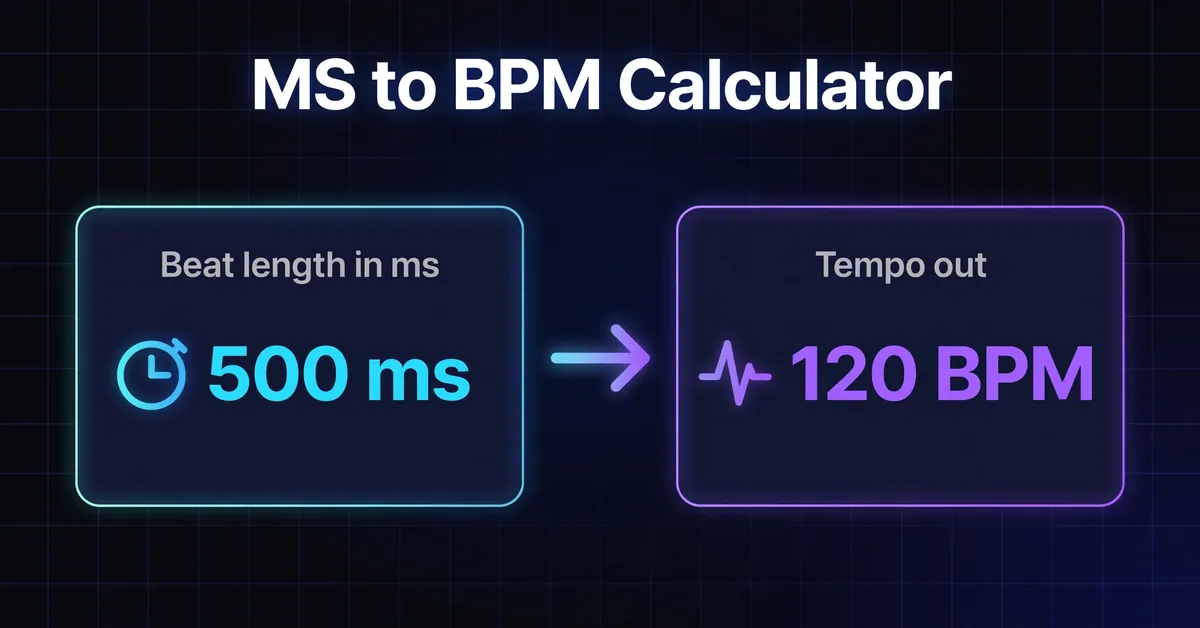
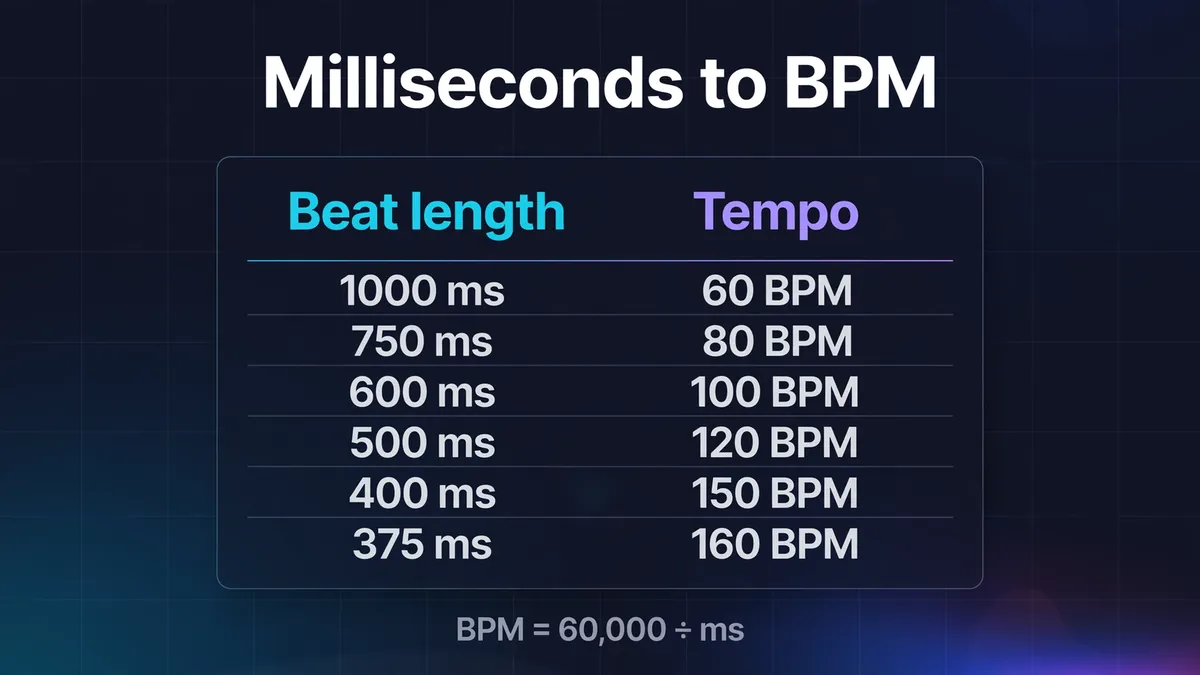
To convert milliseconds to BPM, divide 60,000 by the duration of one quarter note. A 500 ms quarter note equals 120 BPM. Choose the interval's note value before converting. This MS to BPM calculator uses your selected note value to return quarter note BPM and the entered interval's frequency in hertz.
Formula for a quarter note interval: BPM = 60,000 ÷ milliseconds
Enter milliseconds and choose the rhythmic identity. For decimal precision, read the formula result: it rounds to two decimal places, while the large BPM display rounds to a whole number.
These examples assume BPM counts quarter notes.
| Quarter note interval | Calculation | Tempo |
|---|---|---|
| 400 ms | 60,000 ÷ 400 | 150 BPM |
| 500 ms | 60,000 ÷ 500 | 120 BPM |
| 750 ms | 60,000 ÷ 750 | 80 BPM |
| 1,000 ms | 60,000 ÷ 1,000 | 60 BPM |
These examples are exact. Sengpiel Audio's conversion reference documents the inverse relationship between tempo and beat length. Convert seconds first; 0.5 seconds is 500 ms. Entering 0.5 as milliseconds implies 120,000 quarter note BPM.
Which Note Value Does Your Interval Represent?
Choose quarter, eighth, sixteenth or dotted eighth to tell the calculator what your interval means. The tool does not identify that note value automatically. A delay setting, LFO period or tap interval gives a duration; you supply its musical role before the calculator can express it as quarter note BPM.
Use a multiplier of 1 for a quarter note, 0.5 for an eighth, 0.25 for a sixteenth or 0.75 for a dotted eighth. A dot adds half the original note's duration, as explained in Open Music Theory's rhythmic values lesson.
The table treats the same 375 ms interval four ways. BPM counts quarter notes. If that 375 ms is a dotted quarter in 6/8, it is 160 dotted quarters per minute, or 240 quarter note BPM in the BPM to MS calculator.
| 375 ms represents | Quarter note duration | Tempo |
|---|---|---|
| Quarter note | 375 ms | 160 BPM |
| Dotted eighth | 500 ms | 120 BPM |
| Eighth note | 750 ms | 80 BPM |
| Sixteenth note | 1,500 ms | 40 BPM |
These tempos are exact. The interval repeats at about 2.67 Hz in every row.
Suppose a guitarist recalls using a 450 ms dotted eighth delay. Select dotted eighth: 60,000 × 0.75 ÷ 450 = 100 BPM. Selecting quarter instead gives about 133.33 BPM. Only the first matches that recalled setting. Use the delay calculator to compare other repeat patterns.
How Do You Find BPM From Loop or Sample Length?
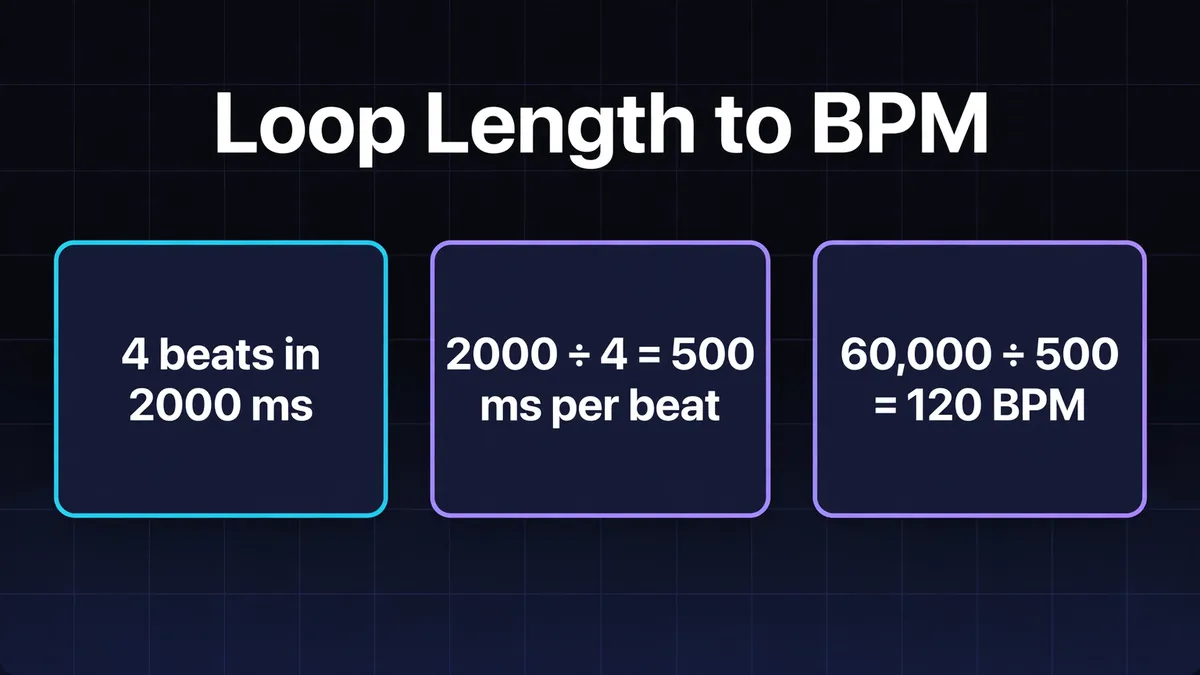
Divide the complete loop length by the number of quarter note beats it spans, then enter that interval and choose quarter note. Measure from the loop's start to its end boundary, including the final beat interval. Duration alone cannot establish tempo unless you also know how much musical time it contains.
Once more, the answers are quarter note BPM.
| Loop length | Complete bars in 4/4 | Quarter note beats | Milliseconds per quarter | BPM |
|---|---|---|---|---|
| 2,000 ms | 1 | 4 | 500 ms | 120 |
| 4,000 ms | 2 | 8 | 500 ms | 120 |
| 8,000 ms | 4 | 16 | 500 ms | 120 |
All three loops have the same tempo because their beat counts grow with their durations. Eight quarter notes in 2,000 ms instead give 240 BPM; eight eighth notes equal four quarter notes and give 120 BPM.
A producer finds an unlabeled two bar loop lasting 3,840 ms. Listening confirms 4/4, containing eight quarter notes. Divide 3,840 by 8 to get 480 ms, then select quarter note: 60,000 ÷ 480 = 125 BPM. Alternatively, enter eight beats and 3.84 seconds in the BPM calculator.
How Do You Measure a Loop Without Losing a Beat?
Measure between matching musical positions, such as the start of one bar and the start of the next. Include the space after the last beat, but exclude silence outside the intended loop. Counting waveform peaks can mislead you because extra hits and missing hits do not change the bar's length.
At 120 quarter note BPM, four evenly spaced attacks occur at 0, 500, 1,000 and 1,500 ms. The next bar begins at 2,000 ms. Measuring only from the first attack to the fourth covers three gaps. Calling that a four beat loop produces an incorrect 160 BPM result.
If you can identify nine consecutive quarter note attacks spanning 4,000 ms, there are eight intervals between them. Divide 4,000 by 8, not 9. For tapping by ear rather than measuring audio, use tap tempo.
Check whether your DAW has stretched the clip. In Ableton Live, switching Warp off plays a sample at its original tempo, independently of the Set tempo, according to the Live manual.
An editor showing sample frames requires one extra conversion:
Milliseconds = sample frames × 1,000 ÷ sample rate
Audacity defines sample rate as samples per second. At 48,000 samples per second, a selection of 96,000 sample frames lasts 2,000 ms. If it spans four quarter notes, that gives 120 BPM. Use the session's actual rate; BPM to samples handles the forward conversion once you know the tempo.
How Do You Convert Intervals in 6/8?
Count the interval in quarter note units before using this calculator for 6/8. A complete 6/8 bar contains six eighth notes, equivalent to three quarter notes. Its two dotted quarter pulses each span one and a half quarter notes, so a dotted quarter tempo mark needs conversion to this tool's quarter note basis.
Open Music Theory's compound meter lesson explains the grouping into dotted quarter beats. A 2,000 ms bar in 6/8 therefore gives 60,000 × 3 ÷ 2,000 = 90 quarter note BPM. Each dotted quarter lasts 1,000 ms, giving 60 dotted quarter pulses per minute.
The selector has no dotted quarter option. Divide that 1,000 ms pulse by 1.5 to obtain its quarter note interval, about 666.67 ms, before entering it as a quarter note. Keep the unrounded value if available. See time signatures and BPM for more on beat units.
How Are Milliseconds, BPM and Hertz Related?
Hertz measures repetitions per second, while BPM measures beats per minute. The calculator's frequency output describes the interval you entered, regardless of the selected note value. It equals the quarter note beat frequency only when your entered duration represents a quarter note. An LFO period must cover one complete modulation cycle.
A 375 ms dotted eighth corresponds to 120 quarter note BPM. Its interval repeats at about 2.67 Hz, while the quarter note beat repeats at 2 Hz. To convert a known tempo into a beat frequency, use BPM to Hz.
For compound meter, keep the pulse label attached: dotted quarter equals 60 means one dotted quarter pulse per second, while the equivalent quarter note rate is 90 BPM.
Why Does the Result Look Wrong?
Check units, note value and measurement boundaries before changing the calculated tempo. A result near half or twice your expected BPM often means you counted a different rhythmic level. Small differences can come from rounded milliseconds; a changing performance may need several measurements rather than a single BPM assigned to its entire duration.
Rounded input: At 128 quarter note BPM, the interval is exactly 468.75 ms. Rounding it to 469 ms and converting back gives about 127.93 BPM. That difference comes from discarding 0.25 ms. Keep unrounded values until the final step, including when checking a conversion in reverse.
Unequal intervals: Two quarter note gaps of 480 and 520 ms span 1,000 ms together, an average of 500 ms per quarter and 120 BPM. Their separate readings are 125 and about 115.38 BPM. Averaging those BPM readings gives about 120.19, so calculate from total time divided by interval count instead.
Unknown beat count: Listen before assigning a loop length. The BPM finder can provide an audio analysis estimate when you lack a reliable count. A single drum hit's decay or a reverb tail does not establish the song's tempo.
Invalid duration: Zero has no finite reciprocal, and a negative interval is not elapsed time. Use a positive measured duration. Extremely short positive intervals can yield mathematically valid tempos that are not useful musical readings.