
What BPM Is Drum and Bass?
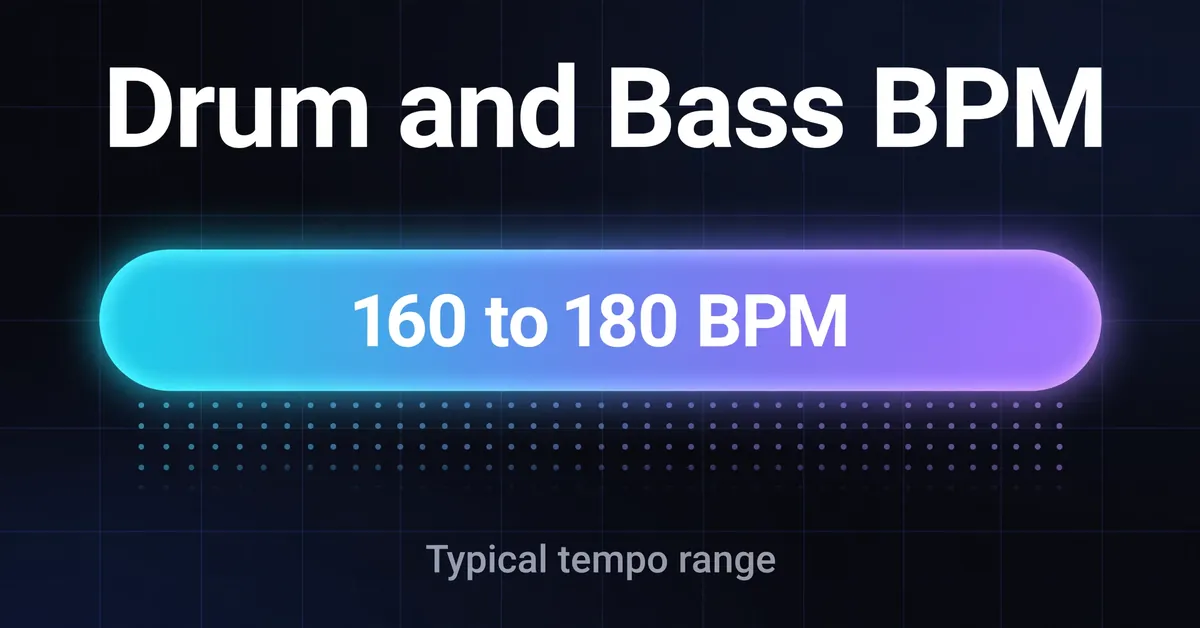
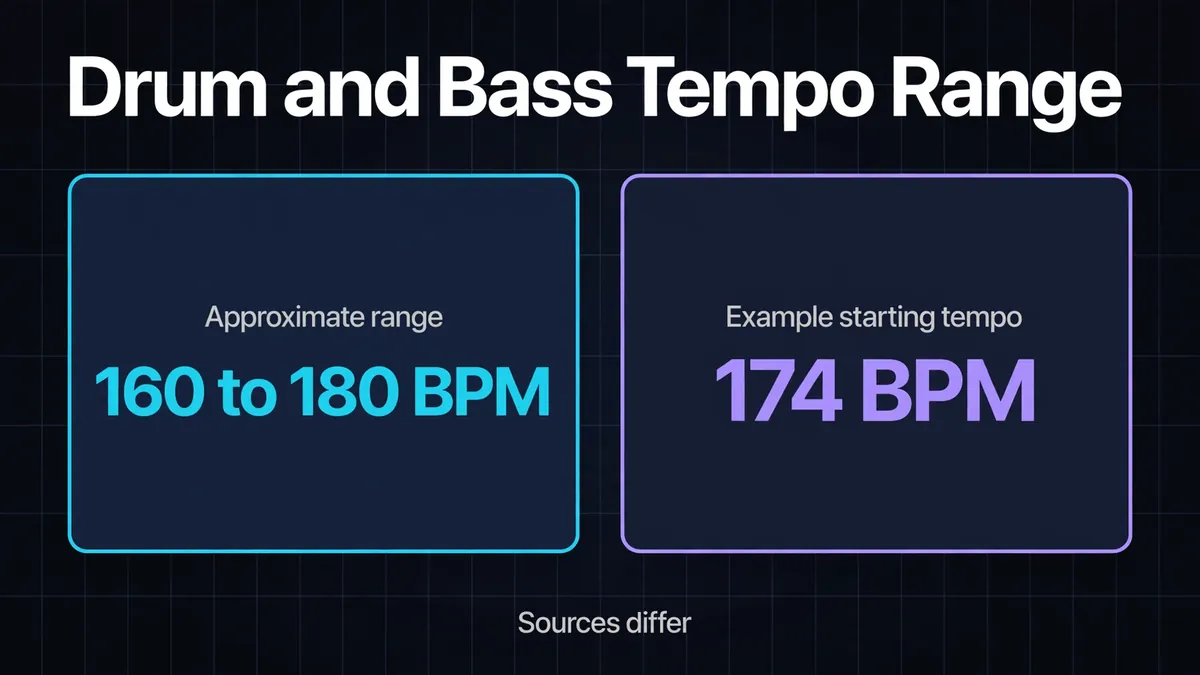
Drum and bass BPM sits in an approximate 160 to 180 BPM reference range on this page, with 170 to 176 as a modern core reference band. Try 174 BPM for the two step groove below. A halftime arrangement at that grid tempo can suggest an 87 BPM pulse without slowing the audio.
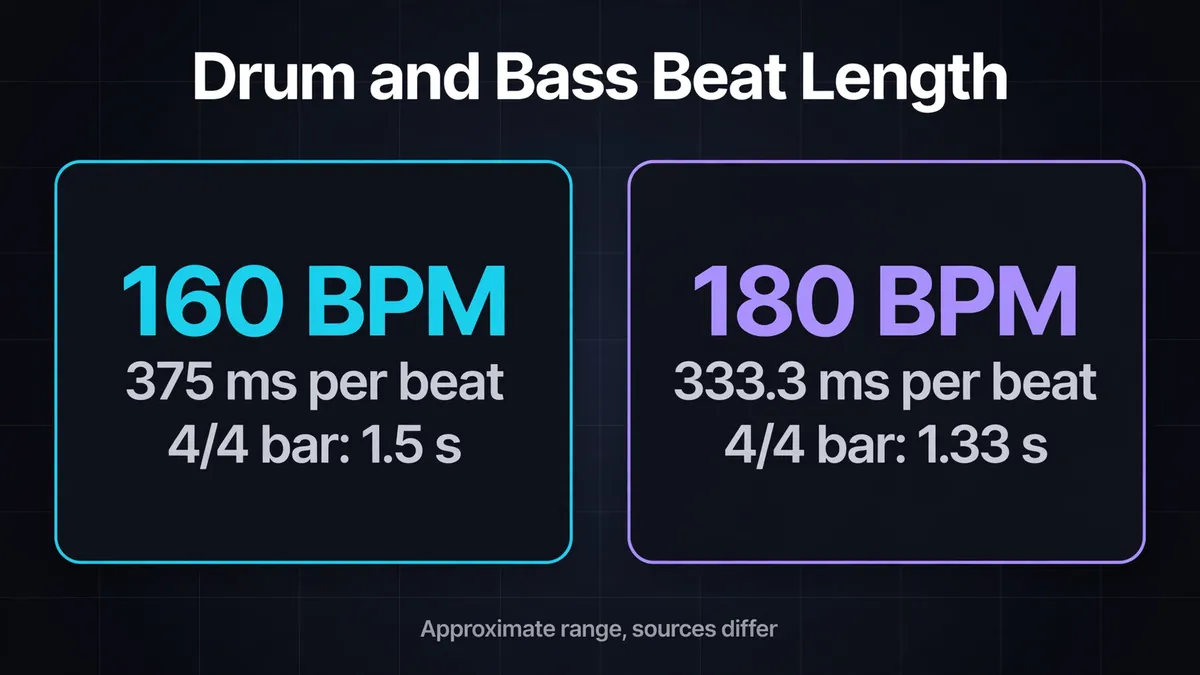
Inside that band, one quarter note lasts between 375 ms at 160 BPM and 333.33 ms at 180 BPM. The gap looks small on paper, yet it changes how much room a bass note has before the next kick. At 174 BPM the quarter note is 344.83 ms, which is where most of the examples on this page live.
What BPM Do Drum and Bass Subgenres Use?
Drum and bass subgenres share most of the same tempo space. This page uses 160 to 168 BPM for jungle, 170 to 174 for liquid, 172 to 176 for neurofunk and modern dancefloor examples, and 174 to 178 for jump up. Treat these as starting bands, then identify a style by its breaks, bass and arrangement.
| Subgenre | Approximate BPM reference | How to use the example |
|---|---|---|
| Jungle | 160 to 168 | Try chopped and resequenced breaks |
| Liquid DnB | 170 to 174 | Explore chords and vocals over a rolling groove |
| Modern dancefloor DnB | 172 to 176 | Example starting tempo 174 |
| Neurofunk | 172 to 176 | Compare the two step pattern with the variation below |
| Jump up | 174 to 178 | Test a more syncopated bass phrase |
| Halftime DnB | 170 to 176, felt at 85 to 88 | Keep the grid speed and change the snare pattern |
The felt values in the halftime row come from simple halving: 170 ÷ 2 = 85 and 176 ÷ 2 = 88.
Why Start a Drum and Bass Beat at 174 BPM?
174 BPM gives you a concrete starting point for comparing two step and halftime patterns inside the modern core band. Program both at the same project tempo, then listen to how snare placement changes the perceived pace. Bass clarity depends on note length, arrangement and sound design; the tempo does not impose a fixed sub bass limit.
Scenario: a producer has a vocal sample at 172 BPM and a project at 174. The speed change is 174 ÷ 172 = 1.0116, a rise of about 1.16%. Small adjustments like that often pass unnoticed on drums but can be easier to hear on a sustained vocal, so listen to the stretched audio before committing.
How Does Drum and Bass Feel at 174 BPM?
The two step pattern at 174 BPM puts the kick on beat 1 and the and of 3, with snares on beats 2 and 4. That second kick, one eighth note before the second snare, creates the rolling push listeners associate with the genre. Learn it as a one bar exercise in 4/4, counted in sixteenths.
Each beat has four sixteenth note steps, counted 1 e and a. Beats 1, 2, 3 and 4 begin on steps 1, 5, 9 and 13.
| Voice | Steps | Placement |
|---|---|---|
| Kick | 1, 11 | Beat 1 and the and of 3 |
| Snare | 5, 13 | Beats 2 and 4 |
| Hi hat | 1, 3, 5, 7, 9, 11, 13, 15 | Eighths over the syncopated kick |
The second kick lands an eighth note before the second snare. At 174 BPM that gap is 172.41 ms. Keep that space audible when adding ghost notes or chopped breaks.
MusicRadar's jungle and drum and bass tutorial also shows a neurofunk variation with the second kick on step 8, the last sixteenth before beat 3. Its halftime example replaces the backbeat with a snare on beat 3. These are different rhythmic options at a shared grid tempo.
Moving that kick from step 11 to step 8 shifts it by three sixteenths, or 3 × 86.21 = 258.62 ms at 174 BPM. That single move changes the bar from a rolling push to a tighter, more clipped shape.
What Is Halftime Drum and Bass?
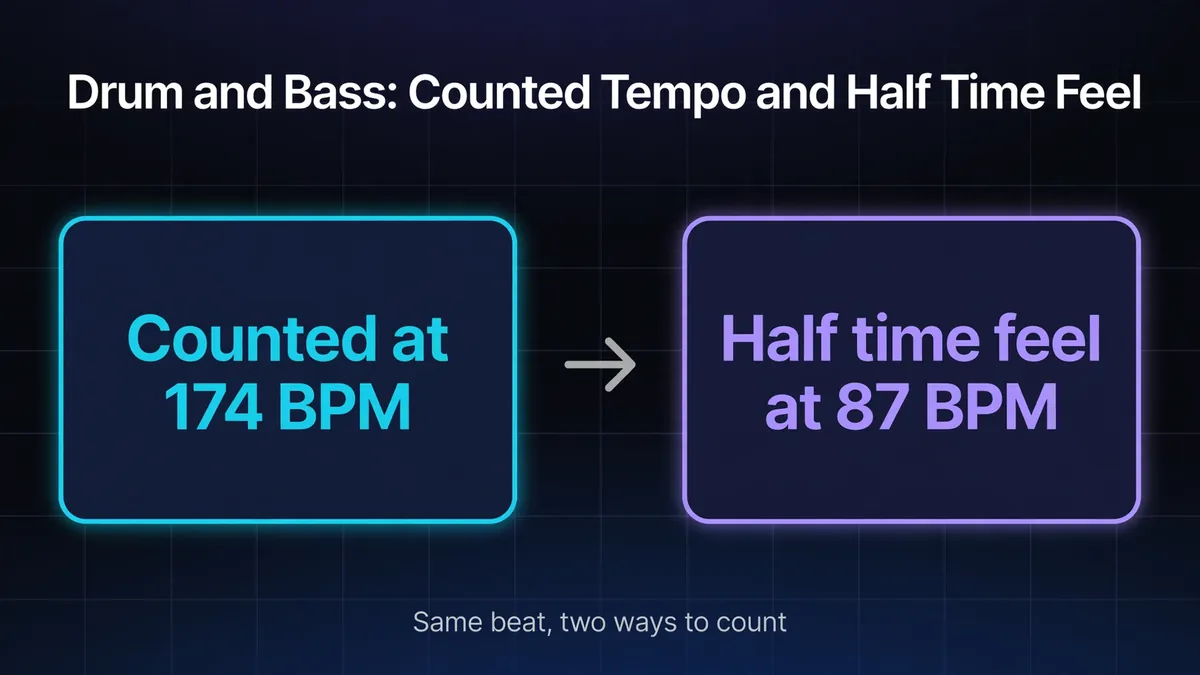
Halftime drum and bass keeps the project at a normal drum and bass tempo, such as 174 BPM, but moves the main snare to beat 3. With one backbeat per bar instead of two, listeners tend to feel a slower pulse around 87 BPM. The audio does not slow down; only the drum placement changes.
| Pattern at 174 BPM | Kick steps | Snare steps | Snares per bar | Pulse a listener may feel |
|---|---|---|---|---|
| Two step | 1, 11 | 5, 13 | 2 | 174 BPM |
| Halftime exercise | 1 | 9 | 1 | 87 BPM |
At 87 BPM a felt beat lasts 689.66 ms, exactly two quarter notes of the 174 BPM grid. Hats and percussion can still run at sixteenths (86.21 ms), which is why halftime sections often sound heavy and busy at once. For the general concept across genres, see half time vs double time and the half time BPM calculator.
Note Values at 174 BPM
Every value counts a quarter note at 174, the same grid your DAW shows for a drum and bass project.
| Note value | Length in ms |
|---|---|
| Quarter note | 344.83 |
| Eighth note | 172.41 |
| Sixteenth note | 86.21 |
| Dotted eighth note | 258.62 |
| Eighth note triplet | 114.94 |
Worked example: 60,000 ÷ 174 = 344.83 ms, and 344.83 × 0.75 = 258.62 ms.
Try a dotted eighth delay at 258.62 ms on a vocal shout. Listen to the repeats against the chopped break and reduce feedback where they mask ghost notes. Use BPM to MS to check other subdivisions, or the delay calculator for dotted and triplet times side by side.
How Long Are Bars and Phrases at 174 BPM?
A 4/4 bar at 174 BPM lasts 1,379.31 ms, about 1.38 seconds. Sixteen bars take about 22.07 seconds and thirty two bars about 44.14 seconds. Those figures help when you plan an intro length, cut a radio edit or estimate how long a DJ blend will run.
| Tempo | Quarter note, ms | One bar, ms | 16 bars, s | 32 bars, s |
|---|---|---|---|---|
| 160 BPM | 375.00 | 1,500.00 | 24.00 | 48.00 |
| 174 BPM | 344.83 | 1,379.31 | 22.07 | 44.14 |
| 180 BPM | 333.33 | 1,333.33 | 21.33 | 42.67 |
How Do You Check the Tempo of a Drum and Bass Track?
Tap along to the snare backbeat or the kick, not to every hat or break hit. If your taps land on beats 2 and 4 only, double the reading. Most drum and bass you check this way should settle somewhere in the 160 to 180 BPM range; a result near 87 usually means you are counting half as often.
Use the tap tempo tool with the spacebar or a letter or number key. It averages your last 8 gaps, sets outliers aside, and starts a fresh reading after a 2.5 second pause. For a file on your own computer, the BPM finder analyzes the audio locally and reports BPM only. If two tools disagree by a factor of two, read why BPM detectors disagree.
Practicing and Mixing at Drum and Bass Tempos
Players: Learn the kick and snare placements at a slower tempo before adding hats and ghost notes. Raise the speed only while the second kick stays on the and of 3. Record the pattern to check that a faster tempo has not moved that kick onto beat 3.
A drummer working up to 174 BPM might start the online metronome at 130 with sixteenth subdivisions, then use the speed trainer to climb in small steps. At 130 BPM a sixteenth lasts 115.38 ms; at 174 it shrinks to 86.21 ms, so hand speed rises by about a third over the same pattern.
DJs: 174 BPM and 140 BPM do not share a half or double tempo relationship. Halving them gives 87 and 70, which still differ. Plan a deliberate tempo change, a transition track or a different kind of handoff. A 174 BPM track and an 87 BPM track share a pulse ratio, but their phrasing still needs checking.
The arithmetic shows the size of the gap. Pulling a 174 BPM record down to 140 is a change of about 19.54%. Pushing a 140 BPM record up to 174 is about 24.29%. Both are far outside a small pitch nudge, so most DJs move between these genres with a cut, an echo out or a tool that bridges the tempos. The tempo calculator shows the percentage for any pair.
Which Mistakes Come Up Most at Drum and Bass Tempos?
The most frequent mistake is reading a halftime value as the real tempo, entering 87 instead of 174. Close behind are tapping every break hit, letting the second kick drift onto beat 3 at speed, and assuming one subgenre equals one fixed BPM. Each one is quick to catch once you know the numbers.
- Grid at 87 instead of 174: every delay time comes out twice as long. A dotted eighth reads 517.24 ms instead of 258.62 ms.
- Tapping the break: taps that follow ghost snares produce jumpy readings. Tap the main backbeat instead.
- Kick drift: at full speed the step 11 kick can creep toward step 9. Loop one bar and listen for the eighth note gap before the second snare.
- Subgenre by number: a 174 BPM track could be liquid, neurofunk or modern dancefloor in the table above. Listen to the bass and arrangement.
- Forcing a dubstep blend: matching 174 with 140 needs a planned transition rather than a halving trick.