
What BPM Is Pop Music?
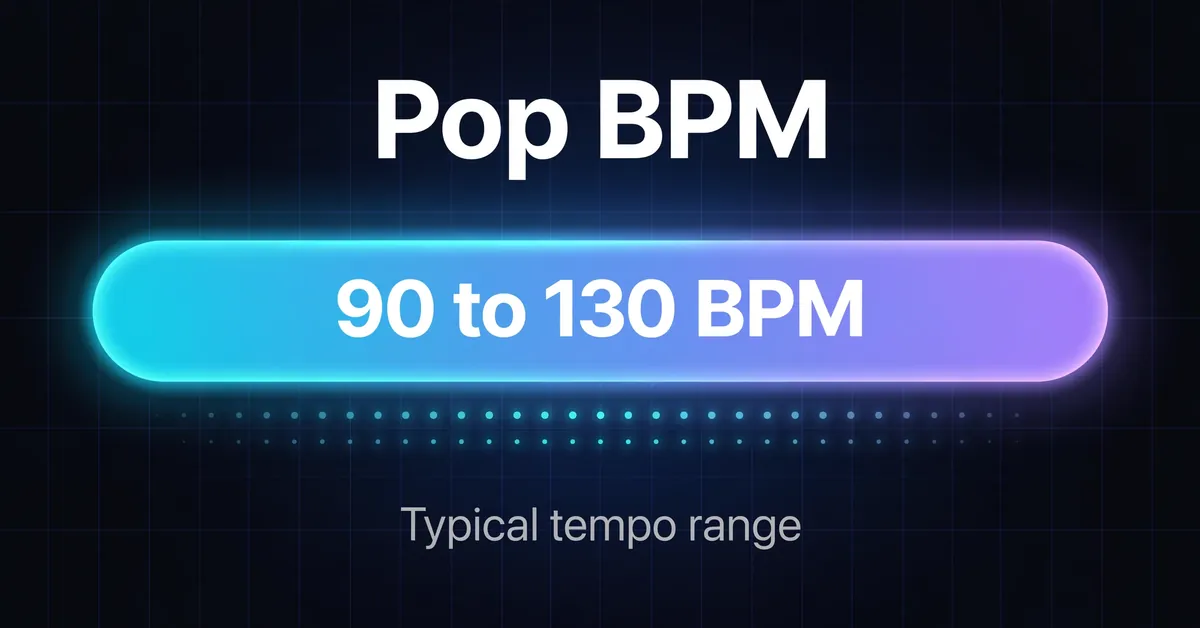
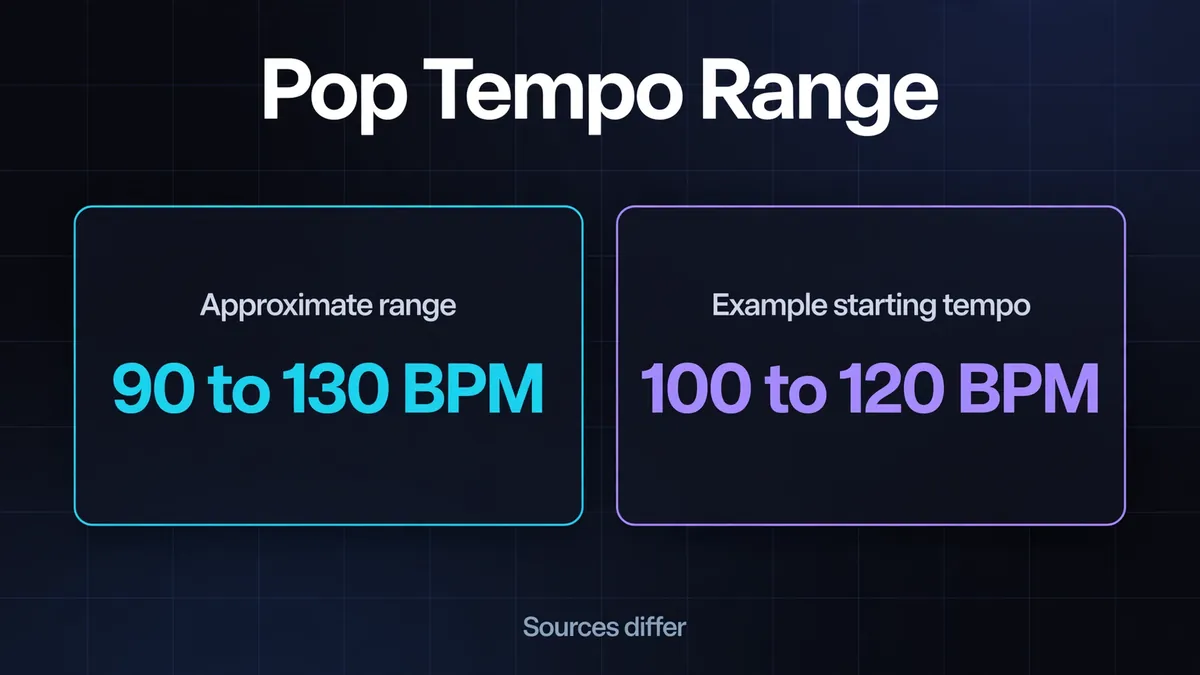
For pop music BPM, this site uses 90 to 130 BPM as an approximate reference band, not a measured chart average. Slower ballads and faster crossover songs fall outside it. Try 100 to 120 BPM as a starting band, with 120 BPM for the groove exercise below, then adjust the speed to the melody and lyrics.
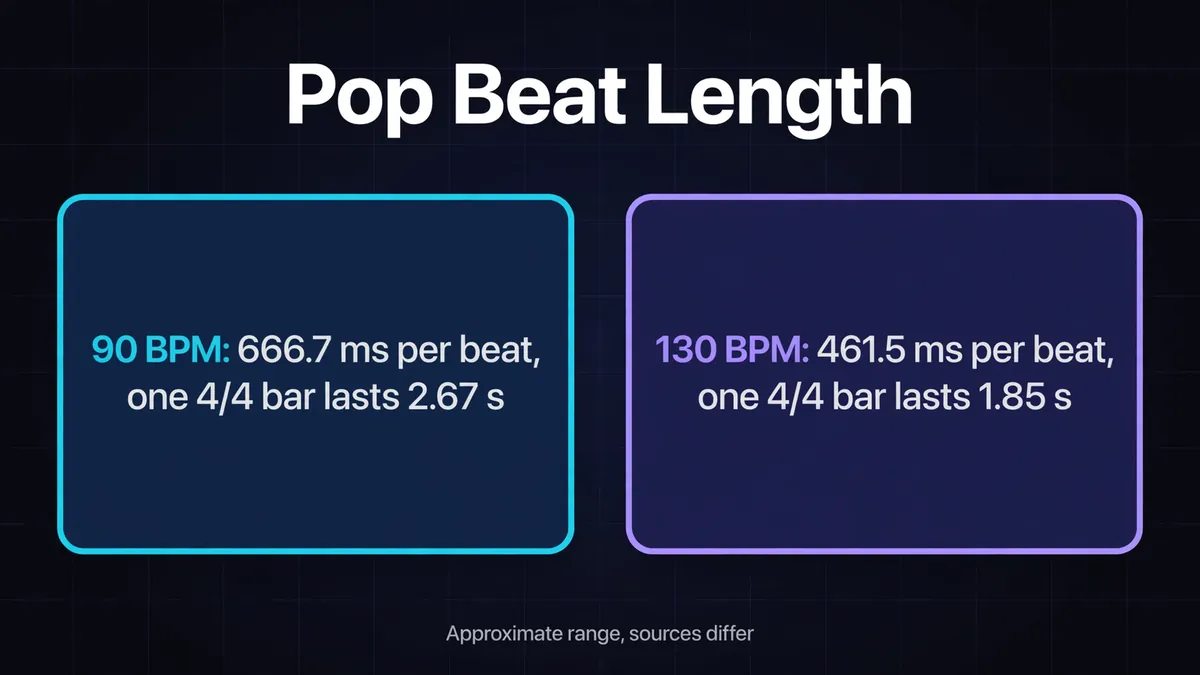
Pop is defined by songwriting and audience more than by a drum pattern, so its tempo spread is wide. A useful way to read the band: at 90 BPM each quarter note lasts 666.67 ms, and at 130 BPM it lasts 461.54 ms. The whole headline range sits between those two pulse lengths.
What BPM Does Each Pop Style Use?
Each pop style on this page has its own suggested band: ballads 60 to 80 BPM, mid tempo pop 90 to 110, upbeat pop and pop rock 110 to 125, dance pop and synth pop 118 to 128, and fast pop crossovers 130 to 150. The bands overlap on purpose, because arrangement often separates styles more than speed does.
| Style | Approximate BPM reference | How to use the example |
|---|---|---|
| Pop ballads | 60 to 80 | A slower exercise band below the headline range |
| Mid tempo pop | 90 to 110 | Test a backbeat with the vocal phrase |
| Upbeat pop and pop rock | 110 to 125 | Try guitar or synth accompaniment |
| Dance pop and synth pop | 118 to 128 | Compare the four on the floor example below |
| Fast pop and pop punk crossovers | 130 to 150 | A faster crossover exercise band |
Notice that dance pop at 120 BPM and pop rock at 120 BPM share a click. What changes is the kick: a four on the floor kick on every beat pushes the song toward the dance floor, while a kick on beats 1 and 3 with a snare backbeat points toward a band sound. If your song feels like the wrong style, change the drum pattern before you change the tempo.
Why Do Some Pop Hits Sit Outside 90 to 130 BPM?
Hits often sit outside the band because listings count different note levels and because songwriters pick speeds for the lyric, not for a chart. A fast song may be listed at its full tempo or at half of it. Both numbers describe the same recording, so check the counting level before comparing.
Tunebat lists Taylor Swift's "Shake It Off" from 1989 (Deluxe Edition) at 160 BPM, and Musicnotes' piano arrangement marks quarter note equals 160. Tapping every other beat gives 80 BPM without changing playback speed.
Worked example: 160 ÷ 2 = 80 BPM. At 160 BPM a quarter note lasts 375 ms; at 80 BPM it lasts 750 ms. Neither count is wrong, and neither makes 90 to 130 a boundary for pop. If you tap the song on our tap tempo tool and get 80, you are counting the half time pulse. The half time vs double time guide explains how to pick a level and keep it.
How Do You Choose a Pop Song Tempo?
Choose a pop tempo by singing the melody over a simple accompaniment and checking whether every word lands clearly. Held notes need space before the next phrase. Start near 100 to 120 BPM, record a verse and chorus, then move in steps of 2 to 4 BPM until the lyric sits comfortably without sounding rushed.
A practical sequence for a songwriter:
- Set the online metronome to 110 BPM and sing the chorus with just piano or guitar.
- Note the fastest syllable run. If it is a string of sixteenth notes, each syllable gets 136.36 ms at 110 BPM. Slow down if consonants smear together.
- Try 116 and 104 BPM. Record all three takes.
- Listen back the next day and pick the take where the hook sounds easiest to sing along to.
More layers, a busier hi hat or a different backbeat can raise the energy without any change in BPM. Before you speed a chorus up, try adding a clap or opening the hats. A tempo change across the whole song also changes every note value, so delays and synth arpeggios will need retiming.
How Does Pop Feel at 120 BPM?
At 120 BPM pop moves at two quarter notes per second, so each 4/4 bar lasts 2 seconds and an 8 bar verse lasts 16 seconds. That even grid makes it an easy test setting. The one bar dance pop exercise below uses a four on the floor kick, a backbeat and steady eighth note hats.
Each beat has four sixteenth note steps, counted 1 e and a. Beats 1, 2, 3 and 4 begin on steps 1, 5, 9 and 13.
| Voice | Steps | Placement |
|---|---|---|
| Kick | 1, 5, 9, 13 | Four on the floor in this dance pop exercise |
| Snare or clap | 5, 13 | Backbeat on beats 2 and 4 |
| Hi hat | 1, 3, 5, 7, 9, 11, 13, 15 | Even eighths under the vocal |
For a verse variation, remove the kicks on beats 2 and 4 while leaving the snare in place. Restore the full kick pattern in the chorus. Compare the two sections at the same BPM before deciding whether the song needs a tempo change.
A half time bridge can use a snare on beat 3 instead of beats 2 and 4. That changes the drum feel while the project grid remains at 120 BPM. Listeners often hear the bridge at 60 BPM, which gives the final chorus more lift when the backbeat returns.
What Are the Note Values at 120 BPM?
At 120 BPM a quarter note lasts 500 ms, an eighth note 250 ms, a sixteenth note 125 ms, a dotted eighth 375 ms and an eighth note triplet 166.67 ms. Each one assumes a quarter note beat, as in a standard 4/4 pop session.
| Note value | Length in ms |
|---|---|
| Quarter note | 500.00 |
| Eighth note | 250.00 |
| Sixteenth note | 125.00 |
| Dotted eighth note | 375.00 |
| Eighth note triplet | 166.67 |
Try 31.25 ms of vocal reverb pre delay, a sixty fourth note at 120 BPM (500 ÷ 16 = 31.25). It is a starting setting, not a rule for vocal clarity. Adjust it for the consonants, phrase and reverb sound with the reverb calculator.
How Do Producers, Singers and DJs Use Pop Tempos?
Producers lock the project tempo early, singers learn the melody slower and then match the recording, and DJs use the BPM as a first filter before checking phrase starts and vocals. In each case the number is a starting point. The final decision rests on how the vocal, drums and transitions sound together.
Producer: You get a topline demo recorded at 112 BPM in Logic Pro and want a dance pop version. Moving to 122 BPM shortens each quarter note from 535.71 ms to 491.80 ms, about 9 percent faster. Check that the singer can still deliver the verse, or plan to re record the vocal rather than time stretch it.
Singer or student: Learn the melody at a comfortable tempo, then move toward the recording. Practice verse and chorus entries against the same click before adding runs. If a phrase feels rushed, check the note placement as well as the tempo.
DJ: Use the dance pop reference rows to look for possible transitions into house, then measure the actual tracks. A ballad may suit a clear break or a shorter handoff. Check vocal overlap and phrase starts along with BPM and key.
What Mistakes Do People Make With Pop Tempo?
The most common mistakes are treating 120 BPM as a hit formula, mixing counting levels when comparing songs, and speeding up a whole track when the chorus only needed a busier arrangement. Each one is easy to avoid once you measure the pulse yourself and keep one counting level.
- Assuming one tempo predicts success. No source used on this page shows that a single BPM makes a hit, and this guide does not claim one.
- Comparing an 80 BPM listing with a 160 BPM listing as if they were different speeds. Divide or multiply by 2 first.
- Trusting a single detector reading. Library tools may pick a different pulse level, which the guide on why BPM detectors disagree covers in detail.
- Forgetting the beat unit in 6/8 or 12/8 ballads. Read the score marking before typing a number into a calculator; the time signatures guide shows the conversion.
- Retiming delays by ear after a tempo change. Recalculate from 60,000 ÷ BPM instead.