
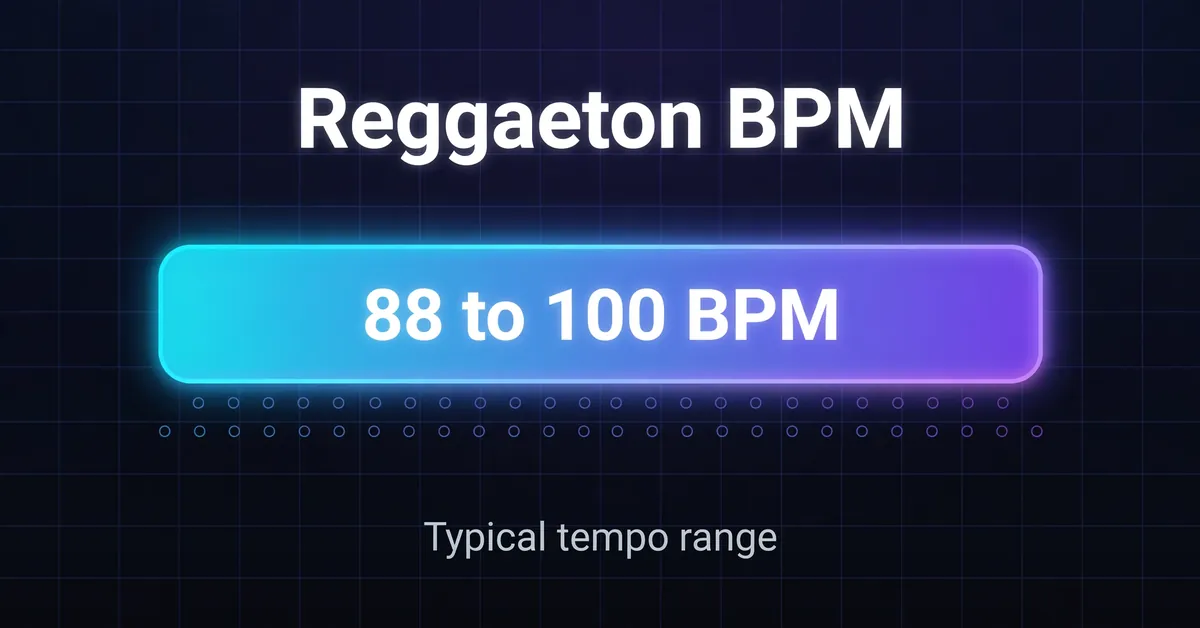
What BPM Is Reggaeton?
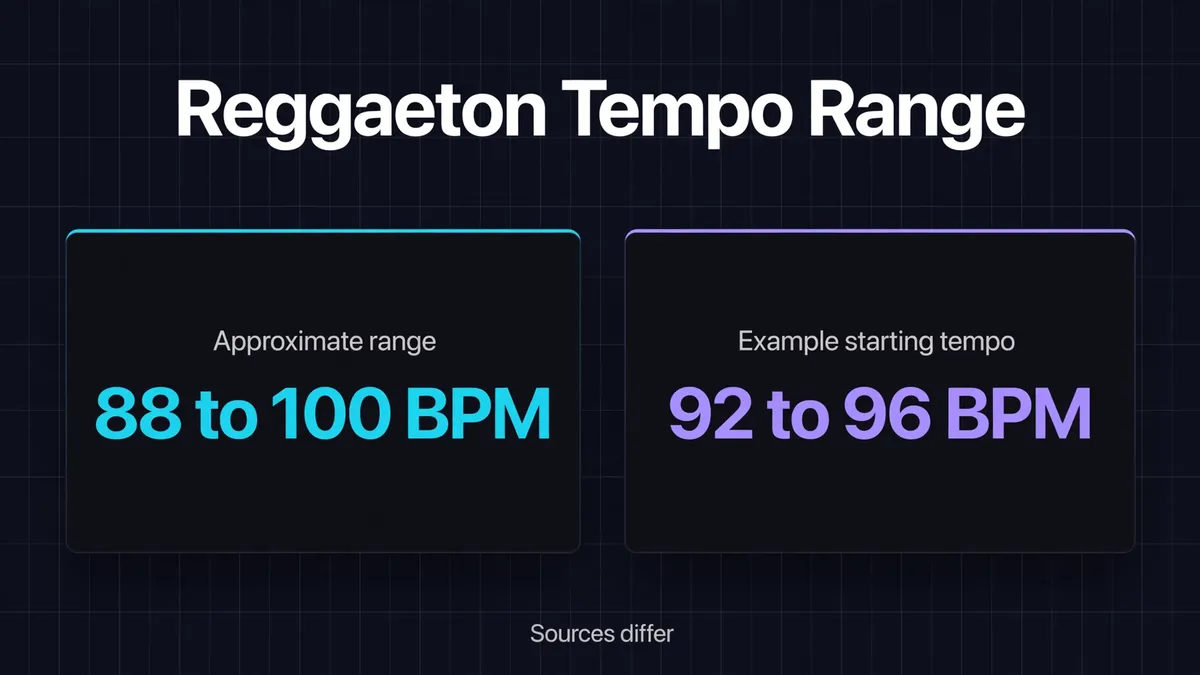
Reggaeton BPM on this page sits in an approximate reference range of 88 to 100 beats per minute. Start around 92 to 96 BPM, or try 94 BPM for the dembow exercise below. The kick and syncopated snare create the combined rhythm together; the snare row alone is not a repeating 3 plus 3 plus 2 pattern.
The bands on this page are this site's estimates, and other guides list reggaeton tempos a little differently. Substyle bands are suggested production examples, not measured catalog ranges, and the same 88 to 100 band appears on the homepage genre table. For a specific song, measure it with tap tempo or the BPM finder.
BPM by Style
| Style | Approximate BPM reference | How to use the example |
|---|---|---|
| Romantic reggaeton and slow perreo | 88 to 92 | A suggested slower exercise band |
| Classic dembow example | 92 to 96 | Example starting tempo 94 |
| Modern club reggaeton | 96 to 100 | Try a faster version of the same pattern |
| Reggaeton pop crossovers | 92 to 100 | Compare the vocal and arrangement at a shared tempo |
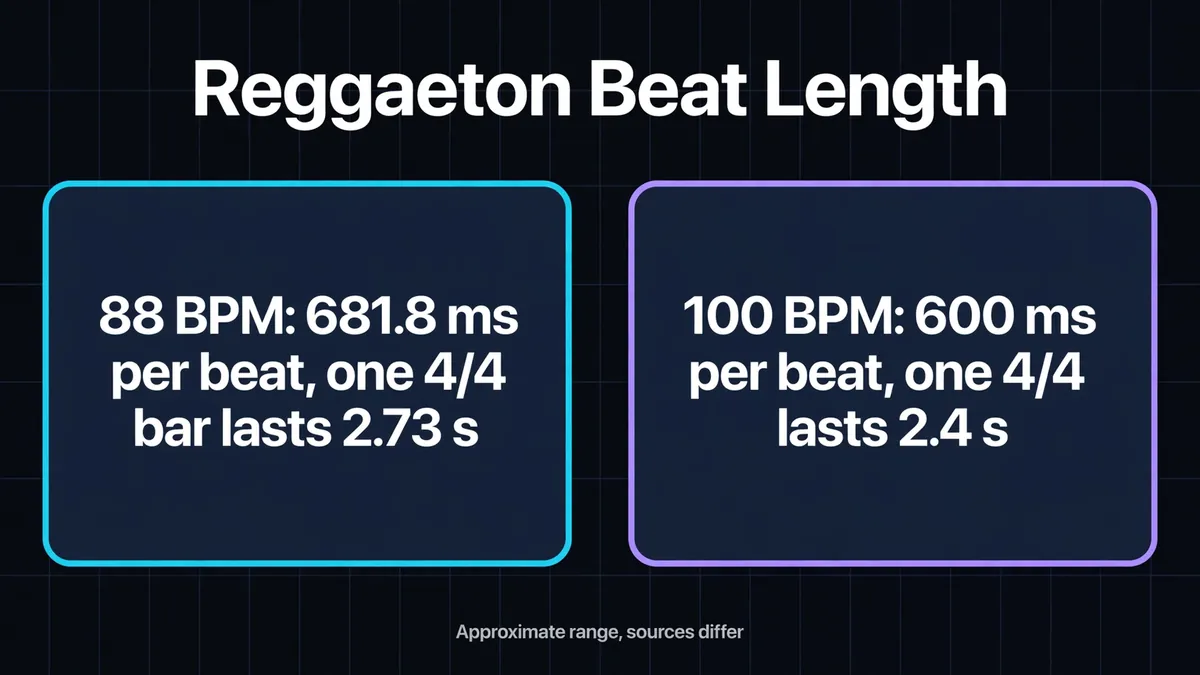
Every band stays inside 88 to 100 BPM. The difference between the slowest and fastest edge is 12 BPM, which changes a quarter note from 681.82 ms at 88 BPM to 600 ms at 100 BPM. For neighboring styles, compare the Afrobeats and hip hop pages or the full BPM chart.
How Do You Choose a Reggaeton Tempo?
Play the dembow pattern at 94 BPM, then test the vocal and bassline over it. Keep the drum placements fixed as you try slower and faster versions. Perreo and romantic reggaeton labels suggest an arrangement direction, but neither dancing nor the dembow pattern requires one exact tempo, so let the hook decide.
A quick test in Ableton Live, Logic Pro or FL Studio:
- Program the grid below at 94 BPM.
- Loop four bars and sing the chorus melody over it.
- Drop to 90 BPM if the lyric feels rushed; raise to 98 BPM if the energy sags.
- Keep whichever tempo lets the snare pickups land between syllables rather than on top of them.
Going from 94 to 90 BPM adds 28.37 ms to every beat (666.67 minus 638.30). Over an eight bar chorus that is about 0.91 seconds more space (21.33 minus 20.43 seconds).
How Does Reggaeton Feel at 94 BPM?
At 94 BPM, one bar of 4/4 lasts 2,553.19 ms and each sixteenth note step is 159.57 ms. In this exercise the kick plays every quarter note, the snare hits steps 4, 7, 12 and 15, and hi hats fill eighths. That kick sounds like four on the floor, while the snare supplies the syncopation.
Each beat has four sixteenth note steps, counted 1 e and a. Beats 1, 2, 3 and 4 begin on steps 1, 5, 9 and 13.
| Voice | Steps | Placement |
|---|---|---|
| Kick | 1, 5, 9, 13 | Every quarter note beat |
| Snare or rimshot | 4, 7, 12, 15 | The a of 1, the and of 2, the a of 3 and the and of 4 |
| Hi hat | 1, 3, 5, 7, 9, 11, 13, 15 | Eighths under the combined kick and snare rhythm |
These kick and snare placements follow Native Instruments' reggaeton tutorial. The snare steps have cyclic gaps of 3, 5, 3 and 5 sixteenths, including the gap back to the next bar. Across the combined parts, kick step 1 and snare steps 4 and 7 outline a 3 plus 3 plus 2 grouping over eight steps, repeated from step 9. Additional kicks sit inside that grouping.
In time: snare step 4 lands 3 × 159.57 = 478.72 ms after the downbeat, and step 7 lands 6 × 159.57 = 957.45 ms after it.
Where Does the Dembow Rhythm Come From?
The dembow rhythm comes from Jamaican dancehall. Berklee traces it to Steely and Clevie's riddim for "Poco Man Jam" in 1989, its release as "Fish Market" in 1990, and Shabba Ranks' "Dem Bow" the same year. Reggaeton then developed through Spanish reggae in Panama and exchange through Puerto Rico and New York.
That account comes from Berklee's dembow history, which also notes that dembow names a distinct Dominican genre. The dancehall lineage is more precise than calling the pattern a generic Latin backbeat, and it explains why reggaeton and dancehall sets blend so easily. Do not apply this page's 88 to 100 band automatically to every track labeled Dominican dembow.
Note Values at 94 BPM
Durations count quarter notes at 94, so each dembow bar of four beats lasts about 2.55 seconds.
| Note value | Length in ms |
|---|---|
| Quarter note | 638.30 |
| Eighth note | 319.15 |
| Sixteenth note | 159.57 |
| Dotted eighth note | 478.72 |
| Eighth note triplet | 212.77 |
A dotted eighth delay at 478.72 ms matches the three sixteenth gap from snare step 4 to step 7. It does not match the complete snare pattern, which also has five sixteenth gaps of 797.87 ms. Compare repeat lengths with the delay calculator or the BPM to ms converter.
How Long Are Bars and Sections at Reggaeton Tempos?
In 4/4, a bar lasts 240,000 ÷ BPM milliseconds. At 94 BPM that is 2.55 seconds per bar, 20.43 seconds per eight bars and 40.85 seconds per sixteen. Across the 88 to 100 BPM range, an eight bar section runs between 19.20 and 21.82 seconds.
| BPM | One bar | 8 bars | 16 bars |
|---|---|---|---|
| 88 | 2.73 s | 21.82 s | 43.64 s |
| 94 | 2.55 s | 20.43 s | 40.85 s |
| 100 | 2.40 s | 19.20 s | 38.40 s |
A dance teacher building an eight count routine to a 94 BPM track gets one eight count every 5.11 seconds (8 × 638.30 ms). Eight bars hold 32 counts, so one eight bar phrase equals four eight counts.
Why Do Reggaeton Songs Show Two Different BPMs?
Many reggaeton tracks appear at two tempos, one double the other, because sheet music and detectors may count different note values. "Despacito" is a clear case: one arrangement marks 89 BPM and a database lists 178 BPM. Since 89 × 2 = 178, both describe the same groove at different counting levels.
Musicnotes' Danny Rayel piano arrangement marks quarter note equals 89, while SongData's listing for Luis Fonsi and Daddy Yankee on VIDA reports 178 BPM. Check the recording and bar grouping before changing playback speed. The double time BPM and why BPM detectors disagree pages explain the pattern; for reggaeton, the half value inside 88 to 100 is usually the useful one for this page's grid.
Practicing and Mixing at Reggaeton Tempos
Players: Learn the snare row slowly, counting 1 e and a, 2 e and a, and continuing through the bar. Set the online metronome to 94 BPM with 4 subdivisions so each sixteenth clicks. Add the quarter note kicks without moving the snares, and listen to the combined accents rather than calling the snare row alone a tresillo.
Drummers: Once the grid is solid at 94, use the metronome's speed trainer to step from 88 to 100 BPM so the pattern holds across the whole band.
DJs: Check the drum pattern and phrase starts when blending reggaeton with Afrobeats or dancehall. Shared tempo does not guarantee that the percussion layers support each other. Moving from a 94 BPM reggaeton track to a 100 BPM one is a 6.4 percent change (6 ÷ 94), noticeable on vocals, so preview the overlap and shorten it if accents compete.
Common mistakes:
- Tapping the snare pickups instead of the kick gives an uneven reading. Tap the four kicks.
- Reading 178 for a track and building the grid at that speed doubles every part.
- Calling the snare row a tresillo; its gaps run 3, 5, 3 and 5.