
What Is 60 BPM?
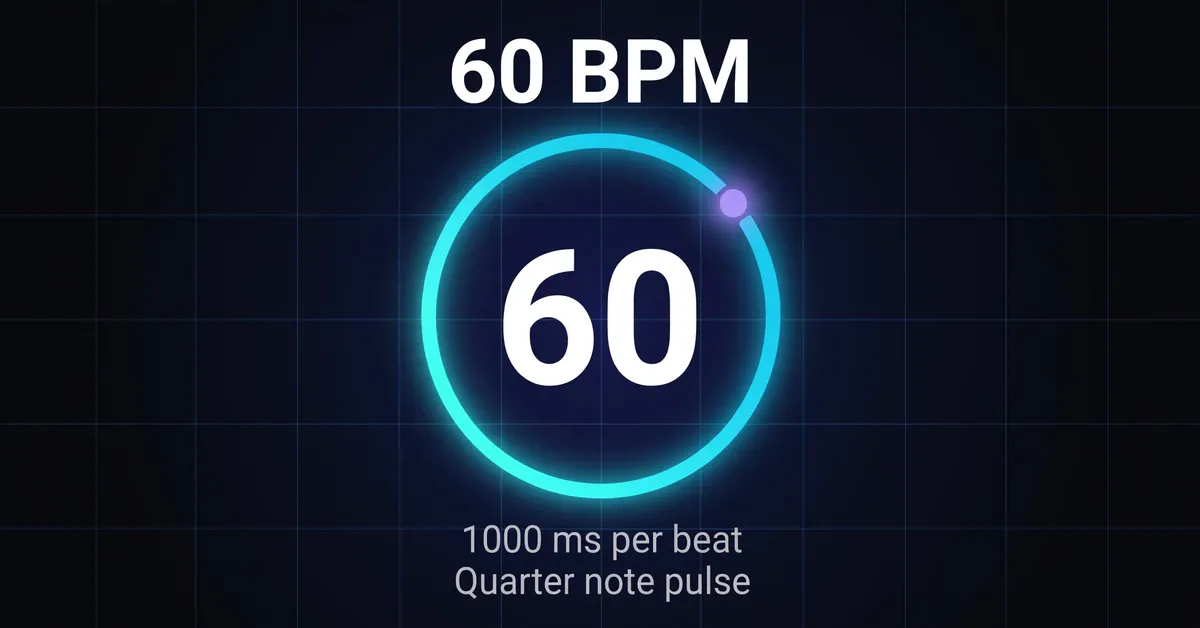
60 BPM means 60 beats per minute, which is exactly one beat every second, or 1000 milliseconds per quarter note. Start the 60 BPM metronome and the click lines up with the second hand of a clock. That slow, even pulse leaves room to hear whether the notes you place between clicks are evenly spaced.
Because 60 divides a minute so cleanly, almost every number on this page is a round figure. A sixteenth note is 250 ms, a bar of 4/4 is 4 seconds, and a minute holds 15 bars of 4/4. That makes 60 the easiest tempo for checking arithmetic by hand before you move to messier numbers such as 70 or 72.
On this site's tempo markings chart, 60 sits at the top of the Largo band (40 to 60) and the Lento band (45 to 60), and at the bottom of Larghetto (60 to 66). Other tempo charts draw the slow bands a little differently, so a printed metronome mark on a score always wins over the Italian word.
How Long Is Each Note Value at 60 BPM?
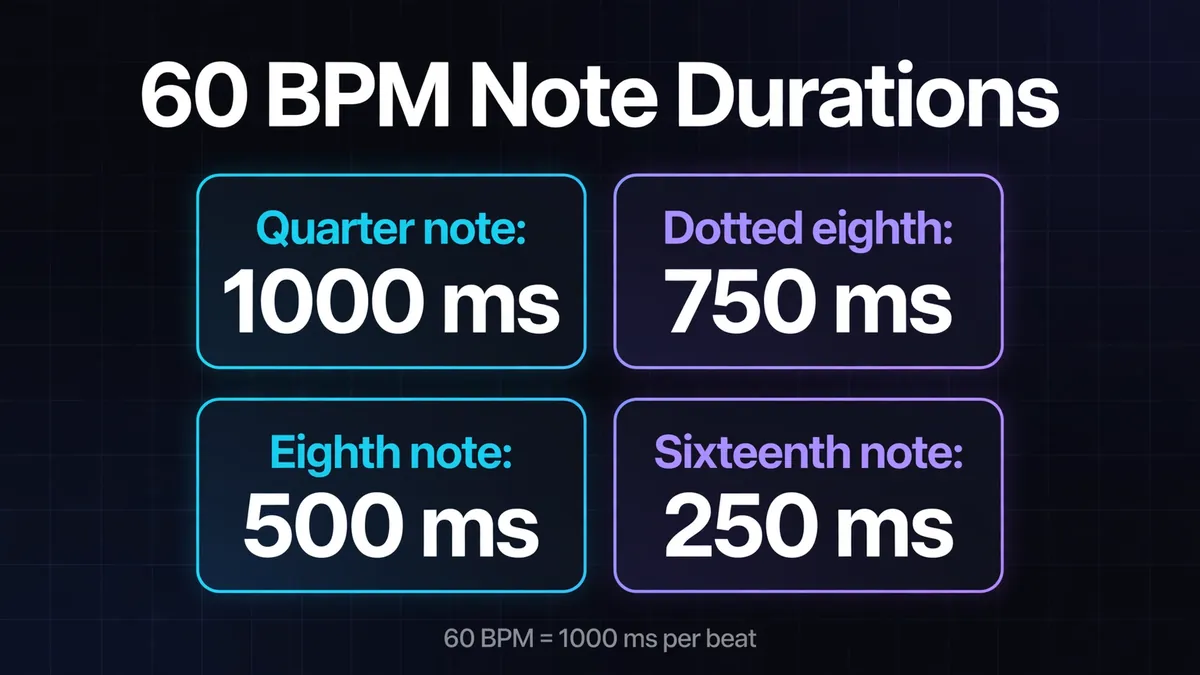
At 60 BPM a quarter note lasts 1000 ms, an eighth note 500 ms, a sixteenth note 250 ms and a thirty second note 125 ms. Every value comes from one formula: divide 60,000 by the BPM to get the quarter note, then multiply by the note's fraction of a beat.
Every value counts the quarter note as the beat. A slow 6/8 marked dotted quarter = 40 also lands here, since 40 × 1.5 = 60 on a quarter note metronome. Values round to two decimals.
| Note value | Fraction of a beat | Duration at 60 BPM (ms) |
|---|---|---|
| Whole note | 4 | 4000.00 |
| Dotted half note | 3 | 3000.00 |
| Half note | 2 | 2000.00 |
| Dotted quarter | 1.5 | 1500.00 |
| Quarter note | 1 | 1000.00 |
| Quarter note triplet | 2/3 | 666.67 |
| Dotted eighth | 0.75 | 750.00 |
| Eighth note | 0.5 | 500.00 |
| Dotted sixteenth | 0.375 | 375.00 |
| Eighth note triplet | 1/3 | 333.33 |
| Sixteenth note | 0.25 | 250.00 |
| Sixteenth note triplet | 1/6 | 166.67 |
| Thirty second note | 0.125 | 125.00 |
| Sixty fourth note | 0.0625 | 62.50 |
Worked example: a dotted eighth is three sixteenths. Three times 250 ms gives 750 ms, which matches 1000 × 0.75. Triplets are the only values here that do not land on whole milliseconds, because 1000 does not divide evenly by 3: an eighth note triplet is 1000 ÷ 3 = 333.33 ms, and three of them fill the beat exactly.
For other tempos, the note duration calculator and BPM to ms converter run the same formula.
How Long Is a Bar at 60 BPM?
A bar of 4/4 at 60 BPM lasts exactly 4 seconds, a bar of 3/4 lasts 3 seconds, and a bar of 6/8 also lasts 3 seconds when the BPM counts quarter notes. Eight bars of 4/4 take 32 seconds, and one minute holds 15 bars.
| Length | 4/4 | 3/4 | 6/8 (quarter note = 60) |
|---|---|---|---|
| 1 bar | 4 s | 3 s | 3 s |
| 4 bars | 16 s | 12 s | 12 s |
| 8 bars | 32 s | 24 s | 24 s |
| 16 bars | 64 s | 48 s | 48 s |
| 32 bars | 128 s | 96 s | 96 s |
On the site's online metronome, x/8 meters keep the BPM on the quarter note and click each eighth. So 6/8 at 60 BPM gives six clicks of 500 ms per bar. If you feel 6/8 in two dotted quarter beats and want each of those beats to last one second, set 90 instead, which gives eighths of 333.33 ms. The time signatures and BPM guide covers this in more depth.
What Does 60 BPM Feel Like?
60 BPM feels like a slow, deliberate walk or the tick of a wall clock. Each beat lasts a full second, so a long silence sits between clicks. That space is useful for hearing timing problems, but it also makes it easier to rush, because the next click seems a long way off.
Its frequency is 1.00 Hz: one cycle per second. Use the BPM to Hz converter to compare it with modulation rates. At this speed most players subdivide in their head without being told to, and that habit is what keeps them steady.
How Should You Practice at 60 BPM?
Practice at 60 BPM by counting the subdivision aloud before playing it, then playing it without speaking. Start with eighth notes ("1 and 2 and"), then sixteenths ("1 e and a"), then triplets ("1 trip let"). Moving between those grids on one click is the core slow practice drill.
- Guitarist or pianist: play a scale with one note per eighth note, so each note lasts 500 ms. When the gaps stay even for two octaves, switch to sixteenths at 250 ms each.
- Drummer: play single strokes on sixteenths, four per click. Then play accents on the first of every three sixteenths; the accent pattern drifts across the beat and returns to beat 1 every three beats.
- Student working toward a fast tempo: learn the passage at 60, then step up by 4 or 5 BPM once it is clean three times in a row. The speed trainer on the online metronome can raise the tempo for you.
- Singer: hold a note for four clicks. That is exactly 4 seconds, so you can check breath support without a stopwatch.
A useful self check is to turn on only beat 1 in your head and let the click sound on all four. If you can still land the "and" of 4 exactly 500 ms before the next downbeat, your internal pulse is solid. To measure how steady you are in the other direction, tap along on tap tempo for eight or more beats and see whether the reading stays close to 60.
Which Songs Are Reported at 60 BPM?
Tunebat reports "Take You Down" by Chris Brown at 60 BPM, and SongBPM lists Joep Beving's "Passage" at 60. "Once Upon a Dream" by Lana Del Rey is reported at 120 BPM and appears here only as a 60 BPM alternative count. These are database readings, not independent measurements.
Nearby matches and alternative counts are labeled separately. Use the named version where one is given; a counting option does not establish the recording's intended feel.
| Song | Artist | Recording version | Reported BPM | Counting option | Sources |
|---|---|---|---|---|---|
| Take You Down | Chris Brown | Exclusive (Expanded Edition) | 60 | 60 BPM count | Tunebat |
| Passage | Joep Beving | Version unspecified | 60 | 60 BPM count | SongBPM |
| Once Upon a Dream | Lana Del Rey | From Maleficent / Pop Version | 120 | 60 BPM alternative count | SongBPM |
If you hear a different number for a recording, the cause is usually a different pulse level rather than a broken tool. The why BPM detectors disagree guide explains how the same song gets read at 60 and 120. To check a track yourself, tap it on tap tempo or analyze a local file with the BPM finder.
How Do Producers Use 60 BPM?
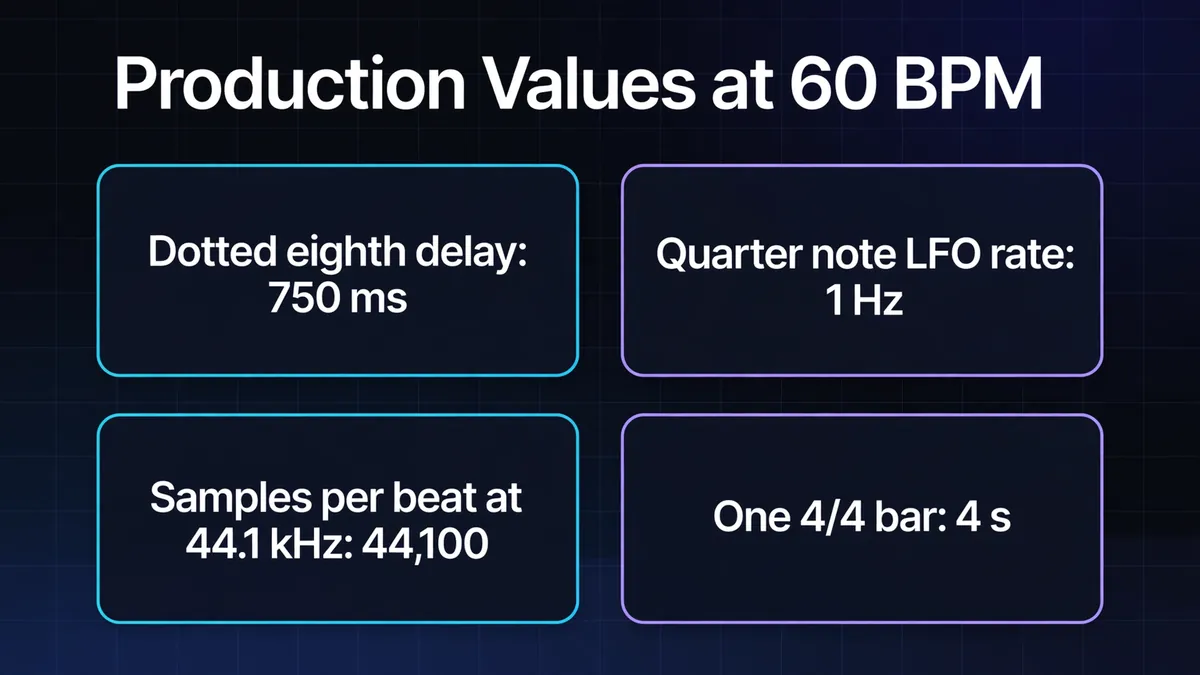
Producers use 60 BPM timings as starting points for tempo synced effects: a 500 ms eighth note delay, a 750 ms dotted eighth delay, or a 62.5 ms sixty fourth note reverb pre delay. In a DAW such as Ableton Live, Logic Pro, FL Studio or Pro Tools, these match the synced note settings at 60 BPM.
| Production setting | Note value | Value at 60 BPM |
|---|---|---|
| Slapback style delay | Sixteenth note | 250 ms |
| Straight delay | Eighth note | 500 ms |
| Dotted delay | Dotted eighth | 750 ms |
| Triplet delay | Eighth note triplet | 333.33 ms |
| Reverb pre delay experiment | Sixty fourth note | 62.5 ms |
| Reverb pre delay experiment | Thirty second note | 125 ms |
| LFO rate | Quarter note | 1.00 Hz |
| Sample length at 48 kHz | Quarter note | 48,000 samples |
Worked example: a dotted eighth delay at 750 ms is three quarters of a beat. On a phrase of straight eighth notes, the repeats land on the "e" and "a" sixteenths between the played notes, which fills the gaps and makes the line sound busier. Compare it with the 500 ms straight eighth on the same phrase before adding feedback. Pre delay values are experiments; adjust them by ear to fit the source. The delay calculator, reverb calculator and BPM to samples converter list the full sets.
What Are Half Time and Double Time at 60 BPM?
Half time of 60 BPM is 30 BPM, with 2000 ms per beat, and double time is 120 BPM, with 500 ms per beat. You can count the same recording at either level without changing playback speed. Changing the drum pattern creates a different musical feel.
| Pulse level | BPM | ms per beat | 4/4 bar |
|---|---|---|---|
| Half time count | 30 | 2000 | 8 s |
| As written | 60 | 1000 | 4 s |
| Double time count | 120 | 500 | 2 s |
Notice that the 120 BPM quarter note equals the 60 BPM eighth note: 500 ms either way. That is why a slow ballad at 60 and a pop track at 120 can share the same delay setting. Compare the numbers with the half time calculator and double time calculator, or read the half time vs double time guide for the musical distinction. The neighboring number page is 70 BPM, and the BPM chart places 60 among every tempo the site covers.
Which Mistakes Happen at 60 BPM?
The most common mistake at 60 BPM is rushing into the next click, because a one second gap feels longer than it is. Other frequent errors are entering 60 when a compound meter score means dotted quarter equals 60, and treating a database's 60 or 120 reading as the recording's intended feel.
- Rushing the "and": players often land the offbeat early. Counting aloud fixes most of it.
- Wrong beat unit: in 6/8 marked dotted quarter = 60, set 90 so the eighths come out at 333.33 ms.
- Rounding triplets: entering 333 ms instead of 333.33 ms is close, but three of them add to 999 ms, so the repeats creep ahead of the grid over a long phrase. Using the DAW's synced triplet setting avoids this.
- Thinking slow means easy: long gaps expose uneven note lengths that a fast tempo hides.