
What Is 110 BPM?
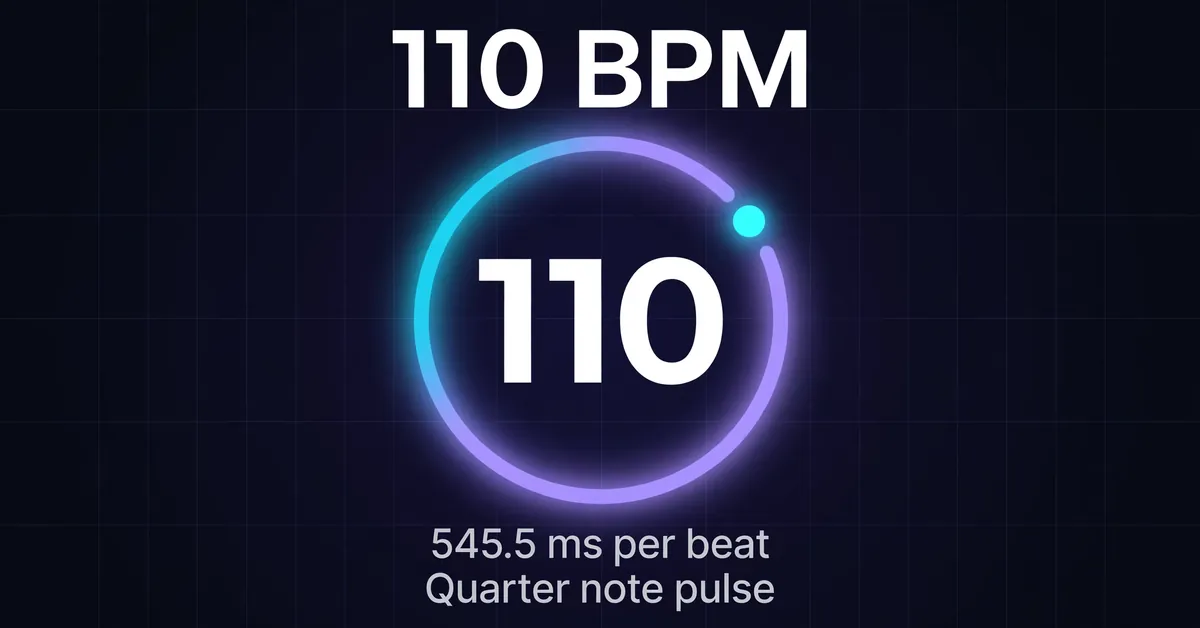
A 110 BPM metronome clicks 110 beats per minute, so each beat lasts about 545.45 milliseconds and you hear 1.83 clicks per second. That places it inside this site's approximate Moderato range. It suits pop and disco rhythm exercises, with enough drive to feel like dancing and enough room to place sixteenth notes cleanly.
How Long Is Each Note Value at 110 BPM?
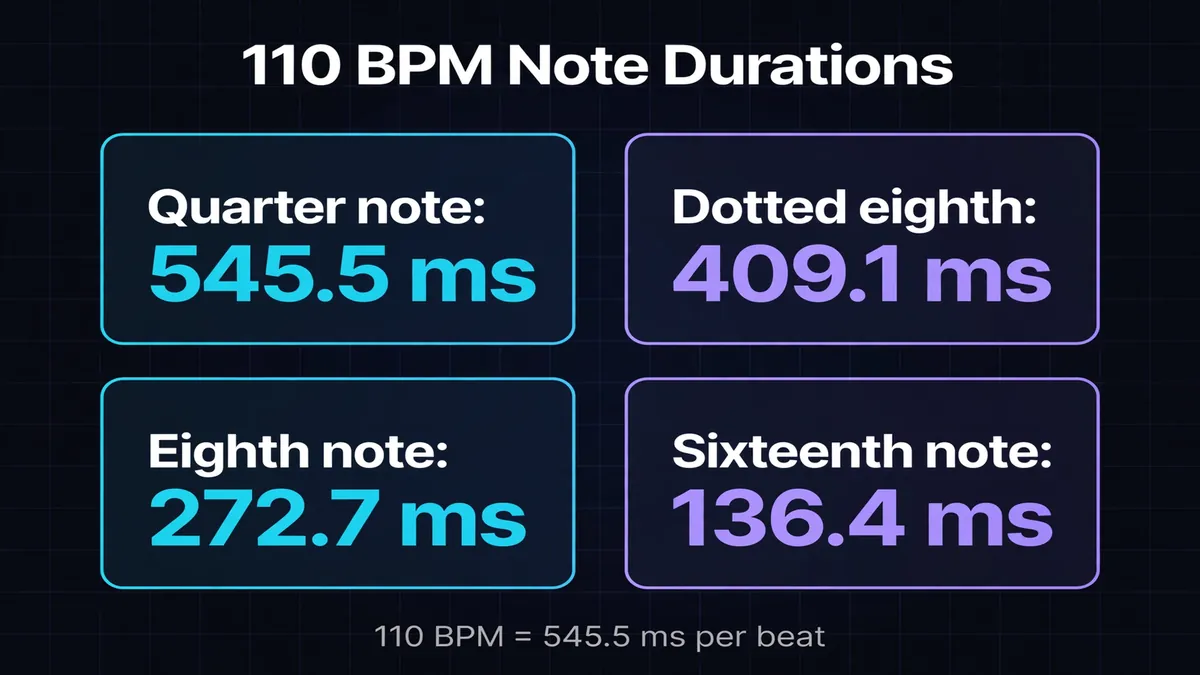
At 110 BPM a quarter note lasts 545.45 ms, an eighth note 272.73 ms, a sixteenth 136.36 ms and an eighth note triplet 181.82 ms. A dotted eighth is 409.09 ms and a dotted quarter is 818.18 ms. Values are rounded to two decimals from the unrounded result of 60,000 ÷ 110.
The table reads 110 as quarter notes per minute. Working from a 6/8 part instead? Multiply its dotted quarter mark by 1.5, so dotted quarter = 70 becomes 105 and dotted quarter = 74 becomes 111.
| Note value | Multiplier of the beat | Duration (ms) | Hz (repeats per second) |
|---|---|---|---|
| Whole note | 4 | 2181.82 | 0.46 |
| Dotted half | 3 | 1636.36 | 0.61 |
| Half note | 2 | 1090.91 | 0.92 |
| Dotted quarter | 1.5 | 818.18 | 1.22 |
| Quarter note | 1 | 545.45 | 1.83 |
| Quarter note triplet | 2/3 | 363.64 | 2.75 |
| Dotted eighth | 0.75 | 409.09 | 2.44 |
| Eighth note | 0.5 | 272.73 | 3.67 |
| Dotted sixteenth | 0.375 | 204.55 | 4.89 |
| Eighth note triplet | 1/3 | 181.82 | 5.50 |
| Sixteenth note | 0.25 | 136.36 | 7.33 |
| Sixteenth note triplet | 1/6 | 90.91 | 11.00 |
| Thirty second note | 0.125 | 68.18 | 14.67 |
| Sixty fourth note | 0.0625 | 34.09 | 29.33 |
Worked example: an eighth note triplet is one third of a beat, so 545.45 ÷ 3 = 181.82 ms. Multiply from the unrounded beat, not from a rounded value, or small errors stack up across a bar. The note duration calculator and BPM to ms converter handle other values.
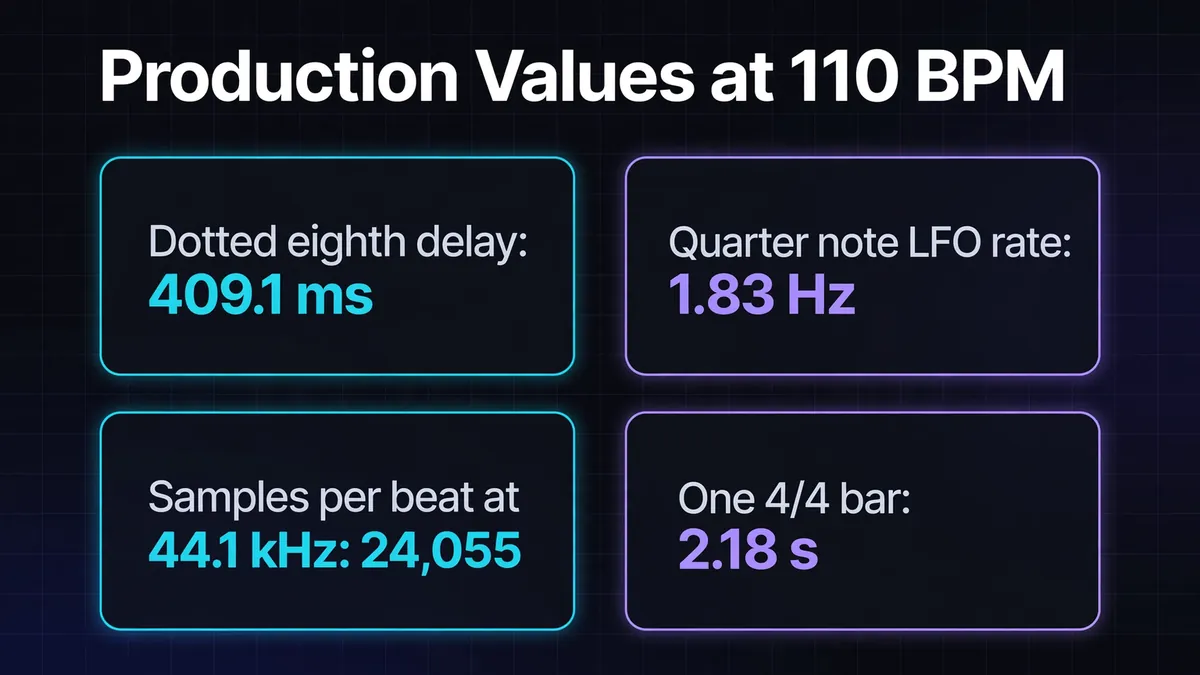
In samples, one beat is about 24,054.55 samples at 44.1 kHz and about 26,181.82 at 48 kHz. Neither is a whole number, which is normal at this tempo; see BPM to samples for other rates.
How Long Are Bars and Phrases at 110 BPM?
One bar of 4/4 at 110 BPM lasts about 2.18 seconds, a bar of 3/4 about 1.64 seconds, and an 8 bar phrase in 4/4 about 17.45 seconds. Multiply beats by 60 and divide by 110. Round only at the end so that long phrases stay accurate.
| Length (4/4 unless noted) | Beats | Duration |
|---|---|---|
| 1 bar of 3/4 | 3 | 1.636 s |
| 1 bar | 4 | 2.182 s |
| 4 bars | 16 | 8.727 s |
| 8 bars | 32 | 17.455 s |
| 16 bars | 64 | 34.909 s |
| 32 bars | 128 | 69.818 s |
A three minute song at 110 BPM holds 330 beats, which is 82.5 bars of 4/4. A dancer counting in eights covers one eight count about every 4.36 seconds (8 × 545.45 ms). For other meters, see time signatures and BPM.
What Tempo Marking Is 110 BPM?
110 BPM is labeled Moderato on this site's tempo chart, which uses an approximate Moderato band of 108 to 120 BPM. When a score prints a metronome mark with a note symbol, follow that instead of the word.
On the same chart, the Andante band runs 76 to 108 BPM, so 110 sits just above that boundary. The tempo markings BPM chart shows all bands, and what is tempo covers how Italian tempo markings describe character as well as speed.
What Does 110 BPM Feel Like?
110 BPM feels brisk and steady, a comfortable pace for a groove you can nod to without strain. The 272.73 ms eighth note gap is wide enough to hear offbeat hi hats as separate events, which makes this tempo useful for practicing disco and pop patterns.
For a disco exercise, play a kick on every beat in 4/4, the four on the floor pattern, and add a quiet hi hat between kicks. Keep the offbeat hits evenly placed as you change chords. Then remove the hats and maintain the same pulse. This practice pattern does not prescribe the arrangement of the songs below.
110 BPM also falls inside this site's approximate pop band of 90 to 130 BPM and its approximate Afrobeats band of 95 to 115 BPM. Genre comes from rhythm, sound and arrangement, not the number. For more, see the pop BPM guide.
How Should You Practice With a 110 BPM Metronome?
Count two bars aloud with the click on quarters, then play. When the passage is clean, switch the subdivision to eighths or sixteenths to catch drift. If 110 is out of reach, start at 100 BPM and step up by 5 BPM per clean pass.
A ladder for a pianist, guitarist or drummer:
- 100 BPM, click on quarters, four clean repetitions (600 ms per beat).
- 105 BPM, same passage (about 571.43 ms per beat).
- 110 BPM, click on eighths so every 272.73 ms gap is audible.
- 110 BPM, click on quarters while you count the subdivisions silently.
- 115 BPM as an overshoot, then return to 110.
The online metronome covers 20 to 360 BPM with 4 subdivisions, a speed trainer and an accent on beat 1 only. For a 6/8 piece marked dotted quarter equals 110, enter 165, because in x/8 meters the site's BPM counts quarter notes and each eighth clicks.
To check whether a recording is really at 110, tap along on the tap tempo page using the spacebar or a letter or number key. It averages the last 8 gaps, sets outliers aside, and starts over after a 2.5 second pause.
Which Songs Are Reported at 110 BPM?
Linked databases report Linkin Park's "Numb" and Maroon 5's "Payphone" at 110 BPM. Queen's "Another One Bites the Dust" shows 110 on SongBPM but 112 on GetSongBPM. These are attributed reports from the linked entries, not independent audio measurements.
The linked databases report the tempos below. Nearby matches and alternative counts are labeled separately. Use the named version where one is given; a counting option does not establish the recording's intended feel.
| Song | Artist | Recording version | Reported BPM | Counting option | Sources |
|---|---|---|---|---|---|
| Another One Bites the Dust | Queen | Version unspecified | 110 (SongBPM); 112 (GetSongBPM) | Conflicting estimates | SongBPM, GetSongBPM |
| Numb | Linkin Park | Meteora (Bonus Edition) | 110 | 110 BPM count | Tunebat |
| Payphone | Maroon 5 featuring Wiz Khalifa | Version unspecified | 110 | 110 BPM count | GetSongBPM |
A 2 BPM disagreement adds up: over three minutes, 110 and 112 BPM differ by 6 beats, more than a full bar. Check the section you want to play along with. Why BPM detectors disagree explains the common causes.
How Do Producers Use 110 BPM?
At 110 BPM, an eighth note delay is about 272.73 ms, a dotted eighth about 409.09 ms and a quarter note delay about 545.45 ms. An LFO synced to one cycle per beat runs at about 1.83 Hz. Use sync mode where possible, since typed ms values are rounded.
A dotted eighth delay lasts about 409.09 ms, compared with about 272.73 ms for a straight eighth. A sixty fourth note reverb pre delay is about 34.09 ms. Compare the settings against the vocal and bass rather than choosing an effect by tempo alone. Use the delay calculator and reverb calculator to compare timings.
Scenario: a producer in Logic Pro, Ableton Live or Pro Tools builds a four on the floor track at 110 BPM and adds sidechain compression from the kick. Kicks arrive every 545.45 ms, so a release of about 272.73 ms, one eighth note, lets the pad recover by the offbeat hi hat. Typing 273 ms into a delay without sync gives a repeat about 0.27 ms late per echo, harmless for a few repeats but audible as smearing over long feedback tails. The BPM to Hz tool converts other synced rates.
What Are Half Time and Double Time at 110 BPM?
Half time of 110 BPM is 55 BPM, with about 1,090.91 ms per counted beat; double time is 220 BPM, with about 272.73 ms per counted beat. The recording does not speed up or slow down. Only the pulse level you count changes.
Half the rate is 55 BPM, and double the rate is 220 BPM. You can follow those pulse levels without changing playback speed. A half time or double time drum feel depends on the pattern and accents as well as the count. Compare the numbers with the half time calculator and double time calculator, or use the half time vs double time guide for the musical distinction.
The Queen disagreement above is not a half or double reading; 110 and 112 are separate estimates. A half or double error would show 55 or 220 instead. Neighboring presets are the 100 BPM metronome and the 120 BPM metronome.
What Mistakes Do People Make at 110 BPM?
Common slips at 110 BPM are rounding the beat too early, mistaking a 2 BPM database disagreement for a half time reading, and entering the dotted quarter value straight into a quarter note metronome. Each one moves the click away from the music.
- Rounding to 545 ms and multiplying by 128 beats. The result is about 58 ms short of the exact 69,818.18 ms for 32 bars.
- Entering 110 for a 6/8 piece marked dotted quarter equals 110. Enter 165 instead.
- Reading a 220 BPM detector result as a faster song. It is usually 110 counted in eighths.