
What Does This BPM Reference Cover?
This BPM reference connects tools for measuring tempo, approximate BPM ranges by genre, and individual tempo pages for practice. BPM means beats per minute: the number of beats counted in a minute. Pick a tool to measure a song, compare the result with a genre, or open a single BPM value below.
Think of this page as a switchboard rather than a lesson. Each section answers one routing question in a few lines and then sends you to the page that does the real work. For the meaning of a beat and how BPM is read in music, start with what is BPM. For a reading path through the whole subject, use the BPM guides.
Which BPM Tool Should You Use?
Choose by your starting point. A song playing in the room, an audio file on your drive, a count you already made, and a click you want to hear are four different tasks, and each has its own tool on this site. The table matches the situation to the tool in one line.
| Your starting point | Tool | What it does |
|---|---|---|
| A song is playing | Tap Tempo | Estimates BPM from the intervals between your taps |
| You want to tap for a fixed counting window | BPM Counter | Counts taps over 15, 30 or 60 seconds |
| You have an audio file | BPM Finder | Analyzes audio locally in your browser and shows estimated BPM, confidence, duration and waveform |
| You already counted beats and elapsed seconds | BPM Calculator | Converts the count and elapsed time into BPM |
| You want to hear a tempo | Online Metronome | Plays a practice click at 20 to 360 BPM |
| You have a millisecond gap and want BPM | MS to BPM | Turns a beat length in ms back into a tempo |
To tap a song, use the spacebar, a letter or a number key for 8 to 12 taps. The tap tool averages the most recent 8 gaps with outliers set aside; a 2.5 second pause starts a fresh reading, and Esc resets. For a video or streaming track, including YouTube or Spotify, play it in another tab and tap along on the homepage. The BPM Finder reads files only and reports BPM, not musical key.
A drummer learning a cover usually wants Tap Tempo first and the metronome second. A DJ sorting a folder of downloads saves time with the BPM Finder. A student timing a recording with a stopwatch already has beats and seconds, so the BPM Calculator does the arithmetic: 46 beats in 23 seconds is 46 × 60 ÷ 23 = 120 BPM.
Which Calculator Fits a Timing Question?
Once you know the tempo, most follow up questions are conversions: how long a note lasts, what delay time locks to the beat, how many samples fill a bar, or what the half time count is. Each has a dedicated calculator, and they all start from the same quarter note beat length.
| Question | Page |
|---|---|
| How many ms is one beat or note value? | BPM to MS |
| Every note value, dotted and triplet, in one view | Note duration calculator |
| Which delay time fits the song? | Delay calculator |
| What predelay and decay suit the tempo? | Reverb calculator |
| What LFO rate in Hz matches the beat? | BPM to Hz |
| How many samples per beat at 44.1 or 48 kHz? | BPM to samples |
| How do I change speed by a percentage or time stretch? | Tempo calculator |
| What is the half or double count? | Half time BPM and double time BPM |
A worked check at 120 BPM: a quarter note lasts 60,000 ÷ 120 = 500 ms, a dotted eighth lasts 0.75 × 500 = 375 ms, and the beat rate is 120 ÷ 60 = 2 Hz.
Note times count the quarter note as one beat. In 6/8, convert a dotted quarter mark by multiplying it by 1.5 before reading the table.
BPM by Genre: A Quick Comparison
Genres do sit in rough tempo zones, which makes a short comparison useful for a first guess. Those zones are this site's approximations and do not match every published source. Overlapping ranges cannot identify a genre by themselves. The genre BPM guide adds suggested starting tempos and rhythm examples for each style.
| Genre | Approximate site range (BPM) | Genre | Approximate site range (BPM) |
|---|---|---|---|
| R&B slow jams and neo soul | 60 to 90 | House | 120 to 130 |
| Hip hop | 80 to 115 | Techno | 125 to 150 |
| Reggaeton | 88 to 100 | Trap | 130 to 160; slower pulse 65 to 80 |
| Pop | 90 to 130 | Dubstep | 138 to 145; slower pulse about 70 |
| Afrobeats | 95 to 115 | Drum and bass | 160 to 180 |
| Rock | 100 to 150 |
BPM Values: Find a Tempo Reference
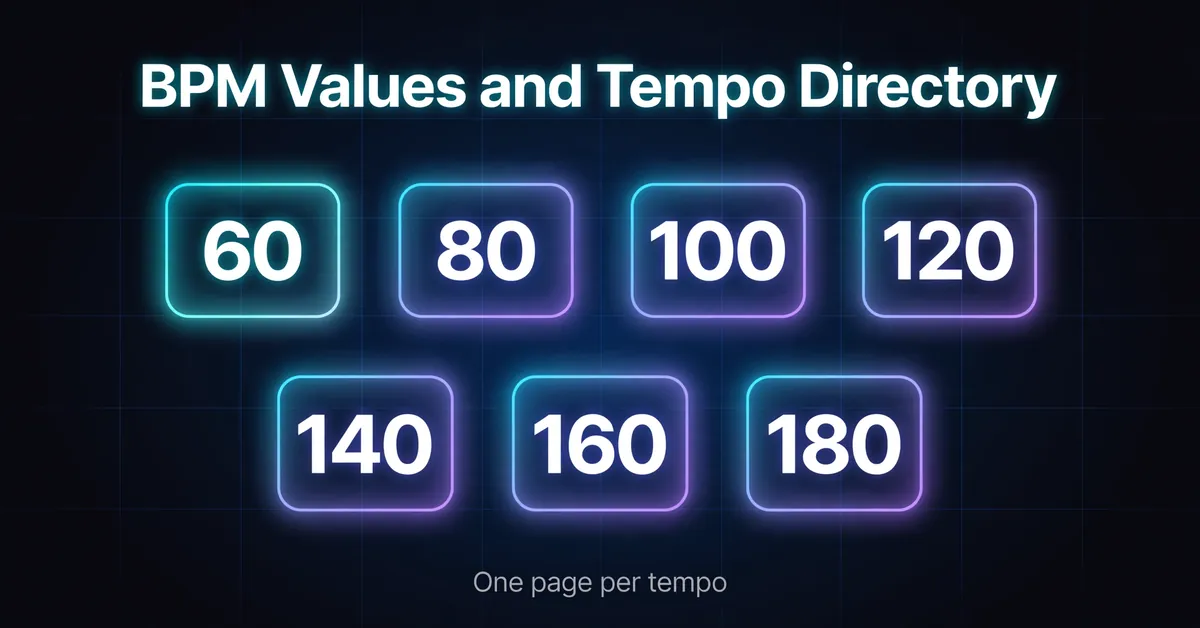
Each value page pairs a metronome preset with note durations, practice ideas and reported song examples for that one tempo. Open the number closest to your target. Use the BPM chart when you want to compare many tempos, note times and approximate Italian marking labels side by side.
| Slow (60 to 80) | Moderate (90 to 110) | Dance (120 to 130) | Fast (140 to 180) |
|---|---|---|---|
| 60 BPM | 90 BPM | 120 BPM | 140 BPM |
| 70 BPM | 92 BPM | 125 BPM | 150 BPM |
| 72 BPM | 96 BPM | 128 BPM | 160 BPM |
| 75 BPM | 100 BPM | 130 BPM | 170 BPM |
| 80 BPM | 110 BPM | 174 BPM | |
| 180 BPM |
If your number is missing, say 115, set it directly in the online metronome, which covers 20 to 360 BPM, and use BPM to MS for its note times.
Beat lengths and note times on these pages assume BPM counts quarter notes. Italian marking labels follow this site's rough bands, which other references set differently. For Italian tempo marking meanings and comparisons between published ranges, open the tempo markings chart.
Where Should You Go When a BPM Number Looks Wrong?
Most strange readings fall into three cases: the number is half or double what you hear, two tools disagree by a few BPM, or the song itself changes speed. Each case has a guide that walks through the check, so you can decide which number to keep instead of guessing.
- Half or double: read half time vs double time. A track measured at 87 that feels like 174 is a pulse level question, not an error.
- Tools disagree: read why BPM detectors disagree. It covers analysis windows, rounding and difficult material.
- Tempo drifts or uses rubato: measure separate sections, and see how does tap tempo work if your taps feel unsteady. How to find BPM compares methods, and how to count BPM shows timed counting by hand.