
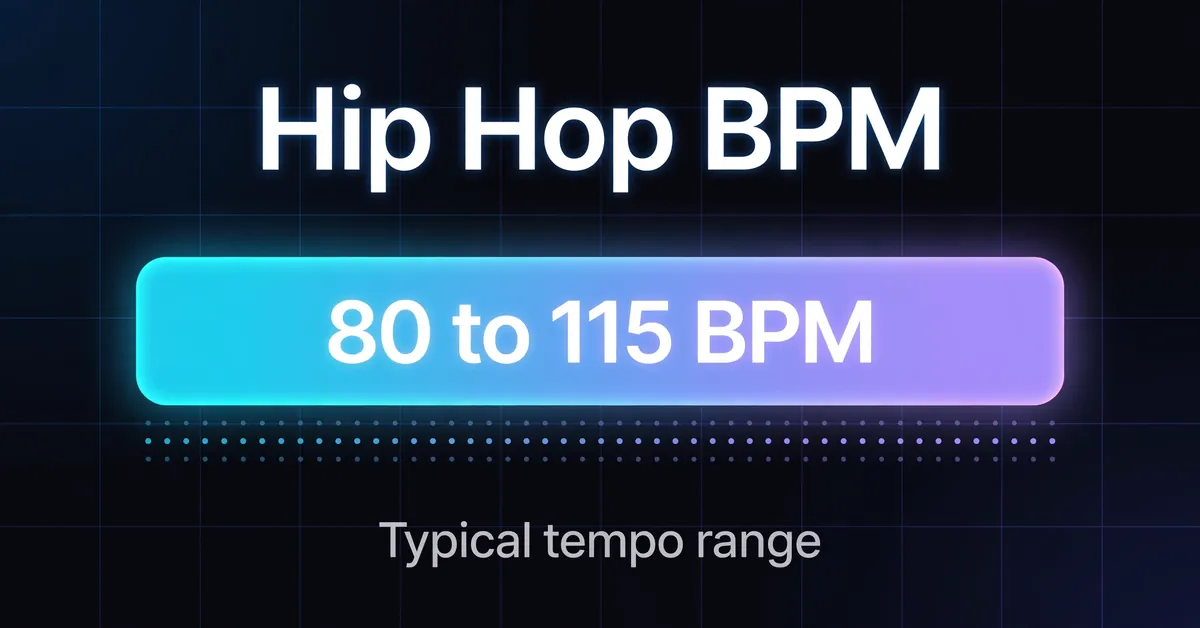
What BPM Is Hip Hop?
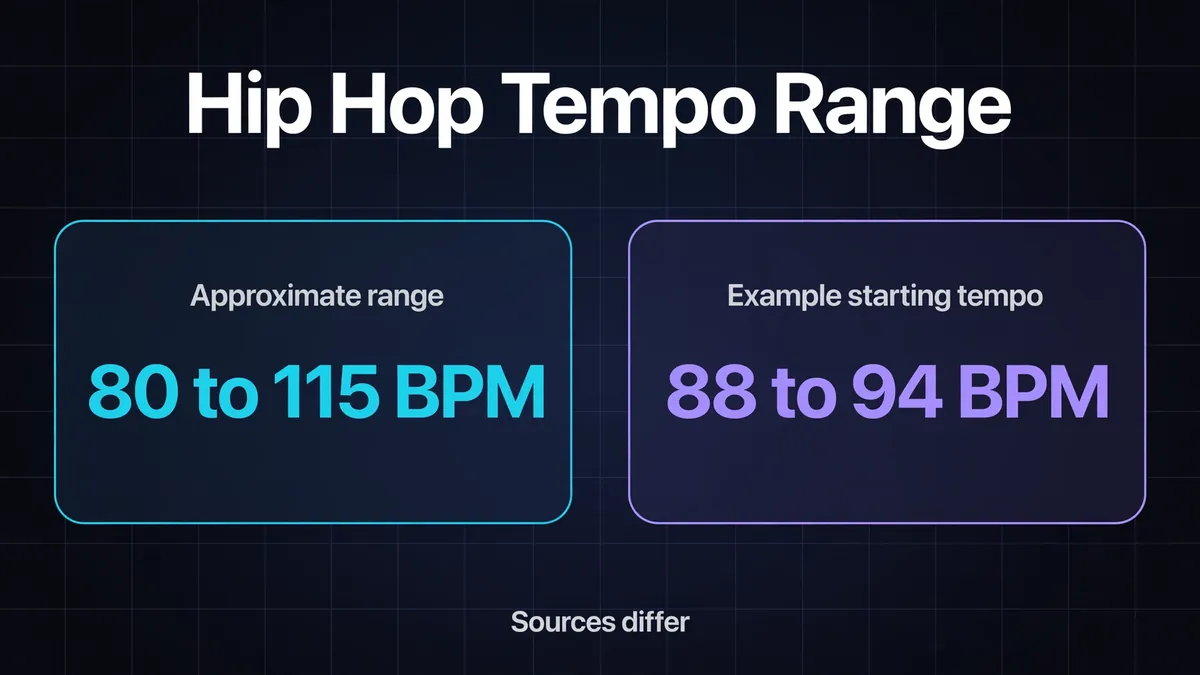
For hip hop, this guide uses an approximate 80 to 115 BPM reference band. Boom bap examples start around 88 to 94 BPM, while lo fi examples extend below the headline range. At 90 BPM, a snare backbeat leaves room for sample chops and varied rap flows without prescribing one vocal rhythm.
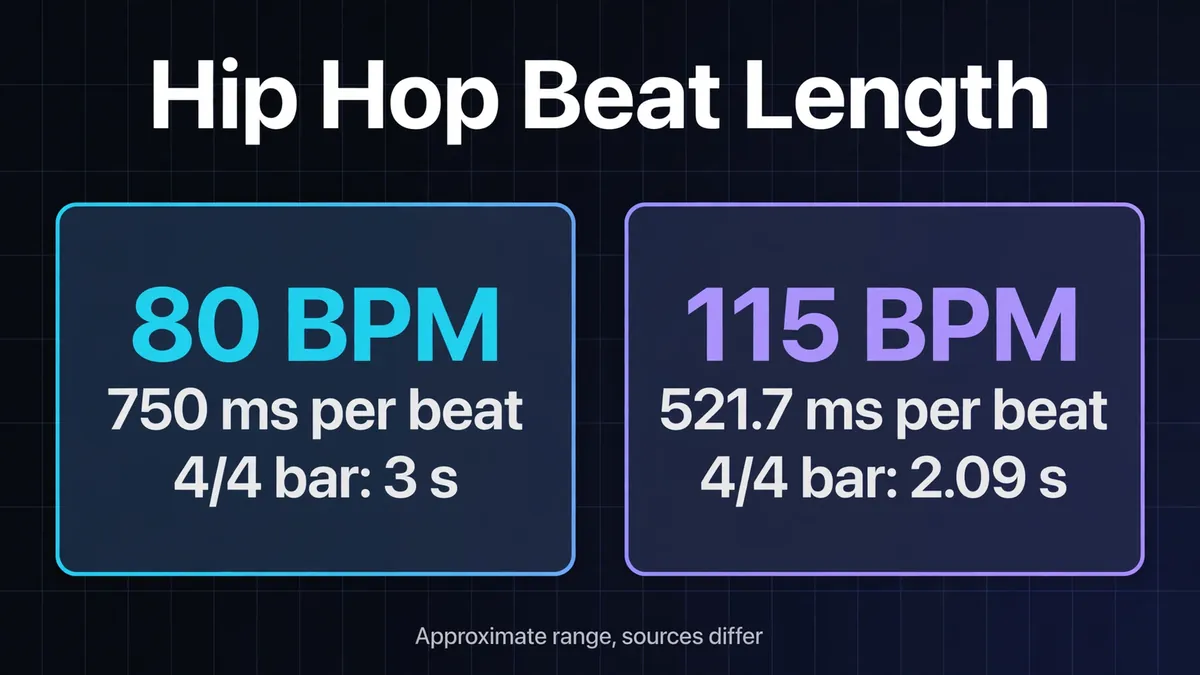
In milliseconds the headline band is narrower than it looks. At 80 BPM one quarter note lasts 750.00 ms; at 115 BPM it lasts 521.74 ms. That gap of about 228 ms per beat is the whole space most of the examples on this page live in.
BPM by Subgenre
The bands below are this site's working examples. They overlap on purpose, because a producer picks a tempo for a sample and a verse, not for a label.
| Subgenre | Approximate BPM reference | How to use the example |
|---|---|---|
| Lo fi hip hop | 70 to 82 | A slower example band below the headline range |
| Slow storytelling rap | 75 to 85 | Test the vocal phrasing before adding fills |
| Boom bap | 85 to 95 | Suggested starting band 88 to 94 |
| West coast and G funk | 90 to 100 | Explore a bassline with longer notes |
| Party and funk rap | 95 to 110 | Try a more active bass and drum arrangement |
| Trap influenced rap | 130 to 150 produced, felt at 65 to 75 | A doubled grid; see the trap guide |
Wayne Marshall's production lessons give 80 to 110 BPM as a hip hop production convention, with a reminder that conventions are not fixed rules.
Notice the last row. A trap influenced beat built at 140 BPM is usually heard with a pulse near 70, which sits just under the lo fi band. Two beats with the same felt pulse can show numbers that differ by a factor of 2 in a DAW or DJ library. The trap BPM guide covers that grid in detail.
How Do You Choose a Hip Hop Tempo?
Fit the beat to the sample and the verse. Loop the main phrase at 90 BPM, then rap or play over it before changing the speed. A flow can use eighths, sixteenths or triplets over the same pulse, so syllable density is a reason to test a tempo, not proof of a fixed rap tempo range.
A practical order works well:
- Find the tempo of the sample first. Tap along with the loop on the tap tempo page, or drop the file into the audio BPM finder.
- Decide whether to keep that tempo or stretch the sample. Each 1 BPM change at 90 BPM is about 1.1 percent (1 ÷ 90 = 0.0111), small enough that warping in Ableton Live or Logic Pro usually sounds natural.
- Record a rough verse or hum the cadence. If the rapper runs out of breath on dense lines, try 2 or 3 BPM slower before rewriting the drums.
- Set the final project tempo and lock it before chopping, so slice points stay on the grid.
Scenario: a producer finds a soul loop that taps out at 93 BPM. The vocalist wants a laid back feel. Dropping to 88 BPM is a change of 5 BPM, or 5.4 percent (5 ÷ 93 = 0.0538). That is audible on a vocal sample but often acceptable on drums and keys. If the sample sounds smeared, keep 93 and get the relaxed feel from swing and later snare placement instead.
How Does Hip Hop Feel at 90 BPM?
At 90 BPM each beat lasts 666.67 ms and a 4/4 bar lasts 2,666.67 ms. Use the one bar exercise below. Each beat has four sixteenth note steps, counted 1 e and a. Beats 1, 2, 3 and 4 begin on steps 1, 5, 9 and 13.
| Voice | Steps | Placement |
|---|---|---|
| Kick | 1, 8, 11 | Beat 1, the a of 2 and the and of 3 |
| Snare | 5, 13 | The backbeat on beats 2 and 4 |
| Hi hat | 1, 3, 5, 7, 9, 11, 13, 15 | Eighths before swing is applied |
Use the straight grid as a reference, then compare swung hats with a steady snare. Sample start points also matter: a sound with silence before its attack can feel late even when its MIDI note sits on the grid. A kick with 15 ms of silence before the hit lands 15 ms behind the grid line, which is 9 percent of a 166.67 ms sixteenth note step. Trim the start or nudge the region earlier in FL Studio, Pro Tools or your DAW of choice.
How Does MPC Swing Change the Timing?
MPC swing shifts the second note of each pair of subdivisions later, while the first note of the pair stays on the grid. The setting is a percentage: 50 percent is even spacing, and higher values give the first note a larger share of the pair. It does not add a fixed delay in milliseconds.
The MPC60 manual specifies swing from 50 to 75 percent. The value describes the first interval's share of a pair: 50 percent is even, and about 66.7 percent gives a 2:1 ratio. In a Roger Linn interview, he describes 54 percent as a subtle setting and 58 percent as a looser option.
Here is what those settings mean at 90 BPM when swing is applied to sixteenth notes. A pair of sixteenths spans one eighth note, 333.33 ms.
| Swing setting | First sixteenth (ms) | Second sixteenth (ms) | Second note moved later by (ms) |
|---|---|---|---|
| 50 percent | 166.67 | 166.67 | 0.00 |
| 54 percent | 180.00 | 153.33 | 13.33 |
| 58 percent | 193.33 | 140.00 | 26.67 |
| 66.7 percent | 222.22 | 111.11 | 55.56 |
| 75 percent | 250.00 | 83.33 | 83.33 |
Worked example: 333.33 × 0.58 = 193.33 ms, so the second sixteenth arrives 193.33 ms after the first instead of 166.67 ms, a shift of 26.67 ms. The same percentage gives a larger shift in milliseconds at slower tempos, which is one reason lo fi beats at 75 BPM can sound looser than boom bap at 95 BPM with an identical setting.
Note Values at 90 BPM
The table counts quarter notes at 90, the way a DAW grid does. A 6/8 sample marked dotted quarter = 60 lines up with this same 90 BPM grid.
| Note value | Length in ms |
|---|---|
| Quarter note | 666.67 |
| Eighth note | 333.33 |
| Sixteenth note | 166.67 |
| Dotted eighth note | 500.00 |
| Eighth note triplet | 222.22 |
A dotted eighth echo at 500.00 ms is one option for a vocal ad lib or sample chop. Try it at the end of a phrase and reduce feedback if repeats obscure the next line. Compare note lengths with the delay calculator or the note duration calculator.
How Long Are Bars and Loops at Hip Hop Tempos?
A 4/4 bar lasts four beats, so its length is 240,000 ÷ BPM in milliseconds. At 90 BPM that is 2.67 seconds per bar, and a 16 bar verse takes 42.67 seconds. Knowing this helps when you cut a sample loop, plan a hook length or check an export.
| BPM | One bar (s) | 4 bars (s) | 16 bars (s) |
|---|---|---|---|
| 75 | 3.20 | 12.80 | 51.20 |
| 80 | 3.00 | 12.00 | 48.00 |
| 90 | 2.67 | 10.67 | 42.67 |
| 94 | 2.55 | 10.21 | 40.85 |
| 100 | 2.40 | 9.60 | 38.40 |
| 115 | 2.09 | 8.35 | 33.39 |
Scenario: a student chops a two bar drum break that lasts exactly 5.10 seconds. Two bars equals eight beats, so 8 × 60 ÷ 5.10 = 94.12 BPM. Setting the project to 94 BPM leaves a tiny gap at the loop point; 94.12 matches the break exactly. For other conversions, use the BPM calculator.
Why Do Some Rap Songs Read at Twice the Tempo?
A rap song can read at 70 BPM on one site and 140 BPM on another because each source counts a different pulse. Producers of trap influenced beats often set the DAW to the faster grid, while listeners nod at the slower one. The audio does not change; only the counting level does.
A quick test: tap along with the snare. If the snare lands on every second tap, you are counting at the slow level with a backbeat. If it lands on every fourth tap, you are counting the faster grid with the snare on beat 3. At 140 BPM the gap between taps is 428.57 ms; at 70 BPM it is 857.14 ms. The half time vs double time guide walks through more cases, and the half time BPM calculator halves any value.
Boom bap rarely raises this question, because a 90 BPM backbeat on 2 and 4 is already the natural nod. Doubling it to 180 BPM would make the snare fall on beat 3 of every bar, a reading that seldom matches how anyone dances to it.
Practicing and Mixing at Hip Hop Tempos
Players: For a 90 BPM backbeat exercise, set the online metronome to 45 BPM and count each click as beat 2 or 4. Establish the count before playing, then keep beats 1 and 3 steady between clicks. Each click is 1,333.33 ms apart, so the gap you fill is long enough to expose rushing.
Drummers who want the full grid can switch the same metronome to 90 BPM with eighth note subdivisions, then lower it to 85 and raise it to 95 to cover the boom bap band. Note that the metronome accents beat 1 only, so the backbeat comes from your own count.
DJs: Check the sample loop and vocal entry before choosing an overlap. A short cut or echo transition can work when two verses compete during a longer blend. For trap influenced rap, check whether the library reports the slower pulse or the doubled grid tempo. Moving a 90 BPM track to 94 BPM is a 4.4 percent change (4 ÷ 90 = 0.0444), which can shift the pitch of a vocal noticeably if key lock is off.
Dancers: Count the 90 BPM pattern in eights. Eight counts at 90 BPM take 5.33 seconds, which is two bars, so a cypher round of eight bars lasts 21.33 seconds.
Which Tempo Mistakes Show Up Most Often?
- Setting the project tempo after chopping. Slices made at the old tempo drift once the grid changes; lock the tempo first.
- Reading a doubled value as a different genre. A beat logged at 180 BPM may simply be a 90 BPM groove counted at the eighth note.
- Treating swing as a fixed delay. The same percentage moves notes by different amounts at 80 BPM and 110 BPM, as the swing table shows.
- Ignoring sample start silence. A late transient makes a perfectly quantized kick sound behind the beat.
- Chasing a whole number. A break that loops cleanly at 94.12 BPM can be left at 94.12 rather than forced to 94.