
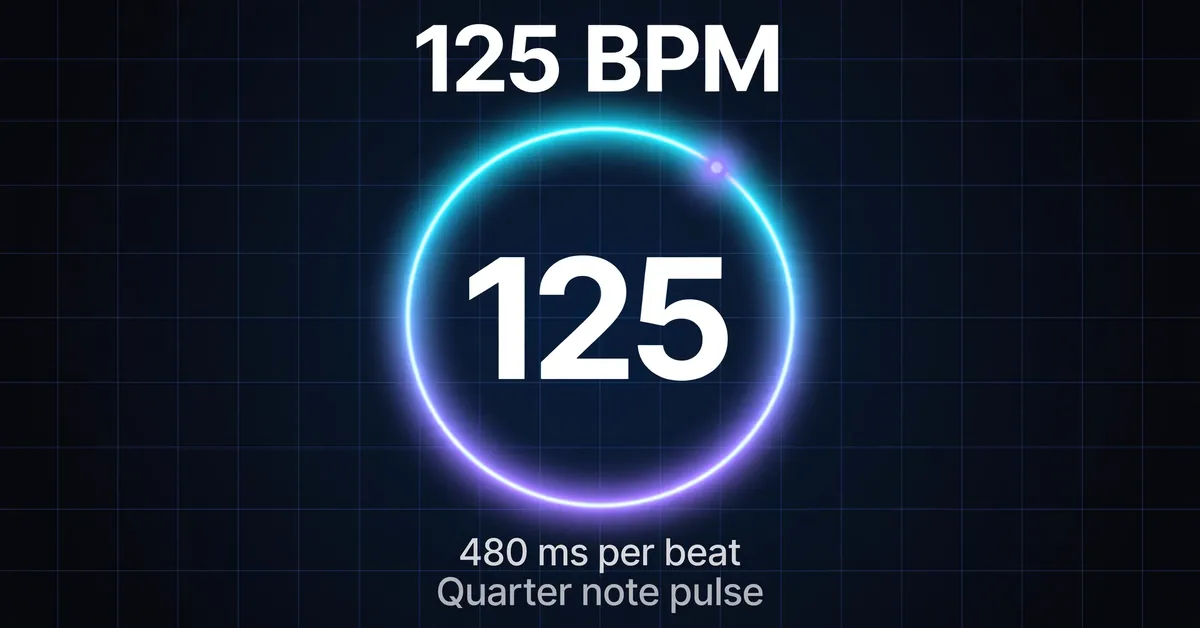
What Is 125 BPM?
125 BPM is 125 beats per minute, which puts one quarter note every 480 milliseconds and a full 4/4 bar at 1.92 seconds. Start the 125 BPM metronome for a house groove exercise, then try a pop or rock pattern on the same click. The rate is shared across styles; no single genre owns it.
At first glance 125 looks less friendly than 120, but the millisecond values are all whole numbers. That happens because 480 divides by 2, 3, 4, 8, 16 and 32 without a remainder, so even triplets land cleanly: an eighth note triplet is exactly 160 ms. Only the frequency column gets messy, since 125 ÷ 60 is 2.0833 Hz.
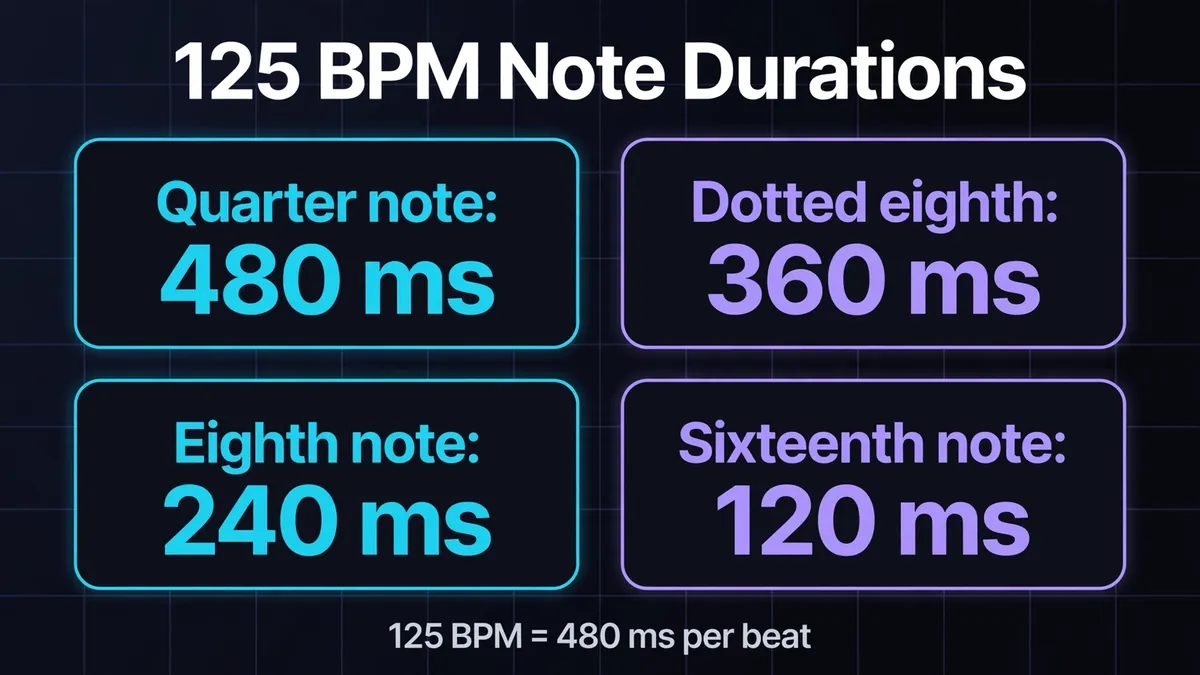
How Long Is Each Note Value at 125 BPM?
At 125 BPM a quarter note lasts 480 ms, an eighth note 240 ms, a sixteenth note 120 ms and a thirty second note 60 ms. Divide 60,000 by 125 for the beat, then scale by the note's fraction of a beat. Frequency in Hz is 1000 divided by the millisecond value.
Here the beat is a quarter note. Scores in 6/8 that print a dotted quarter value need it multiplied by 1.5, so dotted quarter = 84 would call for 126, just above this page. Values round to two decimals.
| Note value | Beats | ms at 125 BPM | Hz |
|---|---|---|---|
| Whole note | 4 | 1920.00 | 0.52 |
| Dotted half note | 3 | 1440.00 | 0.69 |
| Half note | 2 | 960.00 | 1.04 |
| Dotted quarter | 1.5 | 720.00 | 1.39 |
| Quarter note | 1 | 480.00 | 2.08 |
| Dotted eighth | 0.75 | 360.00 | 2.78 |
| Quarter note triplet | 2/3 | 320.00 | 3.13 |
| Eighth note | 0.5 | 240.00 | 4.17 |
| Dotted sixteenth | 0.375 | 180.00 | 5.56 |
| Eighth note triplet | 1/3 | 160.00 | 6.25 |
| Sixteenth note | 0.25 | 120.00 | 8.33 |
| Sixteenth note triplet | 1/6 | 80.00 | 12.50 |
| Thirty second note | 0.125 | 60.00 | 16.67 |
| Thirty second triplet | 1/12 | 40.00 | 25.00 |
| Sixty fourth note | 0.0625 | 30.00 | 33.33 |
Worked example: a quarter note triplet splits a half note (960 ms) into three, so 960 ÷ 3 = 320 ms. Check it the other way: 480 × 2/3 = 320. Because no rounding is needed, a triplet delay typed by hand at 320 ms stays locked to the grid as well as the synced setting does.
For other tempos, run the note duration calculator, the BPM to ms converter or the BPM to Hz converter.
How Long Are Bars and Phrases at 125 BPM?
A bar of 4/4 at 125 BPM lasts 1.92 seconds, a bar of 3/4 lasts 1.44 seconds, and a bar of 6/8 also lasts 1.44 seconds when the BPM counts quarter notes. A 32 bar section in 4/4 takes 61.44 seconds, just over one minute.
| Bars | 4/4 | 3/4 | 6/8 (quarter note = 125) |
|---|---|---|---|
| 1 | 1.92 s | 1.44 s | 1.44 s |
| 4 | 7.68 s | 5.76 s | 5.76 s |
| 8 | 15.36 s | 11.52 s | 11.52 s |
| 16 | 30.72 s | 23.04 s | 23.04 s |
| 32 | 61.44 s | 46.08 s | 46.08 s |
One minute holds 31.25 bars of 4/4, so a 60 second radio edit or social clip will not end on a bar line at this tempo. Trim to 32 bars (61.44 s) or 28 bars (53.76 s) instead. On the online metronome, 6/8 at 125 clicks six eighths of 240 ms per bar. If the music is felt in two dotted quarter beats at 125, set 187.5 as the quarter note value; the time signatures and BPM guide walks through that conversion.
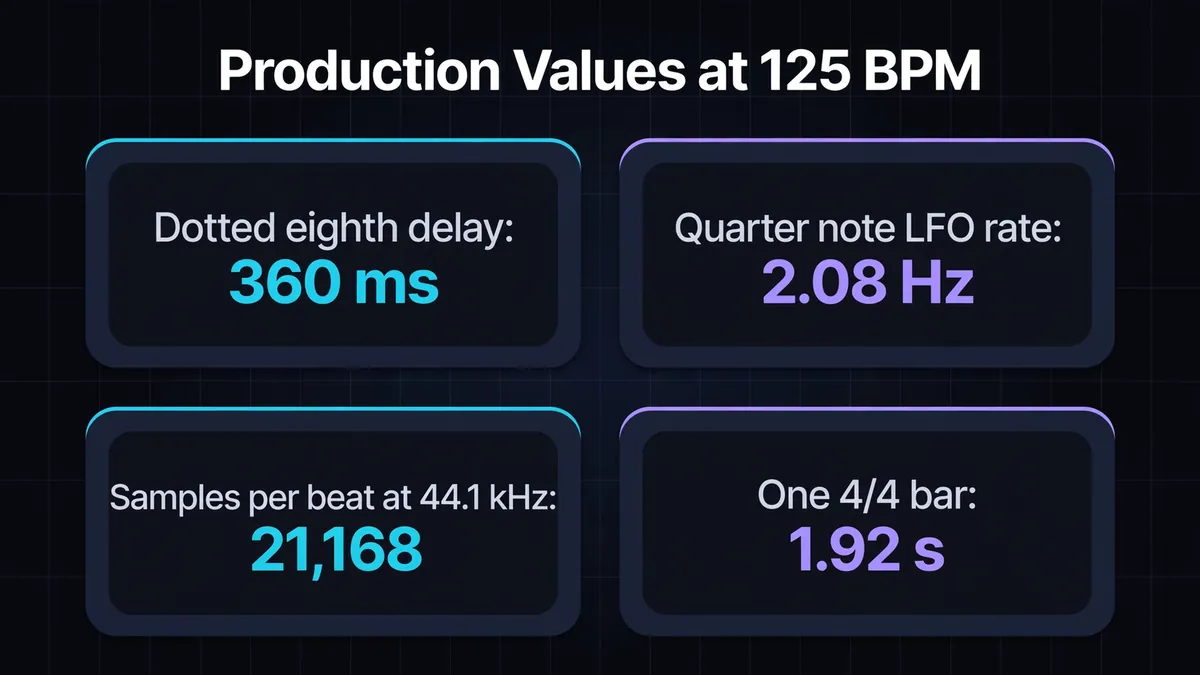
How Many Samples Is a Beat at 125 BPM?
A quarter note at 125 BPM is 21,168 samples at 44.1 kHz and 23,040 samples at 48 kHz. Multiply the beat length of 0.48 seconds by the sample rate. Every value in the table below is a whole number of samples, so loop points never fall between samples.
| Note value | 44.1 kHz | 48 kHz |
|---|---|---|
| 4/4 bar | 84,672 | 92,160 |
| Half note | 42,336 | 46,080 |
| Quarter note | 21,168 | 23,040 |
| Dotted eighth | 15,876 | 17,280 |
| Eighth note | 10,584 | 11,520 |
| Eighth note triplet | 7,056 | 7,680 |
| Sixteenth note | 5,292 | 5,760 |
| Thirty second note | 2,646 | 2,880 |
| Sixty fourth note | 1,323 | 1,440 |
That makes 125 easier than 120 for hand edited loops at 44.1 kHz, where 120 produces half samples on dotted eighths and sixteenths. The BPM to samples converter covers other rates.
Which Tempo Marking Fits 125 BPM?
On this site's chart, 125 BPM falls in Allegro (120 to 156) and just above Allegretto, which ends at 124. Moderato, at 108 to 120, sits below it. Not every reference agrees with these borders, and a printed metronome mark outranks the word.
Allegro means fast and lively, but 125 is near the bottom of that band, so a classical piece marked Allegro at this number will feel brisk rather than racing. For the full comparison across sources, see the tempo markings chart.
How Do You Practice House Rhythms at 125 BPM?
Build the groove in layers on a 125 BPM click: kick on every beat, clap on 2 and 4, then an open hi hat on each offbeat eighth, 240 ms after the kick. Hold each layer for 8 bars, which is 15.36 seconds, before adding the next.
- Drummer: play the house pattern above with your foot, then add sixteenth note closed hats at 120 ms. Try a light swing on the hats and listen for whether the kick stays square.
- DJ practicing by ear: set the metronome at 125 and nudge a track until its kicks sit under the clicks for 16 bars. Then switch the click to 128 to hear how a 3 BPM gap drifts.
- Bassist: lock an offbeat bass note to the "and" of each beat, the classic house bounce, without touching the downbeat.
- Dancer: two bars of 4/4 make an eight count of 3.84 seconds.
- Rock guitarist: play the same click with a backbeat strum to feel how one tempo supports a very different style.
Tap along on tap tempo for eight or more beats to check that your sense of 125 is not sliding toward 120 or 128. The house BPM page explains the genre's usual range.
Which Songs Are Reported at 125 BPM?
Linked databases report "Believer" by Imagine Dragons, "Disturbia" by Rihanna and "Satellite" by Dave Matthews Band at 125 BPM. The three artists work in quite different styles, which shows how little a tempo says about genre. These are database readings, not independent measurements.
Nearby matches and alternative counts are labeled separately. Use the named version where one is given; a counting option does not establish the recording's intended feel.
| Song | Artist | Recording version | Reported BPM | Counting option | Sources |
|---|---|---|---|---|---|
| Believer | Imagine Dragons | Evolve | 125 | 125 BPM count | Tunebat |
| Disturbia | Rihanna | Version unspecified | 125 | 125 BPM count | SongBPM |
| Satellite | Dave Matthews Band | Under the Table and Dreaming (Expanded Edition) | 125 | 125 BPM count | SongData |
A different reading, such as 62.5 or 250, usually reflects a different pulse level; why BPM detectors disagree explains it. To measure a local file yourself, use the BPM finder.
How Do Producers Use 125 BPM?
At 125 BPM an eighth note delay is 240 ms, a dotted eighth is 360 ms, and a quarter note LFO runs at about 2.08 Hz. In Ableton Live, Logic Pro, FL Studio or Pro Tools, synced settings produce these same values, and because the ms figures are whole numbers, typed values match too.
| Setting | Note value | Value at 125 BPM |
|---|---|---|
| Short slap delay | Thirty second note | 60 ms |
| Straight delay | Eighth note | 240 ms |
| Dotted delay | Dotted eighth | 360 ms |
| Triplet delay | Eighth note triplet | 160 ms |
| Reverb pre delay experiment | Sixty fourth note | 30 ms |
| Sidechain release starting point | Eighth note | 240 ms |
| LFO rate | Sixteenth note | 8.33 Hz |
Worked example: on a four on the floor kick, a sidechain on the pads that recovers in roughly 240 ms brings them back on the offbeat, where the open hat lands. Adjust by ear from there. A sixteenth note LFO cycles every 120 ms; keep the depth low while comparing rates so speed and intensity stay separate decisions. Pre delay values are starting points as well. The delay calculator and reverb calculator give the full sets.
What Are Half Time and Double Time at 125 BPM?
Half time of 125 BPM is 62.5 BPM, with 960 ms per beat, and double time is 250 BPM, with 240 ms per beat. Counting at either level leaves playback speed unchanged. The musical feel of half time or double time depends on drum pattern and accents.
| Pulse level | BPM | ms per beat | 4/4 bar |
|---|---|---|---|
| Half time count | 62.5 | 960 | 3.84 s |
| As written | 125 | 480 | 1.92 s |
| Double time count | 250 | 240 | 0.96 s |
The double time quarter note equals the original eighth note: 240 ms either way, so delay settings carry over between levels. Compare numbers with the half time calculator and double time calculator, or read the half time vs double time guide. Neighboring pages are 120 BPM and 128 BPM, and the BPM chart lists every tempo covered.
Which Mistakes Show Up at 125 BPM?
The biggest mistake at 125 BPM is treating a 125 track and a 128 track as close enough to mix without adjustment. Over 16 bars of 4/4, the 125 track runs 30.72 seconds and the 128 track 30 seconds, a gap of 0.72 seconds. Choosing a half or double count does not fix that.
- Wrong beat unit: a 6/8 piece marked dotted quarter = 125 needs a quarter note setting of 187.5.
- Assuming genre from tempo: "Believer" and "Disturbia" share 125 but not a style.
- Ending edits on the minute: 60 seconds is 31.25 bars, so cuts land mid bar.
- Rounding the Hz: entering 2 Hz instead of 2.08 Hz for a quarter note LFO lets it slip a full cycle every 12 seconds.