
What BPM Is Techno?
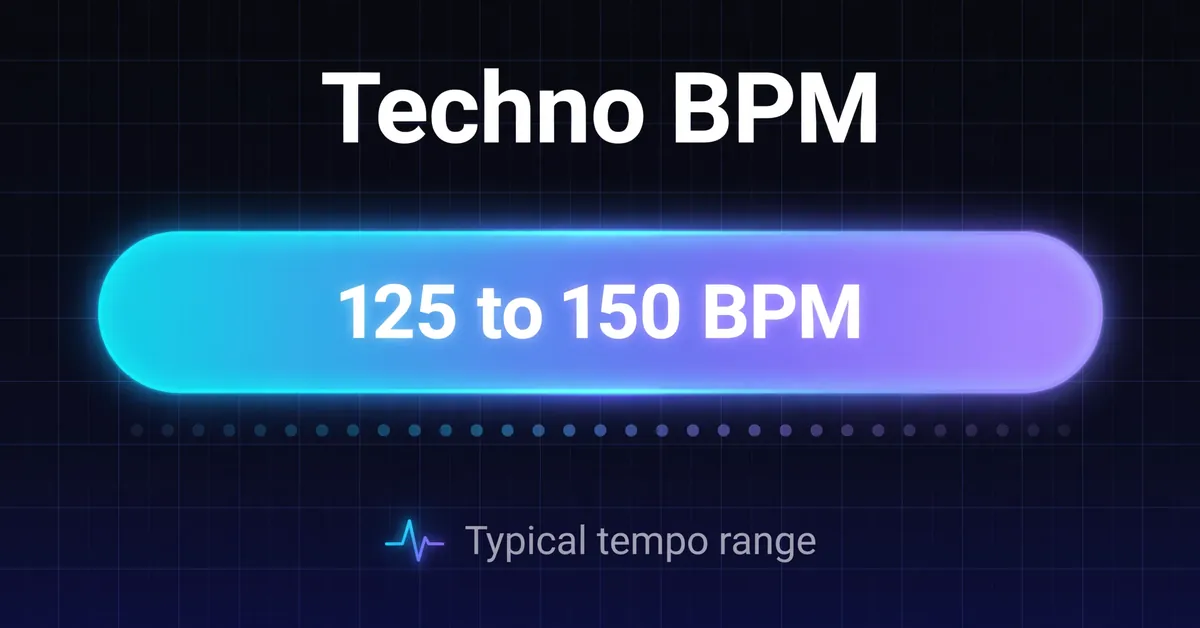
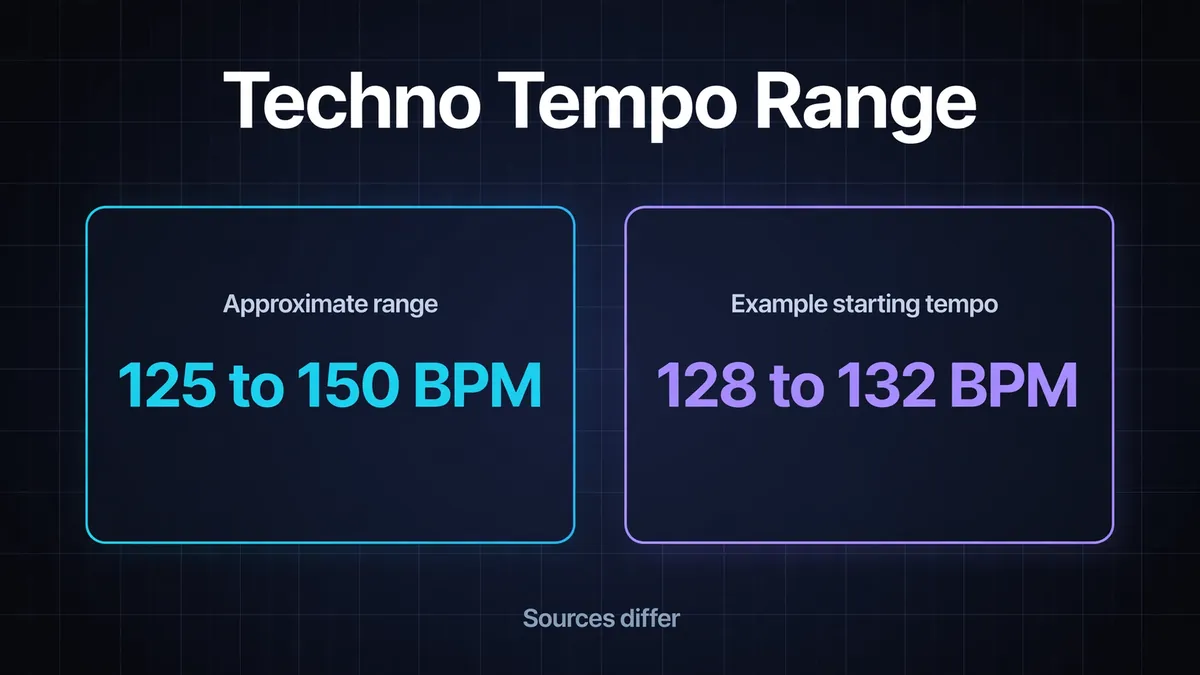
A useful techno BPM reference is 125 to 150 BPM, with 128 to 132 BPM as a starting band. This guide's melodic techno examples sit lower than its hard techno examples, with overlap between styles. A steady kick can support straight or swung percussion, so tempo alone does not identify the sound.
Published guides draw the edges in different places. Techno Airlines places most techno at 125 to 140 BPM and hard techno at 140 to 160. This site's 125 to 150 band covers the common club core plus the lower part of the hard styles, and the table below shows where faster material continues.
BPM by Subgenre
Techno subgenres stretch across a wider span than house, from dubby grooves in the low 120s to schranz above 150. Use the rows as starting tempos for practice and production. Neighboring rows overlap because two tracks at 128 BPM can sound nothing alike once the kick, bass and texture change.
| Subgenre | Approximate BPM reference | How to use the example |
|---|---|---|
| Dub and deep techno | 122 to 128 | Explore space around repeating echoes |
| Melodic techno | 124 to 128 | Test the tempo against the melody |
| Hypnotic and raw techno | 126 to 132 | Build an exercise around repeating percussion |
| Peak time and driving techno | 128 to 134 | Retained site example band; references differ |
| Industrial and hard techno | 138 to 150 | Compare distortion and kick tail lengths |
| Schranz | 145 to 155 | A faster exercise band, not an upper limit |
Seedj's hard techno production guide gives roughly 145 to 160 BPM for modern hard techno. The industrial and hard techno row above is an exercise band, not a ceiling for the style. Future Proof Music School also places hard techno at 145 to 160 BPM, so a 152 BPM set is still hard techno even though it sits above the site row.
How Do You Choose a Techno Tempo?
Choose a tempo by testing the repeating parts together. At 130 BPM, play the kick, bass and main sequence before building the arrangement. If you add a rumble, shorten or duck its tail when it masks the next kick. Rumble is one production technique, not a requirement for techno.
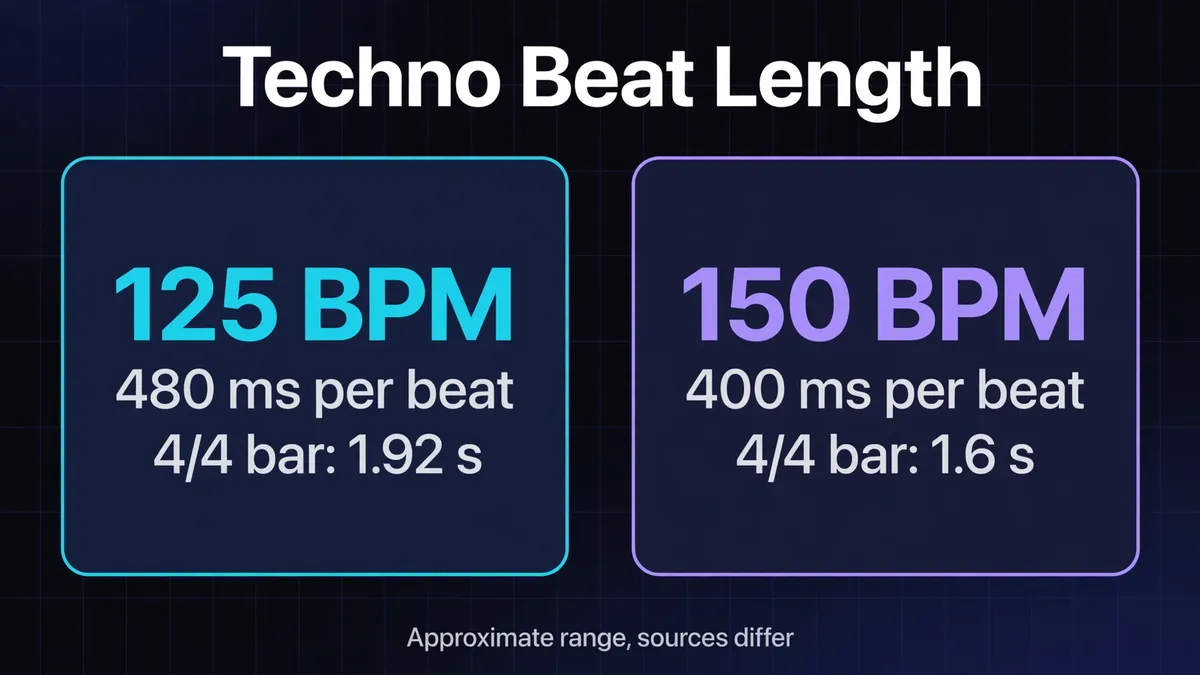
The gap between kicks is the real constraint. At 125 BPM each quarter note lasts 480.00 ms; at 140 BPM it is 428.57 ms; at 150 BPM only 400.00 ms. A long, boomy kick that works at 125 can run into the next hit at 150, so faster tempos often call for shorter kick tails or tighter ducking.
Try three passes in Ableton Live, Logic Pro or FL Studio with the same loop:
- 126 BPM for a hypnotic or melodic sketch, where a sequence of long notes has space to evolve.
- 130 BPM, the preset here, for a straight club pattern.
- 140 BPM, which pushes the loop toward the industrial row and shrinks every sixteenth to 107.14 ms.
Listen for the point where the bassline starts to feel crowded. That point, not a chart, tells you how far the track can go.
How Does Techno Feel at 130 BPM?
Use this one bar exercise in 4/4. Each beat has four sixteenth note steps, counted 1 e and a. Beats 1, 2, 3 and 4 begin on steps 1, 5, 9 and 13.
| Voice | Steps | Placement |
|---|---|---|
| Kick | 1, 5, 9, 13 | Every quarter note beat |
| Open hi hat or ride | 3, 7, 11, 15 | Offbeats between the kicks |
| Closed hi hat | All 16 steps | Sixteenths with selected accents |
| Rumble | Between kicks | A processed kick tail, ducked under each new kick |
For the rumble option, send the kick through reverb, delay and distortion, then control the return beneath the dry kick. Check the combined low end rather than setting the tail length from BPM alone.
Techno can use swing. Native Instruments demonstrates it in a techno pattern. Compare straight and swung hats while leaving the main kick placements fixed.
At 130 BPM a straight sixteenth pair splits an eighth of 230.77 ms into two equal 115.38 ms halves. At 56 percent swing, the first note of the pair takes about 129.23 ms, so the offbeat sixteenth lands roughly 14 ms late. Small numbers, but on a closed hat running for six minutes they change the whole feel.
Note Values at 130 BPM
Each duration is measured against a quarter note kick at 130 BPM.
| Note value | Length in ms |
|---|---|
| Quarter note | 461.54 |
| Eighth note | 230.77 |
| Sixteenth note | 115.38 |
| Dotted eighth note | 346.15 |
| Eighth note triplet | 153.85 |
An eighth triplet LFO at 130 BPM runs at 6.5 Hz, completing three cycles per quarter note. When phase aligned, it repeats at each beat. Use BPM to Hz to compare modulation rates.
For a dub style echo on a chord, a dotted eighth delay of 346.15 ms is a starting point. Check other subdivisions with the delay calculator.
How Do Timing Values Change Across the Techno Range?
Moving from 125 to 150 BPM shortens every note value by one sixth, because 125 ÷ 150 = 0.833. Delay times, release settings and bar lengths all shrink together. The table gives side by side values for three points in the range so you can reset effects when you change the project tempo.
| BPM | Quarter note | Sixteenth note | Dotted eighth | One bar | 32 bars |
|---|---|---|---|---|---|
| 128 | 468.75 ms | 117.19 ms | 351.56 ms | 1.88 s | 60.00 s |
| 135 | 444.44 ms | 111.11 ms | 333.33 ms | 1.78 s | 56.89 s |
| 150 | 400.00 ms | 100.00 ms | 300.00 ms | 1.60 s | 51.20 s |
At 150 BPM a sixteenth is exactly 100 ms, a handy number when checking a roll by ear. A 32 bar breakdown that runs a full minute at 128 BPM lasts under 52 seconds at 150, which matters when you plan the length of a build.
Practicing and Mixing at Techno Tempos
Players: Loop the example at 130 BPM. Change one element at a time: hat velocity, swing, then the rumble level. Keep the tempo fixed so you can hear which change creates the movement you want. For live drum machine practice, set the online metronome to 130 BPM with sixteenth subdivision and play the closed hats against it.
DJs: Audition tempo changes with the playback settings you plan to use. Ableton's warping documentation explains how time stretching can separate playback tempo from pitch. The size of a playback rate change is proportional to the starting BPM; there is no universal safe threshold expressed as a fixed number of BPM.
Consider a set that climbs over two hours. Moving one track from 130 to 135 BPM is a 3.85 percent change, about 0.65 semitone without key lock. Jumping from 128 straight to 140 is 9.38 percent, roughly 1.55 semitones, which most listeners will hear on sustained pads. Raising the tempo over several transitions spreads the change out.
Which Techno Tempo Mistakes Should You Avoid?
Most techno tempo errors come from trusting a label or a single analyzer reading over your ears. A store category, a chart row or a detector result is a hint; the kick pattern and the bar structure decide.
- Treating 150 as a ceiling. Hard techno and schranz often run faster, as the sources above show.
- Assuming a BPM names a subgenre. A 128 BPM track may be melodic, dub or peak time.
- Accepting a half reading. A 140 BPM industrial track can register as 70; check it against the kick, and see why BPM detectors disagree.
- Keeping old delay times after a tempo change. A 346.15 ms echo from 130 BPM drifts against a 140 BPM grid, where the dotted eighth is 321.43 ms.