
What Is 96 BPM?
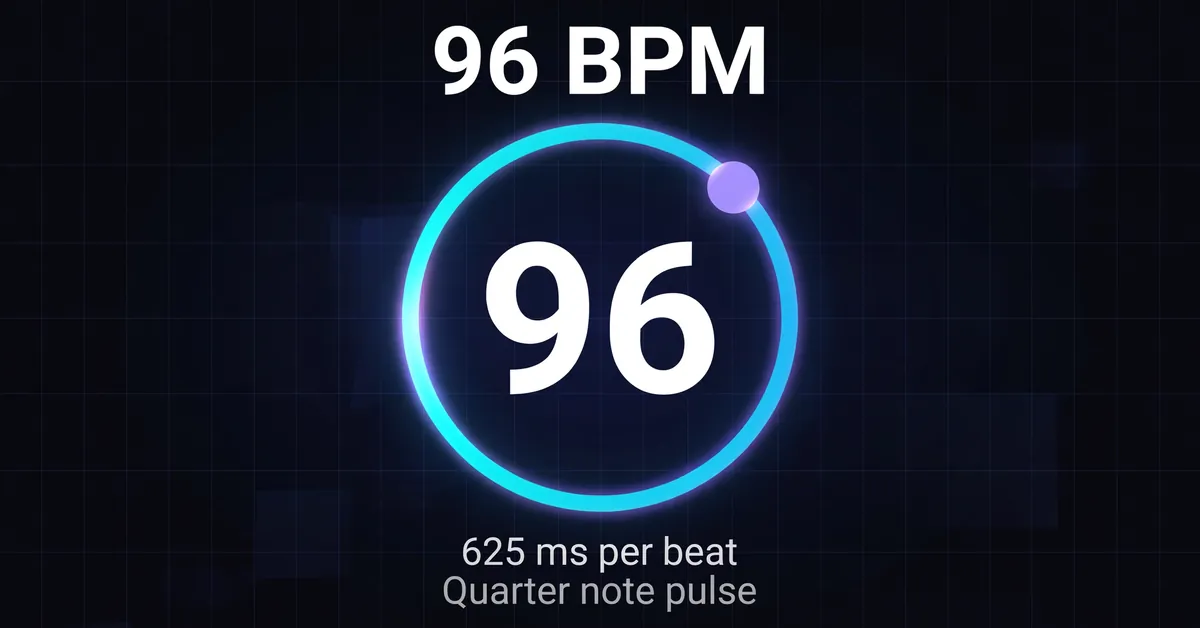
96 BPM means 96 beats per minute, so a 96 BPM metronome clicks exactly every 625 milliseconds, or 1.6 times per second. A 4/4 bar lasts exactly 2.5 seconds. On this site's tempo chart, 96 falls inside the Andante band of 76 to 108 BPM, and it suits pop rhythm practice with syncopated strumming.
96 is one of the friendliest tempos for arithmetic. Because 60,000 divides by 96 into a clean 625, the straight note values come out as whole or simple decimal numbers, and bar lengths land on round seconds. Only the triplets need rounding. Italian labels used here are approximate and specific to this site; for how other references place 96, see the tempo markings chart.
How Long Is Each Note at 96 BPM?
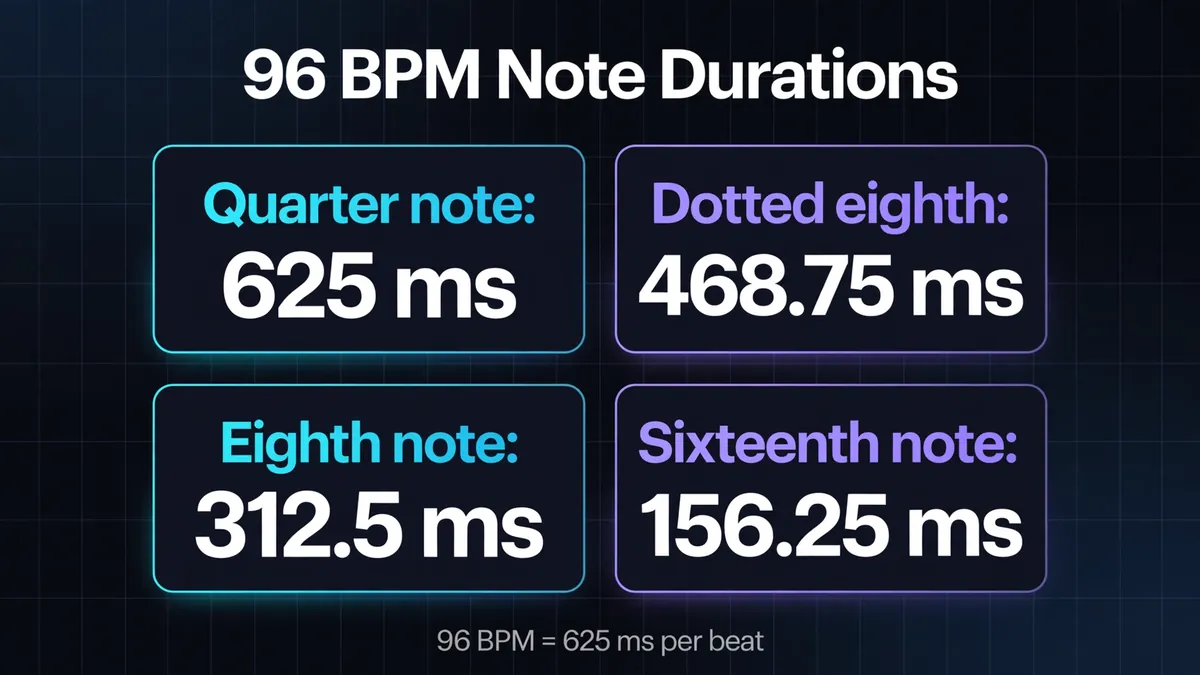
At 96 BPM a quarter note lasts 625 ms, an eighth note 312.5 ms, a sixteenth note 156.25 ms and an eighth note triplet 208.33 ms. A dotted eighth lasts 468.75 ms and a dotted quarter 937.5 ms. Each value is 625 ms multiplied by the note's length in beats.
These note durations assume BPM counts quarter notes. In compound meters such as 6/8, a score marked dotted quarter equals 64 means a quarter note setting of 96, because 64 × 1.5 = 96.
| Note value | Beats | Duration (ms) |
|---|---|---|
| Whole note | 4 | 2500.00 |
| Dotted half | 3 | 1875.00 |
| Half note | 2 | 1250.00 |
| Dotted quarter | 1.5 | 937.50 |
| Quarter note | 1 | 625.00 |
| Quarter note triplet | 2/3 | 416.67 |
| Dotted eighth | 0.75 | 468.75 |
| Eighth note | 0.5 | 312.50 |
| Eighth note triplet | 1/3 | 208.33 |
| Sixteenth note | 0.25 | 156.25 |
| Sixteenth note triplet | 1/6 | 104.17 |
| Thirty second note | 0.125 | 78.13 |
Worked example: a dotted eighth is three sixteenths, so 156.25 × 3 = 468.75 ms with no rounding at all. A quarter note triplet splits a half note in three: 1,250 ÷ 3 = 416.67 ms. The note duration calculator and BPM to ms converter handle any other value.
How Long Is a Bar at 96 BPM?
A 4/4 bar at 96 BPM lasts exactly 2.5 seconds, and a 3/4 bar lasts 1.875 seconds. Eight bars of 4/4 take exactly 20 seconds and sixteen bars take 40 seconds. You play 24 bars of 4/4 every minute, since 96 ÷ 4 = 24.
| Length | 4/4 | 3/4 |
|---|---|---|
| 1 bar | 2.5 s | 1.875 s |
| 4 bars | 10 s | 7.5 s |
| 8 bars | 20 s | 15 s |
| 16 bars | 40 s | 30 s |
| 32 bars | 80 s | 60 s |
These round numbers make 96 handy for timed content. A 30 second ad spot holds exactly 12 bars of 4/4. A 15 second clip holds 6 bars. Thirty two bars of 3/4, a common waltz length, fill exactly one minute. In 6/8 with a quarter note click of 96, each bar holds three quarter note beats and lasts 1.875 seconds, the same as 3/4. The time signatures and BPM guide explains how meters change the count.
What Does 96 BPM Feel Like?
96 BPM feels like a relaxed walk that still pushes forward. It is slow enough to fit syncopated strums and sixteenth note guitar patterns cleanly, yet quick enough that a chorus does not drag. Many pop and mid tempo hip hop recordings are listed around this tempo.
Try a syncopated pop accompaniment. Strum down on beat 1, then place chord hits on the "and" of beat 2 and the "and" of beat 3, so two of the accents fall 312.5 ms after a click. Keep counting the beats out loud while the chords land between them, then return to a clear downbeat on the next bar. Syncopation moves notes relative to the pulse; the tempo does not change.
Producers often pair this kind of pattern with a sparse kick and a backbeat clap. The pop BPM guide gives broader genre context, and the hip hop BPM guide uses an approximate range of 80 to 115 BPM that includes 96.
Which Songs Are 96 BPM?
The databases linked below report these recordings at 96 BPM. Use the named version where one is given, because remixes, acoustic takes and duplicate database entries can show different numbers, sometimes a double count near 192.
<a id="songs-at-96-bpm"></a>
| Song | Artist | Recording version | Reported BPM | Source |
|---|---|---|---|---|
| Shape of You | Ed Sheeran | Version unspecified | 96 | Tunebat |
| Blank Space | Taylor Swift | 1989 | 96 | GetSongBPM |
| Torn | Natalie Imbruglia | Left Of The Middle | 96 | Tunebat |
| Mass Appeal | Gang Starr | Version unspecified | 96 | SongBPM |
For "Mass Appeal," Beatport's Original Mix listing also reports 96. These are database reports, not an independent analysis. To check your own copy, tap along with the tap tempo tool or run the file through the BPM finder, and read why BPM detectors disagree when two sources give different numbers.
How Do You Practice With a 96 BPM Metronome?
Set the online metronome to 96 BPM, count in four clicks and play along. Add subdivisions to hear eighth notes every 312.5 ms or sixteenths every 156.25 ms. If 96 feels too quick, start at 84 and let the speed trainer raise the tempo gradually until 96 feels comfortable.
A guitarist learning a pop strumming pattern could work like this:
- Strum only on each click for one minute, which is 24 bars.
- Switch to eighth note subdivision and strum down on beats, up on the "and".
- Mute the strings on beats 2 and 4 to add a percussive backbeat.
- Set the click to sound accented on beat 1 and check that every bar still lands with it.
A singer can rehearse a 16 bar verse in exactly 40 seconds. A piano student playing sixteenth note scales at 96 performs 384 notes per minute (96 × 4). A dancer counting in eights finishes each eight count in exactly 5 seconds, two bars of 4/4, which makes choreography timing easy to plan.
How Do You Use 96 BPM in Production?
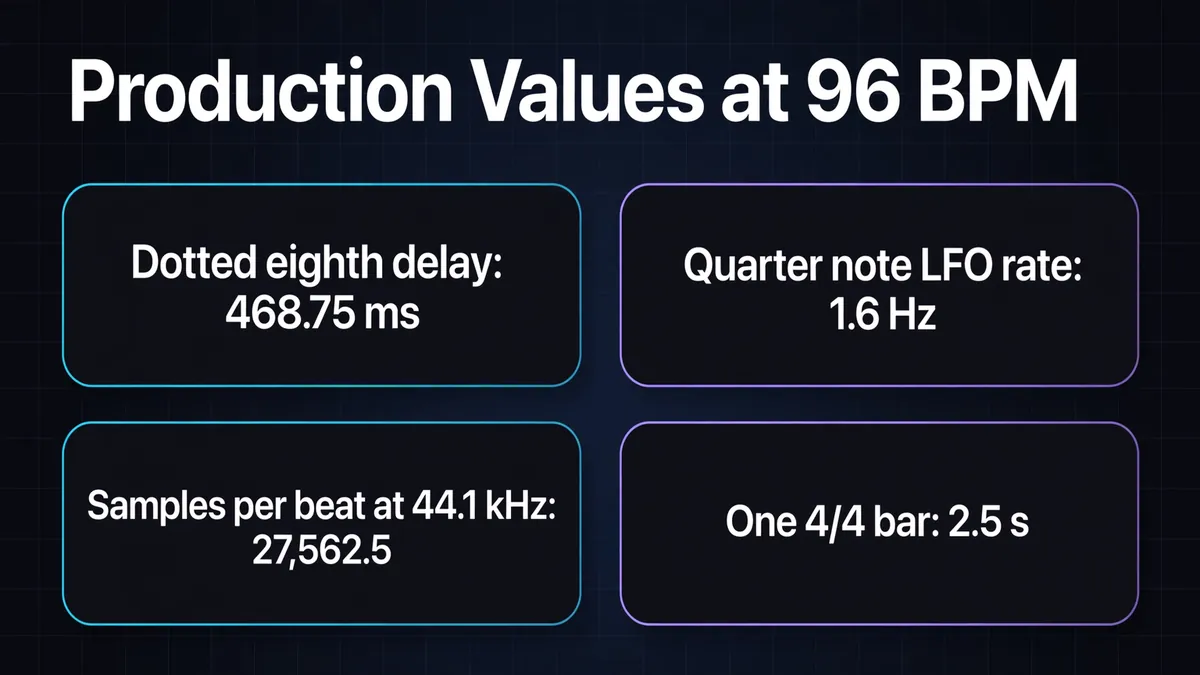
In a 96 BPM project, a quarter note delay is 625 ms, a dotted eighth 468.75 ms and a straight eighth 312.5 ms. A one beat LFO runs at 1.6 Hz and an eighth note LFO at 3.2 Hz. Ableton Live, Logic Pro, FL Studio and Pro Tools can sync these to the session tempo automatically.
When a plugin or pedal has no sync, enter the numbers by hand. Compare the straight eighth with the dotted eighth over the same chord pattern: the dotted repeat lands off the grid and builds a cascading rhythm. For reverb pre delay, a sixty fourth note of 39.06 ms (625 ÷ 16) is a starting point; listen to the dry attack and the tail separately as you adjust.
| Use | Note value | Value at 96 BPM |
|---|---|---|
| Delay | Quarter | 625 ms |
| Delay | Dotted eighth | 468.75 ms |
| Delay | Eighth | 312.5 ms |
| Delay | Eighth triplet | 208.33 ms |
| LFO | 1 beat | 1.6 Hz |
| LFO | Eighth | 3.2 Hz |
| Sample count | Quarter at 44.1 kHz | 27,562.5 samples |
| Sample count | Quarter at 48 kHz | 30,000 samples |
At 48 kHz a beat is exactly 30,000 samples, so loops cut at 96 BPM line up cleanly in a 48 kHz session. At 44.1 kHz the beat lands on a half sample, which is harmless in a synced DAW. For a sidechain duck that recovers before the next kick, try a release near one eighth note, 312.5 ms. The delay calculator, reverb calculator, BPM to Hz converter and BPM to samples calculator cover any tempo.
What Are Half Time and Double Time of 96 BPM?
Half time of 96 BPM is 48 BPM and double time is 192 BPM. The audio plays at the same speed either way: 48 BPM means one beat every 1,250 ms, and 192 BPM means one beat every 312.5 ms, which is the eighth note at 96.
A 96 BPM loop fits a 192 BPM project without time stretching, because two bars at 192 last 2.5 seconds, the same as one bar at 96. Counting at 48 suits slow, spacious sections where the snare falls only on beat 3. A true half time or double time feel depends on where the kick and snare fall, not just the number. Use the half time calculator and double time calculator, and see the half time vs double time guide for the musical difference. Neighboring pages are 90 BPM and 100 BPM.
What Mistakes Happen at 96 BPM?
The usual mistake is trusting one database number. "Shape of You" appears at 96 in some listings and with a conflicting duplicate in others, so always match the recording. Other errors are reading a 6/8 dotted quarter marking as the click, and confusing 96 with its double time count of 192.
Rounding the triplets is the one place 96 needs care. An eighth note triplet is 208.333 ms; typing 208 into an unsynced delay drifts by a third of a millisecond each repeat. Tap readings can wander too: if your tap result reads 95 or 97, average a longer stretch, since a few uneven taps shift the result by a beat per minute. And remember the Andante label is a guide; a printed metronome mark on a score always wins.