
What BPM Is Rock Music?
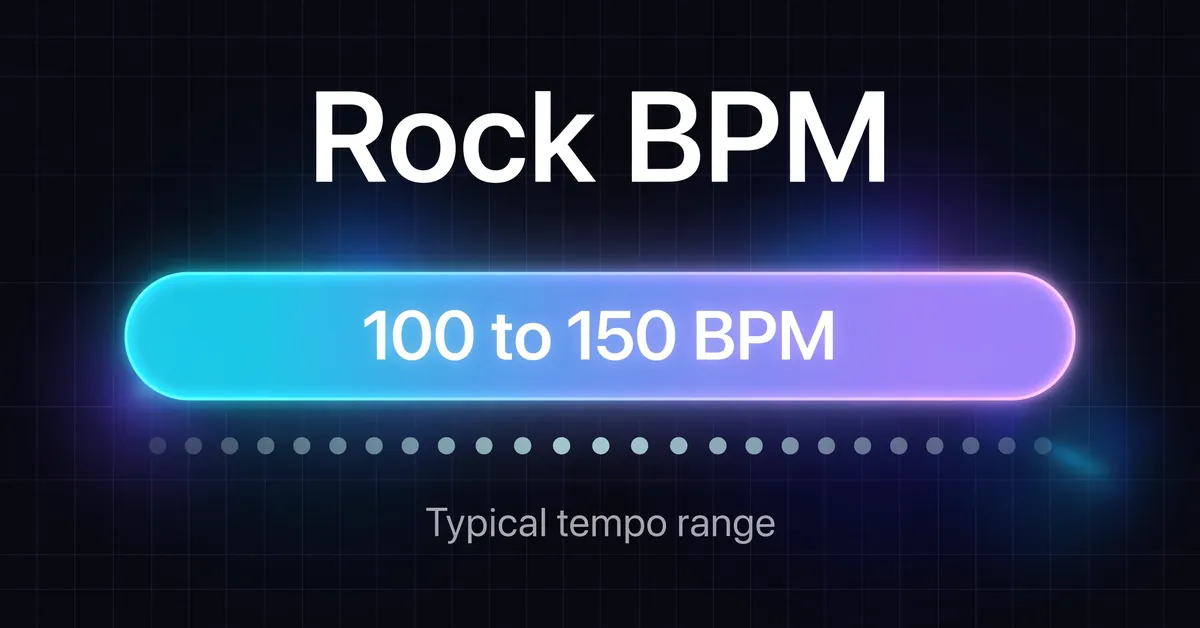
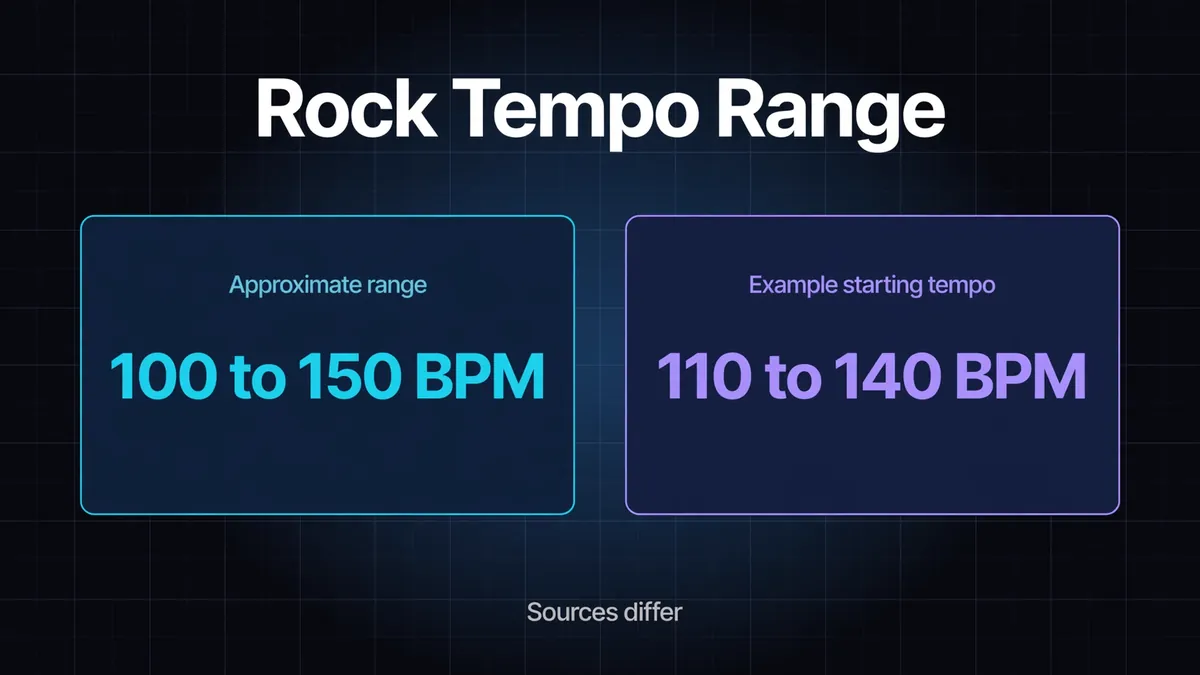
For rock music BPM, this site uses an approximate reference range of 100 to 150 BPM, with 110 to 140 BPM as an example starting band. Classic rock examples extend below that starting band, while punk and metal reach higher tempos. A recording may follow a click or breathe with the band, so measure the performance itself.
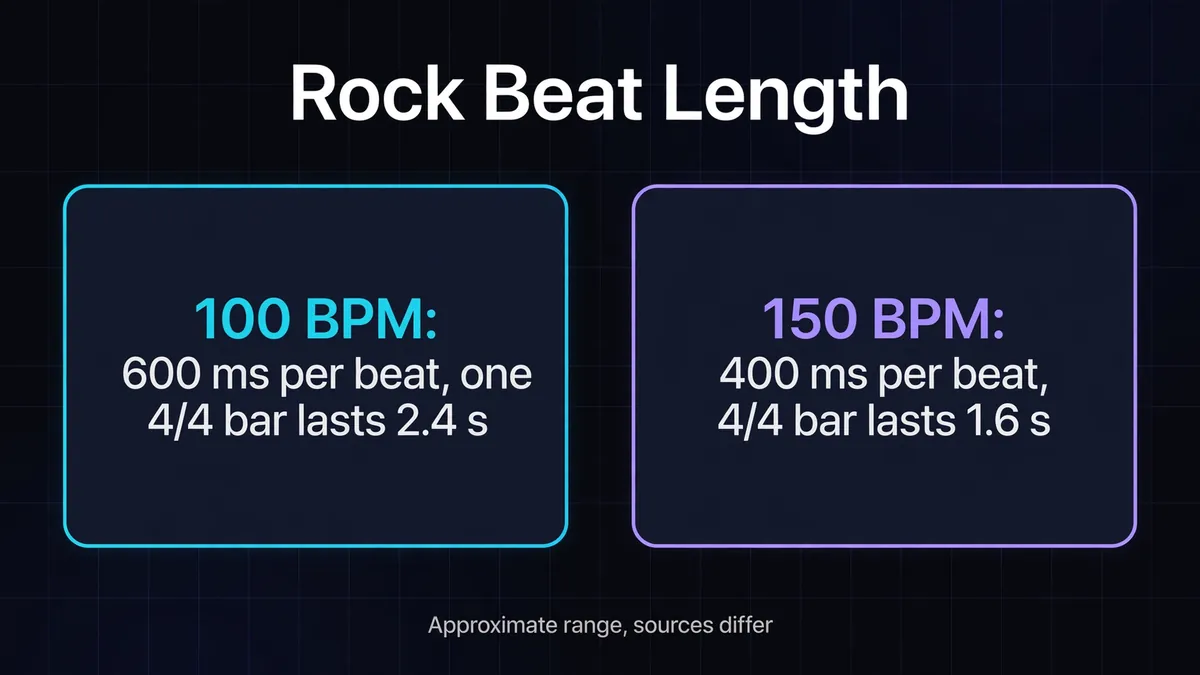
In milliseconds, the headline band runs from a 600 ms quarter note at 100 BPM to a 400 ms quarter note at 150 BPM. That 200 ms spread is the gap between a loping mid tempo groove and a song that drives hard on every beat.
What BPM Does Each Rock Subgenre Use?
This page suggests 90 to 120 BPM for alternative and grunge, 105 to 125 for classic and hard rock, 110 to 140 for mainstream and arena rock, 130 to 190 and above for heavy metal and thrash, and 150 to 180 for punk and pop punk. These are starting settings for practice and production, not catalog measurements.
| Subgenre | Approximate BPM reference | How to use the example |
|---|---|---|
| Alternative and grunge | 90 to 120 | Try contrasting quiet and loud sections |
| Classic and hard rock | 105 to 125 | Extends below the 110 to 140 starting band |
| Mainstream and arena rock | 110 to 140 | A suggested starting band for a driving riff |
| Heavy metal and thrash | 130 to 190 and above | A broad exercise band; double bass adds subdivisions |
| Punk and pop punk | 150 to 180 | Compare picking and drum accents at faster tempos |
Two subgenres can share a BPM and still feel unrelated. A grunge verse at 110 BPM with sparse kicks and a ringing open chord sounds slower than an arena rock verse at the same speed with driving eighth note bass. Guitar tone, drum density and how long chords sustain all shape perceived speed.
How Do You Choose a Rock Tempo?
Choose a rock tempo by playing the main riff with the vocal and listening for whether chords ring, fills fit and the singer can breathe between lines. Start at 120 BPM, then try 4 BPM faster and slower. A busier kick or a switch from hats to ride can add drive without raising the click.
Worked example for a band demo:
- Play the chorus riff at 120 BPM on the online metronome. Each bar lasts 2 seconds.
- Try 128 BPM. The bar shrinks to 1.875 seconds, a cut of 125 ms per bar. Check whether the drummer's fill into the chorus still lands cleanly.
- Try 112 BPM. The bar grows to 2.14 seconds. Notice whether long chords now sound heavy or merely slow.
- Record each pass and choose the one where the riff and vocal both feel settled.
If the band cannot agree, tap the tempo the drummer naturally plays during rehearsal with our tap tempo tool. That number is often closer to the song's real home than a value picked in advance.
How Does Rock Feel at 120 BPM?
At 120 BPM a rock backbeat places the snare on beats 2 and 4 every 1 second, with kicks on beats 1 and 3 and eighth notes on the hi hat or ride. The one bar exercise below is a standard starting groove you can vary without moving the tempo.
Each beat has four sixteenth note steps, counted 1 e and a. Beats 1, 2, 3 and 4 begin on steps 1, 5, 9 and 13.
| Voice | Steps | Placement |
|---|---|---|
| Kick | 1, 9 | Beats 1 and 3 |
| Snare | 5, 13 | The backbeat on beats 2 and 4 |
| Hi hat or ride | 1, 3, 5, 7, 9, 11, 13, 15 | Eighths through the bar |
For a more active variation, add a kick on step 11, the and of 3. Keep the snare steady as you change the kick rhythm. Then compare closed hats in the verse with a more open sound in the chorus.
A half time chorus moves the snare to beat 3 only. The click stays at 120 BPM, but many listeners will feel 60 BPM. Switching back to the full backbeat for the last chorus gives a lift without any tempo change. The half time BPM calculator shows the felt pulse for any tempo.
What Are the Note Values at 120 BPM?
At 120 BPM a quarter note lasts 500 ms, an eighth note 250 ms, a sixteenth note 125 ms, a dotted eighth 375 ms and an eighth note triplet 166.67 ms. The quarter note is the beat here; a rock song in 6/8 marked by its dotted quarter needs that number times 1.5 in a quarter note tool.
| Note value | Length in ms |
|---|---|
| Quarter note | 500.00 |
| Eighth note | 250.00 |
| Sixteenth note | 125.00 |
| Dotted eighth note | 375.00 |
| Eighth note triplet | 166.67 |
Try a dotted eighth guitar delay at 375.00 ms. The repeats' placement depends on the rhythm you play into the effect. Compare with shorter repeats using the delay calculator.
The same setting moves with the song. At 100 BPM the dotted eighth is 450 ms; at 140 BPM it is 321.43 ms. Formula: dotted eighth ms = (60,000 ÷ BPM) × 0.75. If your pedal has a tap button, tapping quarter notes and choosing the dotted eighth subdivision gets the same result.
How Do Fast Punk and Metal Tempos Work?
Fast punk and metal tempos stack more notes into each beat, so the quarter note pulse can stay readable even when the kick or picking runs much faster. At 180 BPM a quarter note lasts 333.33 ms and an eighth note 166.67 ms. Double bass sixteenths at that speed are only 83.33 ms apart.
That is why rapid kick hits alone do not set the tempo. A double bass pattern at 150 BPM plays sixteenth notes 100 ms apart, which can sound faster than a punk song at 180 BPM with plain eighth note kicks. Count the snare backbeat, not the kick stream, to find the quarter note pulse.
| Tempo | Quarter note | Eighth note | Sixteenth note |
|---|---|---|---|
| 150 BPM | 400.00 ms | 200.00 ms | 100.00 ms |
| 160 BPM | 375.00 ms | 187.50 ms | 93.75 ms |
| 180 BPM | 333.33 ms | 166.67 ms | 83.33 ms |
Counting level causes confusion here too. A punk song at 180 BPM can be tapped at 90 if you only follow beats 1 and 3. A slow breakdown in a metal song may feel like half time while the drummer keeps the same grid. Pick a level and stick to it when comparing tracks.
Practice tip: build speed in small steps. If a picking pattern breaks down at 170 BPM, drop to 150, play it cleanly for several passes, then raise the click by 4 BPM at a time with the speed trainer on the online metronome.
Does Rock Always Follow a Click?
No. Some rock recordings are played by a live band without a click, and the tempo can rise or settle between sections. Others are tracked to a click and edited to the grid. Genre alone does not tell you which, so measure several sections before assuming the song has one fixed BPM.
Measure separate sections if the recording changes speed. Live drums do not prove that the tempo drifts, and a steady passage does not prove that a click was used.
Rock also does not stay in 4/4. David Gilmour described the seven beat riff of Pink Floyd's "Money" and the band's move to 4/4 for its guitar solo. A meter change like that is different from a half time drum feel, which keeps the same meter and BPM. The time signatures guide explains how meter and tempo interact.
How Do Drummers, Guitarists and DJs Use Rock Tempos?
Drummers use the BPM to set a practice click and plan fills, guitarists use it to time delays and build picking speed, and DJs use it as a first check before looking for steady sections to blend. In each case, measuring several parts of the actual recording matters more than any genre band.
Drummer: Start the groove slowly enough to keep the backbeat even. Record a full verse and chorus with fills. If fills rush, practice only the bar before the fill and the bar after it until the landing on beat 1 is clean.
Guitarist: Start the riff slowly enough to keep accents and picking even. Add the vocal or a second instrument before raising the tempo. Set the delay from the tempo you will actually play live, not from the studio version if the band plays it faster on stage.
Producer: In Pro Tools, Ableton Live or Logic Pro, a band tracked without a click can still be edited. Map the tempo per section rather than forcing one number on the whole song, or the grid will drift away from the drums.
DJ: Check more than the opening bar before planning a long blend. If the track's timing changes, a shorter overlap or a transition between sections may work better. The guide to why BPM detectors disagree explains why a single estimate may not fit the whole recording.