
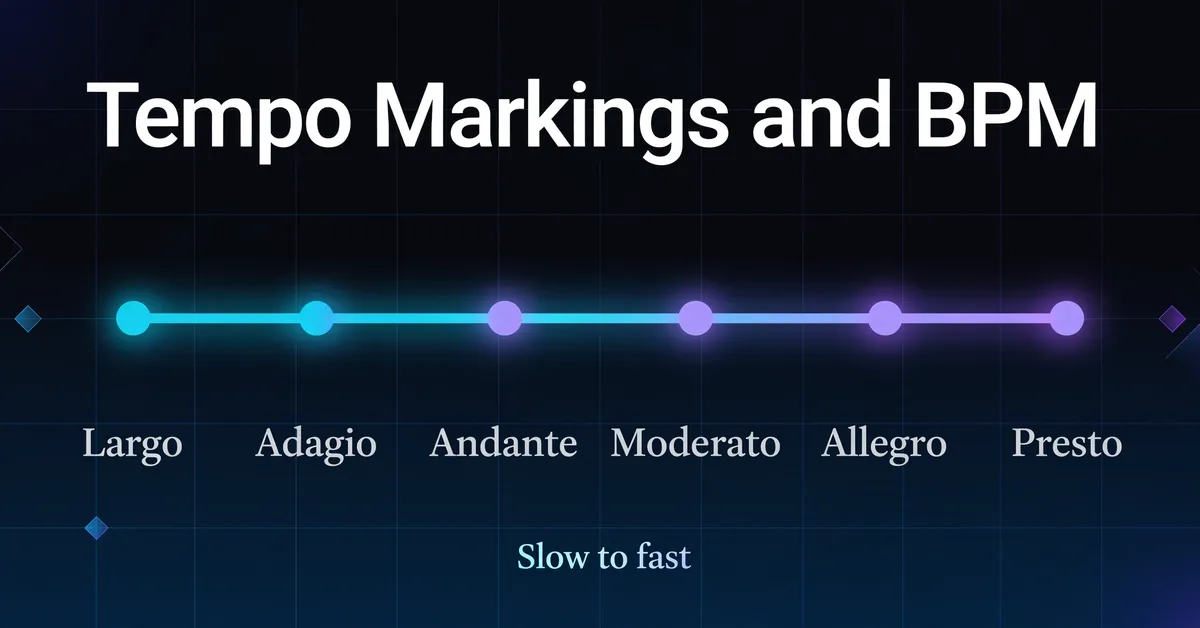
What Are Tempo Markings?
Tempo markings tell musicians how fast to play, and many also hint at a character such as broad, lively or solemn. Most of the familiar terms are Italian. This tempo markings chart pairs those words with BPM ranges that are this site's approximations, since published sources never fully agree. A printed metronome mark is always more specific than the word alone.
You'll find a marking at the top of the first system and again wherever the pace changes. A word like Allegro is a direction of travel. A note value with a number, such as quarter note = 132, is a destination. Our tempo guide covers that distinction in more depth, and the BPM explainer covers the number itself.
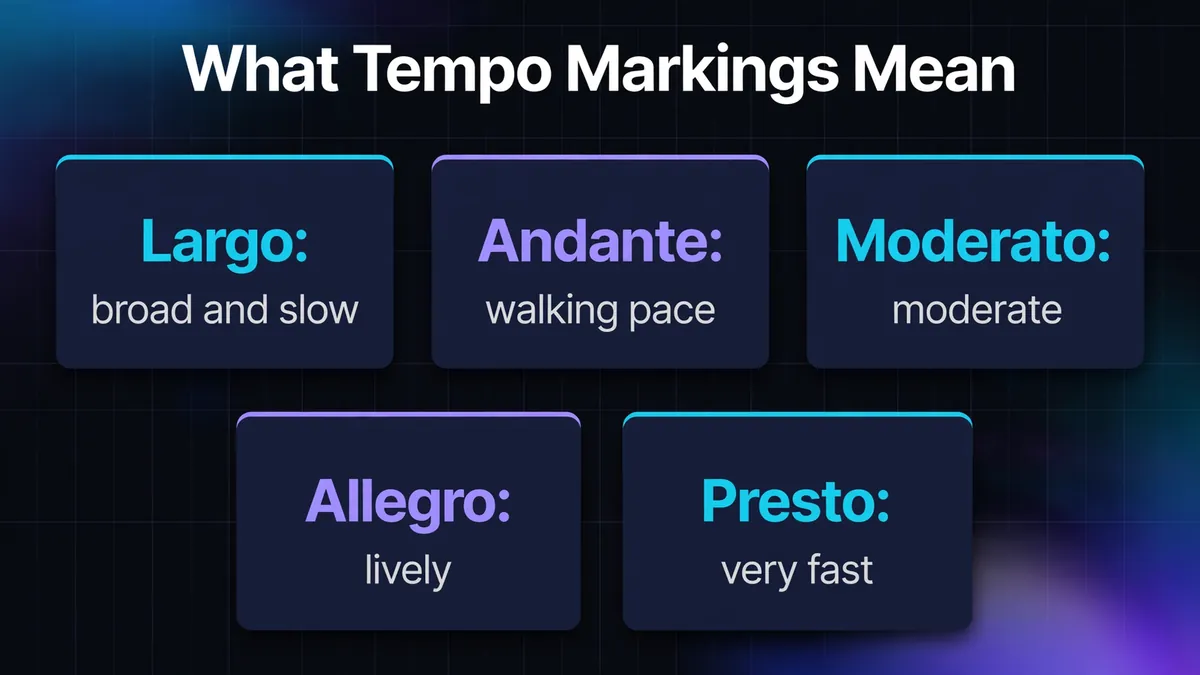
The Tempo Markings Chart
Treat them as reference bands rather than hard borders. The order runs broadly from slower to faster, and neighboring terms overlap on purpose.
All the numbers are quarter note BPM. An Andante in 6/8 marked dotted quarter = 60 therefore plays at 90 on a quarter note metronome.
| Marking | Site reference BPM range | Meaning or character |
|---|---|---|
| Larghissimo | 20 or below | Extremely broad and slow |
| Grave | 20 to 40 | Slow and solemn |
| Largo | 40 to 60 | Broad and slow |
| Lento | 45 to 60 | Slow |
| Larghetto | 60 to 66 | Rather broad, generally less slow than Largo |
| Adagio | 66 to 76 | Slow, at ease |
| Adagietto | 70 to 80 | A little Adagio, generally less slow |
| Andante | 76 to 108 | At a walking pace |
| Andantino | 80 to 108 | Near Andante; interpretation depends on context |
| Moderato | 108 to 120 | Moderate speed |
| Allegretto | 112 to 124 | Moderately fast, a little Allegro |
| Allegro | 120 to 156 | Fast, lively or cheerful |
| Vivace | 156 to 176 | Lively and brisk |
| Presto | 168 to 200 | Very fast |
| Prestissimo | 200 and above | Extremely fast |
Look at 122 BPM. It sits inside both the Allegretto and the Allegro bands, and that's fine, because the word still carries a mood the number can't. Andantino is the slipperiest entry. Some writers read it as a little slower than Andante, others as a little faster, and Dolmetsch discusses those differing historical interpretations. When you meet it, let the music decide.
If you want to hear any band, the online metronome runs from 20 to 360 BPM, so every row in this chart fits, including a very slow Grave.
Why Do Sources Give Different BPM Ranges?
Because tempo words never had fixed numbers attached. A teaching chart, a metronome scale and a survey of recordings answer three different questions, so their figures shouldn't be swapped for one another as if they measured the same thing.
Symphony Nova Scotia gives a reference list for listeners. Musicca reports analyses of recordings. Dolmetsch lists broad ranges next to other source and metronome figures. Each is useful, and each is a different kind of evidence.
There's a practical reason too. A slow movement full of sixteenth notes can feel busy at 60 BPM, while a hymn in half notes feels calm at 100. The marking describes the experience, and composers chose it with the rhythm on the page in mind.
Allegro, Moderato and Andante: Ranges by Source
All figures are BPM. The site reference column assumes quarter note BPM; convert any dotted quarter mark by multiplying it by 1.5. When using a score, keep its indicated beat unit rather than assuming every source or recording uses the same one.
| Marking | Site reference range | Musicca reported typical range | Musicca reported mean | Symphony Nova Scotia | Dolmetsch main listed range |
|---|---|---|---|---|---|
| Allegro | 120 to 156 | 100 to 160 | 133 | 109 to 132 | 84 to 144 |
| Moderato | 108 to 120 | 50 to 120 | 83 | 86 to 97 | 66 to 126 |
| Andante | 76 to 108 | 40 to 90 | 64 | 73 to 77 | 56 to 88 |
Musicca describes an analysis of 100 recordings for each term: Allegro, Moderato and Andante. Its typical ranges and means describe those samples, not universal limits or recommended starting tempos. The Symphony Nova Scotia list and Dolmetsch table are separate references; Dolmetsch also includes alternatives beyond the main ranges shown here.
Notice the Moderato row. Musicca's reported mean of 83 falls below this site's whole Moderato band, which starts at 108. Neither figure is wrong. One is an average of real performances, the other is a teaching band, and the gap is a good reminder that recordings don't follow charts.
How Do You Read a Metronome Mark Next to the Word?
A metronome mark has two parts: a note value and a number. The note value is the beat unit, and the number is how many of those land in a minute. To use it in a tool that counts quarter notes, convert the note value to quarters first, then set the result.
| Printed mark | Length in quarter notes | Enter in a quarter note tool |
|---|---|---|
| Quarter note = 96 | 1 | 96 |
| Half note = 60 | 2 | 120 |
| Dotted quarter = 60 | 1.5 | 90 |
| Dotted quarter = 72 | 1.5 | 108 |
| Eighth note = 132 | 0.5 | 66 |
| Dotted half = 50 | 3 | 150 |
Here's where the word and the number can seem to disagree. A piece marked Allegro with half note = 80 converts to 160 quarter note BPM, which lands in this site's Vivace band. Nothing is broken. The composer felt two big beats per bar, and Allegro describes how those half notes move. The same thing happens in reverse with a slow movement marked eighth note = 132: the quarter note setting is 66, squarely Adagio territory, even though the eighth clicks are quick. The note duration calculator helps when you want the millisecond length of each value at your chosen tempo.
Italian Qualifiers: Molto, Più and Con Brio
Qualifiers adjust speed or character without giving a fixed numerical conversion. Musicca's musical terms reference separates tempo language from expression instructions, and that split is worth keeping in mind.
| Term | Meaning | How to read it |
|---|---|---|
| Molto | Very or much | Intensifies the instruction it modifies |
| Più mosso | More motion | Move faster |
| Meno mosso | Less motion | Move slower |
| Con brio | With spirit or vigor | Add energy and character |
| Con fuoco | With fire | Play with fiery character |
| Non troppo | Not too much | Moderate the preceding instruction |
Molto Allegro means very fast. It doesn't mean multiply an Allegro BPM by some factor. Allegro ma non troppo pulls the other way: fast, but don't overdo it. Con brio and con fuoco are about attitude and attack, so they can't stand in for a metronome mark.
Changes inside a piece use their own vocabulary. Accelerando and ritardando move the tempo gradually. Musicca defines a tempo as a return to the preceding tempo and tempo primo as a return to the first one, which matters once a piece has already passed through two or three speeds.
How Do You Use a Tempo Marking in Practice?
Read the whole marking first and check for a note value and number. If only a word appears, use a reference band as starting context, then let phrasing, articulation, style and the hardest bar guide the final choice. Practicing below the target speed is normal and usually faster in the long run.
A few situations show how this plays out.
A piano student gets a sonatina movement marked Allegro with no number. She starts at 100, below the site band, because the left hand has running eighths. Once the passage is clean she nudges up 4 BPM at a time and ends around 126, inside the band, with every note still even.
A community choir conductor sees Andante on a hymn arrangement. The text has long phrases, so 76 would leave the singers gasping. She tries 88 and checks that the longest phrase fits in one breath. The band gave her a neighborhood; the singers gave her the address.
A producer wants a string sample to feel like Adagio under a beat at 140. Rather than slowing the track, he writes the strings in half notes. At 140 BPM the half notes move at 70 per minute, which sits in the site's Adagio band, while the drums keep their pace. The half time BPM calculator runs the same idea from the other side.
When you have a recording rather than a score, find the number first with tap tempo or the BPM finder, then compare it with the chart. The BPM chart compares numerical settings across many tempos; this page explains the words.
Common Mistakes With Tempo Markings
Most tempo trouble comes from reading the chart as law. These are the slips that come up again and again with students and in rehearsals.
- Treating a band edge as a rule. Playing Andante at 110 isn't an error if the music needs it; the site band is a reference, not a border.
- Ignoring the beat unit. Half note = 60 is 120 quarter notes per minute, not 60.
- Starting at performance speed. If the hardest bar falls apart, the tempo is wrong for today, whatever the marking says.
- Reading Andante as slow. It's a walking pace, and in this site's chart it sits above Adagio.
- Forgetting character. Allegro at a correct number but played heavily misses half the instruction.
- Mixing up a tempo and tempo primo after several changes, then resuming the wrong speed.