
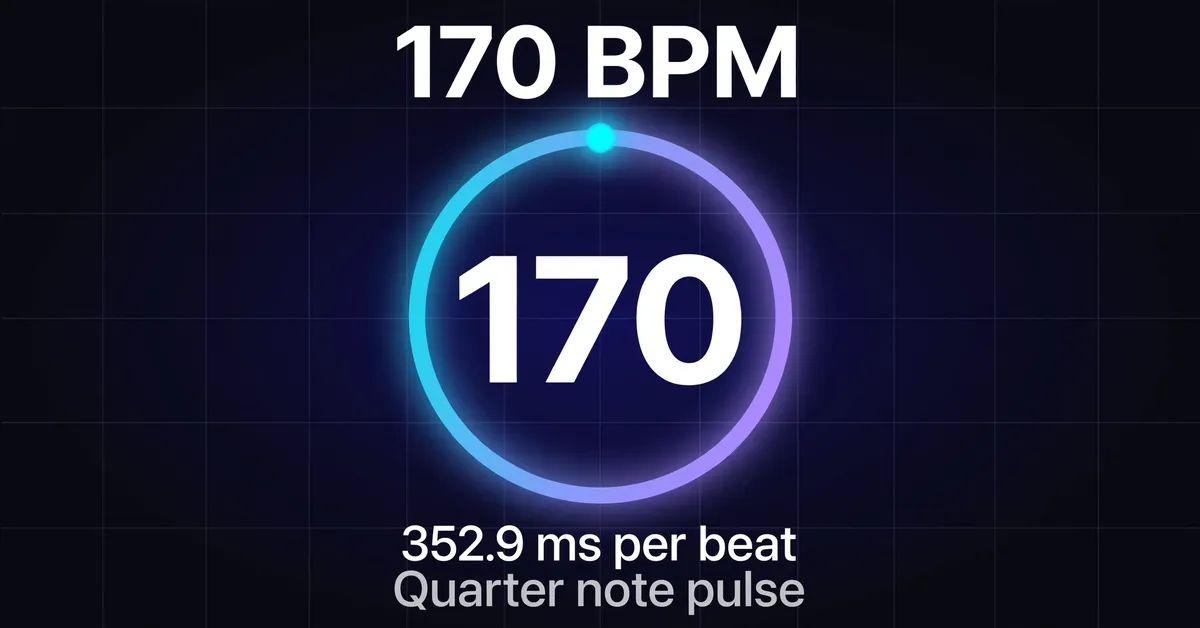
What Is 170 BPM?
A 170 BPM metronome ticks 170 times a minute, leaving roughly 352.94 milliseconds between beats, or about 2.83 beats per second. On this site's chart that rate lands where Vivace and Presto overlap. It is a common working tempo for drum and bass practice, and many listeners follow it as an 85 BPM half count.
Unlike 160, this tempo does not divide into tidy milliseconds. The beat is 352.941... ms, a repeating decimal, so the rounding habits you use here matter more than they do at friendlier numbers. The sections below show where that bites and how to avoid it.

What Are the Note Lengths at 170 BPM?
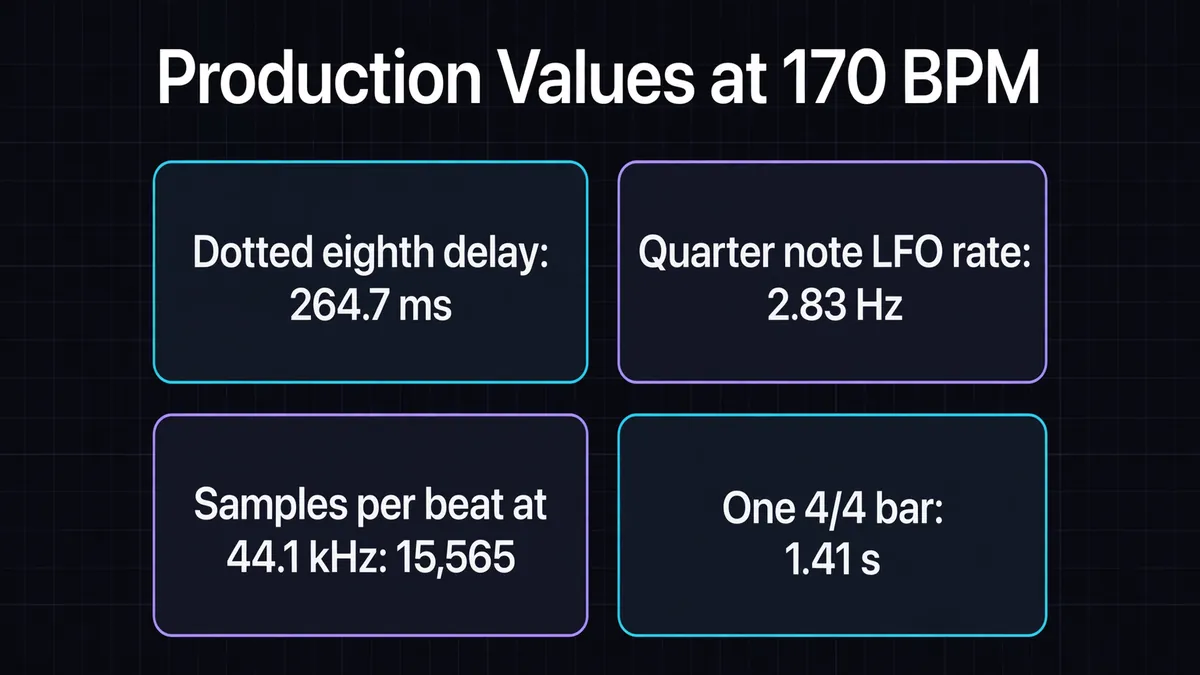
At 170 BPM a quarter note lasts about 352.94 ms, an eighth about 176.47 ms, a sixteenth about 88.24 ms and an eighth note triplet about 117.65 ms. The dotted eighth comes to about 264.71 ms. Each value is calculated from the unrounded beat and rounded only at the last step.
The beat behind each value is a quarter note. Reading a 6/8 tune marked by its dotted quarter? Multiply by 1.5 first; a mark of 114 would give 171, a single BPM above this page.
| Note value | Beats | Duration (ms) | Rate (Hz) |
|---|---|---|---|
| Whole note | 4 | 1411.76 | 0.71 |
| Dotted half | 3 | 1058.82 | 0.94 |
| Half note | 2 | 705.88 | 1.42 |
| Dotted quarter | 1.5 | 529.41 | 1.89 |
| Quarter note | 1 | 352.94 | 2.83 |
| Dotted eighth | 0.75 | 264.71 | 3.78 |
| Quarter note triplet | 2/3 | 235.29 | 4.25 |
| Eighth note | 0.5 | 176.47 | 5.67 |
| Dotted sixteenth | 0.375 | 132.35 | 7.56 |
| Eighth note triplet | 1/3 | 117.65 | 8.50 |
| Sixteenth note | 0.25 | 88.24 | 11.33 |
| Sixteenth note triplet | 1/6 | 58.82 | 17.00 |
| Thirty second note | 0.125 | 44.12 | 22.67 |
| Sixty fourth note | 0.0625 | 22.06 | 45.33 |
Interestingly, the Hz column comes out cleaner than the milliseconds: eighth note triplets repeat at exactly 8.5 Hz and sixteenth triplets at exactly 17 Hz, because 170 ÷ 60 × 3 = 8.5. If your synth's LFO accepts Hz rather than note values, those are the settings that stay exact. The note duration calculator and BPM to ms converter give values for neighboring tempos.
In samples, one beat is about 15,564.71 at 44.1 kHz and about 16,941.18 at 48 kHz. A 4/4 bar comes to about 62,258.82 and 67,764.71 samples. Neither lands on a whole number, so let the DAW's grid handle loop points rather than typing sample counts. See BPM to samples for the method.
How Long Do Bars and Sections Last at 170 BPM?
One 4/4 bar at 170 BPM lasts about 1.412 seconds, while 3/4 and 6/8 bars each take about 1.059 seconds. Sixteen bars of 4/4, a typical drum and bass intro length, run about 22.59 seconds. Multiply the beats by 60, divide by 170, and round at the end.
| Bars | 4/4 (4 beats) | 3/4 (3 beats) | 6/8 (3 quarter beats) |
|---|---|---|---|
| 1 | 1.412 s | 1.059 s | 1.059 s |
| 4 | 5.647 s | 4.235 s | 4.235 s |
| 8 | 11.294 s | 8.471 s | 8.471 s |
| 16 | 22.588 s | 16.941 s | 16.941 s |
| 32 | 45.176 s | 33.882 s | 33.882 s |
The 6/8 column counts six eighths as three quarter note beats, the same assumption the online metronome uses in x/8 meters, where each eighth clicks. A 6/8 piece marked dotted quarter equals 170 would need 255 entered as the quarter note setting.
For a DJ, a three minute track at 170 holds 510 beats, or 127.5 bars of 4/4, so a radio edit often ends mid phrase unless it was cut to a bar line. A dancer counting eights finishes each eight count in about 2.82 seconds. The time signatures and BPM guide covers other meters.
Is 170 BPM Vivace or Presto?
On this site's chart, 170 BPM belongs to both: Vivace spans roughly 156 to 176 BPM and Presto roughly 168 to 200 BPM, so the bands overlap from 168 to 176. Both ranges are this site's approximations, and other references overlap them in different places. The character of the passage, lively or very fast, decides which word a composer would choose.
If a score prints a metronome mark with a note symbol, trust that over the Italian word. Every band appears on the tempo markings BPM chart, and what is tempo explains how the terms describe mood alongside speed.
What Is a Good Way to Practice at 170 BPM?
Build up from the half count. Play the part against 85 BPM, treating each click as two beats, then raise the metronome in small jumps toward 170. Finish with an eighth note subdivision, where gaps of about 176.47 ms make any early or late note obvious.
A liquid drum and bass exercise suits keyboard players and producers alike: hold sustained chords for two bars each while a simple two step drum loop runs underneath, and keep counting the pulse through every chord change. The challenge is staying relaxed in the harmony while the drums move quickly. Calling a track liquid describes its sound and harmony as much as its tempo.
A step plan for a drummer:
- 85 BPM, click on every beat, play the groove as if each click were a half note (about 705.88 ms apart).
- 130 BPM, quarters (about 461.54 ms).
- 150 BPM, quarters, four clean passes (400 ms).
- 170 BPM with the click on eighths.
- 174 BPM briefly as an overshoot, then settle back to 170.
The speed trainer on the metronome can handle the climb for you, and since the accent is on beat 1 only, saying bar numbers aloud keeps long sections on track. To check a reference track, use tap tempo with the spacebar or a letter or number key; it averages the last 8 gaps, sets outliers aside and starts fresh after a 2.5 second pause.
Which Songs Are Reported at 170 BPM?
Linked databases list "STAY" by The Kid LAROI and Justin Bieber, "Darkside" by Alan Walker featuring Au/Ra and Tomine Harket, and "Strangers" by Kenya Grace at 170 BPM. These are database readings with links, not independent audio analysis, and sharing a tempo does not make a song drum and bass.
The linked databases report the tempos below. Nearby matches and alternative counts are labeled separately. Use the named version where one is given; a counting option does not establish the recording's intended feel.
| Song | Artist | Recording version | Reported BPM | Counting option | Sources |
|---|---|---|---|---|---|
| STAY | The Kid LAROI and Justin Bieber | With Justin Bieber | 170 | 170 BPM count | SongBPM |
| Darkside | Alan Walker featuring Au/Ra and Tomine Harket | Different World | 170 | 170 BPM count | Tunebat |
| Strangers | Kenya Grace | Version unspecified | 170 | 170 BPM count | SongBPM |
If you tap one of these and get 85, you are counting the slower layer, which is normal for fast pop and electronic tracks. Why BPM detectors disagree explains how half and double readings arise.
How Do Producers Set Up a Session at 170 BPM?
Set the project tempo to 170 and use tempo synced effects wherever possible. Useful starting points are an eighth note delay around 176.47 ms, a dotted eighth around 264.71 ms and a sixty fourth note reverb pre delay near 22.06 ms. Then shorten decay or feedback until the repeats clear the next snare.
An eighth note delay lasts about 176.47 ms. A sixty fourth note reverb pre delay is about 22.06 ms. Compare the repeats with the snare and hi hats, then shorten the decay or reduce feedback if the effect crowds the next phrase. Use the delay calculator and reverb calculator to compare timings.
Scenario: a producer in Ableton Live, FL Studio, Logic Pro or Pro Tools ducks a reese bass with sidechain compression from a kick on beats 1 and 3. Kicks then arrive every 705.88 ms, so a release around 352.94 ms, one beat, lets the bass return before the snare on beat 2. If the delay plugin has no sync and you type 176 ms, each repeat lands about 0.47 ms early; after 20 feedback repeats that adds up to roughly 9.41 ms, enough to soften the groove. The BPM to Hz tool converts LFO rates.
What Do 85 BPM and 340 BPM Mean for 170 BPM?
Half time of 170 BPM is 85 BPM, about 705.88 ms per counted beat, and double time is 340 BPM, about 176.47 ms per counted beat. Playback speed stays the same in both cases. What changes is which layer of the rhythm you choose to call the beat.
Half the rate is 85 BPM, and double the rate is 340 BPM. You can follow those pulse levels without changing playback speed. A half time or double time drum feel depends on the pattern and accents as well as the count. Compare the numbers with the half time calculator and double time calculator, or use the half time vs double time guide for the musical distinction.
Compared with 174, a frequent drum and bass reference, 170 is four BPM slower and each beat is about 8.11 ms longer (352.94 against 344.83 ms). Over 32 bars of 4/4 that gap grows to about 1.04 seconds, so two tracks at these tempos drift apart quickly in a mix unless one is adjusted. Neighboring presets are the 160 BPM metronome and the 174 BPM metronome, and the drum and bass BPM page has the genre context.
Which Mistakes Show Up Most at 170 BPM?
Most errors at 170 BPM come from rounding the 352.94 ms beat too early, confusing an 85 BPM half count with a different tempo, and assuming 170 and 174 are interchangeable. Each one either shifts your timing or leads you to the wrong number.
- Rounding the beat to 353 ms before multiplying. Across 32 bars (128 beats) that gives 45,184 ms, about 7.53 ms longer than the exact 45,176.47 ms.
- Reporting 85 as a song's tempo because you tapped on the snare. Snares in a two step pattern fall every 705.88 ms.
- Mixing a 170 track against a 174 track without adjusting either one.
- Entering 170 for a 6/8 score marked dotted quarter equals 170. The quarter note setting is 255.
- Treating every 170 BPM song as drum and bass, when the list above includes pop.