
How Do You Count BPM by Hand?
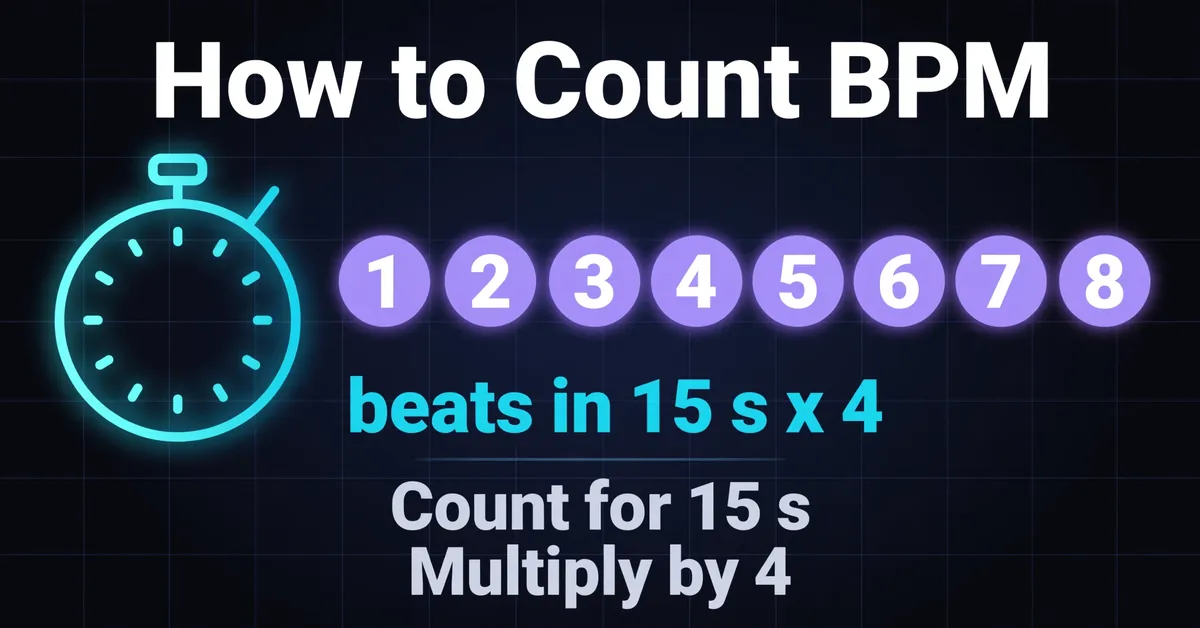
Here is how to count BPM with nothing but a timer: start a stopwatch on a beat and call that beat zero, count every following beat for 15 seconds, then multiply by four. If beat 32 lands right at 15 seconds, the song is 32 × 4 = 128 BPM. Repeat once to confirm.
- Play the song and listen for a few bars before touching the clock. Find the pulse you would nod your head to.
- Start the stopwatch exactly on a beat and say "zero" out loud or in your head.
- Count each following beat: one, two, three, and keep going.
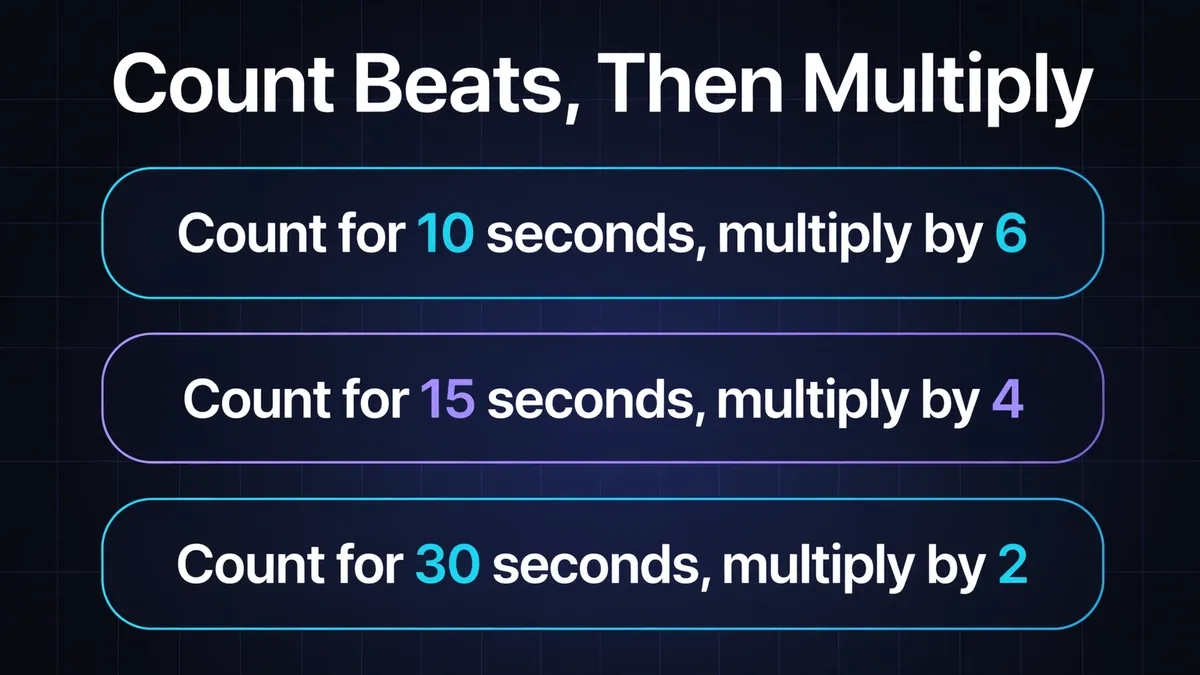
- Stop at your chosen window and multiply: 15 seconds by 4, 30 seconds by 2, 60 seconds by 1.
That is the whole method. The rest of this page is about the places it quietly goes wrong, because a hand count can easily be 4 or 8 BPM off without feeling wrong.
What Is the BPM Counting Formula?
The general formula divides the beats you counted by the seconds that passed, then scales to a minute. It works for any window, not just 15, 30 or 60 seconds, as long as the count starts at zero on a beat.
Count from zero to 48 over 24 seconds and you get (48 ÷ 24) × 60 = 120 BPM. Count 40 beats and stop the watch on the 40th, reading 18.8 seconds: (40 ÷ 18.8) × 60 = 127.7, so call it 128 BPM.
The BPM calculator does this arithmetic for any count and duration. All examples here assume BPM counts quarter notes, which is the usual convention in pop, rock, electronic music and DAW software. Counting the big pulse of a 6/8 tune instead? Multiply your count by 1.5 to get quarter note BPM.
Why Do You Start the Count at Zero?
Because you are counting gaps between beats, not the beats themselves. The beat that starts the clock has no time behind it yet. Calling it "one" adds a beat that took zero seconds, and the result comes out high.
Picture a fence. Five posts make four gaps. In a 15 second count, that one extra post adds 4 BPM: a true 120 BPM song reads as 31 × 4 = 124. This is the single most common mistake in manual counting, and it always errs in the same direction, which makes it easy to miss.
Soundplate's counting guide uses a shorter 10 second window with the same principle: 21 beats in 10 seconds, times 6, gives 126 BPM.
Which Counting Window Should You Use?
Longer windows shrink the effect of a single miscount. One extra or missing beat costs 4 BPM over 15 seconds but only 1 BPM over 60 seconds. The tradeoff is concentration, and a long window blurs any tempo change inside it.
| Counting window | Multiply count by | One beat off changes result by | Good for |
|---|---|---|---|
| 10 seconds | 6 | 6 BPM | Rough first guess |
| 15 seconds | 4 | 4 BPM | Quick check |
| 30 seconds | 2 | 2 BPM | Most songs |
| 60 seconds | 1 | 1 BPM | Steady tracks, final check |
This table assumes BPM counts quarter notes. The error column comes straight from the multiplier; it is not a measured accuracy figure.
The same error matters more at slow tempos. A 4 BPM miss on a 72 BPM ballad is about 5.6 percent of the tempo. On a 170 BPM drum and bass track it is about 2.4 percent. For slow music, lean toward 30 or 60 seconds.
What If the Timer Stops Between Beats?
Then your count is only an estimate. The fixed multiplier assumes the last beat lands exactly on 15 seconds, and it rarely does. At 128 BPM, beats arrive every 469 ms, so the window often ends somewhere between two of them.
There are two clean fixes. First, ignore the fixed window: count to a round number like 32 or 64, stop the watch on that beat, and use the general formula with the real elapsed time. Second, if you have the audio in a DAW or editor, read the timeline. A beat at 0:12.40 and the 64th beat after it at 0:42.40 give 64 beats in 30.0 seconds, which is (64 ÷ 30) × 60 = 128 BPM.
Can You Count Bars Instead of Beats?
Yes, if you know the time signature and which note gets the beat. Bars are easier to track over a long window because you count 30 things instead of 120.
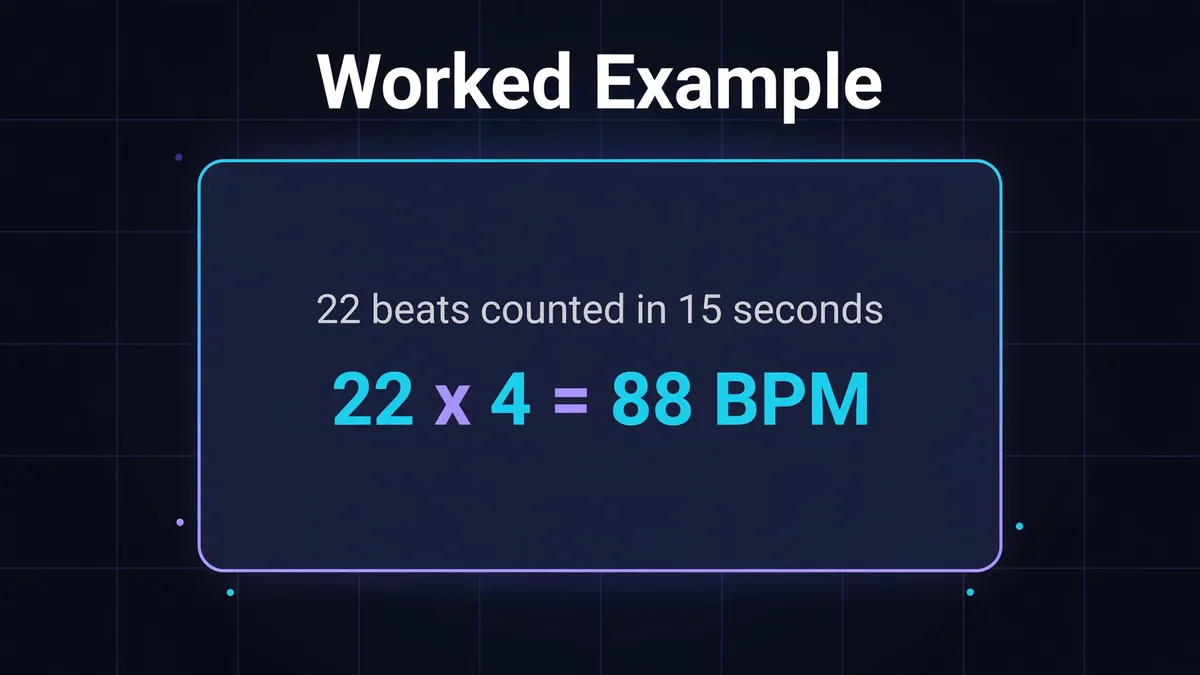
In 4/4, each bar holds four quarter note beats. Count 30 bars in 60 seconds and the tempo is 30 × 4 = 120 BPM. In 3/4, multiply bars by 3. In 6/8, most players feel two dotted quarter beats per bar, so 22 dotted quarter beats in 15 seconds is 88 per minute on that pulse; a quarter note metronome would need 88 × 1.5 = 132 BPM. The time signatures guide covers those conversions in detail.
Bar counting breaks down when a song drops or adds a beat, which happens more often in live recordings than you would think. If the numbers look odd, go back to counting beats.
What Should You Count, and What Goes Wrong?
Count the underlying pulse, not every sound you hear. A kick drum can skip beats, the snare often lands only on 2 and 4, and a hi hat may play two or four notes per beat. Pick a level and stay there through fills.
The usual mistakes, roughly in order of how often they show up:
- Starting at one instead of zero, which inflates the result.
- Switching from beats to hi hat eighth notes halfway through a busy fill.
- Losing your place around beat 40 and guessing.
- Counting through a tempo change, a breakdown or a free intro.
- Getting half or double the published BPM and assuming you miscounted.
That last one usually is not a mistake at all. A hip hop track at 90 BPM can feel like 180, and a dubstep track at 140 often feels like 70. Both counts describe real pulses. The half time vs double time guide helps you choose the one that fits your purpose.
Music without drums is harder but still countable. Follow bass notes, strummed chords or the place where a melody leans. If the music breathes freely with no regular pulse, as in some solo piano or ambient pieces, a single BPM may not describe it usefully.
Counting in Real Situations
A drummer at rehearsal wants to know if the band rushed the chorus. She counts from zero for 30 seconds on the rehearsal recording during the verse and gets 58, which is 116 BPM. The chorus gives 62, which is 124 BPM. That 8 BPM jump is the conversation to have before the gig.
A student preparing an exam piece has no metronome handy. He counts 18 beats in 15 seconds on a reference recording, which is 72 BPM, then checks with a 30 second count of 37, giving 74. The two answers bracket the tempo, so he practices at 72 on the online metronome later that night.
A DJ who cannot load a track into software counts 32 in 15 seconds, 128 BPM, then confirms with the tap tempo tool in a few seconds of tapping. Counting and tapping are good cross checks precisely because they fail in different ways. If you prefer a timer that does the counting for you, the BPM counter records your taps over 15, 30 or 60 seconds. For every other way to get a tempo, including audio analysis, see how to find BPM.