
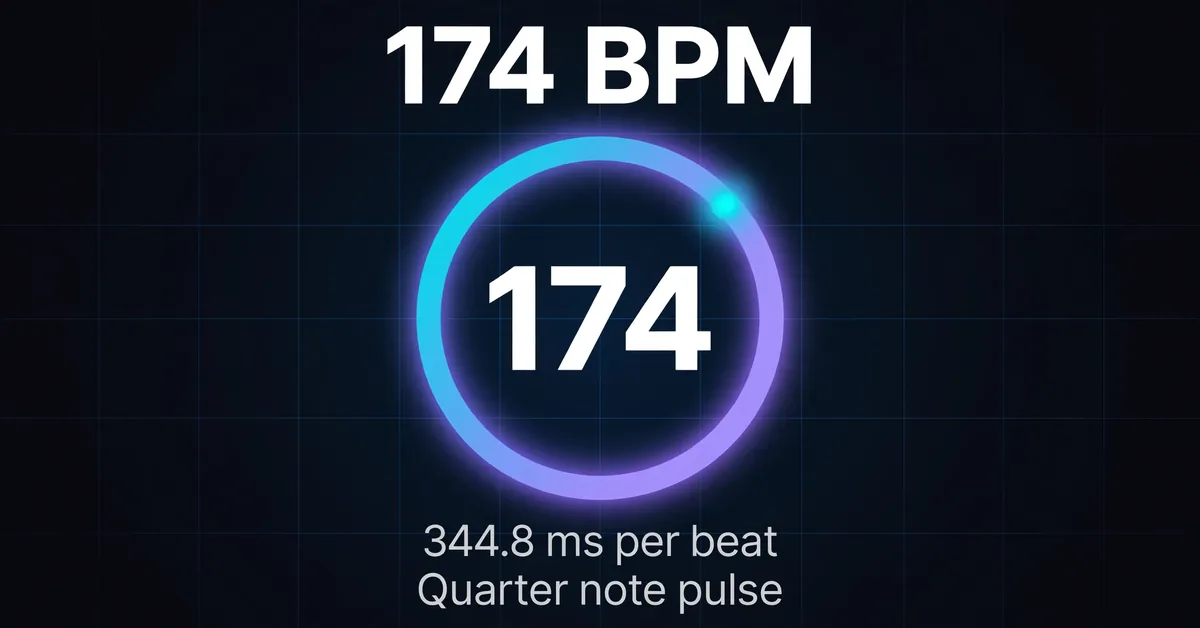
What Is 174 BPM?
174 BPM means 174 beats per minute, so a new beat arrives roughly every 344.83 milliseconds, a little under three per second. Drum and bass producers often start a project here and feel it as 87. Start the 174 BPM metronome, then use the tables below for note lengths, bar timings and sample counts.
That half count matters more at this tempo than at most others. Many listeners nod along at 87 while the hi hats and breakbeats race at the full rate, so this page gives you both numbers side by side.
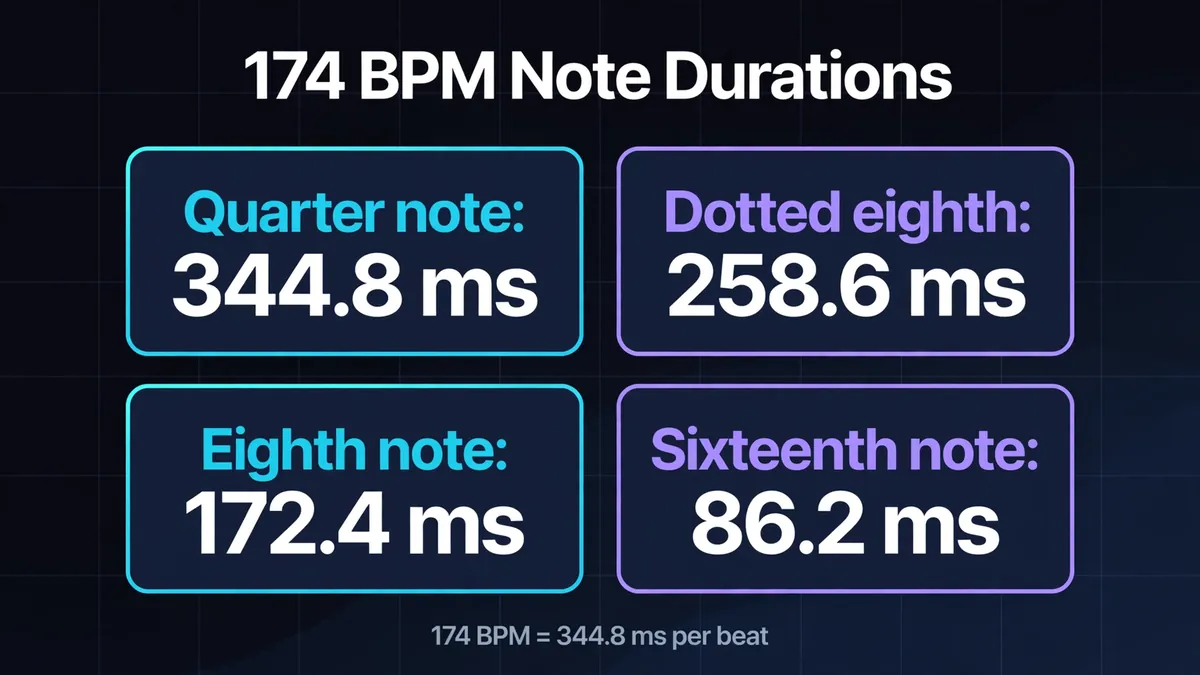
How Long Is Each Note Value at 174 BPM?
A quarter note at 174 BPM lasts 344.83 ms. Halve it for an eighth note (172.41 ms) and again for a sixteenth (86.21 ms). A dotted eighth runs 258.62 ms and an eighth note triplet 114.94 ms. Every value below is rounded to two decimals from the unrounded result of 60,000 ÷ 174.
Each value counts a 174 BPM quarter note. A 6/8 jig marked dotted quarter = 116 asks for exactly this setting, because 116 × 1.5 = 174.
| Note value | Beats | Duration (ms) | Hz (repeats per second) |
|---|---|---|---|
| Whole note | 4 | 1379.31 | 0.73 |
| Dotted half | 3 | 1034.48 | 0.97 |
| Half note | 2 | 689.66 | 1.45 |
| Half note triplet | 4/3 | 459.77 | 2.18 |
| Dotted quarter | 1.5 | 517.24 | 1.93 |
| Quarter note | 1 | 344.83 | 2.90 |
| Dotted eighth | 0.75 | 258.62 | 3.87 |
| Quarter note triplet | 2/3 | 229.89 | 4.35 |
| Eighth note | 0.5 | 172.41 | 5.80 |
| Dotted sixteenth | 0.375 | 129.31 | 7.73 |
| Eighth note triplet | 1/3 | 114.94 | 8.70 |
| Sixteenth note | 0.25 | 86.21 | 11.60 |
| Sixteenth note triplet | 1/6 | 57.47 | 17.40 |
| Thirty second note | 0.125 | 43.10 | 23.20 |
| Sixty fourth note | 0.0625 | 21.55 | 46.40 |
Worked example: a dotted eighth is three sixteenths, so 86.2069 × 3 = 258.62 ms. Working from the rounded 86.21 gives 258.63, which is why the table always multiplies the unrounded beat. The note duration calculator and BPM to ms converter cover any value not listed.
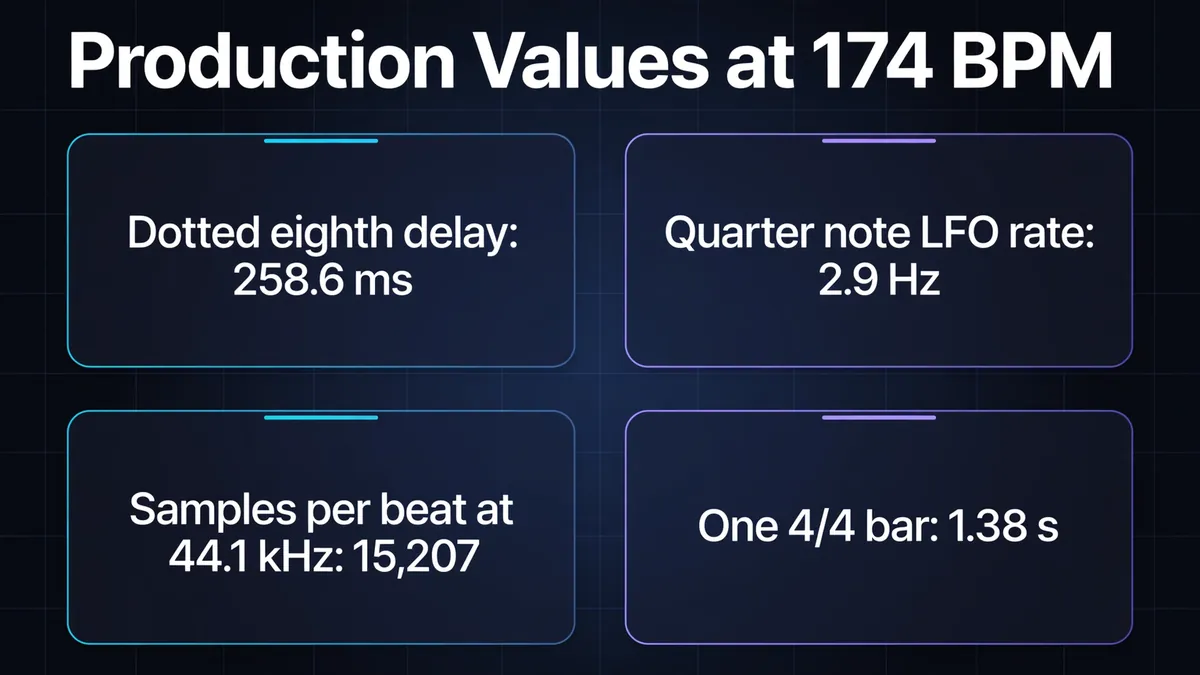
Sample counts are useful when you trim loops by hand. One beat equals about 15,206.90 samples at 44.1 kHz and about 16,551.72 at 48 kHz. A full 4/4 bar is about 60,827.59 samples at 44.1 kHz and about 66,206.90 at 48 kHz. None of these land on whole numbers, so let your DAW grid do the cutting; BPM to samples handles other rates.
| Unit at 174 BPM | Samples at 44.1 kHz | Samples at 48 kHz |
|---|---|---|
| Sixteenth note | 3,801.72 | 4,137.93 |
| Quarter note | 15,206.90 | 16,551.72 |
| One 4/4 bar | 60,827.59 | 66,206.90 |
How Long Are Bars and Phrases at 174 BPM?
One 4/4 bar at 174 BPM takes about 1.379 seconds, and a 16 bar section takes about 22.069 seconds. Bars of 3/4 and 6/8 each hold three quarter note beats, so they last about 1.034 seconds. Multiply the beats in the passage by 60, divide by 174, and round once at the end.
| Bars | 4/4 (4 beats) | 3/4 (3 beats) | 6/8 (3 quarter beats) |
|---|---|---|---|
| 1 | 1.379 s | 1.034 s | 1.034 s |
| 4 | 5.517 s | 4.138 s | 4.138 s |
| 8 | 11.034 s | 8.276 s | 8.276 s |
| 16 | 22.069 s | 16.552 s | 16.552 s |
| 32 | 44.138 s | 33.103 s | 33.103 s |
In 6/8 the metronome still counts quarter notes, and each eighth clicks, so six clicks fill one bar. A DJ planning a mix can use the 32 bar figure directly: a 32 bar intro lasts about 44 seconds, which is the window for bringing in the next track. A three minute arrangement at 174 holds 522 beats, or 130.5 bars of 4/4. More meters are covered in time signatures and BPM.
What Tempo Marking Is 174 BPM?
On this site's tempo chart, 174 BPM sits where Vivace (156 to 176 BPM) and Presto (168 to 200 BPM) overlap. It is not Prestissimo, which starts at 200 on the chart. Other charts move these lines, and a printed metronome mark always takes priority.
The overlap simply means either word could describe the pace. Vivace suggests liveliness, while Presto stresses sheer speed. The tempo markings chart lists every band and explains why the bands share edges.
What Does 174 BPM Feel Like?
At full rate the pulse feels urgent, close to three clicks a second. Counted at 87, it relaxes into a steady head nod with busy detail on top. One two step drum and bass exercise in 4/4 puts the kick on beat 1 and the "and" of 3, with snares on 2 and 4.
That two step layout is a practice pattern, not a rule for the genre. Count it as "1 and 2 and 3 and 4 and" with the metronome on every number. The snare on 2 and 4 at 174 lands every 689.66 ms, the same spacing as beats 1 and 2 of an 87 BPM count, which is why the track can feel slow and fast at once.
How Can You Practice With a 174 BPM Metronome?
Begin below the target, around 150 BPM, then raise the click in small steps once a pattern feels even. At 174 the sixteenth note gap is only 86.21 ms, so loose hand motion shows up quickly. Use the speed trainer on the online metronome to climb gradually instead of jumping.
A drummer learning a breakbeat might work like this:
- Set the metronome to 87 BPM and play the pattern with the click on every quarter note. Each click now equals two beats at 174.
- Move to 174 BPM with an eighth note subdivision off, so the click marks each full rate beat.
- Turn on the sixteenth subdivision for the last pass and check that the ghost notes sit between clicks rather than smearing into them.
A guitarist or keyboard player can do the same with eighth note runs: 172.41 ms per note is fast but manageable once the hand stays relaxed. If you only have a recording and no number, tap along with the tap tempo tool first to confirm you are at 174 and not 172 or 175.
Which Songs Are Reported at 174 BPM?
Linked databases report "Footloose" by Kenny Loggins, "As It Was" by Harry Styles and "Empire State of Mind" by Jay-Z and Alicia Keys at 174 BPM. Sigma's "Nobody To Love" Radio Edit is a nearby match at 175, and "Wonderwall" is reported at 87, half of 174.
<a id="songs-at-174-bpm"></a>
These figures come from the linked database entries, not from our own audio measurement. Nearby matches and alternative counts are labeled separately. Use the named version where one is given; a counting option does not establish the recording's intended feel.
| Song | Artist | Recording version | Reported BPM | Counting option | Sources |
|---|---|---|---|---|---|
| Footloose | Kenny Loggins | Version unspecified | 174 | 174 BPM count | SongBPM |
| Nobody To Love | Sigma | Radio Edit | 175 | Nearby match, 1 BPM above 174 | SongBPM |
| As It Was | Harry Styles | Version unspecified | 174 | 87 BPM alternative count | Tunebat |
| Empire State of Mind | Jay-Z and Alicia Keys | Version unspecified | 174 | 87 BPM alternative count | SongBPM |
| Wonderwall | Oasis | Version unspecified | 87 | 174 BPM double count | GetSongBPM |
Notice how mixed this list is. A rock anthem, a pop hit and a hip hop track all show 174 or 87, which shows that the number alone says little about style. If a detector gives you 87 for a song you hear at 174, nothing is wrong; why BPM detectors disagree explains the octave issue.
How Do Producers Work at 174 BPM?
Producers at 174 BPM usually set delays and modulation from note values: a dotted eighth delay of about 258.62 ms, a straight eighth of 172.41 ms, and a sixty fourth note reverb pre delay near 21.55 ms. Treat these as starting points and trim by ear against the drums.
174 BPM is a practical drum and bass starting point, and Native Instruments uses it in a production tutorial. That example supports trying the setting, not a universal rule. In Ableton Live, Logic Pro, FL Studio or Pro Tools, type 174 into the project tempo field and the grid, synced LFOs and tempo synced delays follow.
A few starting settings, all derived from 344.83 ms per beat:
- Sidechain release on a bass under the kick: try a quarter note (344.83 ms) for long pumping or an eighth (172.41 ms) for a tighter duck.
- Wobble or filter LFO: a quarter note rate cycles 2.90 times a second; an eighth note triplet cycles 8.70 times a second.
- Reverb tail on the snare: a half note (689.66 ms) decays before the next snare at the 174 count, which keeps the backbeat clear.
The delay calculator and reverb calculator list more values.
What Are Half Time and Double Time at 174 BPM?
Half time of 174 BPM is 87 BPM, with a beat every 689.66 ms. Double time is 348 BPM, with a beat every 172.41 ms. In halftime drum and bass, the drums are often counted at 87 while the tempo setting stays at 174; playback speed does not change.
One halftime bar of 4/4 counted at 87 lasts 4 × 60 ÷ 87 = 2.759 seconds, exactly the length of two bars at 174. That is why a halftime section drops into a 174 project without any tempo change: the snare just moves from beats 2 and 4 to beat 3 of the bar. The real difference in feel comes from where the accents sit, not from the number. Compare levels with the half time calculator and double time calculator, and read half time vs double time for the musical side. The neighboring presets are 170 BPM and 180 BPM.
Where Do People Go Wrong at 174 BPM?
The usual errors at 174 BPM come from mixing up pulse levels or rounding too early. People enter 87 into a DAW when the project should be 174, calculate delays from a rounded 345 ms, or call the tempo Prestissimo. Each one shifts timing or labels in a way you can hear or measure.
- Using 345 ms per beat. Over 32 bars the error grows to 128 × 0.17 ms, about 22 ms, enough to drift a hand placed sample off the grid.
- Setting the project to 87 for halftime. The grid then treats each sixteenth as 172.41 ms, so synced hats and delays run at half the intended rate.
- Assuming a database figure of 87 is wrong. It is often the same song counted at the other level.
- Practicing only at full speed. Jumping straight to 174 hides uneven sixteenths; build up from a slower click.
- Calling 174 Prestissimo. On this site's chart it sits in the Vivace to Presto overlap.