
What Is 90 BPM?
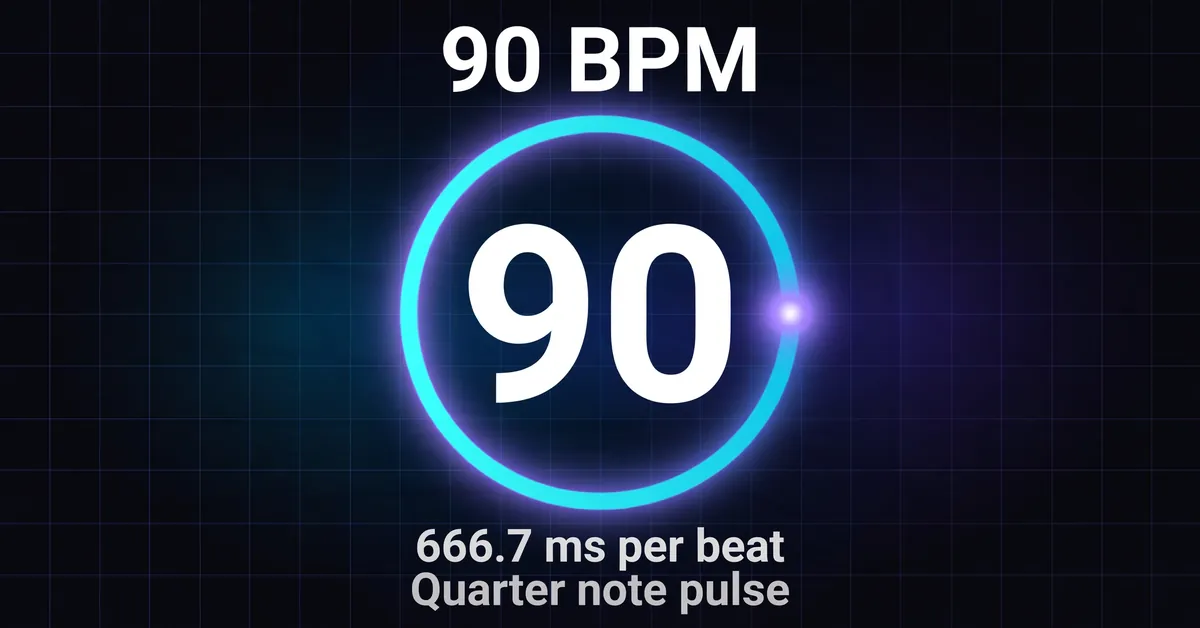
90 BPM means 90 beats per minute, or exactly 1.5 beats per second. Each beat lasts about 666.67 milliseconds. Start the 90 BPM metronome for a hip hop groove, use the linked songs for listening practice, and compare a 180 BPM double count without changing the recording's playback speed.
The beat length repeats forever as a decimal (666.666...), but many related values come out whole. A dotted quarter is exactly 1,000 ms, a dotted eighth exactly 500 ms, and a bar of 3/4 exactly 2 seconds. Those round figures make 90 a friendly tempo for delays and for counting in 3.
How Long Is Each Note Value at 90 BPM?
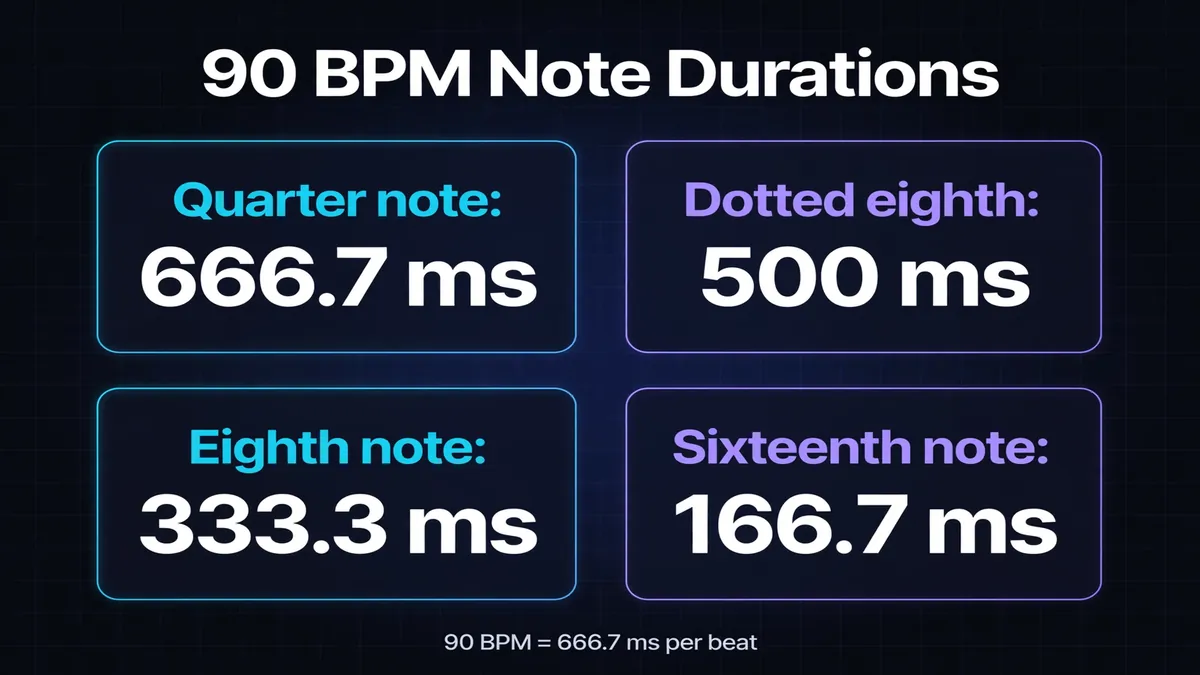
At 90 BPM a quarter note lasts 666.67 ms, an eighth note 333.33 ms, a sixteenth 166.67 ms and an eighth note triplet 222.22 ms. A dotted eighth is exactly 500 ms and a dotted quarter exactly 1,000 ms. These values assume BPM counts quarter notes.
| Note value | Fraction of a beat | Duration (ms) | Rate (Hz) |
|---|---|---|---|
| Whole note | 4 | 2666.67 | 0.38 |
| Dotted half | 3 | 2000.00 | 0.50 |
| Half note | 2 | 1333.33 | 0.75 |
| Dotted quarter | 1.5 | 1000.00 | 1.00 |
| Quarter note | 1 | 666.67 | 1.50 |
| Dotted eighth | 0.75 | 500.00 | 2.00 |
| Quarter note triplet | 2/3 | 444.44 | 2.25 |
| Eighth note | 1/2 | 333.33 | 3.00 |
| Dotted sixteenth | 3/8 | 250.00 | 4.00 |
| Eighth note triplet | 1/3 | 222.22 | 4.50 |
| Sixteenth note | 1/4 | 166.67 | 6.00 |
| Sixteenth note triplet | 1/6 | 111.11 | 9.00 |
| Thirty second note | 1/8 | 83.33 | 12.00 |
| Sixty fourth note | 1/16 | 41.67 | 24.00 |
The dotted eighth at 90 matches a quarter note at 120 BPM, and the dotted quarter matches a quarter note at 60 BPM. That link to 60 is also the reason 6/8 scores often point here: a dotted quarter mark of 60 becomes 90 on a quarter note metronome (60 × 1.5), with each eighth click 333.33 ms apart. For other tempos, use the note duration calculator or the BPM to ms converter.
How Long Are Bars and Loops at 90 BPM?
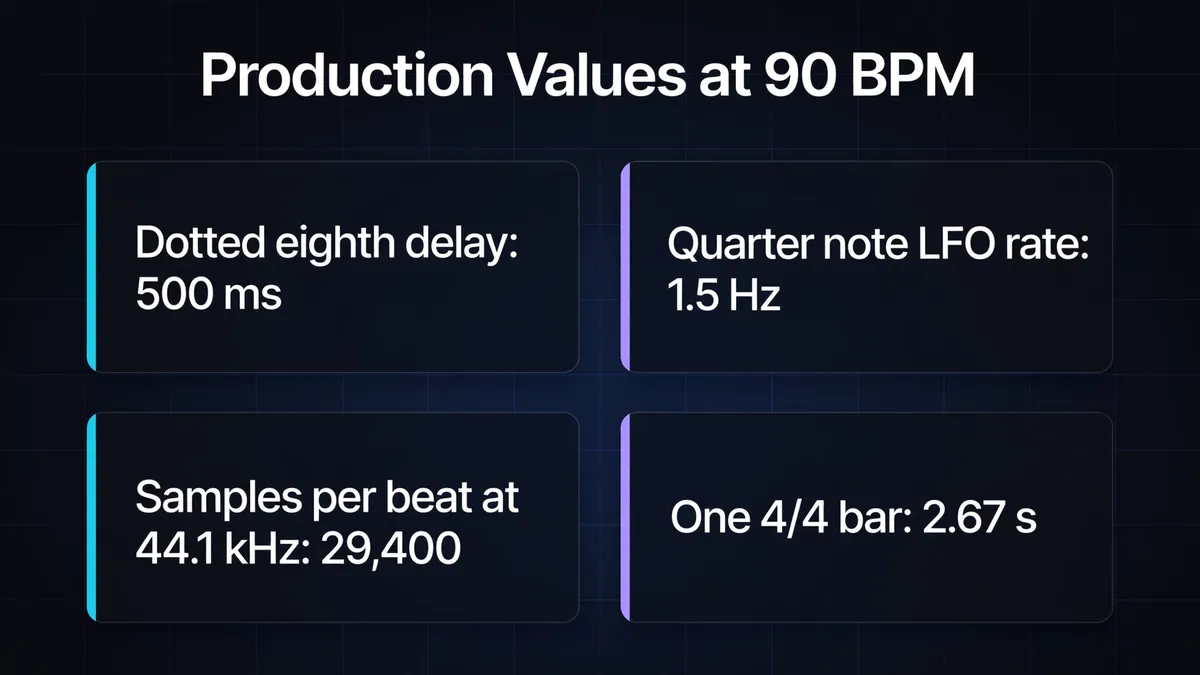
One bar of 4/4 at 90 BPM lasts about 2.67 seconds, so 4 bars take 10.67 seconds, 8 bars 21.33 seconds and 16 bars 42.67 seconds. A bar of 3/4 lasts exactly 2 seconds. In one minute you get 22.5 bars of 4/4 or 30 bars of 3/4.
| Length | 4/4 | 3/4 |
|---|---|---|
| 1 bar | 2.67 s | 2.00 s |
| 4 bars | 10.67 s | 8.00 s |
| 8 bars | 21.33 s | 16.00 s |
| 16 bars | 42.67 s | 32.00 s |
| 32 bars | 85.33 s | 64.00 s |
Worked example: a producer needs a beat of about 3 minutes. At 22.5 bars per minute, 3 minutes is 67.5 bars, so 68 bars of 4/4 gives 181.33 seconds (68 × 2.6667). At 44.1 kHz one beat spans exactly 29,400 samples, and at 48 kHz exactly 32,000, which keeps sample edits clean. The BPM to samples calculator handles any rate.
What Tempo Marking Is 90 BPM?
On this site's tempo chart, 90 BPM sits near the middle of the approximate Andante band of 76 to 108 BPM, described as a walking pace. It also falls inside the Andantino band of 80 to 108. Published charts disagree on where Andante starts and stops, which is why these bands are this site's approximation.
Some references place Andante lower, so a score marked Andante might be played well under 90 by one performer and right at it by another. When a score prints a metronome mark, follow the number and its note symbol over the word. The tempo markings chart compares the sources.
What Does 90 BPM Feel Like?
90 BPM gives a steady, unhurried pulse with room between clicks for syncopation. Try writing a short rap phrase over the metronome, leave a deliberate rest at the end, then enter again on the next downbeat. The exercise tests whether you keep counting through silence.
A busier phrase adds rhythmic activity while the underlying tempo stays the same. Rap verses at this tempo often move in sixteenths, which arrive every 166.67 ms, and switching to triplets (222.22 ms per eighth note triplet) changes the flow without touching the BPM. Listen to the pulse separately from the number of notes; the same click can carry a sparse ballad or a dense verse.
Songs at 90 BPM
<a id="songs-at-90-bpm"></a>
The linked databases report the tempos below. Nearby matches are labeled. Use the named version where one is given; a database reading does not establish the recording's intended feel.
| Song | Artist | Recording version | Reported BPM | Note | Sources |
|---|---|---|---|---|---|
| Flashing Lights | Kanye West | Graduation | 90 | 90 BPM count | Tunebat |
| In Da Club | 50 Cent | Version unspecified | 90 | 90 BPM count | SongBPM |
| Sunflower | Post Malone and Swae Lee | Version unspecified | 89 | Nearby match, 1 BPM below 90 | GetSongBPM |
A 1 BPM gap sounds small, but it adds up. At 89 BPM a beat lasts 674.16 ms, about 7.49 ms longer than at 90, so after 16 bars (64 beats) the song sits roughly 479 ms behind a 90 BPM click. To check a track yourself, tap along on the tap tempo page or load a local file into the BPM finder.
How Do You Practice With a 90 BPM Metronome?
Set the metronome to 90 BPM in 4/4, listen for one bar, then play quarters, eighths, triplets and sixteenths for four bars each. Each four bar block lasts about 10.67 seconds, so a full cycle through all four subdivisions takes under 43 seconds and can be repeated several times.
- Quarters, 666.67 ms apart. Aim to bury the click under your note.
- Eighths, 333.33 ms apart, counting "one and".
- Eighth note triplets, 222.22 ms apart, counting "one trip let".
- Sixteenths, 166.67 ms apart, counting "one e and a".
- Set the click to beats 2 and 4 only by halving the tempo to 45 BPM and hearing each click as a backbeat. This builds an internal pulse.
For 6/8 pieces marked dotted quarter equals 60, choose 6/8 on the online metronome and enter 90; each eighth clicks and the accent marks beat 1. Guitarists working up a riff written at 110 can use the speed trainer to start at 90 and climb in small steps.
Using 90 BPM in Production
The dotted eighth delay at 90 BPM is exactly 500 ms, matching a quarter note at 120 BPM, and the straight eighth is 333.33 ms. A sixty fourth note of about 41.67 ms is a reasonable reverb pre delay starting point. Compare repeats against the vocal's rests before increasing feedback.
Delay worked example: a hook phrase ends on the "and" of beat 2. A quarter note delay of 666.67 ms repeats it on the "and" of beat 3, then of beat 4, which can crowd the snare's neighbors. A dotted eighth of 500 ms spreads repeats across sixteenth positions and leaves the backbeat clear. The delay calculator and reverb calculator list every note length.
An LFO synced to one cycle per beat runs at exactly 1.5 Hz; per eighth, 3 Hz; per sixteenth, 6 Hz. These whole numbers make 90 BPM easy for plugins that only accept hertz, which the BPM to Hz converter covers. In Ableton Live, Logic Pro, FL Studio or Pro Tools, synced plugins follow the project tempo automatically, and a sidechain release of one eighth note, 333.33 ms, recovers just before the next eighth.
Swing at 90 BPM: on an MPC style setting, the percentage sets where the second sixteenth falls inside each 333.33 ms eighth pair. At 54% it lands at 180 ms instead of 166.67 ms, 13.33 ms late; at 62% it lands at 206.67 ms, 40 ms late. In his MPC timing interview, Roger Linn describes both settings and discusses 62% at 90 BPM.
Half Time and Double Time at 90 BPM
Half time of 90 BPM is 45 BPM, with a 1,333.33 ms pulse, and double time is 180 BPM, with a 333.33 ms pulse. Counting the same recording at either level leaves playback speed unchanged; it only changes which note you treat as the beat.
A half time or double time drum feel depends on the pattern and accents as well as the count. Databases sometimes report a 90 BPM rap track at 180 because the hi hats run in steady eighths. If your foot taps 90 and a site says 180, both describe one recording. Compare the numbers with the half time calculator and double time calculator, or read the half time vs double time guide. Nearby tempo pages: 80 BPM, 100 BPM and 180 BPM.
Which Mistakes Come Up at 90 BPM?
Most mistakes at 90 BPM come from rounding the repeating decimal. Entering 667 ms for a quarter note or 333 ms for an eighth is close, but the error builds over long delay tails and sample edits. Other common slips are reading 180 as a different tempo and mistaking 89 BPM songs for exact matches.
- Rounding beat length. 667 ms instead of 666.67 ms is 0.33 ms long per beat, about 21 ms after 64 beats. Use tempo sync or the exact decimal.
- Treating 180 as a new tempo. It is the double time count of the same pulse.
- Nearby songs. An 89 BPM track slides off a 90 BPM click within a few bars.
- 6/8 confusion. Dotted quarter equals 90 is a different tempo; each eighth then lasts 222.22 ms, so a quarter note metronome needs 135 BPM.
- Short tapping. Tap at least 8 beats; the tap tempo tool averages the last 8 gaps and sets outliers aside.