
What BPM Is Afrobeats?
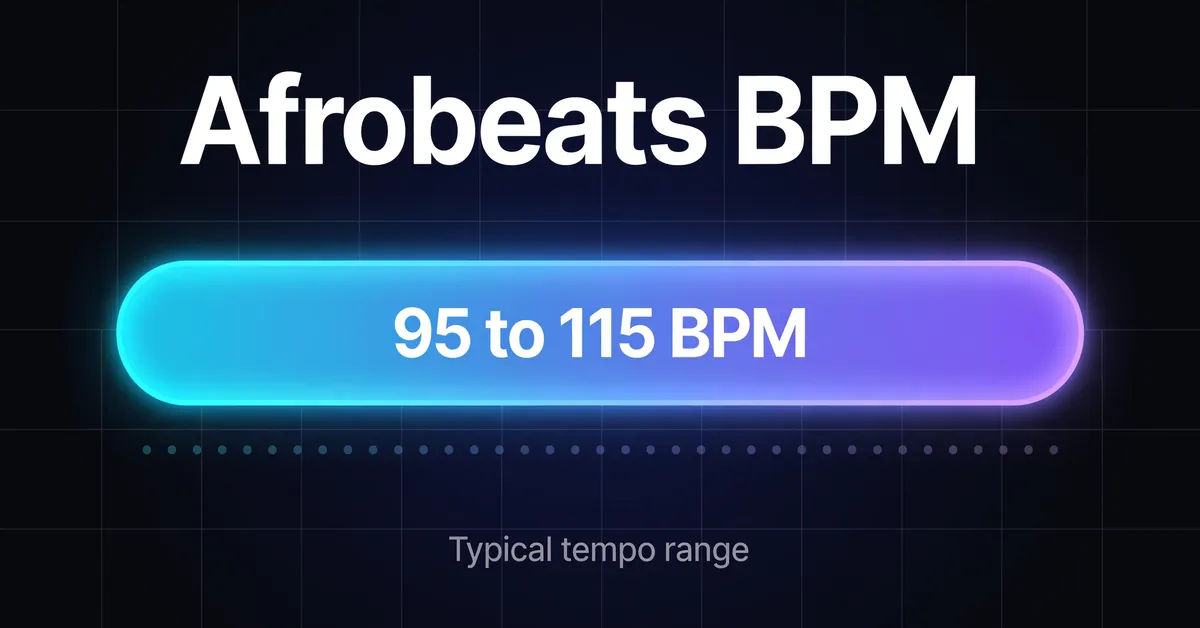
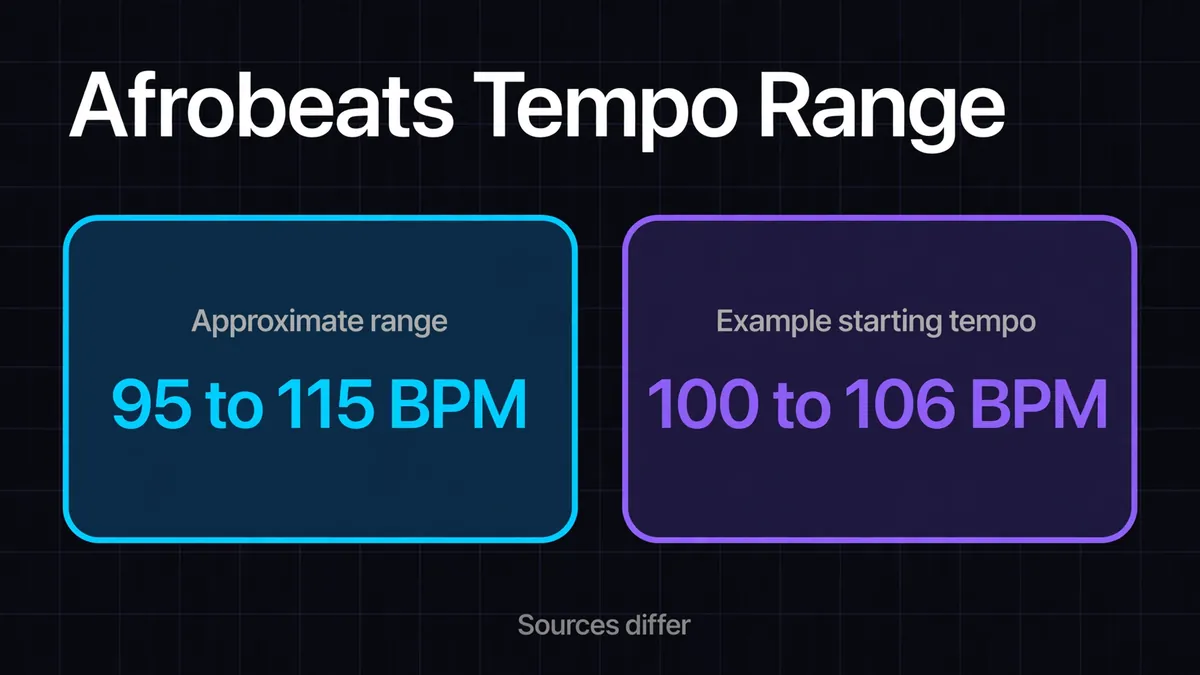
For Afrobeats BPM, this site uses 95 to 115 beats per minute as an approximate reference range, with 100 to 106 BPM as a starting band. Try 104 BPM for the layered percussion exercise below. Amapiano and Afro house have overlapping reference tempos, but their production traditions differ, and a log drum sound alone does not identify a genre.
These ranges are this site's approximation; other guides quote afrobeats tempos a little higher or lower. Substyle bands below are suggested production examples, not measured catalog ranges. If you have a track in front of you, measure it with tap tempo or the BPM finder rather than trusting a chart.
Real releases show why. Spotify reports an average Afrobeats tempo of 119 BPM in 2015 and 114 BPM in 2025. The same report lists Burna Boy's "Last Last" at 88 BPM and Rema's "Calm Down" at 107 BPM. Those averages describe Spotify's data rather than define a genre boundary, and "Last Last" sits below this page's 95 to 115 band. The recording always matters more than the chart.
BPM by Style
| Style | Approximate BPM reference | How to use the example |
|---|---|---|
| Classic Afrobeats groove | 95 to 105 | Try the layered percussion exercise below |
| Modern chart Afrobeats | 100 to 112 | Suggested band for testing vocal phrasing |
| Afropop crossovers | 108 to 118 | A crossover exercise band extending above the headline range |
| Amapiano (neighboring genre) | 110 to 115 | Neighboring South African genre; associated with log drum basslines |
| Afro house (neighboring genre) | 118 to 124 | Neighboring house style; compare the kick pattern |
The amapiano figure comes from Splice's amapiano guide with Kooldrink, which places the style at 110 to 115 BPM. Afro house sits closer to the house world. For a full list across genres, see the BPM chart or the genres hub.
Is Afrobeats the Same as Afrobeat?
No. Afrobeat, without the s, is the style Fela Anikulapo Kuti developed in the early 1970s, blending jazz, funk, psychedelic rock and West African rhythms. Afrobeats is a later umbrella for contemporary West African pop. The tempo band on this page covers Afrobeats only; it is not a BPM rule for Fela's catalog.
The official Fela Kuti biography says he started out playing jazz and highlife, that drummer Tony Allen joined his band in 1964, and that 1973's Gentleman, recorded with Africa 70, was the first fully formed Afrobeat album. An LSE Africa at LSE article describes Afrobeat as Fela's own name for his invention, and Afrobeats as a genre that emerged when West African pop "became cool," drawing on hip hop, R&B, reggae, fuji, juju, makossa and more. The same article notes a real relationship between the two.
| Afrobeat | Afrobeats | |
|---|---|---|
| Associated with | Fela Kuti and Africa 70 | Contemporary West African pop artists |
| Era | Early 1970s onward | Pop wave after the late 1990s |
| Typical shape | Long band arrangements | Song length pop releases |
| BPM on this page | Not assigned | 95 to 105 classic band, 95 to 115 overall |
How Do You Choose an Afrobeats Tempo?
Build a short percussion loop before choosing the final speed. At 104 BPM, combine the shaker, rimshot and kick, then add the vocal or guitar response. Check where each part accents the bar. In Ableton Live, Logic Pro or FL Studio, try 100 BPM if the hook crowds the sixteenths and 108 BPM if it drags. Layered percussion has no single physical speed limit.
Changing 104 to 100 BPM lengthens each quarter note from 576.92 ms to 600 ms, an extra 23.08 ms per beat. That sounds small, but across a sixteen bar verse it adds 1.48 seconds (38.40 minus 36.92), enough to relax a dense vocal.
How Does Afrobeats Feel at 104 BPM?
At 104 BPM, a one bar 4/4 groove lasts 2,307.69 ms, and each sixteenth note step is 144.23 ms. The exercise below places a steady shaker on all sixteen steps, cross stick on beats 2 and 4, and a syncopated kick that avoids four on the floor. It is practice material, not a required foundation.
Each beat has four sixteenth note steps, counted 1 e and a. Beats 1, 2, 3 and 4 begin on steps 1, 5, 9 and 13.
| Voice | Steps | Placement |
|---|---|---|
| Kick | 1, 7, 9, 15 | Beat 1, the and of 2, beat 3 and the and of 4 |
| Cross stick or rimshot | 5, 13 | Beats 2 and 4 in this exercise |
| Shaker | All 16 steps | Sixteenths with chosen accents |
Keep the shaker steady while learning the kick placements, then vary its accents. The kick on step 7 is 6 steps after step 1, or 6 × 144.23 = 865.38 ms into the bar.
A tresillo cell divides a cycle into 3 plus 3 plus 2. It is distinct from the full two bar son clave, as the music theory explanation of son clave shows. Neither term should be applied automatically to every percussion layer; identify the real pattern before naming it.
Splice's amapiano guide associates log drum basslines with South African amapiano. Fusion tracks can borrow that sound, but a log drum does not have an intrinsic BPM.
Note Values at 104 BPM
Values count quarter notes at 104, matching the beat most afrobeats producers program in their DAW.
| Note value | Length in ms |
|---|---|
| Quarter note | 576.92 |
| Eighth note | 288.46 |
| Sixteenth note | 144.23 |
| Dotted eighth note | 432.69 |
| Eighth note triplet | 192.31 |
Try a dotted eighth delay at 432.69 ms on a plucked guitar response. Play the phrase against the percussion before choosing feedback and level. The delay calculator compares repeat lengths, and the note duration calculator covers other values.
How Long Are Bars and Sections at Afrobeats Tempos?
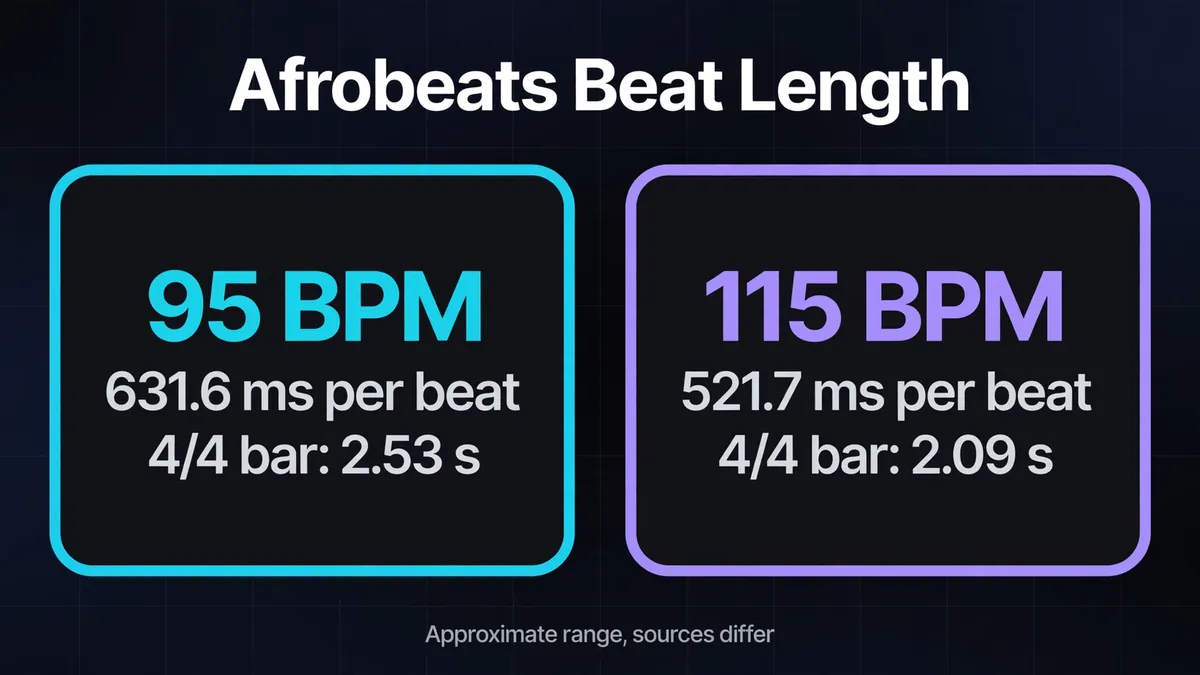
In 4/4, one bar equals four quarter notes, so bar length is 240,000 ÷ BPM in milliseconds. At 104 BPM a bar is 2.31 seconds, eight bars take 18.46 seconds and sixteen bars take 36.92 seconds. Slower or faster edges of the range shift these numbers by several seconds.
| BPM | One bar | 8 bars | 16 bars |
|---|---|---|---|
| 88 | 2.73 s | 21.82 s | 43.64 s |
| 95 | 2.53 s | 20.21 s | 40.42 s |
| 104 | 2.31 s | 18.46 s | 36.92 s |
| 107 | 2.24 s | 17.94 s | 35.89 s |
| 115 | 2.09 s | 16.70 s | 33.39 s |
A dancer choreographing an eight bar routine to a 107 BPM record has about 17.9 seconds per section. A DJ planning a sixteen bar blend at 95 BPM needs just over 40 seconds of overlap.
Practicing and Mixing at Afrobeats Tempos
Players: Learn the shaker, rimshot and kick separately, then combine them at a comfortable speed on the online metronome, set to 4 subdivisions so it clicks sixteenths. Keep the shaker subdivision steady as the kick moves around it. Add guitar or vocals only after you can hear the full bar without relying on every kick as a beat marker.
DJs: Measure both tracks when moving between Afrobeats, dancehall, reggaeton, R&B and amapiano. Listen for percussion accents and phrase starts in addition to BPM. A tempo overlap suggests a possible transition; the layered rhythms decide whether a long overlap works. Going from a 104 BPM Afrobeats record to a 112 BPM amapiano track is a 7.7 percent jump (8 ÷ 104), so many DJs ride a breakdown rather than stretch one deck that far.
Producers: When an Afrobeats track is measured near 88 BPM, check whether a detector is calling it 176. The why BPM detectors disagree guide and double time BPM page explain the doubling.
Which Mistakes Throw Off an Afrobeats Tempo?
The most common errors come from counting the wrong layer: tapping the shaker gives a number four times too high, and tapping only the kick in a syncopated pattern drifts between beats. Mixing up Afrobeat and Afrobeats, or assuming a log drum means amapiano tempo, also misleads.
- Tapping sixteenths: a 104 BPM shaker taps at 416 per minute. Tap the beat you would clap on.
- Following the kick: in the grid above, kicks on steps 7 and 15 are off the beat. Tap the cross stick on 2 and 4 instead.
- Trusting one average: Spotify's 114 BPM average for 2025 still includes an 88 BPM hit.