
What Is 160 BPM?
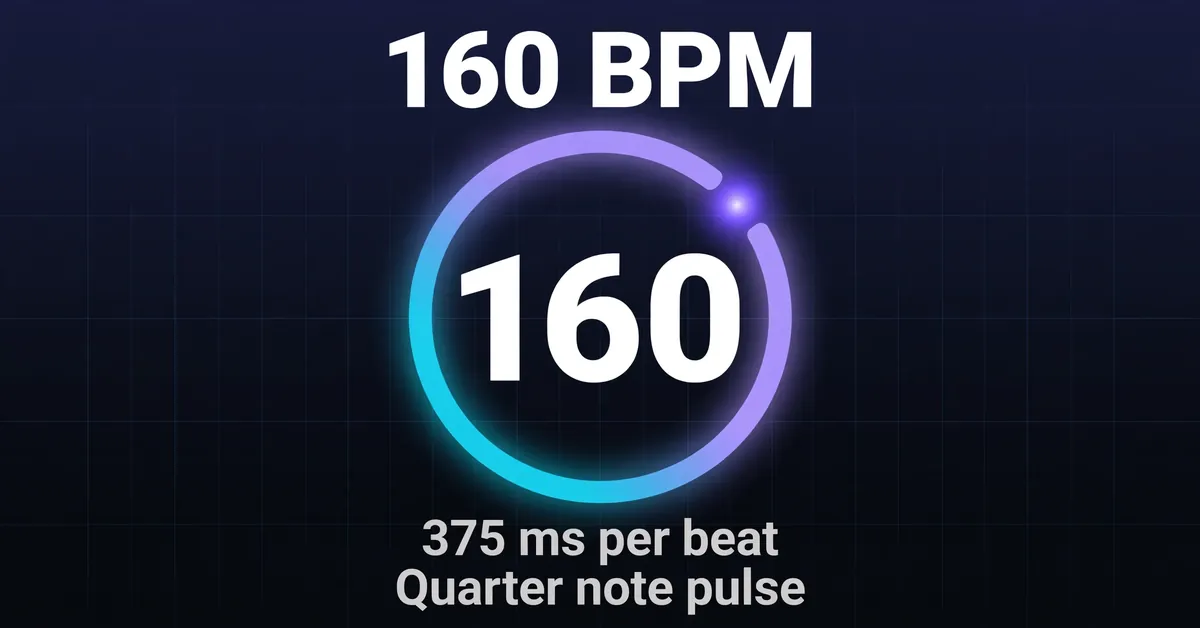
A 160 BPM metronome sounds 160 beats per minute, which puts exactly 375 milliseconds between clicks and about 2.67 clicks in every second. Few tempos divide this cleanly: the beat, the bar and even the sample counts land on round numbers. On this site's chart it reads as Vivace, and it sits at twice the rate of 80 BPM.
That tidy 375 ms value is the reason producers like to sketch ideas here and why drummers find the grid easy to reason about. It also sits at the slow edge of the drum and bass band used on this site, so jungle and footwork patterns are natural material for practice.
How Long Is Every Note Value at 160 BPM?
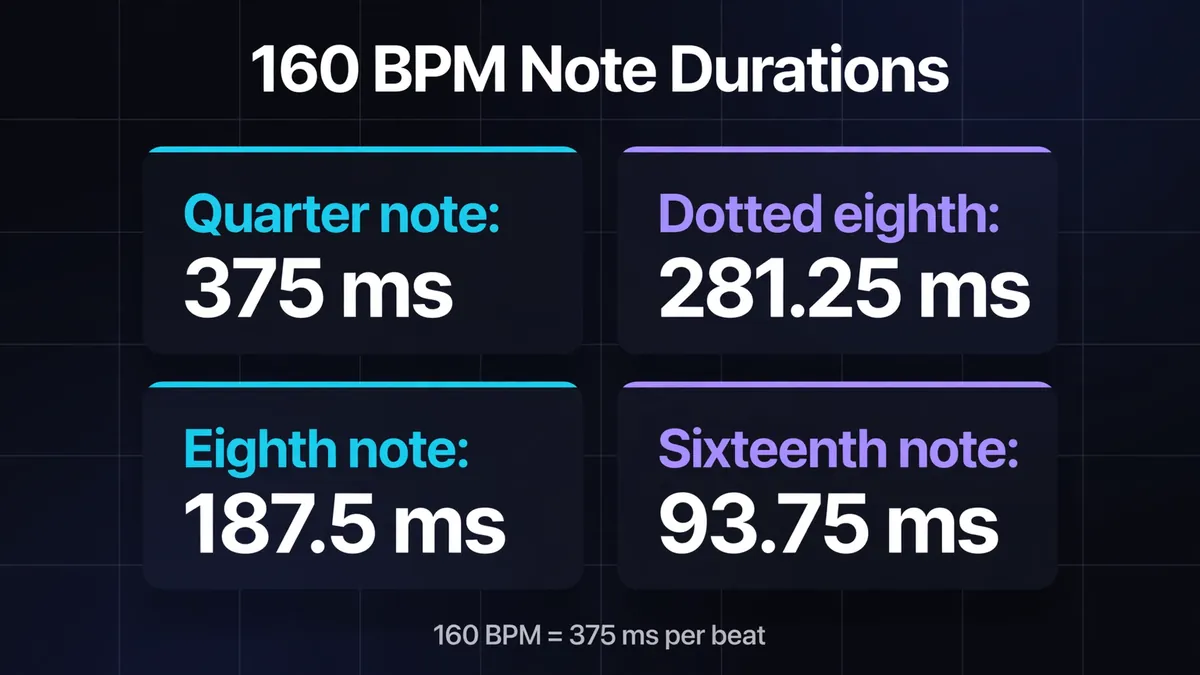
At 160 BPM a quarter note lasts 375 ms, an eighth note 187.5 ms, a sixteenth 93.75 ms and an eighth note triplet exactly 125 ms. Dotted values are just as friendly: a dotted eighth is 281.25 ms and a dotted quarter is 562.5 ms. Everything comes from one division, 60,000 ÷ 160.
Durations count quarter notes at 160 per minute. Converting from a dotted quarter mark in 6/8 means multiplying by 1.5, so a marking of 106 comes to 159 here.
| Note value | Beats | Duration (ms) | Rate (Hz) |
|---|---|---|---|
| Whole note | 4 | 1500.00 | 0.67 |
| Dotted half | 3 | 1125.00 | 0.89 |
| Half note | 2 | 750.00 | 1.33 |
| Dotted quarter | 1.5 | 562.50 | 1.78 |
| Quarter note | 1 | 375.00 | 2.67 |
| Dotted eighth | 0.75 | 281.25 | 3.56 |
| Quarter note triplet | 2/3 | 250.00 | 4.00 |
| Eighth note | 0.5 | 187.50 | 5.33 |
| Dotted sixteenth | 0.375 | 140.63 | 7.11 |
| Eighth note triplet | 1/3 | 125.00 | 8.00 |
| Sixteenth note | 0.25 | 93.75 | 10.67 |
| Sixteenth note triplet | 1/6 | 62.50 | 16.00 |
| Thirty second note | 0.125 | 46.88 | 21.33 |
| Sixty fourth note | 0.0625 | 23.44 | 42.67 |
The triplet rows are the pleasant surprise. Because 375 divides by 3, quarter note triplets fall at 250 ms and eighth note triplets at 125 ms with no rounding at all, so a shuffle or a triplet fill typed in by hand stays locked to the grid. The dotted sixteenth (140.625 ms) and the two shortest values are the only rows that needed rounding. For other tempos, use the note duration calculator or the BPM to ms converter.
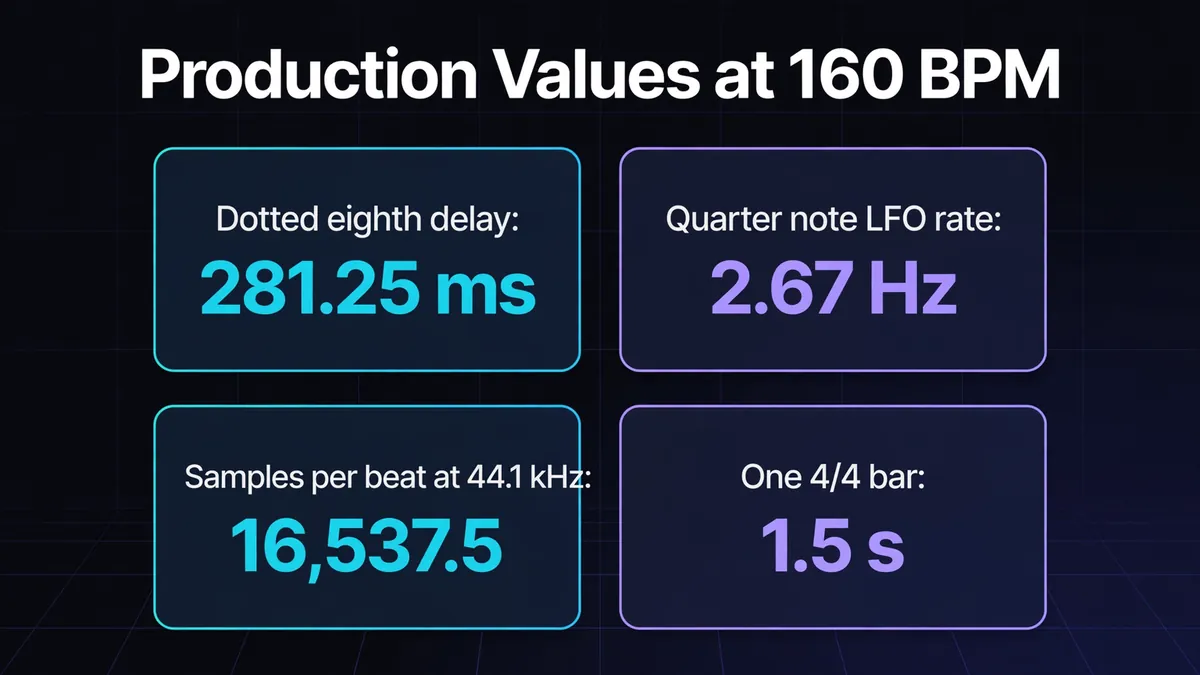
Sample counts are whole numbers too. One beat equals 16,537.5 samples at 44.1 kHz and exactly 18,000 samples at 48 kHz. A 4/4 bar is 66,150 samples at 44.1 kHz and 72,000 at 48 kHz, so loops cut at 160 BPM trim cleanly on a bar line. The BPM to samples page covers other rates.
How Many Seconds Do Bars Take at 160 BPM?
A 4/4 bar at 160 BPM lasts exactly 1.5 seconds, and a 3/4 bar lasts 1.125 seconds. A bar of 6/8 also takes 1.125 seconds, because six eighth notes equal three quarter note beats. Thirty two bars of 4/4 last 48 seconds flat, which makes arrangement planning simple.
| Bars | 4/4 (4 beats) | 3/4 (3 beats) | 6/8 (3 quarter beats) |
|---|---|---|---|
| 1 | 1.5 s | 1.125 s | 1.125 s |
| 4 | 6 s | 4.5 s | 4.5 s |
| 8 | 12 s | 9 s | 9 s |
| 16 | 24 s | 18 s | 18 s |
| 32 | 48 s | 36 s | 36 s |
The 6/8 column treats the BPM as a quarter note count, matching how this site's online metronome handles x/8 meters, where each eighth clicks. If a piece in 6/8 is marked dotted quarter equals 160, multiply by 1.5 and enter 240 instead.
Some quick planning numbers: a three minute track at 160 BPM holds 480 beats, or 120 bars of 4/4. A dancer counting eights reaches the end of each eight count every 3 seconds. A DJ building a 16 bar intro knows it will run 24 seconds before the first drop. More meter detail lives in time signatures and BPM.
Which Tempo Marking Covers 160 BPM?
160 BPM is labeled Vivace on this site's tempo chart, which places Vivace at roughly 156 to 176 BPM, lively and brisk. The chart's Allegro band stops at 156 and Presto starts at 168, so 160 sits inside Vivace with no overlap. Those edges are this site's estimates, and published charts do not all agree on them.
A printed metronome mark with its note symbol always outranks the word. The tempo markings BPM chart lists every band, and what is tempo explains why Italian terms carry character as well as speed.
How Do You Practice at 160 BPM Without Rushing?
Treat 160 as a destination, not a starting point. Learn the passage at 80 BPM, where each click marks a half note's worth of the target, then climb in steps of 10 to 20 BPM. When you arrive, set the click to eighths so the 187.5 ms gaps expose any drifting.
A ladder that works for a drummer on a jungle break or a guitarist on fast strumming:
- 80 BPM with the click on every beat. Play the part counting it as eighth notes against a slow pulse (750 ms per click).
- 120 BPM, quarters only (500 ms per click).
- 140 BPM, quarters, until four passes in a row feel relaxed (about 428.57 ms).
- 160 BPM with an eighth note subdivision so every 187.5 ms slot is audible.
- 160 BPM back on quarters while you count "1 and 2 and" silently.
The metronome's speed trainer can automate the climb, and the accent falls on beat 1 only, so count bar numbers aloud during long passages. A student whose hands tense up past 140 is better served by playing 150 cleanly than 160 sloppily.
To confirm whether a song you are copying is really at 160, use tap tempo with the spacebar or a letter or number key. It averages the last 8 gaps, sets outliers aside, and resets after a 2.5 second pause.
Which Songs Are Reported at 160 BPM?
Linked databases list Taylor Swift's "Shake It Off," The Chainsmokers' "Don't Let Me Down" with Daya, and the 2015 Remaster of Iron Maiden's "The Trooper" at 160 BPM. These are attributed database readings, not independent measurements, and one entry also suggests an 80 BPM count.
The linked databases report the tempos below. Nearby matches and alternative counts are labeled separately. Use the named version where one is given; a counting option does not establish the recording's intended feel.
| Song | Artist | Recording version | Reported BPM | Counting option | Sources |
|---|---|---|---|---|---|
| Shake It Off | Taylor Swift | 1989 (Deluxe Edition) | 160 | 160 BPM count | Tunebat |
| Don't Let Me Down | The Chainsmokers featuring Daya | Version unspecified | 160 | 80 BPM alternative count | SongBPM |
| The Trooper | Iron Maiden | 2015 Remaster | 160 | 160 BPM count | Tunebat |
Notice the spread: a pop single, an electronic pop track and a galloping metal classic share one number. That is a good reminder that tempo does not decide genre. If your own tap result reads 80 for one of these, you are most likely counting every other beat. Why BPM detectors disagree covers the common reasons readings split.
What Delay and Reverb Settings Fit 160 BPM?
Start a quarter note delay at 375 ms, an eighth at 187.5 ms and a dotted eighth at 281.25 ms. A sixty fourth note reverb pre delay comes out near 23.44 ms. Treat these as starting points and adjust by ear against the vocal, the snare and the space in the arrangement.
A quarter note at 160 lasts 375 ms, the same span as a dotted eighth at 120 BPM. The millisecond value matches, but the musical role does not, so a preset saved at one tempo will sound different at the other. Use the delay calculator and reverb calculator to compare timings.
Scenario: a producer in FL Studio or Ableton Live writes a footwork sketch at 160 and wants the pad to pump against the kick through sidechain compression. With kicks on every beat, a release near 187.5 ms lets the pad swell back by the offbeat. An LFO set to one cycle per beat runs at 2.67 Hz; one cycle per bar runs at 0.67 Hz. Tempo sync in Logic Pro or Pro Tools plugins is still preferable to typing values, though here the typed numbers happen to be exact. The BPM to Hz tool converts other rates.
How Do 80 BPM and 320 BPM Relate to 160 BPM?
Half time of 160 BPM is 80 BPM, with 750 ms per counted beat, and double time is 320 BPM, with 187.5 ms per counted beat. Neither changes how fast the recording plays. You simply choose which layer of the rhythm to count as the beat.
Half the rate is 80 BPM, and double the rate is 320 BPM. You can follow those pulse levels without changing playback speed. A half time or double time drum feel depends on the pattern and accents as well as the count. Compare the numbers with the half time calculator and double time calculator, or use the half time vs double time guide for the musical distinction.
This matters for drum and bass in particular: many listeners nod along at 80 while the breakbeat runs at 160. Both counts describe the same audio. The site's metronome reaches 360 BPM, so you can hear 320 directly if you want to drill the faster layer. Neighboring presets are the 150 BPM metronome, the 170 BPM metronome and the 80 BPM metronome. Genre context is on the drum and bass BPM page.
Where Do People Go Wrong at 160 BPM?
The usual errors at 160 BPM are logging a half count of 80 as the song's tempo, entering a dotted quarter mark straight into a quarter note metronome, and jumping to full speed before the part is secure. Each one either misreports the music or builds tension into your playing.
- Tapping on the snare only. In a backbeat groove, snares land every 750 ms, so the tap reads 80 rather than 160.
- Setting 160 for a 6/8 piece marked dotted quarter equals 160. The correct quarter note entry is 240.
- Reading 160 as if the 80 BPM half count changes playback. It does not; only the counting changes.
- Skipping the subdivision. At 160, a slightly early eighth hides easily inside a quarter note click.
- Assuming every song at 160 is drum and bass. The table above shows pop and metal at the same rate.