
How Do You Calculate Delay Time From BPM?
To calculate delay time, divide 60,000 by BPM for a quarter note in milliseconds. Halve that result for an eighth note or multiply it by 0.75 for a dotted eighth. This delay calculator gives you straight, dotted and triplet timing references to enter into a delay plugin or pedal.
These note values assume BPM counts quarter notes. For a score marked dotted quarter = 60, enter 90 here.
At 100 BPM, a quarter note is 600 ms, an eighth is 300 ms and a dotted eighth is 450 ms. One minute contains 60,000 milliseconds, which is where the formula's starting number comes from.
Enter the song's BPM, choose a displayed timing reference, then copy its millisecond value into your processor's time control. Use the speaker button to audition the pulse spacing. If you need the starting tempo, use tap tempo while listening. The pulse preview helps you judge an interval; set the actual effect on your pedal or in your DAW.
What Are the Delay Times at 120 BPM?
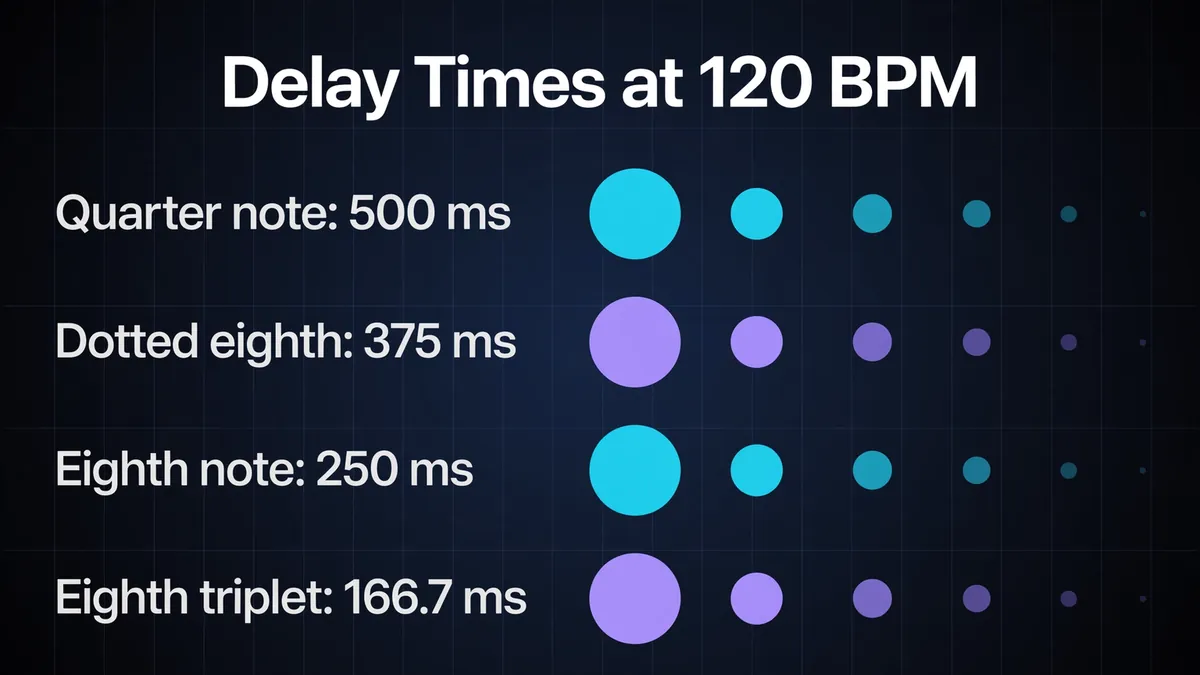
At 120 BPM, quarter note delay is 500 ms, straight eighth delay is 250 ms and dotted eighth delay is 375 ms. The table also includes shorter subdivisions and triplets. These numbers describe the interval between repeats, so they do not specify how long the complete echo tail will last.
These note values assume BPM counts quarter notes. For a score marked dotted quarter = 60, enter 90 here.
| Note value | Straight | Dotted | Triplet |
|---|---|---|---|
| Quarter note | 500 ms | 750 ms | 333 ms |
| Eighth note | 250 ms | 375 ms | 167 ms |
| Sixteenth note | 125 ms | 188 ms | 83 ms |
| Thirty second note | 63 ms | 94 ms | 42 ms |
Values are rounded to the nearest millisecond from the full calculation. A dotted value is the straight duration × 1.5; a triplet value is the straight duration × 2 ÷ 3. Calculate before rounding: 125 × 1.5 = 187.5 ms, displayed here as 188 ms.
Labels such as 1/8D and 1/8T mean dotted eighth and eighth triplet; 1/8 alone means a straight eighth note. Check the processor's labels before copying a setting. For a broader reference across note lengths, use the note duration calculator.
Which Delay Time Should You Choose?
A quarter note puts the first repeat one beat after the original sound. An eighth puts it halfway through the beat. A dotted eighth lands three quarters of a beat later, creating echoes that can interlock with an evenly picked guitar part. Choose by listening to the part's gaps.
Three eighth triplet intervals fit into one quarter note beat. Try them against a part with a triplet subdivision. A quarter triplet is longer: its factor is 2 ÷ 3, compared with 1 ÷ 3 for an eighth triplet. Neither means a dotted note.
Delay time sets the spacing between repeats; feedback controls how much sound returns for further repeats, and wet level sets their prominence. Lower feedback when echoes cover the next phrase. Changing the time alone will not remove an overly loud tail.
How Do You Set a Dotted Eighth Guitar Delay?
For dotted eighth guitar delay, divide 45,000 by the song's quarter note BPM. At 96 BPM, that gives 468.75 ms. Start with a clearly audible first repeat and little feedback, then play steady eighth notes to hear where the echoes fall between your picked notes.
The calculation is 60,000 ÷ 96 = 625 ms per quarter note; 625 × 0.75 = 468.75 ms. Your picked eighth notes are 312.5 ms apart. A note played at 0 ms therefore echoes at 468.75 ms, halfway between your picked notes at 312.5 and 625 ms.
Practice that placement with the online metronome at 96 BPM. If the pattern gets crowded, leave out some picked notes before raising feedback. BOSS demonstrates dotted eighth delay with The Edge's part on U2's "Where the Streets Have No Name." This 96 BPM exercise is separate from that recording.
How Can You Fit a Vocal Delay Between Phrases?
Fit vocal delay by comparing the first repeat with the available space after a phrase, then control the later repeats with feedback and level. At 100 BPM, a quarter note repeat arrives after 600 ms. An eighth arrives after 300 ms, which may place it under the next word.
Suppose a final syllable starts at 0 ms and ends at 100 ms, followed by a 900 ms gap. The next phrase starts at 1,000 ms. Quarter note repeats begin at 600 and 1,200 ms. The first answers in the gap; the second may overlap the next phrase. Reduce feedback if you want that first answer without a prominent second echo. The syllable's own duration also occupies space.
On an Ableton Live return track, set Delay's Dry/Wet to 100% and adjust the send level; the original vocal remains on its source track. Ableton's Delay manual documents this routing. On an insert, balance dry and wet within the plugin. Listen with the full arrangement before deciding the repeat is too quiet.
How Do Ping Pong and Haas Delays Work?
Ping pong delay sends successive repeats between left and right. Enable your processor's ping pong routing to create that movement. Unequal channel times alone do not establish alternating repeats. As a separate stereo delay example at 120 quarter note BPM, try 250 ms on the left and 375 ms on the right.
Haas widening uses a short offset between copies of a sound. The copies can fuse into one perceived event, with the earlier arrival influencing its apparent direction. Start with a fixed 10 ms offset and adjust by ear. Source material affects whether the result sounds wider or becomes a distinct echo.
The calculator's Haas reference is a 1/64 note: quarter note duration ÷ 16. That gives 31.25 ms at 120 BPM, about 23.44 ms at 160 BPM and 46.88 ms at 80 BPM. These are quarter note BPM values; for a score marked dotted quarter = 60, enter 90. The row is a musical timing reference, not a fixed perceptual boundary.
Check the result in mono because combining delayed and original signals can cause comb filtering. iZotope explains the Haas effect and mono tradeoffs. For pre delay and decay together, use the reverb calculator. This tool's short reverb references are starting values, not complete reverb settings.
Why Does a Calculated Delay Sound Out of Time?
Check the BPM's beat unit, the selected note division and whether the tempo changes. A correct calculation can still use the wrong musical pulse. Typing milliseconds also fixes the interval until you change it, while a supported tempo sync mode follows the host's tempo setting.
If you enter 70 instead of 140, every calculated delay doubles. A dotted eighth becomes 642.86 ms instead of 321.43 ms. Both can be useful rhythms, but they place echoes differently. The half time versus double time guide explains that counting ambiguity.
Compound meter needs care. In 6/8 marked dotted quarter = 60, each dotted quarter lasts 1,000 ms. Entering the equivalent quarter note tempo of 90 gives an eighth note of 333.33 ms and a dotted quarter of 1,000 ms. Entering 60 would make that dotted quarter 1,500 ms. See time signatures and BPM for beat units.
A song moving from 120 to 128 quarter note BPM needs a quarter delay to move from 500 to 468.75 ms. Sync can track a matching DAW tempo map; it cannot follow a freely played recording if the project tempo stays fixed. Audition transitions: some processors change pitch or crossfade when delay time changes.
What If Your Pedal Cannot Reach the Calculated Time?
If a calculated delay exceeds your pedal's maximum time, use a shorter subdivision or another processor. Keep the song's BPM unchanged. At 60 quarter note BPM, a quarter note needs 1,000 ms and an eighth needs 500 ms. A hypothetical pedal limited to 500 ms can supply the eighth.
For whole millisecond controls, round only the final answer. At 87 BPM, dotted eighth delay is 517.241... ms, so enter 517 ms. That is about 0.24 ms shorter per interval. Use the BPM to MS calculator for direct conversion when you only need a note's duration.