
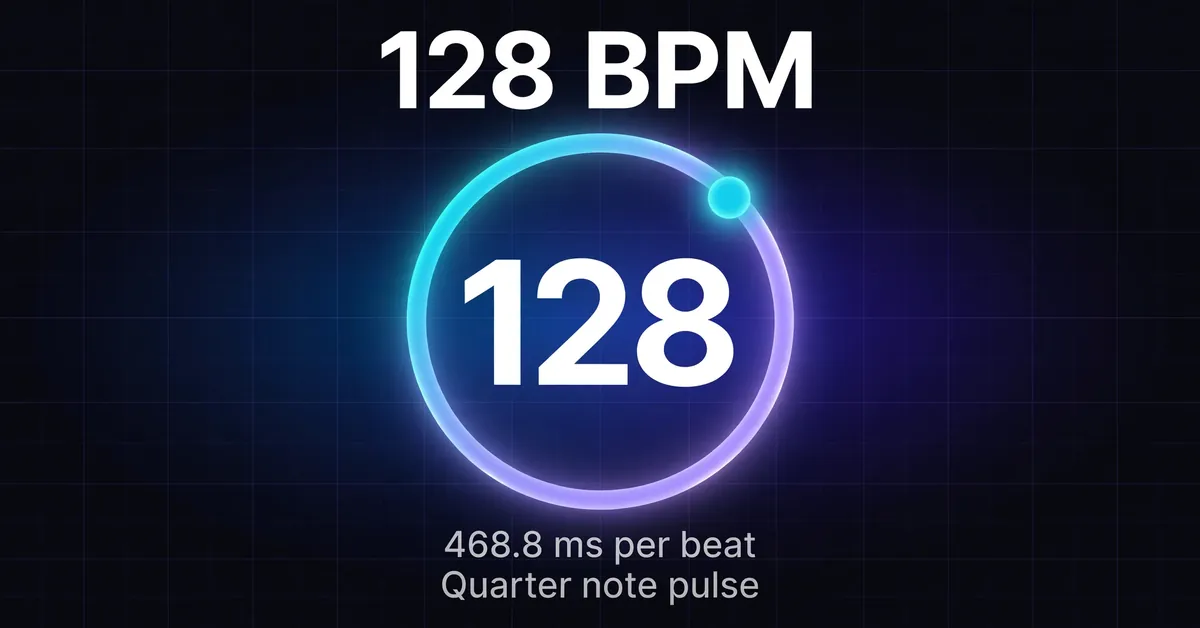
What Is 128 BPM?
A 128 BPM metronome sounds 128 beats per minute, which puts exactly 468.75 milliseconds between clicks and about 2.13 clicks in every second. This site's approximate chart files it under Allegro. The tempo is a common setting for four on the floor EDM drills, and its beat divides into tidy millisecond values for delay and modulation work.
How Long Is Each Note Value at 128 BPM?
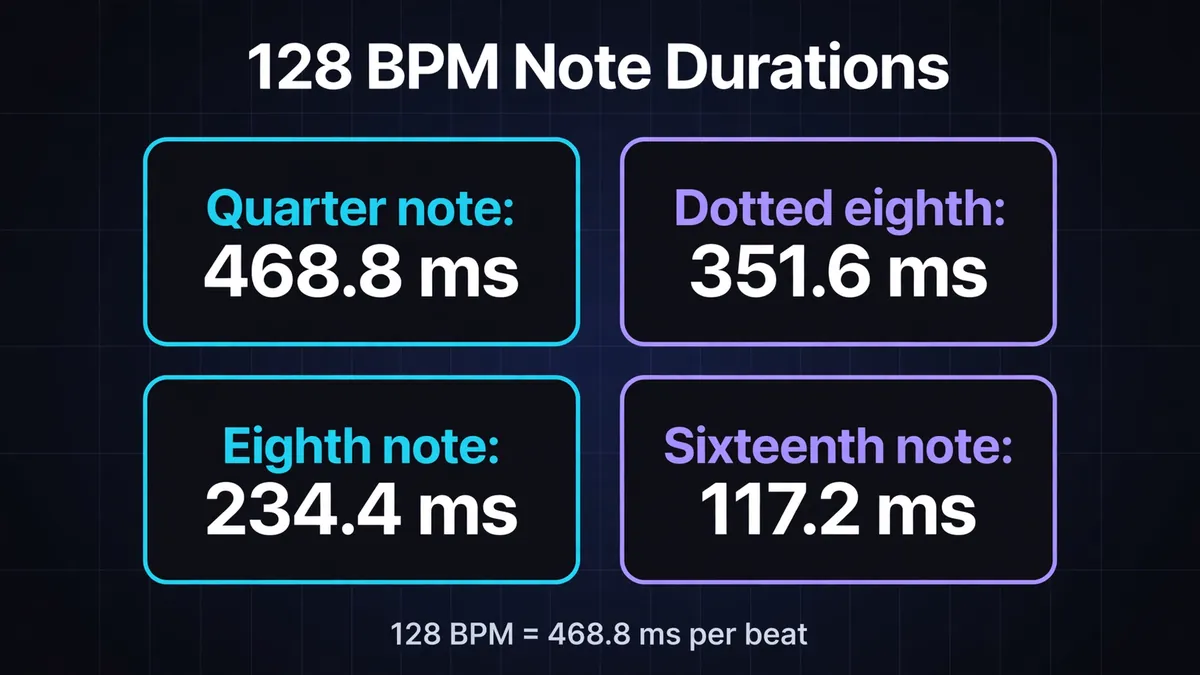
At 128 BPM a quarter note is 468.75 ms, an eighth note 234.38 ms, a sixteenth 117.19 ms and an eighth note triplet exactly 156.25 ms. A dotted eighth comes to 351.56 ms. Every value below starts from the unrounded beat and is rounded to two decimals only at the end.
Read every value as a quarter note beat at 128. For 6/8 material marked with a dotted quarter, multiply that number by 1.5 first; dotted quarter = 85 gives 127.5, a hair under this tempo.
| Note value | Beats | Duration (ms) | Hz (repeats per second) |
|---|---|---|---|
| Whole note | 4 | 1875.00 | 0.53 |
| Dotted half | 3 | 1406.25 | 0.71 |
| Half note | 2 | 937.50 | 1.07 |
| Dotted quarter | 1.5 | 703.13 | 1.42 |
| Quarter note | 1 | 468.75 | 2.13 |
| Quarter note triplet | 2/3 | 312.50 | 3.20 |
| Dotted eighth | 0.75 | 351.56 | 2.84 |
| Eighth note | 0.5 | 234.38 | 4.27 |
| Dotted sixteenth | 0.375 | 175.78 | 5.69 |
| Eighth note triplet | 1/3 | 156.25 | 6.40 |
| Sixteenth note | 0.25 | 117.19 | 8.53 |
| Sixteenth note triplet | 1/6 | 78.13 | 12.80 |
| Thirty second note | 0.125 | 58.59 | 17.07 |
| Sixty fourth note | 0.0625 | 29.30 | 34.13 |
Notice how many values here end cleanly. The whole note is exactly 1,875 ms, the quarter note triplet exactly 312.5 ms and the eighth note triplet exactly 156.25 ms. The straight eighth is really 234.375 ms, so the table shows 234.38 after rounding. For any other value, the note duration calculator and BPM to ms converter do the division for you.
How Long Are Bars and Phrases at 128 BPM?
One bar of 4/4 at 128 BPM lasts exactly 1.875 seconds, so 16 bars take exactly 30 seconds and 32 bars exactly one minute. A bar of 3/4 or 6/8 lasts 1.406 seconds when the metronome counts quarter notes. Multiply the beats by 60 and divide by 128.
| Bars | 4/4 (4 beats) | 3/4 (3 beats) | 6/8 (3 quarter beats) |
|---|---|---|---|
| 1 | 1.875 s | 1.406 s | 1.406 s |
| 4 | 7.500 s | 5.625 s | 5.625 s |
| 8 | 15.000 s | 11.250 s | 11.250 s |
| 16 | 30.000 s | 22.500 s | 22.500 s |
| 32 | 60.000 s | 45.000 s | 45.000 s |
The 6/8 column treats the six eighth notes as three quarter note beats, the way the site metronome counts x/8 meters. If a 6/8 score instead marks dotted quarter equals 128, each bar holds two of those pulses and lasts 2 × 60 ÷ 128 = 0.9375 seconds; set the metronome to 192 to match it. The neat round figures make 128 handy for a DJ counting phrases: a 32 bar intro is one minute of track time. That is a feature of the arithmetic, not a reason any genre chose the tempo. See time signatures and BPM for other meters.
How Many Samples Is One Beat at 128 BPM?
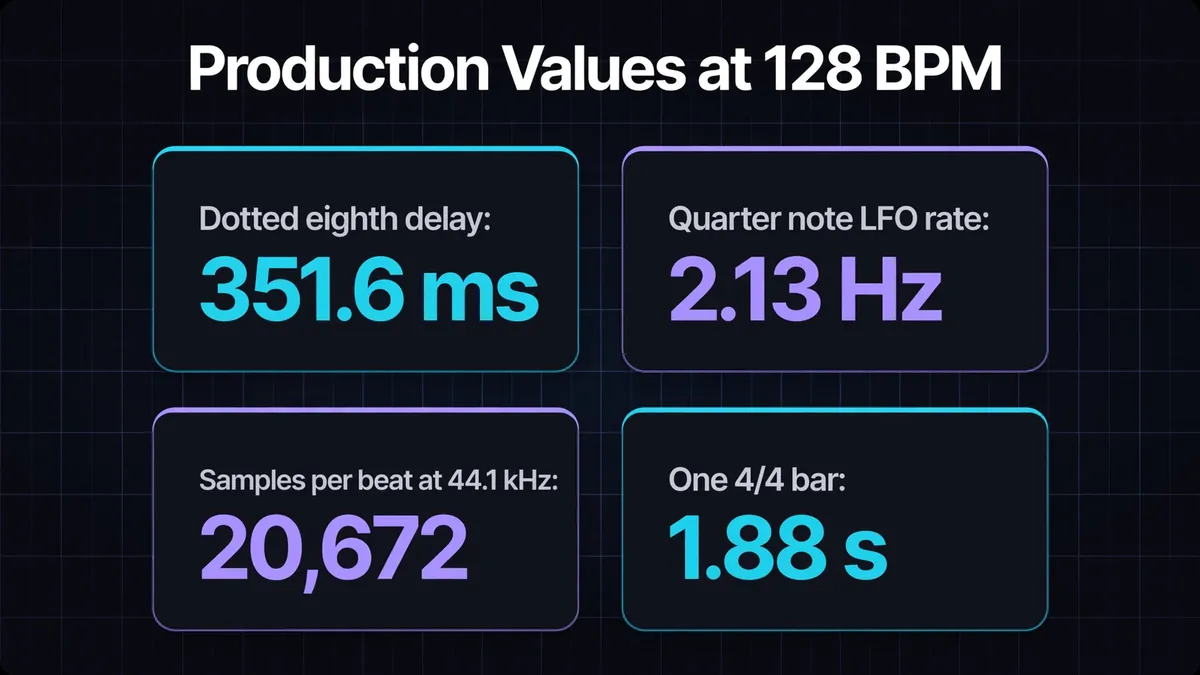
At 48 kHz one beat at 128 BPM holds exactly 22,500 samples, and a bar of 4/4 holds 90,000. At 44.1 kHz the beat is 20,671.875 samples, which is not a whole number. Short subdivisions such as the thirty second note land on fractions at both rates.
| Note | Samples at 44.1 kHz | Samples at 48 kHz |
|---|---|---|
| Whole note | 82,687.5 | 90,000 |
| Quarter note | 20,671.88 | 22,500 |
| Eighth note | 10,335.94 | 11,250 |
| Sixteenth note | 5,167.97 | 5,625 |
| Thirty second note | 2,583.98 | 2,812.5 |
So the clean count holds at 48 kHz down to the sixteenth, then breaks at the thirty second note with 2,812.5 samples. Hosts handle fractional positions internally, so this matters mainly when you trim loops by hand in a sample editor. The BPM to samples calculator covers 88.2, 96 and other rates.
What Tempo Marking Is 128 BPM?
128 BPM is labeled Allegro on this site's tempo chart, which uses an approximate Allegro band of 120 to 156 BPM. It sits just above the chart's Allegretto band of 112 to 124 BPM. Those borders are this site's approximation, and other tempo charts shift them.
A classical player meeting the word Allegro will rarely see 128 printed beside it, and older metronome marks often count a half note or dotted quarter instead. When a score gives a note symbol and a number, that instruction outranks the word. The full set of bands lives on the tempo markings BPM chart.
How Should You Practice With a 128 BPM Metronome?
Lock in the quarter note click first, then move the click to eighths so each 234.38 ms gap is audible. If 128 feels rushed, begin around 116 and add 4 BPM per clean pass. Finish with a few passes slightly above target so 128 starts to feel settled.
A ladder for a drummer or finger drummer working on a four on the floor groove:
- 116 BPM, kick on every quarter, four clean bars (about 517.24 ms per beat).
- 120 BPM, add a closed hi hat on each offbeat (500 ms per beat).
- 124 BPM, open the offbeat hat and keep the kick unaccented.
- 128 BPM, click on eighths, add a clap or snare on beats 2 and 4 for the backbeat.
- 128 BPM, switch the click to quarters and hold sixteenth hats for 16 bars, which is exactly 30 seconds.
A DJ can use the same preset to drill counting. Start the online metronome at 128, count "one" on each downbeat, and say the bar number every four beats until 32 bars arrive at the one minute mark. The metronome runs from 20 to 360 BPM with 4 subdivisions and a speed trainer, and it accents beat 1 only. To check a track's tempo before practicing over it, tap along on the tap tempo page with the spacebar or a letter or number key; it averages the last 8 gaps and starts a fresh reading after a 2.5 second pause.
Which Songs Are Reported at 128 BPM?
Linked databases report "Beauty and a Beat" by Justin Bieber featuring Nicki Minaj, Rihanna's "S&M", KAROL G's "Si Antes Te Hubiera Conocido" and the Europop recording of Eiffel 65's "Blue (Da Ba Dee)" at 128 BPM. These are attributed database reports, not independent audio measurements.
The linked databases report the tempos below. Nearby matches and alternative counts are labeled separately. Use the named version where one is given; a counting option does not establish the recording's intended feel.
| Song | Artist | Recording version | Reported BPM | Counting option | Sources |
|---|---|---|---|---|---|
| Beauty and a Beat | Justin Bieber featuring Nicki Minaj | Version unspecified | 128 | 128 BPM count | SongBPM |
| S&M | Rihanna | Version unspecified | 128 | 128 BPM count | SongBPM |
| Si Antes Te Hubiera Conocido | KAROL G | Version unspecified | 128 | 128 BPM count | SongBPM |
| Blue (Da Ba Dee) | Eiffel 65 | Europop | 128 | 128 BPM count | GetSongBPM |
The list mixes pop, Latin pop and Eurodance, which is a useful reminder that one number turns up across styles. Radio edits, remixes and extended versions can carry different tempos, so confirm against the version you own. Why BPM detectors disagree explains how two databases can list the same song differently.
How Do Producers Use 128 BPM?
At 128 BPM a quarter note delay is 468.75 ms, a dotted eighth about 351.56 ms and an eighth about 234.38 ms. An LFO synced to one cycle per bar runs at about 0.53 Hz. Tempo sync is still safer than typing values, because rounding adds up across long feedback tails.
A dotted eighth delay at about 351.56 ms throws repeats between the beats, while the straight eighth at about 234.38 ms doubles the hi hat rate. A sixty fourth note gives about 29.30 ms as a reverb pre delay experiment; adjust it by ear against the vocal. Use the delay calculator and reverb calculator to compare timings. Check other sample rates with the BPM to samples calculator.
Scenario: a producer in Ableton Live, FL Studio or Logic Pro builds a house loop at 128 BPM and sets sidechain compression on the pads from the kick. Kicks land every 468.75 ms. A release near one eighth note, about 234.38 ms, lets the pad swell back in before the offbeat hat. Then a filter sweep across 8 bars lasts exactly 15 seconds, which makes automation easy to plan. 128 also sits inside this site's approximate house band of 120 to 130 BPM and its techno band of 125 to 150 BPM; sound and arrangement decide which one you are making. The BPM to Hz tool converts other synced rates.
What Are Half Time and Double Time at 128 BPM?
Half time of 128 BPM is 64 BPM, with 937.5 ms per counted beat. Double time is 256 BPM, with about 234.38 ms per counted beat. The recording plays at the same speed either way; only the pulse you choose to count changes.
Half the rate is 64 BPM, and double the rate is 256 BPM. You can follow those pulse levels without changing playback speed. A half time or double time drum feel depends on the pattern and accents as well as the count. Compare the numbers with the half time calculator and double time calculator, or use the half time vs double time guide for the musical distinction.
A detector that returns 64 or 256 for a dance track has usually locked onto every other kick or onto the eighth note hats. The neighboring presets are the 125 BPM metronome and the 130 BPM metronome.
What Mistakes Do People Make at 128 BPM?
The usual slips at 128 BPM are treating it as a rule for a genre, rounding the eighth note to 234 ms before multiplying, and assuming every subdivision has a whole sample count. Each one creates timing problems that are easy to avoid with the exact figures.
- Rounding the eighth to 234 ms for a long delay chain. Each repeat lands 0.375 ms early, so after 16 repeats the echo is 6 ms off the grid.
- Calling 128 the EDM standard. The examples above show a common setting, not a measured ranking or a fixed rule.
- Expecting every note to snap to whole samples. At 48 kHz the thirty second note is 2,812.5 samples, and at 44.1 kHz even the beat is fractional.
- Entering 128 for a 6/8 piece marked dotted quarter equals 128. Enter 192 so the site metronome, which counts quarter notes, matches.
- Assuming 128 and 130 are interchangeable for mixing. The beat gap differs by about 7.21 ms, which drifts a full beat out in about 65 beats without pitch adjustment.