
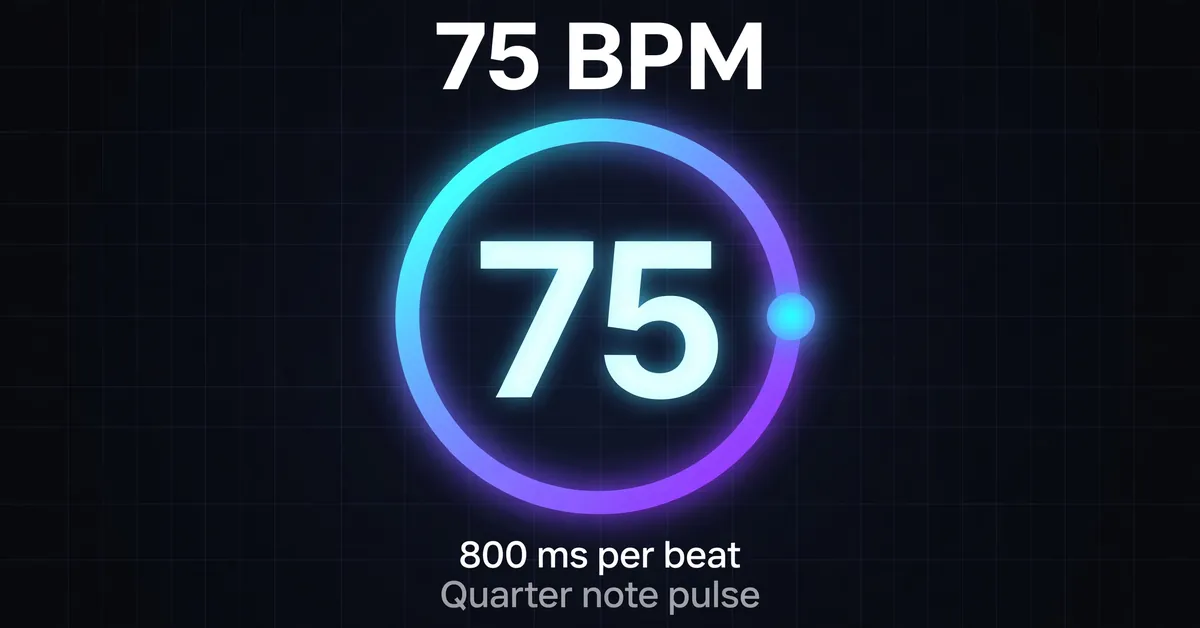
What Is 75 BPM?
75 BPM means 75 beats per minute, or one beat every 800 milliseconds, which is 1.25 beats each second. This slow pulse sits near the upper end of Adagio on this site's chart. Start the 75 BPM metronome for ballad accompaniment or chord changes, and check recording versions before choosing songs to play along with.
75 is one of the tidiest slow tempos to calculate. Every straight value lands on a whole millisecond: 800, 400, 200, 100 and 50. Only the triplets leave decimals, because 800 does not divide evenly by 3.
Frequency check: 75 ÷ 60 = 1.25 Hz for the quarter note pulse. The BPM to Hz converter gives the same reading for other rates.
How Long Is Each Note Value at 75 BPM?
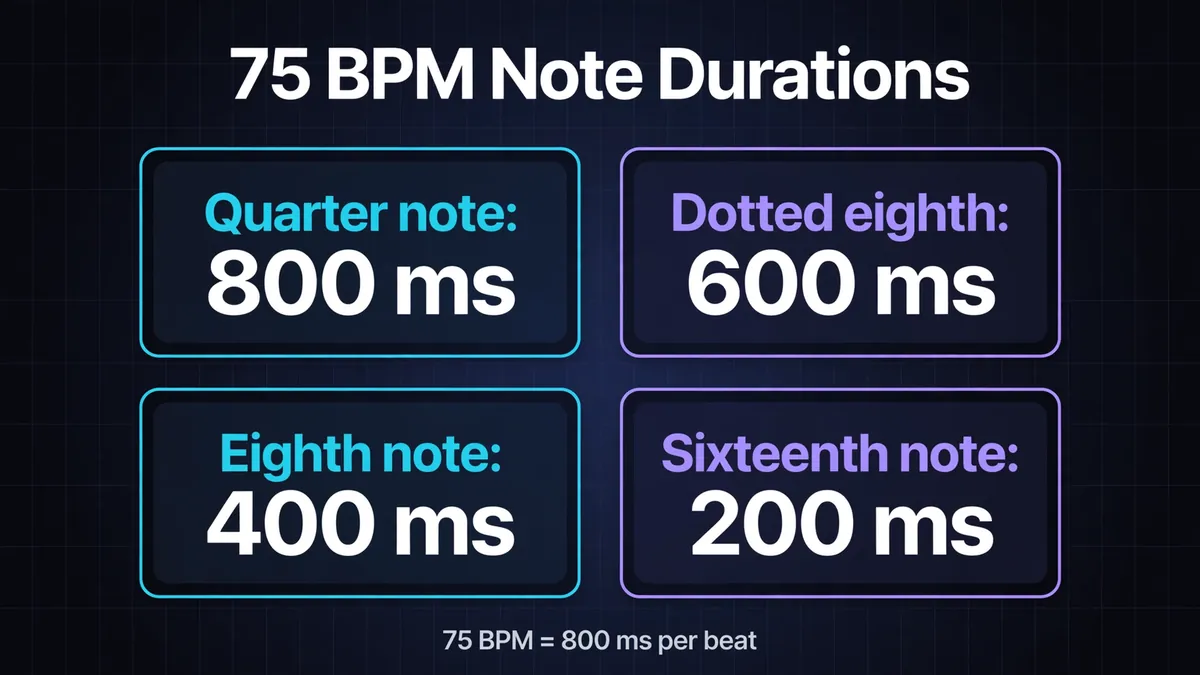
At 75 BPM a quarter note lasts 800 ms, an eighth note 400 ms, a sixteenth 200 ms and an eighth note triplet 266.67 ms. Dotted values add half again: a dotted quarter is 1200 ms and a dotted eighth is 600 ms. Each value is 800 ms multiplied by the note's share of one beat.
The quarter note is the counted beat here. Seeing dotted quarter = 50 on a 6/8 lullaby? That is 75 on a quarter note metronome (50 × 1.5).
| Note value | Beats | Duration (ms) | Rate (Hz) |
|---|---|---|---|
| Whole note | 4 | 3200.00 | 0.31 |
| Half note | 2 | 1600.00 | 0.63 |
| Dotted quarter | 1.5 | 1200.00 | 0.83 |
| Quarter note | 1 | 800.00 | 1.25 |
| Quarter note triplet | 2/3 | 533.33 | 1.88 |
| Dotted eighth | 0.75 | 600.00 | 1.67 |
| Eighth note | 0.5 | 400.00 | 2.50 |
| Dotted sixteenth | 0.375 | 300.00 | 3.33 |
| Eighth note triplet | 1/3 | 266.67 | 3.75 |
| Sixteenth note | 0.25 | 200.00 | 5.00 |
| Sixteenth note triplet | 1/6 | 133.33 | 7.50 |
| Thirty second note | 0.125 | 100.00 | 10.00 |
| Sixty fourth note | 0.0625 | 50.00 | 20.00 |
Worked example: a quarter note triplet fits three notes into two beats, so 1600 ÷ 3 = 533.33 ms. A dotted eighth is 400 × 1.5 = 600 ms. For values not listed, the note duration calculator and BPM to ms converter run the same arithmetic.
How Long Is a Bar at 75 BPM?
One bar of 4/4 at 75 BPM lasts exactly 3.2 seconds, so 18.75 bars pass every minute. A 3/4 bar lasts 2.4 seconds. An 8 bar phrase in 4/4 runs 25.6 seconds, a 16 bar verse 51.2 seconds, and a 32 bar form 1 minute 42.4 seconds.
| Length | Beats | Duration |
|---|---|---|
| 1 bar of 3/4 | 3 | 2.40 s |
| 1 bar of 4/4 | 4 | 3.20 s |
| 1 bar of 6/8 (three quarter note beats) | 3 | 2.40 s |
| 4 bars of 4/4 | 16 | 12.80 s |
| 8 bars of 4/4 | 32 | 25.60 s |
| 16 bars of 4/4 | 64 | 51.20 s |
| 32 bars of 4/4 | 128 | 102.40 s |
The 6/8 row follows the site metronome's rule: in x/8 meters the BPM counts quarter notes and each eighth clicks, so six eighths span three quarter note beats. Because a 4/4 bar is exactly 3.2 seconds, 75 bars take exactly 4 minutes (75 × 3.2 = 240 s), a handy figure when planning a ballad's length.
What Does 75 BPM Feel Like?
75 BPM feels like a slow, steady sway, with enough space between clicks for sustained chords to ring and for a singer to breathe. It sits near the boundary where slow material starts to feel like it is moving forward, so ballads and laid back grooves both work here.
Try sustaining a chord through a complete bar before changing on the next downbeat. Count the quiet beats as carefully as the attack. Then play an arpeggio over the same pulse. The exercise changes how many notes you play while the tempo stays fixed.
Against its neighbors, 75 is 5 BPM faster than 70 BPM, so each beat is 57.14 ms shorter (857.14 minus 800). Moving up to 80 BPM trims the beat to 750 ms, exactly 50 ms less.
How Should You Practice at 75 BPM?
Use 75 BPM to practice control at a slow pace, where every note has 800 ms of room around it. Set the online metronome to 75 with the accent on beat 1, choose 4/4 or 3/4, and play sustained notes, arpeggios and subdivisions over the same click to hear whether your placement holds.
- Pianist: play a left hand bass note on beat 1 and right hand eighth note arpeggios (400 ms apart) through the bar. Then switch to triplets at 266.67 ms.
- Drummer: play a ballad groove with the kick on 1, a cross stick on 2 and 4, and hi hat eighths. Turn off the click every second bar and check the downbeat lands on time.
- Guitarist: strum a chord on beat 1 and let it ring for 3.2 seconds. Change shape silently during beat 4 so the next chord sounds exactly on the downbeat.
- Student in 6/8: if the score says dotted quarter equals 75, the quarter note setting is 112.5, because 75 × 1.5 = 112.5; if the control takes whole numbers, 112 or 113 is the nearest setting.
When a passage is clean, the speed trainer can step it from 75 toward 80. To check the tempo of a recording first, tap along on the tap tempo tool.
Which Songs Are Reported at 75 BPM?
The linked SongBPM entries report "Lean on Me" by Bill Withers, a remastered "Breakfast in America" by Supertramp, and the Eagles' "Hotel California" in its Live On MTV, 1994 version at 75 BPM. These are attributed database reports, not independent audio measurements, and the version matters for each row.
| Song | Artist | Recording version | Reported BPM | Counting option | Sources |
|---|---|---|---|---|---|
| Lean on Me | Bill Withers | Version unspecified | 75 | 75 BPM count | SongBPM |
| Breakfast in America | Supertramp | Remastered | 75 | 75 BPM count | SongBPM |
| Hotel California | Eagles | Live On MTV, 1994 | 75 | 75 BPM count | SongBPM |
The Hotel California reading belongs to that live recording only and should not be assigned to every version of the song. A counting option does not establish the recording's intended feel. If a detector shows 150 where you hear 75, see why BPM detectors disagree.
How Do Producers Use 75 BPM?
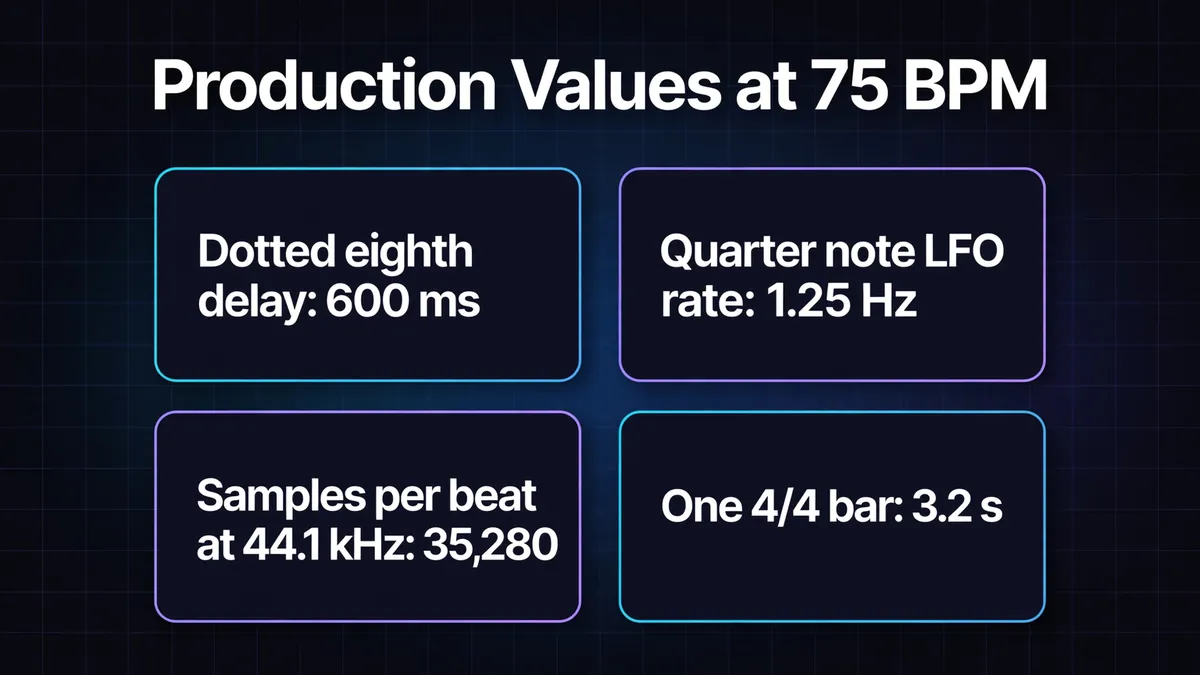
At 75 BPM producers get round delay numbers: an eighth note delay is 400 ms, a dotted eighth 600 ms and a quarter note 800 ms. A sixty fourth note gives 50 ms as a reverb pre delay starting point. Ableton Live, Logic Pro, FL Studio and Pro Tools all accept 75 as a project tempo.
Worked scenario: a producer mixing a soul or R&B ballad at 75 puts a dotted eighth delay (600 ms) on the lead vocal and an eighth note delay (400 ms) on a guitar. Comparing both on a sparse vocal phrase shows where the repeats land between words. A tremolo synced to eighth notes cycles at 2.5 Hz.
| Use | Note value | Time |
|---|---|---|
| Slap style delay | Sixteenth | 200 ms |
| Straight echo | Eighth | 400 ms |
| Rhythmic vocal throw | Dotted eighth | 600 ms |
| Wide echo | Quarter | 800 ms |
| Tremolo or filter LFO | Eighth | 400 ms (2.50 Hz) |
| Sidechain pump per beat | Quarter | 800 ms (1.25 Hz) |
| Reverb pre delay start | Sixty fourth | 50 ms |
At 44.1 kHz one beat holds exactly 35,280 samples, and at 48 kHz exactly 38,400 samples (60 × 48,000 ÷ 75). The BPM to samples converter handles other rates, and the delay calculator and reverb calculator list every synced time.
What Are Half Time and Double Time at 75 BPM?
Half time of 75 BPM is 37.5 BPM, with a 1600 ms beat, and double time is 150 BPM, with a 400 ms beat. You can follow either pulse level without changing playback speed. A true half time or double time drum feel also depends on how the kick and snare accents are placed.
The reverse direction is just as common: half of 150 BPM is 75 BPM. A drummer reading a 150 BPM chart can feel a 75 BPM backbeat by placing the snare on beat 3 of each 150 BPM bar. To practice the 37.5 BPM pulse, keep the metronome at 75 and count only every second click as the beat. Compare the numbers with the half time calculator and double time calculator, or read the half time vs double time guide.
Which Mistakes Happen Most at 75 BPM?
The usual mistakes at 75 BPM are rushing long sustained notes, assigning a live version's tempo to a studio recording, reading a 150 BPM detector result as a different song speed, and treating a dotted quarter score mark as a quarter note BPM. Each one is easy to check with a click and the numbers above.
- Version mix ups: the studio and live recordings of a song can report different tempos, which is why the table names each version.
- Compound meter: dotted quarter equals 75 means a quarter note setting of 112.5, not 75.
- Close neighbors: 75 and 72 differ by 33.33 ms per beat (833.33 minus 800). Over 54 bars of 4/4 that adds up to 7.2 seconds (180 s against 172.8 s). Confirm a track with the BPM counter before syncing delays.