
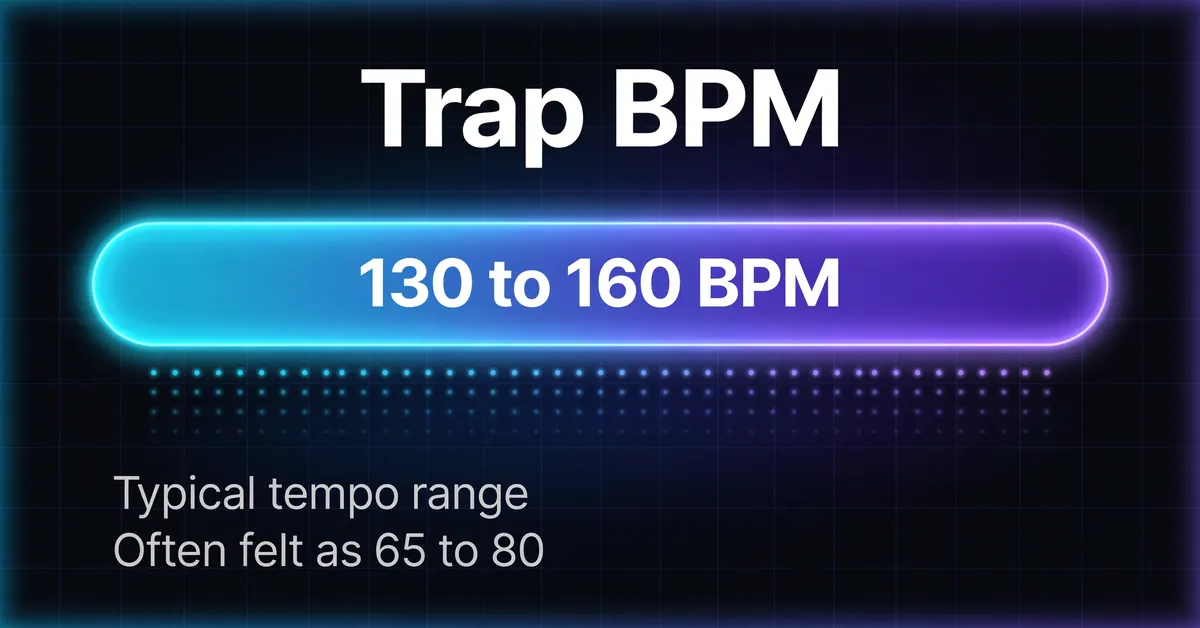
What BPM Is Trap?
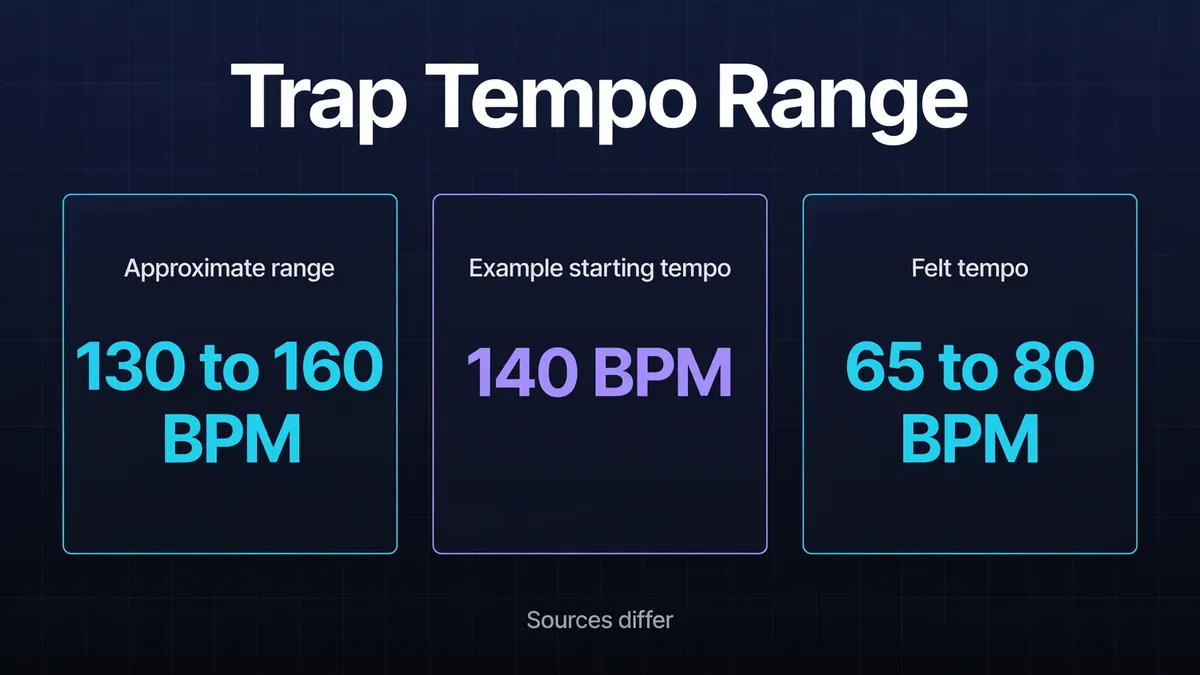
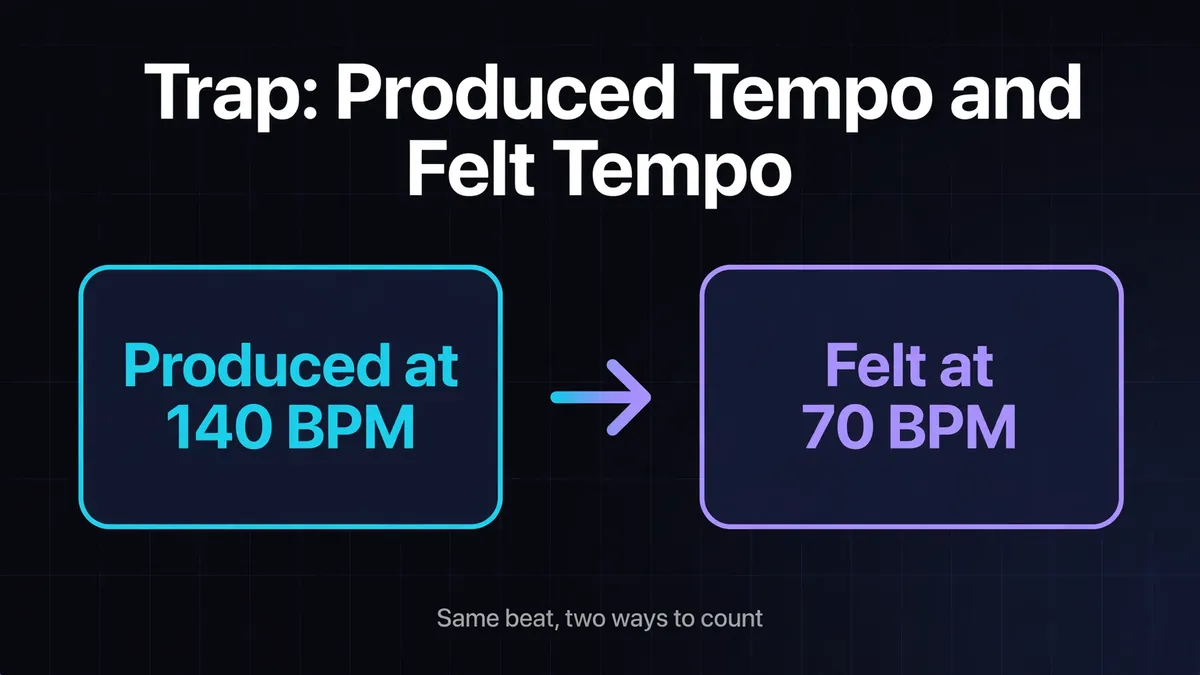
Trap BPM sits in an approximate 130 to 160 BPM production range on this page, paired with a felt pulse of 65 to 80 BPM. With the main snare on beat 3, a 140 BPM grid can feel like 70 BPM. Both counts describe the same performance using different bar groupings and note values.
The two numbers are linked by a factor of 2. Halve any produced tempo and you get the felt pulse: 130 ÷ 2 = 65 and 160 ÷ 2 = 80. That is why trap can sit next to slow hip hop in a playlist while its project file says 140.
BPM by Subgenre
| Subgenre | Approximate BPM reference | How to use the example |
|---|---|---|
| Emo trap and SoundCloud rap | 120 to 140 | Example produced grid; half pulse 60 to 70 |
| Atlanta and Southern trap | 130 to 145 | Example produced grid; half pulse 65 to 72.5 |
| UK and NY drill | 138 to 145 | Check snare placement across the full phrase |
| Mainstream trap | 135 to 150 | Starting suggestions; half pulse 67.5 to 75 |
| EDM and festival trap | 140 to 160 | Example produced grid; half pulse 70 to 80 |
The bands overlap heavily, so BPM alone rarely tells you the subgenre. Drum placement, 808 behavior and hat density usually say more. A drill beat and a mainstream trap beat can both run at 142 BPM.
Should You Make a Trap Beat at 70 or 140 BPM?
Either grid can describe the same performance if you change the note values and bar grouping to match. At 140 BPM, the example has a snare on beat 3 of each bar. Count the same audio at 70 BPM and those snares fall on beats 2 and 4 across a longer bar. Changing the project BPM without adjusting the arrangement changes playback timing.
BeatStars' trap guide supports using 140 BPM as a starting reference and explains the two counting levels. Its selected song survey does not establish a tempo rule for every trap release.
In practice most producers pick 140 because the faster grid gives finer resolution for hats. At 140 BPM a sixteenth note step is 107.14 ms, which matches a thirty second note at 70 BPM. Building at 70 works too, but every roll then needs thirty second and sixty fourth notes, which makes piano roll editing in FL Studio or Ableton Live more cramped. Pick one and stay with it for the whole project.
How Does Half Time Counting Work in Trap?
Half time counting treats two bars of the 140 BPM grid as one bar at 70 BPM. Beat 1 and beat 3 of each 140 bar become beats 1 and 2, or beats 3 and 4, of the slower bar. So a snare on beat 3 of every 140 bar lands on beats 2 and 4 at 70 BPM: a normal backbeat.
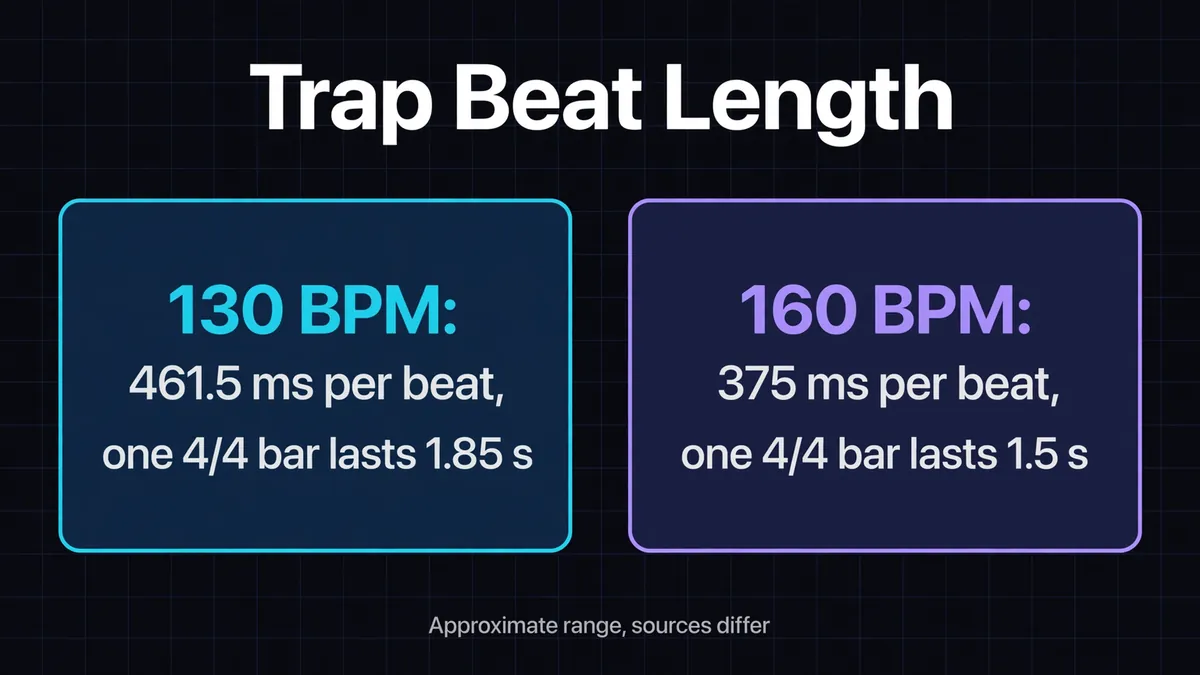
Walk through it with real numbers. At 140 BPM each quarter note lasts 428.57 ms and one bar of 4/4 lasts 1,714.29 ms. At 70 BPM each quarter note lasts 857.14 ms and one bar lasts 3,428.57 ms, exactly two of the faster bars.
| Time from start (ms) | Count at 140 BPM | Count at 70 BPM | What plays |
|---|---|---|---|
| 0.00 | Bar 1, beat 1 | Bar 1, beat 1 | Kick |
| 428.57 | Bar 1, beat 2 | Bar 1, and of 1 | Hats |
| 857.14 | Bar 1, beat 3 | Bar 1, beat 2 | Snare |
| 1,285.71 | Bar 1, beat 4 | Bar 1, and of 2 | Hats |
| 1,714.29 | Bar 2, beat 1 | Bar 1, beat 3 | Kick |
| 2,142.86 | Bar 2, beat 2 | Bar 1, and of 3 | Hats |
| 2,571.43 | Bar 2, beat 3 | Bar 1, beat 4 | Snare |
| 3,000.00 | Bar 2, beat 4 | Bar 1, and of 4 | Hats |
Every note keeps its exact time. Only the labels change: a quarter note at 140 becomes an eighth note at 70, and a sixteenth at 140 becomes a thirty second at 70.
| Length (ms) | Name at 140 BPM | Name at 70 BPM |
|---|---|---|
| 857.14 | Half note | Quarter note |
| 428.57 | Quarter note | Eighth note |
| 214.29 | Eighth note | Sixteenth note |
| 107.14 | Sixteenth note | Thirty second note |
This is also why the head nod feels slow. Listeners tend to move with the snare backbeat, and that backbeat repeats every 1,714.29 ms whichever way you count. More on the general idea is on the half time vs double time page and the half time BPM calculator.
How Does Trap Feel at 140 BPM?
Use this one bar exercise in 4/4. Each beat has four sixteenth note steps, counted 1 e and a. Beats 1, 2, 3 and 4 begin on steps 1, 5, 9 and 13.
| Voice | Steps | Placement |
|---|---|---|
| Snare or clap | 9 | Beat 3 of the 140 BPM bar |
| Kick and 808 trigger | 1, 8, 11 | Beat 1, the a of 2 and the and of 3 |
| Hi hat | 1, 3, 5, 7, 9, 11, 13, 15 | Eighths, with optional rolls added between hits |
Start with the snare and base hats, then add the kick and tune the 808 to the part. For a roll, shorten the grid division for a small group of hats and vary the velocity. Compare straight and triplet subdivisions before adding pitch changes.
Scenario: a producer loops this bar and it feels rushed. Before dropping the tempo, try removing the kick on step 8. Fewer hits per bar often reads as slower even when the grid stays at 140 BPM. If it still feels hurried, move to 135 BPM; each quarter note grows from 428.57 ms to 444.44 ms.
Note Values at 140 BPM
These are quarter note values at 140; if you count the trap groove at a half time 70, double every duration below.
| Note value | Length in ms |
|---|---|
| Quarter note | 428.57 |
| Eighth note | 214.29 |
| Sixteenth note | 107.14 |
| Dotted eighth note | 321.43 |
| Eighth note triplet | 142.86 |
At 140 BPM, thirty second notes are 53.57 ms apart; eighth triplets are 142.86 ms apart. Use the note duration calculator to compare roll subdivisions while keeping the slow snare pulse in view, or the delay calculator for a dotted eighth echo at 321.43 ms on a vocal tag.
How Do Hi Hat Rolls Fit the Grid?
A hat roll is a short burst of faster subdivisions placed on top of the base eighth or sixteenth note pattern. At 140 BPM the common choices are sixteenth triplets at 71.43 ms, thirty second notes at 53.57 ms and thirty second triplets at 35.71 ms. Keep rolls brief so the change in density stands out.
| Roll division at 140 BPM | Hits per beat | Gap between hits (ms) |
|---|---|---|
| Sixteenth note | 4 | 107.14 |
| Sixteenth note triplet | 6 | 71.43 |
| Thirty second note | 8 | 53.57 |
| Thirty second note triplet | 12 | 35.71 |
Worked example: 60,000 ÷ 140 = 428.57 ms per beat; 428.57 ÷ 6 = 71.43 ms for sixteenth triplets. A roll of six such hits fills exactly one beat. Try placing it in the beat just before the snare on beat 3, then let the next beat breathe with plain eighths. In Logic Pro or FL Studio, a note repeat or a quick grid change to 1/24 gives the triplet version.
How Is Drill Different From Trap?
Drill overlaps trap in BPM but differs in drum placement. This page uses 138 to 145 BPM produced for drill, felt at 69 to 72.5. Where the trap example keeps one snare on beat 3 of every bar, drill snares often move across a two bar pattern, so check the whole phrase before you label a beat.
Drill needs its own pattern check. Native Instruments' drill example places a snare on beat 3 in the first bar and beat 4 in the second. Sliding 808s and shifting snares can distinguish the groove even when its BPM overlaps trap.
At 142 BPM that late snare in the second bar arrives 422.54 ms after where a trap ear expects it (60,000 ÷ 142 = 422.54 ms, one quarter note). That one beat displacement is enough to make a DJ or a dancer feel the groove stumble if they count it as trap.
Practicing and Mixing at Trap Tempos
Players: Practice against regular clicks at 70 BPM on the online metronome, counting the snare on beats 2 and 4. Then switch to 140 BPM and count the same snare on beat 3. Keep your playing identical as you switch counting levels. Count through the full phrase so a hat fill does not pull you away from the slower pulse.
DJs: Choose the counting convention that fits your library and verify the beat grid. A trap track and a dubstep track both labeled 140 BPM still need compatible phrase starts and drum placement; the dubstep guide shows its own half time pattern. Preview where their snares meet before committing to the blend. If one track reads 70 and the other 140, they already match; do not stretch either one by 100 percent.
Dancers and runners: Most people step to the felt pulse. At 70 BPM a step falls every 857.14 ms; stepping to every 140 BPM beat doubles that to one step each 428.57 ms. Try both and keep whichever matches the snare.
Which Counting Mistakes Cause the Most Confusion?
- Halving the project tempo without changing the notes. Setting a 140 BPM session to 70 plays everything at half speed; the arrangement has to be rewritten in longer note values.
- Doubling a BPM finder result automatically. If the tool shows 72, check the snare first. On a snare on beats 2 and 4 count, 72 is a valid reading of a 144 grid.
- Counting the snare on beat 3 at 70 BPM. At the slow level the snare sits on beats 2 and 4; beat 3 only applies to the 140 count.
- Assuming every drill bar matches the trap example. The snare can shift a beat in the second bar.
- Building rolls finer than the mix can carry. Thirty second triplets at 35.71 ms blur on small speakers if the hat has a long decay.