
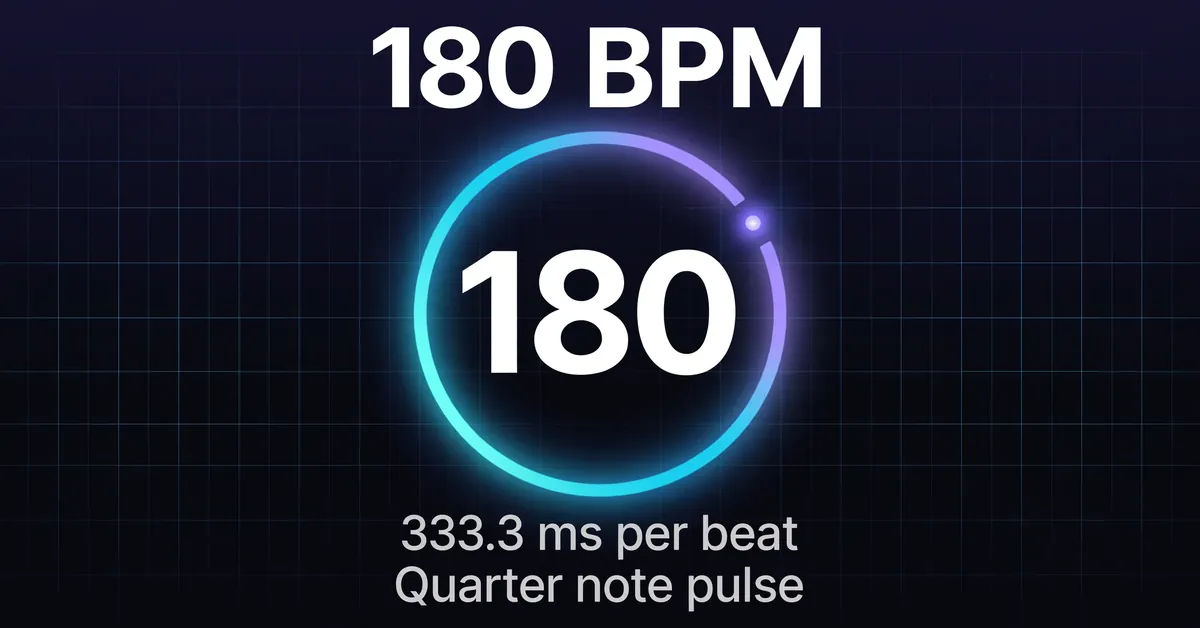
What Is 180 BPM?
180 BPM means 180 beats per minute, which works out to exactly three beats every second and about 333.33 milliseconds per beat. It is a fast pulse used in punk, thrash and hard rock practice. Start the 180 BPM metronome, or count it at 90 if the full rate feels frantic.
Because 180 divides so cleanly into 60, many values here come out as tidy numbers. A dotted quarter is exactly 500 ms, a dotted half is exactly one second, and a bar of 3/4 also lasts one second. That makes 180 a handy reference tempo for checking other timing math.
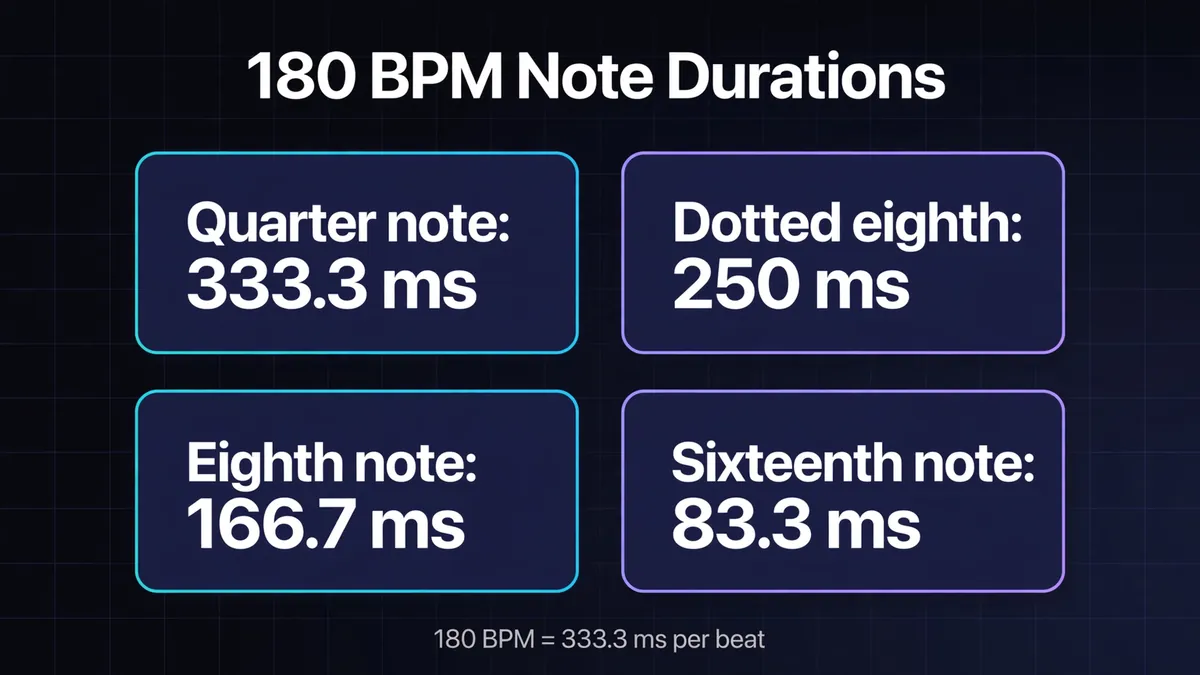
How Long Is Each Note Value at 180 BPM?
At 180 BPM a quarter note lasts 333.33 ms, an eighth note 166.67 ms and a sixteenth 83.33 ms. Several values are exact: the dotted eighth is 250 ms, the dotted quarter 500 ms and the dotted half 1000 ms. All figures are rounded to two decimals from 60,000 ÷ 180.
The quarter note is the beat in every row. In 6/8, a dotted quarter mark of 120 equals 180 here, since 120 × 1.5 = 180.
| Note value | Beats | Duration (ms) | Hz (repeats per second) |
|---|---|---|---|
| Whole note | 4 | 1333.33 | 0.75 |
| Dotted half | 3 | 1000.00 | 1.00 |
| Half note | 2 | 666.67 | 1.50 |
| Dotted quarter | 1.5 | 500.00 | 2.00 |
| Half note triplet | 4/3 | 444.44 | 2.25 |
| Quarter note | 1 | 333.33 | 3.00 |
| Dotted eighth | 0.75 | 250.00 | 4.00 |
| Quarter note triplet | 2/3 | 222.22 | 4.50 |
| Eighth note | 0.5 | 166.67 | 6.00 |
| Dotted sixteenth | 0.375 | 125.00 | 8.00 |
| Eighth note triplet | 1/3 | 111.11 | 9.00 |
| Sixteenth note | 0.25 | 83.33 | 12.00 |
| Sixteenth note triplet | 1/6 | 55.56 | 18.00 |
| Thirty second note | 0.125 | 41.67 | 24.00 |
| Sixty fourth note | 0.0625 | 20.83 | 48.00 |
Worked example: an eighth note triplet splits the beat into three, so 333.33 ÷ 3 = 111.11 ms, and three of them return the full 333.33 ms beat. For values not shown, use the note duration calculator or the BPM to ms converter.
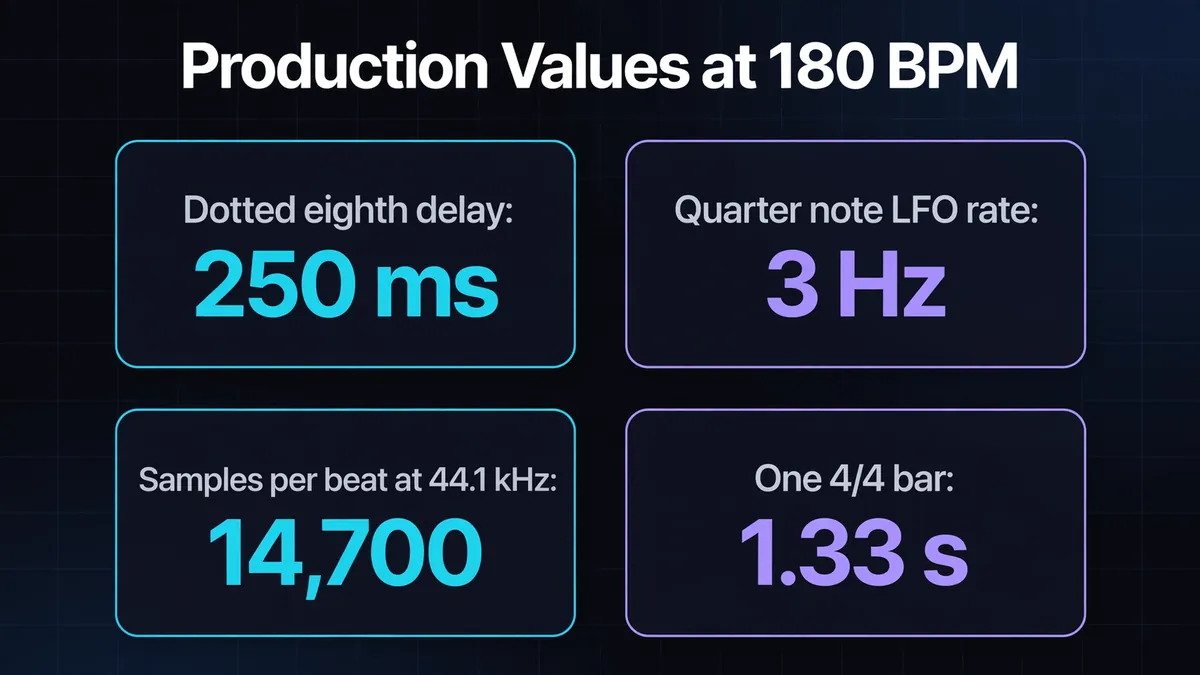
Sample counts at 180 BPM are whole numbers at both common rates, which is unusual. One beat is 14,700 samples at 44.1 kHz and 16,000 at 48 kHz, so loops trimmed to the beat line up without fractional leftovers. BPM to samples covers other sample rates.
| Unit at 180 BPM | Samples at 44.1 kHz | Samples at 48 kHz |
|---|---|---|
| Sixteenth note | 3,675 | 4,000 |
| Quarter note | 14,700 | 16,000 |
| One 4/4 bar | 58,800 | 64,000 |
How Long Are Bars and Phrases at 180 BPM?
A 4/4 bar at 180 BPM lasts about 1.333 seconds, while bars of 3/4 and 6/8 each last exactly one second, since they hold three quarter note beats. Eight bars of 4/4 take about 10.667 seconds and 32 bars about 42.667 seconds. Divide beats times 60 by 180.
| Bars | 4/4 (4 beats) | 3/4 (3 beats) | 6/8 (3 quarter beats) |
|---|---|---|---|
| 1 | 1.333 s | 1.000 s | 1.000 s |
| 4 | 5.333 s | 4.000 s | 4.000 s |
| 8 | 10.667 s | 8.000 s | 8.000 s |
| 16 | 21.333 s | 16.000 s | 16.000 s |
| 32 | 42.667 s | 32.000 s | 32.000 s |
The one second bar in 3/4 is a useful mental anchor: count a bar per second and you are at 180. In 6/8 the metronome counts quarter notes and clicks each eighth, so six clicks fill each one second bar. A two minute punk song at this tempo contains 360 beats, or 90 bars of 4/4. See time signatures and BPM for other meters.
What Tempo Marking Is 180 BPM?
180 BPM falls inside Presto on this site's tempo chart, which runs from 168 to 200 BPM. It sits above the Vivace band (156 to 176) and below Prestissimo, which begins at 200. Other sources set the Presto range a little differently, so follow any printed metronome mark first.
When a score says Presto with no number, 180 is a reasonable first guess, but the composer's beat unit matters. A Presto marked half note = 90 gives the same 180 quarter note setting. The tempo markings chart shows all the bands.
What Does 180 BPM Feel Like?
Three clicks a second feels driving and hard to relax into at first. Played as straight eighths, a punk or thrash guitarist is hitting six notes per second. Counted at 90, the same music can feel like a strong half time groove with fast detail above it.
Try a short rock pattern with the kick on 1 and 3 and the snare on 2 and 4. Keep it simple enough to place evenly before adding fills. For movement, one step per beat gives 180 steps per minute; that arithmetic does not prescribe a suitable cadence for every runner.
How Should You Practice at 180 BPM?
Work up to 180 BPM rather than starting there. Begin near 140 or 150 BPM, confirm the pattern is even, then raise the tempo a few BPM at a time. The online metronome speed trainer can do the stepping for you, and it reaches up to 360 BPM.
A guitarist learning a fast downpicked riff might use this sequence:
- Set 90 BPM with an eighth note subdivision. Each eighth click now matches a quarter note at 180.
- Play the riff as eighths at 90, which is the same note speed as quarters at 180.
- Switch to 180 BPM and play the same riff as quarter notes, then try eighths at 166.67 ms each.
Drummers can practice single strokes as eighth notes at 180 for one minute: that is 360 strokes, or six per second. If you want to confirm a recording's tempo before practicing to it, tap along with the tap tempo tool for a few bars.
Which Songs Are Reported at 180 BPM?
Tunebat reports "Copines" by Aya Nakamura at 180 BPM, and SongBPM reports the remastered "Safe European Home" by The Clash at 180. "Kickstart My Heart" by Mötley Crüe is listed at 179, a nearby match rather than an exact 180 report.
<a id="songs-at-180-bpm"></a>
The figures below come from the linked databases and are not our own measurements. Nearby matches and alternative counts are labeled separately. Use the named version where one is given; a counting option does not establish the recording's intended feel.
| Song | Artist | Recording version | Reported BPM | Counting option | Sources |
|---|---|---|---|---|---|
| Copines | Aya Nakamura | Version unspecified | 180 | 180 BPM count | Tunebat |
| Safe European Home | The Clash | Remastered | 180 | 180 BPM count | SongBPM |
| Kickstart My Heart | Mötley Crüe | Linked 4:43 recording | 179 | Nearby match, 1 BPM below 180 | SongBPM |
A French pop track next to British punk and American hard rock shows that 180 is not tied to one style. Some databases list fast songs at half their tempo, so a figure near 90 can describe the same recording; why BPM detectors disagree explains why.
How Do Producers Use 180 BPM?
At 180 BPM, delay and modulation settings come out unusually round. A dotted eighth delay is 250 ms, a quarter note delay 333.33 ms and an eighth 166.67 ms. A quarter note LFO cycles at exactly 3 Hz and a sixteenth note LFO at 12 Hz.
Set 180 in the tempo field of Ableton Live, Logic Pro, FL Studio or Pro Tools and synced effects follow automatically. When you set things by hand:
- Slapback on a punk vocal: a thirty second note (41.67 ms) or sixteenth (83.33 ms) keeps the echo tight under fast phrasing.
- Reverb pre delay: a sixty fourth note of 20.83 ms keeps the dry snare ahead of the room.
- Sidechain release: an eighth (166.67 ms) recovers before the next beat; a quarter gives a longer swell.
Compare the effect with the click, and adjust phase or retrigger if a cycle needs to start on a particular accent. The delay calculator and reverb calculator list more settings.
What Are Half Time and Double Time at 180 BPM?
Half time of 180 BPM is 90 BPM, with a beat every 666.67 ms, and double time is 360 BPM, with a beat every 166.67 ms. Counting at either level leaves playback speed unchanged. A half time or double time drum feel also depends on where the accents fall.
Runners sometimes use this relationship: two evenly spaced steps per beat of a 90 BPM song give 180 steps per minute, counting both feet. That is a timing relationship, not a recommendation to adopt that cadence. Compare levels with the half time calculator and double time calculator, or read half time vs double time. The nearest lower preset is 174 BPM, and rock tempos are covered on the rock BPM page.
What Mistakes Happen at 180 BPM?
Most problems at 180 BPM come from rushing, tension and confusing pulse levels. Players jump straight to full speed, grip harder as the tempo rises, or follow a database figure of 90 without realizing it is the same song counted differently. Each mistake makes the time feel uneven.
- Starting at 180. Begin slower and build up; unevenness hidden at speed becomes obvious at 150.
- Tensing the hands. At 166.67 ms per eighth note, tight muscles slow recovery between strokes.
- Treating 90 and 180 as different songs. They are often two counts of one recording.
- Rounding to 333 ms. Over 32 bars of 4/4 the 0.33 ms shortfall adds up to about 43 ms.
- Calling 180 Prestissimo. On this site's chart it is Presto; Prestissimo starts at 200.