
What Does Allegro Mean in Music?
In everyday Italian, allegro means cheerful or merry. Placed above a score, it tells the performer to play quickly with a buoyant, energetic character. The speed matters, but so does the mood: a clear, springy Allegro beats a rushed one played at the same number.
The word became a standard heading for fast movements during the Baroque and Classical periods. In a typical Classical symphony, sonata or concerto, the first movement is fast, and Allegro is the most common label for it. That history explains why the marking feels so familiar to piano students and orchestral players alike.
Allegro also works as a noun. Musicians say "the Allegro" to mean a movement or section that carries the marking, in the same way they speak of "the Adagio" for a slow movement. When you see the word in a concert program, it usually names a movement rather than giving a precise speed.
What BPM Is Allegro?
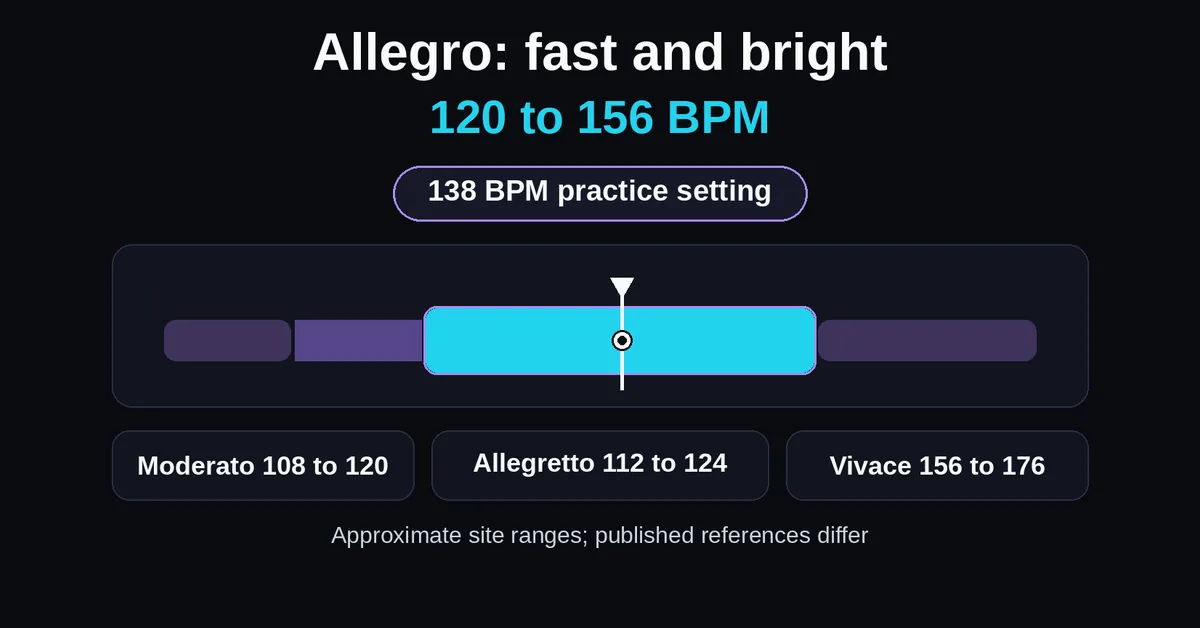
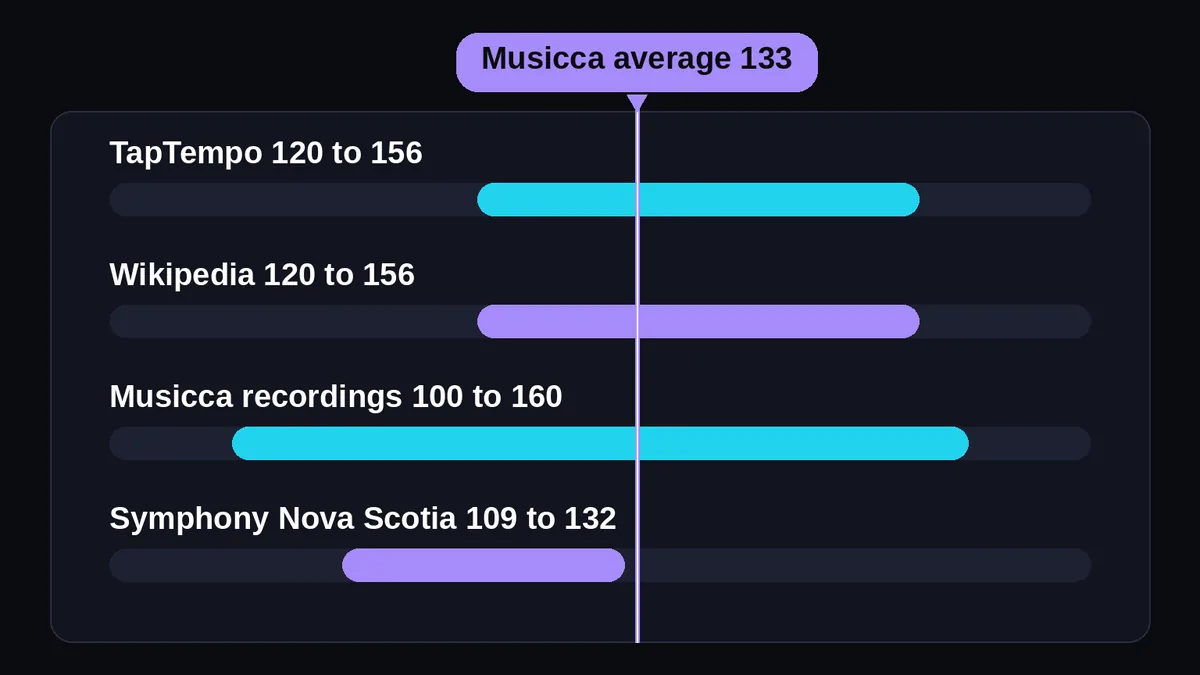
This site places Allegro at 120 to 156 BPM, counting quarter notes, with 138 BPM as the midpoint practice setting. Wikipedia's tempo list gives the same 120 to 156 band, while other references set it lower or wider. Use the band to choose a starting point, then follow the score.
| Source | Allegro figure | What kind of figure it is |
|---|---|---|
| TapTempo tempo chart | 120 to 156 BPM | Site reference band |
| Wikipedia, Tempo | 120 to 156 BPM | Rough guide for 4/4 time |
| Musicca | 100 to 160 BPM, average 133 | Measured from 100 recordings |
| Symphony Nova Scotia | 109 to 132 BPM | Orchestra education reference |
Every figure on this page counts quarter notes unless a row says otherwise. If a score in 6/8 shows a dotted quarter equal to 60, the quarter note setting is 90 BPM, because one dotted quarter holds one and a half quarter notes.
Why Do Allegro BPM Charts Disagree?
Charts disagree because they measure different things. Some list a teaching band, some record what performers actually do, and some come from a single orchestra's guide. None of them is wrong; each answers a slightly different question.
Musicca's figures are the most concrete. It analyzed 100 recordings of classical works marked Allegro, with no more than three recordings of one work and six of one composer, and found an average of 133 BPM across a span of 100 to 160. That average sits inside this site's band, a little below its 138 midpoint.
Wikipedia adds an important warning: tempo words are very rough approximations for 4/4 time, and a metronome marking cannot be deduced from the word alone. A dance movement in 3/4 and a march in cut time can both say Allegro and still feel very different, because the beat unit and the texture change what "fast" means.
The top of the band is the other open question. Many charts stop Allegro at 156 BPM, exactly where Vivace begins, while some teaching charts stretch it to 168. Neither is an error; the two systems simply draw the Allegro and Vivace border in different places.
The beat unit matters as much as the band. In cut time (2/2) the beat is a half note, so a mark of half note = 72 means 144 quarter notes per minute. In 6/8 the beat is a dotted quarter, so multiply by 1.5 instead.
The practical takeaway is simple. Read the band as a neighborhood, not an address. If two charts give 120 and 109 as the lower limit, a performance at 116 BPM can be a convincing Allegro in the right piece.
What Is Allegro Moderato?
Allegro moderato means a moderately fast Allegro: the bright character stays, but the speed is held back. Wikipedia lists it at 116 to 120 BPM. Musicca's recordings stretch from 60 to 150 BPM, which shows how much the surrounding music decides the real pace.
Composers often reach for this marking in broad opening movements that need momentum without display. Beethoven's Piano Concerto No. 4 and Schubert's Symphony No. 8, the "Unfinished," both open Allegro moderato. Each begins with a calm, spacious idea that would sound hurried at a full Allegro speed.
When you practice an Allegro moderato, start near 116 BPM and listen for whether the long phrases still breathe. If the line starts to feel cramped, slow down a few beats per minute instead of trimming the phrasing. For the plain marking without Allegro attached, see Moderato tempo.
What Do Allegro Con Brio, Molto and Ma Non Troppo Change?
Added words adjust the character or the speed of an Allegro. Some push it faster, some calm it, and some only describe the mood. The table gives the usual reading of each combination.
| Marking | Literal meaning | Effect on the performance |
|---|---|---|
| Allegro con brio | Fast, with vigor | Same speed family, more fire and attack |
| Allegro molto or Molto allegro | Very fast | Toward the top of the band; Wikipedia lists 124 to 156 BPM |
| Allegro assai | Very fast | Similar push upward |
| Allegro ma non troppo | Fast, but not too much | Slightly restrained; Musicca reports 70 to 150 BPM |
| Allegro giusto | Fast, at a fitting speed | A sensible, steady Allegro |
| Allegro vivace | Fast and lively | Leans toward Vivace brightness |
The best known example of con brio is the first movement of Beethoven's Symphony No. 5. Its famous four note opening shows that con brio is about energy and attack, not a different number on the metronome.
How Fast Is Allegro Compared With Nearby Markings?
Allegro sits above Moderato and Allegretto and below Vivace and Presto on this site's chart. The boundaries are reference choices, so a relaxed Allegro and a brisk Moderato can meet at 120 BPM.
| Marking | Site reference | Character |
|---|---|---|
| Moderato | 108 to 120 BPM | Moderate and steady |
| Allegretto | 112 to 124 BPM | Moderately fast, lighter than Allegro |
| Allegro | 120 to 156 BPM | Fast, bright, lively |
| Vivace | 156 to 176 BPM | Lively and quick |
| Presto | 168 to 200 BPM | Very fast |
| Prestissimo | 200 BPM and above | As fast as possible |
Allegretto is the one most often confused with Allegro. The "-etto" ending makes it a little Allegro: lighter and usually slower. Grieg's Morning Mood is a good listening example, marked Allegretto pastorale in 6/8.
How Long Are Notes at 138 BPM?
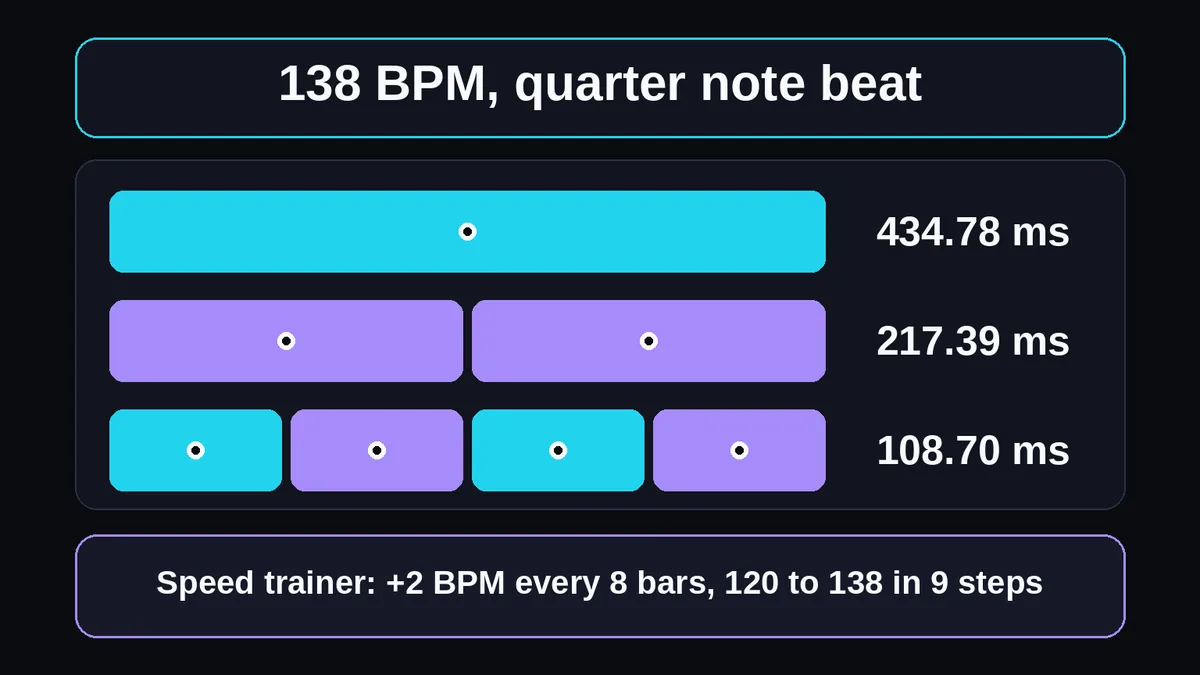
At 138 BPM a quarter note lasts 434.78 milliseconds, an eighth note 217.39 ms and a sixteenth note 108.70 ms. Knowing the gap between notes helps when a fast run starts to blur and you need to hear where each note should land.
| Note value | Quarter notes | At 120 BPM | At 138 BPM | At 156 BPM |
|---|---|---|---|---|
| Half note | 2 | 1,000.00 ms | 869.57 ms | 769.23 ms |
| Dotted quarter | 1.5 | 750.00 ms | 652.17 ms | 576.92 ms |
| Quarter note | 1 | 500.00 ms | 434.78 ms | 384.62 ms |
| Eighth note | 0.5 | 250.00 ms | 217.39 ms | 192.31 ms |
| Sixteenth note | 0.25 | 125.00 ms | 108.70 ms | 96.15 ms |
At the top of the band, sixteenth notes arrive less than a tenth of a second apart. That is why fast Allegro passages are usually practiced in short groups first. For other speeds, the note duration calculator repeats the same math.
Which Famous Pieces Are Marked Allegro?
Clear examples include the first movement of Mozart's Eine kleine Nachtmusik, the Molto allegro that opens his Symphony No. 40, and the Allegro con brio of Beethoven's Fifth Symphony. Recordings vary in speed, so treat them as character models rather than fixed BPM targets.
- Mozart, Eine kleine Nachtmusik, K. 525, first movement (Allegro). Crisp string writing with a strong, even pulse. A good model of Allegro as bright rather than frantic.
- Mozart, Symphony No. 40 in G minor, K. 550, first movement (Molto allegro). Restless and urgent, showing how Allegro energy works in a minor key.
- Beethoven, Symphony No. 5, first movement (Allegro con brio). Short, forceful motifs that need attack more than raw speed.
- Beethoven, Symphony No. 8, first movement (Allegro vivace e con brio). Beethoven gave this movement a dotted half note mark of 69, which equals 207 quarter notes per minute because it is in 3/4. A quarter note chart would never predict that number, which is exactly why the printed mark matters more than the word.
How Do You Practice an Allegro Passage With a Metronome?
Start below the target, build accuracy at a slower setting, then raise the speed in small steps. Set the online metronome to 120 BPM, play the passage cleanly twice, and only then move up. Finish with one run without subdivisions, because the performance will not have them.
- Set 120 BPM with quarter note clicks and the accent on beat 1. Play four bars, slowly enough to hear each note's start.
- Switch to eighth note subdivision. The extra clicks expose rushing between beats, which is the most common Allegro fault.
- Turn on the speed trainer and raise the tempo by 2 BPM every 8 bars. From 120 BPM it reaches the 138 BPM midpoint in nine steps.
- If a run falls apart, go back 6 to 8 BPM, not all the way to the start. Repeat until the difficult bar is clean twice in a row.
- For passages in 6/8, remember that this metronome counts quarter notes and clicks every eighth note. At 138 BPM, the dotted quarter pulse is 92 per minute.
To check a recording you want to imitate, tap along on the tap tempo tool with the spacebar, a letter or a number key. It averages your last eight taps and starts a fresh reading after a pause of 2.5 seconds. If your number looks twice too fast, you were probably tapping eighth notes; the half time and double time guide explains the correction.