
What Does Allegretto Mean in Music?
Allegretto is a softened form of Allegro, asking for a moderately lively pace. It can appear at the beginning of a piece, above a section or as a movement's title. The word describes how the music should move, while a numerical metronome mark supplies a more specific speed for a stated note value. Grove's Allegretto entry.
Musicca's dictionary entry also recognizes Allegretto as a name for a movement or short piece. Neither use makes it a separate time signature or rhythm pattern.
Read compounds as a whole: Allegretto grazioso adds graceful character, while Allegretto con moto adds movement. Neither modifier sets a fixed BPM increment or supplies a loudness instruction.
For a piano part marked Allegretto grazioso, try the melody alone before adding the accompaniment. Keep the chosen pulse while restoring the left hand. If the melody suddenly feels hurried, simplify the accompaniment for a pass to hear where the parts compete. Then restore the written notes and reassess the tempo. Keep the score's dynamics while testing the speed.
What BPM Is Allegretto?
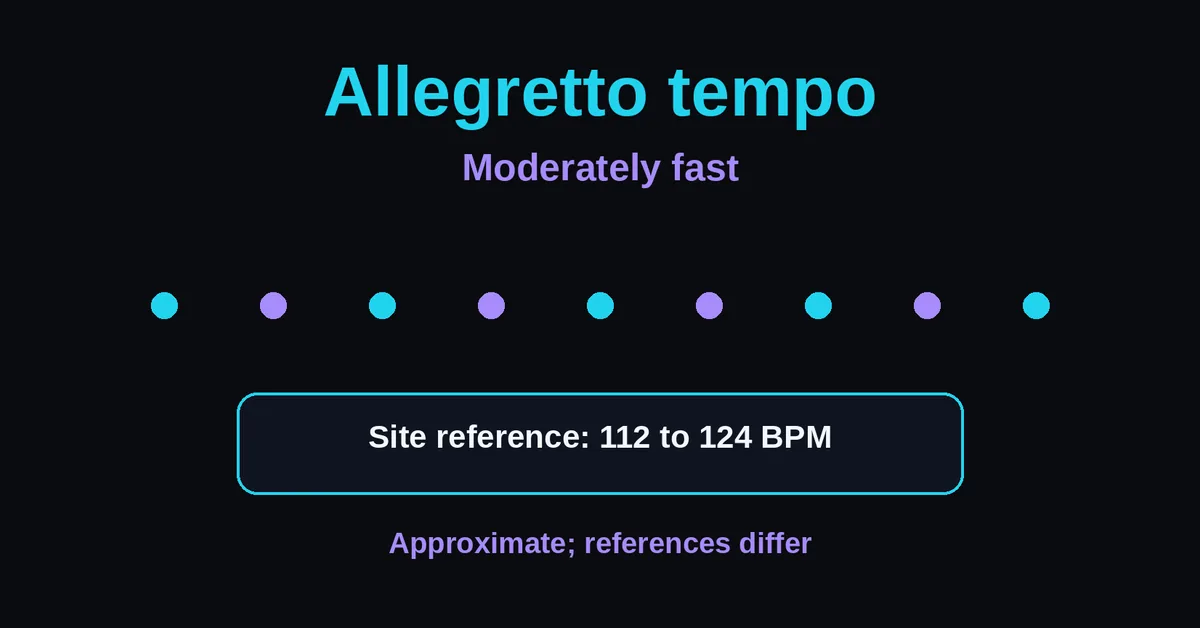
Use 112 to 124 BPM as this site's approximate Allegretto tempo range. Other references use different figures, and Musicca reports a wider performance range. The table separates the site's teaching band from another publisher's reference and Musicca's reported recording analysis. A printed metronome mark remains more specific than any general range.
| Source | Allegretto figure | What it describes |
|---|---|---|
| This site's reference | 112 to 124 BPM | Approximate teaching band |
| Symphony Nova Scotia | 98 to 109 BPM | Published reference |
| Musicca | 70 to 150 BPM; average 110 BPM | Reported typical performance range from 100 recordings |
The selected exercise is 118 BPM, calculated as (112 + 124) ÷ 2. To hear it, open the online metronome, choose 4/4 and the normal subdivision setting labeled 1/4, then enter 118. See the full tempo markings chart for neighboring terms.
Do not average the publishers' figures to find a supposedly definitive Allegretto. A teaching band's midpoint and a recording sample's average answer different questions. For an unnumbered score, use a trial setting, play through the busiest passage and then decide whether that pace suits the whole section.
Is Allegretto Faster Than Moderato or Allegro?
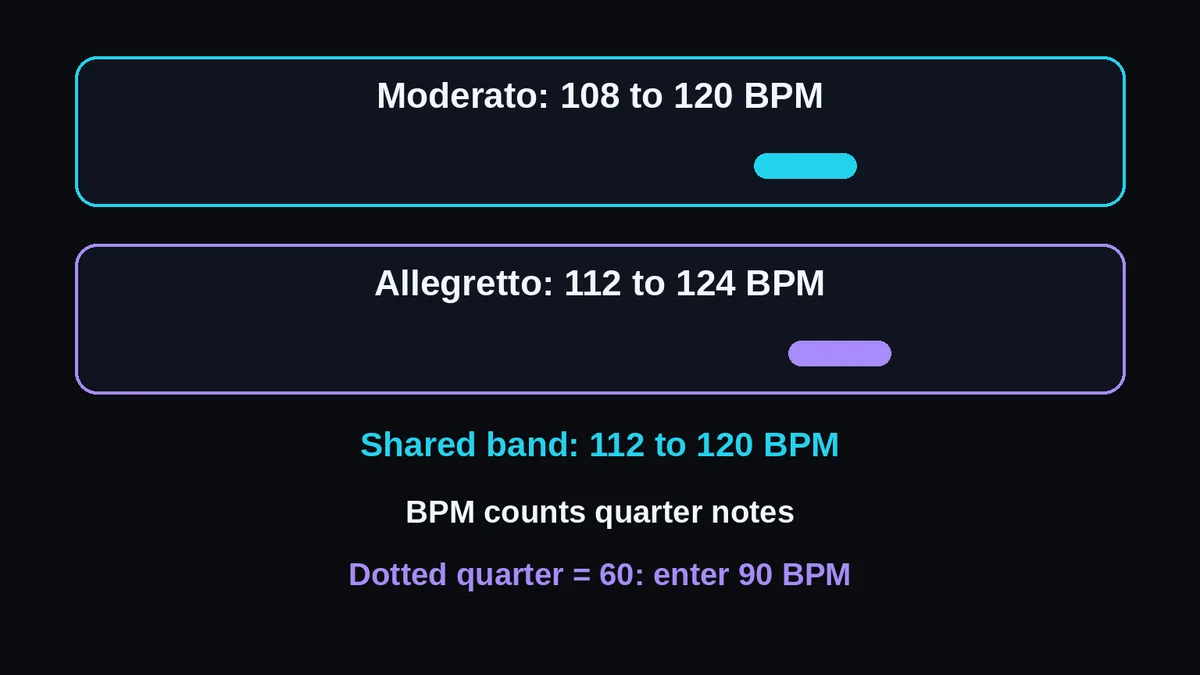
Allegretto usually suggests less speed than Allegro, but it does not sit neatly above every Moderato. This site's bands overlap: Moderato covers 108 to 120 BPM, Allegretto 112 to 124 and Allegro 120 to 156. At 118 BPM, the first two descriptions can apply without the tempo number deciding the character.
That overlap is a teaching choice made for this site; other tempo charts draw Allegretto's edges a few beats higher or lower.
The tempo markings chart sets Moderato's moderate band beside Allegro's faster one. Dynamics still come from the score.
The Moderato and Allegretto bands share 112 to 120 BPM. At 120, all three site bands meet. That overlap is useful when choosing practice settings, but it cannot name a piece's marking from its measured speed. If two sections both work at 120, compare their actual phrasing instructions before deciding to make one faster just because its tempo word changes.
Why Is Beethoven's Allegretto Marked 76 BPM?
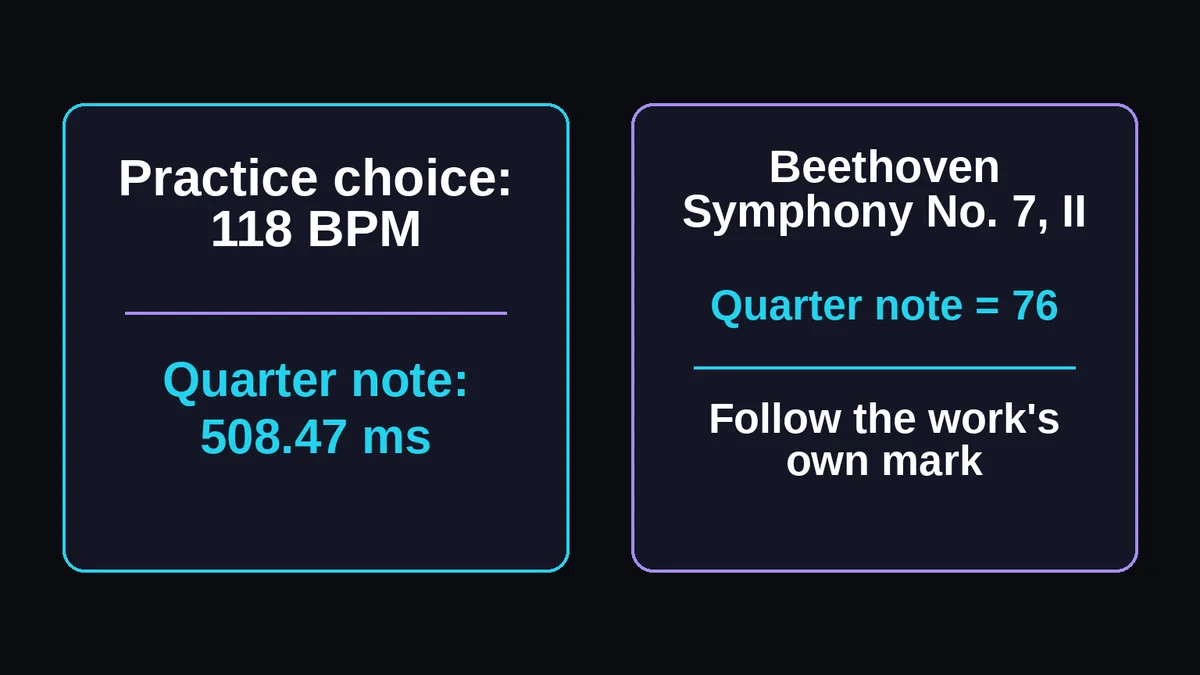
Beethoven's Seventh Symphony marks its Allegretto second movement at quarter note = 76. That is well below this site's general band, which shows why a tempo word cannot replace a work's own instruction. Use the specified note value and mark when studying this movement, then consider the edition and performance context. Cambridge University Press research on the movement.
The 118 BPM exercise below is not a recommended replacement for Beethoven's 76. A guide's practice example and a composer's metronome mark answer different questions.
Here BPM counts quarter notes: 60,000 ÷ 76 gives about 789.47 ms per quarter note, compared with 508.47 ms at 118. Replacing 76 with 118 would raise the tempo by (118 − 76) ÷ 76 × 100, or about 55.26 percent. That is a substantial change, even though both numbers appear on this page.
How Should You Count Allegretto in 6/8?
Allegretto does not specify a meter or a mandatory counted note. In 6/8, check whether the printed metronome mark counts eighths or dotted quarters before entering a number. Multiply a dotted quarter mark by 1.5 for this site's quarter note based metronome; the worked example below uses a pulse of 60.
Mozart's Piano Concerto No. 19 in F, K. 459, has an Allegretto second movement in 6/8. Sydney Symphony's teaching notes identify the marking and meter. The tempo word alone does not decide the note value you should tap.
A bar of 6/8 has six eighth notes, normally grouped into two dotted quarter beats. Each dotted quarter contains three eighths. Try saying “ONE two three FOUR five six” to keep the two groups audible. Open Music Theory's meter lesson.
For a constructed example of dotted quarter = 60:
| Quantity | Calculation | Result |
|---|---|---|
| Eighth notes per minute | 60 × 3 | 180 |
| Quarter notes per minute | 180 ÷ 2 | 90 |
| Seconds per bar | 2 × (60 ÷ 60) | 2 |
Because the app counts quarter notes, the table's second row is the number to type: 90 BPM. In 6/8, choose the normal subdivision setting labeled 1/4 to hear each eighth. At 90, those clicks arrive 180 times per minute. The app accents only the first eighth of the bar; supply the second group mentally rather than expecting another accent on the fourth eighth.
Entering 60 would instead produce a dotted quarter pulse of 40, since 60 ÷ 1.5 = 40. Likewise, copying this page's 118 setting into 6/8 would produce about 78.67 dotted quarter beats per minute, not 118. See time signatures and BPM for beat units and the 6/8 versus 3/4 comparison for the meter itself.
How Can You Practice Allegretto at 118 BPM?
Set the metronome to 118 BPM in 4/4 for a short exercise when your score leaves the exact tempo open. Begin with the normal subdivision setting labeled 1/4, then try 1/8 to check spacing inside each beat. Stop playback before changing tempo, and lower it if the rhythm becomes uneven.
| Note value at 118 BPM | Duration |
|---|---|
| Quarter note | 508.47 ms |
| Eighth note | 254.24 ms |
| Sixteenth note | 127.12 ms |
For an original one bar exercise, play two eighth notes on beat 1, a quarter note on beat 2, four sixteenths on beat 3 and a quarter rest on beat 4. The bar contains four quarter note beats despite the changing number of attacks. Rests occupy measured time too. Open Music Theory's rhythmic values.
Count through the rest and start the next bar on time. If the sixteenths make you rush, isolate beat 3 with the following rest, then restore the whole bar. Avoid making the quarter note on beat 2 shorter just to prepare for the faster notes.
Open the online metronome and compare 112, 118 and 124 manually. Repeat the same four bar phrase at each setting. In steady 4/4, its 16 quarter note beats take 16 × 60 ÷ BPM seconds: about 8.57 seconds at 112, 8.14 at 118 and 7.74 at 124. Exclude any count in or pause after the phrase. These are listening choices inside the site band, not required tempos for every Allegretto.
With another player, agree on the beat unit and give a full bar of count in. If one part has long notes while the other has sixteenths, rehearse the moving part first, then add the sustained line without changing the pulse. Use the metronome subdivisions guide if you need help locating notes between clicks.