
What Does Accelerando Mean in Music?
Accelerando tells you to become faster over the course of the indicated passage. It describes a process rather than a tempo category such as Allegro. Look for accel. where the change starts, then read ahead for the destination. A following numerical tempo or tempo word can help establish where the increase ends. Cambridge's accelerando entry.
An extension line can indicate how long a gradual change lasts. Its opposite is ritardando, gradual slowing. When no endpoint is printed, agree on a destination in rehearsal so each player aims for the same pace. Musicca's tempo change guide.
A new fixed mark establishes the next pace. A tempo asks for the preceding stable tempo again, as it can after a ritardando. It does not automatically mean the beginning of the whole piece; tempo primo is the return to that opening tempo. Musicca's return instructions.
Mark the arrival as carefully as the start. If you keep accelerating afterward, practice the arrival and the first steady bar together.
How Does Accelerando Compare With Other Tempo Changes?
Accelerando gradually increases speed, while ritardando gradually decreases it. Più mosso usually introduces a faster pace for the next section. Stringendo also pushes the music forward, with a sense of tightening or urgency. These words tell you how the transition should behave; none supplies a universal number of extra beats per minute.
| Direction | Basic meaning | Useful distinction |
|---|---|---|
| Accelerando, accel. | Gradually faster | Increase speed through the passage |
| Ritardando, rit. | Gradually slower | Spread the slowing across the passage |
| Più mosso | A faster pace | Establish the next section's tempo |
| Stringendo, string. | Press forward with increasing urgency | Read dynamics separately |
The pace distinction follows Dolmetsch's tempo glossary. Treccani's stringendo definition pairs acceleration with increasing emotional intensity; it does not prescribe one ramp shape.
Try an immediate change from 88 to 100 BPM at a section boundary, then a gradual transition over the preceding phrase. Same destination, different route.
How Much Faster Should an Accelerando Get?
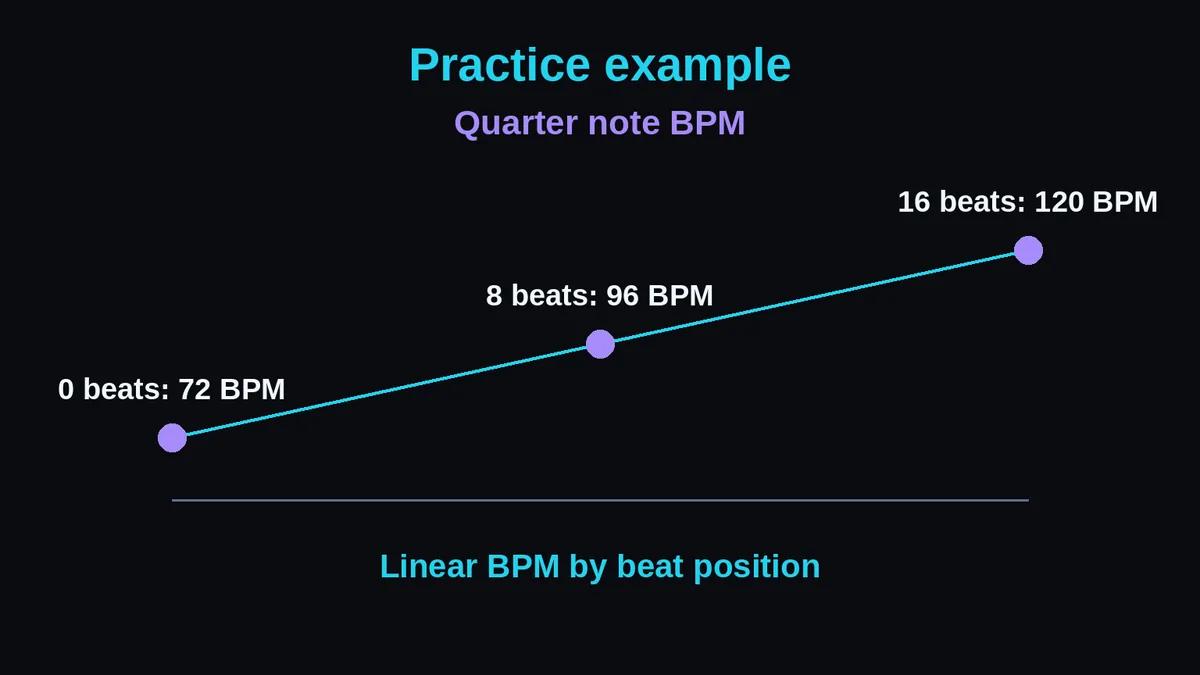
An accelerando has no fixed size. Use the next printed tempo or an agreed rehearsal target to decide how far to go. This constructed example moves from 72 to 120 BPM across 16 quarter note beats. Its halfway setting is 96 BPM because the chosen progression is linear in beat position.
The 72, 96 and 120 BPM figures all count quarter notes.
| Position in the exercise | Tempo | Quarter note duration |
|---|---|---|
| Start, bar 1 | 72 BPM | 833.33 ms |
| After 4 beats, bar 2 | 84 BPM | 714.29 ms |
| After 8 beats, bar 3 | 96 BPM | 625.00 ms |
| After 12 beats, bar 4 | 108 BPM | 555.56 ms |
| After 16 beats, bar 5 | 120 BPM | 500.00 ms |
Quarter note milliseconds = 60,000 ÷ BPM. The tempo increase is (120 − 72) ÷ 72 × 100, or about 66.67 percent. The same endpoints reversed produce a 40 percent decrease because the starting value changes.
Check individual intervals with BPM to milliseconds or compare subdivisions in the note duration calculator.
The selected mathematical shape is BPM(p) = 72 + 48p, with p = completed beats ÷ 16. The slope is 3 BPM per quarter note beat. That does not mean 3 BPM per second. A curve drawn against seconds describes a different timing plan.
The table gives checkpoints along a continuous ramp, not instructions to jump by 12 BPM at each bar line. At the midpoint, 625 ms is the quarter note duration at that tempo; it is not the duration of every beat in the passage.
For a smaller exercise, use 88 to 100 BPM over eight quarter note beats. The change is 12 BPM, about 13.64 percent, with 94 BPM halfway and a slope of 1.5 BPM per beat. Choose this version if the larger ramp overwhelms the phrase. Neither example defines how all accelerandos should sound.
Does Accelerando Also Mean Louder?
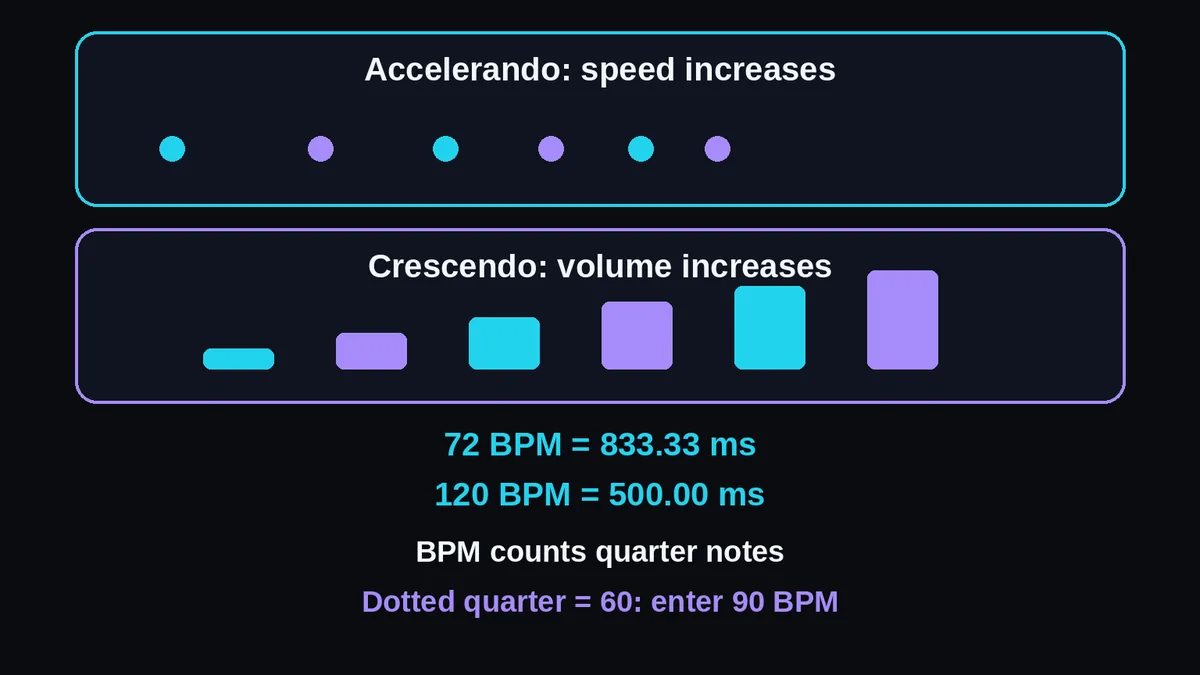
Accelerando changes speed; crescendo changes loudness. You can accelerate while holding the same dynamic, becoming louder or becoming softer. If a score combines accel. with a crescendo, follow both instructions. If it prints only accel., the tempo word alone does not require every beat to become stronger. Musicca's separate tempo and dynamics lists.
As an exercise, clap a steady volume while moving between two familiar pulses. Then repeat with a gradual crescendo. Listening to those separately can help you notice whether you are changing tempo, loudness or both.
Try the passage softly. Make the acceleration audible without extra volume, then restore the written dynamics and check their shape against the phrase.
Is Playing More Notes the Same as Accelerando?
Playing more notes inside each beat does not by itself increase the tempo. Accelerando changes the underlying pulse. To hear the difference, keep counting quarter notes while replacing quarters with eighths. If the quarter note count stays at the same speed, you have changed the rhythm without accelerating.
At quarter note = 90, quarters are 666.67 ms apart and eighths are 333.33 ms apart. Switching to eighths doubles the number of attacks while leaving the quarter note pulse at 90 BPM. These are steady reference values, with BPM counting quarter notes. A dotted quarter mark of 60 corresponds to quarter note = 90. The note relationships follow Open Music Theory's rhythm chapter.
For practice, repeat one simple rhythm throughout the ramp before restoring a busy run. Count through rests too. Use the metronome subdivisions guide if the distinction between pulse and smaller divisions is unclear.
How Can You Practice or Program an Accelerando?
Learn the destination before connecting the transition. Play a short passage at the final tempo, return to the slower opening pace and rehearse the increase without clicks. Keep the same note grouping as you speed up. For a programmed example, place a tempo envelope in a DAW and listen back to the transition.
Use the online metronome to establish 72 and 120 BPM separately. Stop playback before changing settings, then restart. The app supplies the two steady reference pulses for this exercise; rehearse the transition without its click.
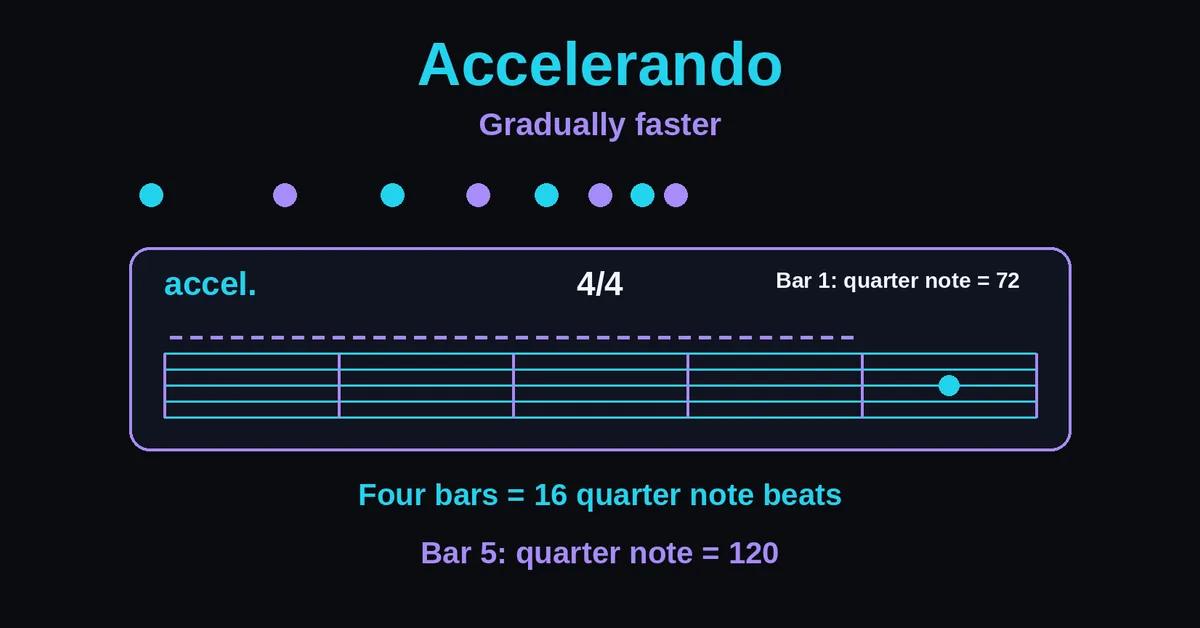
Original notation exercise: in 4/4, begin with quarter note = 72 and place accel. above bar 1. Extend its line across four bars, totaling 16 quarter note beats. Put quarter note = 120 at bar 5 and continue steadily there. This is the constructed ramp above, not a quotation from a composition.
First clap the four bars and continue for two bars at the destination. Then play only the passage's main notes. Finally restore the full rhythm. Record a pass and listen for an abrupt leap before bar 5. If most of the change happens there, try the 96 BPM midpoint as a separate steady reference before another attempt.
In Ableton Live, open Arrangement View, enable Automation Mode and select the Main track. Choose Mixer, then Song Tempo. Set the passage length and endpoints in that automation lane, then listen and revise the curve. Ableton's tempo automation instructions.
For this exercise, place breakpoints at bar 1 with 72 BPM and bar 5 with 120 BPM. Continue horizontally at 120 afterward. Use the breakpoint's Edit Value command to enter exact numbers rather than estimating their vertical positions. Ableton documents that control in its breakpoint editing instructions.
Play from before the ramp until after the arrival. Check for 96 BPM at bar 3. If you curved the line, adjust it or accept the different progression.
How Do You Keep an Ensemble Together Through an Accelerando?
Agree on who leads the change, where it begins and which beat establishes the destination. Rehearse the transition using a shared rhythm before restoring every part. For the four bar exercise, nominate bar 3 as a midpoint check and bar 5 as the arrival, then continue at the new pace.
Try this with a pianist and singer: the pianist plays only the main pulse while the singer speaks the text in rhythm. Rehearse any breath before the arrival, then restore the accompaniment. Agree whether the breath leaves the pulse moving or needs a shared cue; do not leave that decision to the performance.
If the parts separate, isolate the last two bars of the ramp and the first bar afterward. Start that shorter exercise at its own appropriate tempo rather than restarting the whole passage's initial speed. In the constructed example, bar 3 begins at 96 BPM, so beginning it at 72 rehearses a different transition.
What Else Should You Know About Accelerando?
Read any qualifying words with the instruction: poco means a little, molto means much or very, and poco a poco means little by little. These modifiers guide interpretation without supplying a numerical endpoint. Trinity College London's performance terms explains the modifiers and accel. abbreviation.