
What Does Ritardando Mean in a Score?
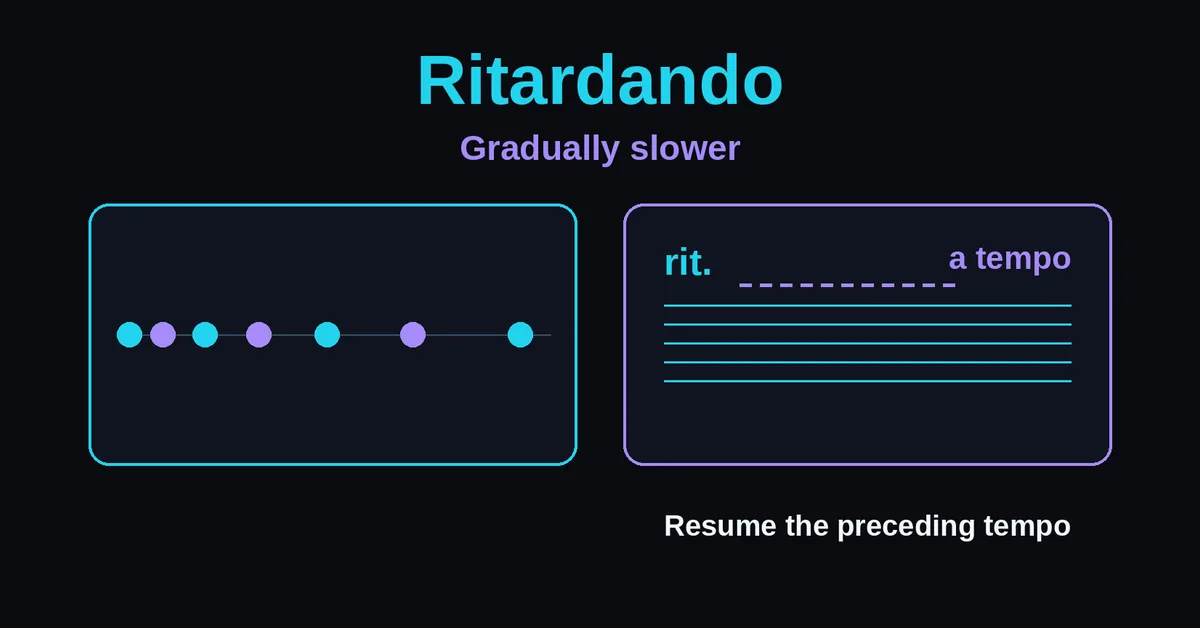
Ritardando asks you to make the pulse progressively slower. Notes of the same written length take more time as the passage unfolds. The abbreviation marks where the change begins; an extension line can show its reach. Read ahead for a new tempo, a return instruction or the passage's ending. Cambridge's definition, Musicca's notation guide.
Poco ritardando asks for a little slowing; molto ritardando asks for more. Neither supplies a percentage. A tempo asks you to resume the preceding tempo, while tempo primo refers to the opening tempo. These distinctions matter if the piece has already changed speed several times. Dolmetsch's tempo glossary.
Try this reading exercise: a piece opens at 120 BPM, later settles at 96, then slows to 72. An a tempo after that slowing points back to 96; tempo primo points to 120. Write the relevant number above the return during practice if you keep reaching for the opening speed automatically.
The opposite direction is accelerando, which gradually increases speed. Volume is a separate instruction: a quieter ending needs a dynamic marking or an interpretive decision as well as a tempo change.
A ritardando can help a phrase ending or cadence feel settled by giving its closing notes more time. It can also connect sections at different speeds. The word changes an established pulse; it does not name a tempo category such as Adagio or Allegro. Cambridge's usage examples.
What Is the Difference Between Rallentando and Ritardando?
Rallentando and ritardando both direct a gradual slowing. There is no dependable rule that one must be longer, stronger or closer to a stop. Some teachers distinguish their character, but the score and performance context decide how that distinction works. Ritenuto can mean an immediate, held back tempo rather than a gradual slowing. Grove's historical discussion.
| Marking | Basic instruction | What to check |
|---|---|---|
| Ritardando, rit., ritard. | Gradually slow down | Where the slowing ends |
| Rallentando, rall. | Gradually slow down | Any additional expression words |
| Ritenuto, riten. | Hold the tempo back, often immediately | Whether the new pace stays steady |
| A tempo | Resume the preceding tempo | Which tempo preceded the change |
Rit. can also abbreviate ritenuto. If the abbreviation is unclear, inspect other markings in the edition or ask the ensemble leader before rehearsal. The spelling alone may not settle the intended shape. Dolmetsch's abbreviation list.
Allargando adds a sense of broadening as the music slows. Rubato allows expressive flexibility in timing, which can include speeding up and slowing down. Ritardando specifies the slowing direction. Broadening can suggest a fuller sound in context, but dynamics still need separate attention. OnMusic's tempo terminology.
For a practical comparison, play a repeated chord at 100 BPM. In one trial, gradually reach 80 across the phrase. In another, move directly to 80 at the marked entrance and stay there. Those constructed trials contrast gradual slowing with an immediately held back pace; they do not assign either term a fixed percentage.
How Much Should You Slow Down?
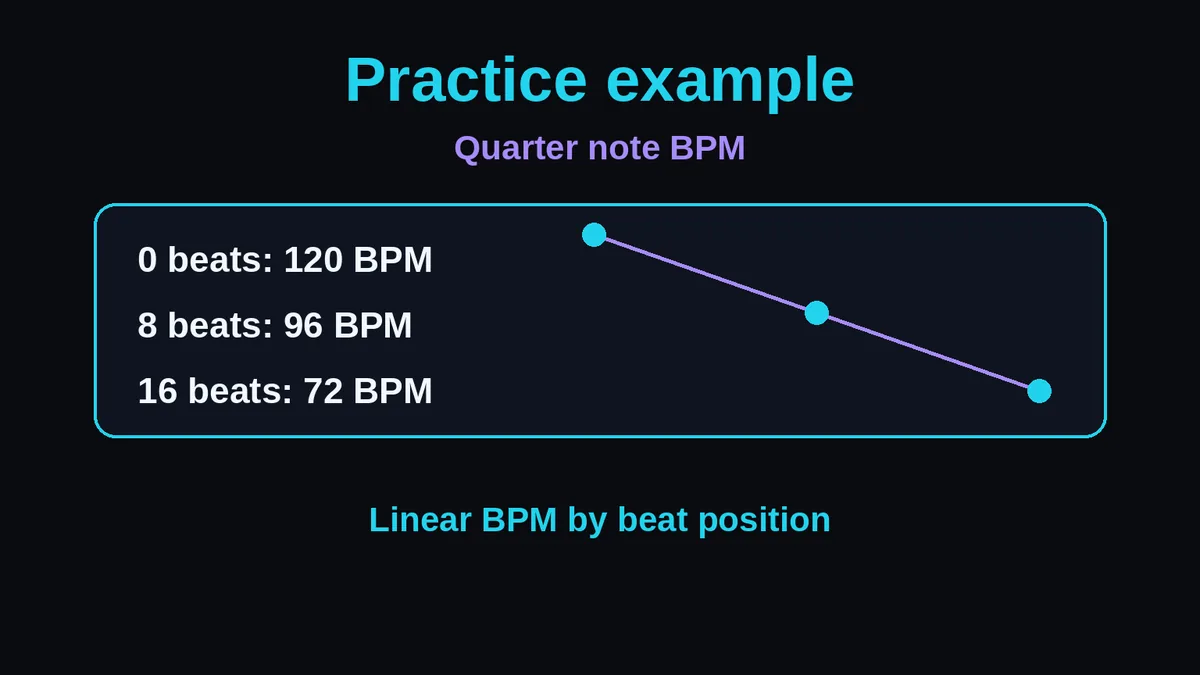
There is no prescribed amount of slowing in ritardando. Choose an endpoint that fits the phrase and any following tempo mark. For a concrete exercise, imagine a change from 120 to 72 BPM over 16 quarter note beats. The midpoint below describes a chosen mathematical shape, not a performance rule.
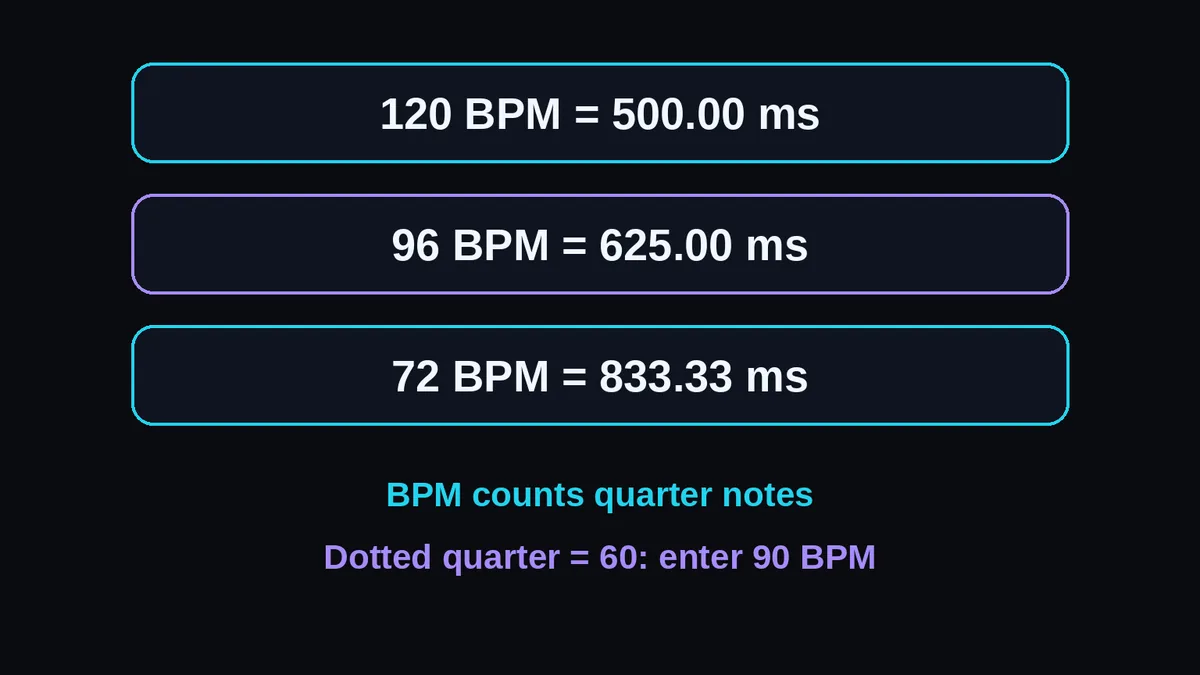
Every figure in this 120 to 72 BPM example counts quarter notes.
| Position in the exercise | Tempo | Quarter note duration |
|---|---|---|
| Start, 0 beats elapsed | 120 BPM | 500.00 ms |
| 4 beats elapsed | 108 BPM | 555.56 ms |
| Halfway through the beat span, 8 beats elapsed | 96 BPM | 625.00 ms |
| 12 beats elapsed | 84 BPM | 714.29 ms |
| End, 16 beats elapsed | 72 BPM | 833.33 ms |
For this example, BPM changes linearly with beat position: BPM(p) = 120 − 48p, where p runs from 0 at the start to 1 after 16 beats. This is not a straight line in elapsed time or in beat duration. Use the BPM to milliseconds converter to compare individual settings.
In 4/4, those 16 quarter note beats span four bars. Put the checkpoints at the starts of bars 1, 2, 3 and 4; reach 72 at the following downbeat. Continue slowing between checkpoints instead of holding each number for a whole bar. For the meter underlying that count, see Texas A&M's simple meter lesson and our 4/4 guide.
The large change makes the exercise easy to hear. For a smaller trial, slow from 100 to 96 BPM across four quarter note beats: (100 − 96) ÷ 100 × 100 = 4 percent. Compare both approaches on the same melody before choosing a shape for your passage. Neither percentage defines poco or molto.
Do not confuse percentage changes in BPM with changes in note length. Here, 833.33 ÷ 500 is about 1.6667, so a 40 percent tempo decrease makes the endpoint quarter note about 66.67 percent longer. These are endpoint durations, not the exact lengths of notes spanning a continuously changing tempo.
How Can You Practice a Ritardando?
First learn the starting and ending pulses separately, then connect them through the phrase. Use a steady metronome to establish each endpoint and rehearse the slowing without clicks. Listen for an even change across the intended span, and check that the following a tempo returns to the pulse you established earlier.
- Set the online metronome to 120 BPM and count a short phrase.
- Stop and repeat at 72 BPM so the destination is familiar.
- Play without the click, slowing through the phrase, then restart at 120 for an a tempo exercise.
Record a trial with a little steady playing on either side. Listen for a sudden drop at the first rit. beat, or a slowdown saved entirely for the last note. If either happens unintentionally, sing or clap the passage before replaying it. Keep the written rhythm recognizable as the pulse stretches.
To hear a programmed ramp, use a DAW tempo envelope. Ableton Live supports song tempo automation in the Main track's automation lane. In Arrangement View, enable Automation Mode, then select Mixer and Song Tempo there. Set endpoints deliberately and listen to the curve; the same start and finish can produce different changes between them. Ableton's automation manual.
If the exercise ends with a tempo, check the first few beats after the return too. Practice entering at the restored pulse without an extra acceleration through the opening notes. For a transition into a new slower section, instead hold the destination steady long enough to hear whether you actually arrived there.
How Do You Keep the Pulse While Slowing?
Keep counting the same beat unit while its spacing increases, and subdivide if the longer gaps become hard to judge. In an ensemble, agree on the start, endpoint and return tempo before playing. Follow the conductor's beat if there is one; otherwise choose a player to cue the transition.
Try counting eighth notes through a short slowing passage, letting the smaller counts stretch with the beat. Jerry Nowak recommends subdivision for pacing a rallentando without a sudden drop. Use the subdivision guide if you need help counting those smaller divisions. Nowak's rehearsal guidance.
For a singer and pianist, rehearse just the last phrase and the next entrance. Decide who leads the slowing and who gives the return cue. Then include the preceding phrase so both players hear the original pulse. Rehearse the same phrase together rather than asking each musician to invent a separate slowing curve.
If the passage leads into a fermata, rehearse the approach and hold separately. In ordinary notation, a fermata over a note or rest allows its duration to be extended; that hold does not specify the shape of the preceding slowdown. Agree on the release and any following entrance. Dolmetsch's fermata explanation.
Where Can You Hear a Real Ritardando?
Franz Ferdinand's Take Me Out has a clear slowdown near the opening transition. The established pulse is 143 BPM. RITMO's analysis notes an early easing to about 140 before the main two bar passage around 0:50 to 0:56, which reaches 104 BPM. These figures describe the analyzed recording. RITMO's recording analysis.
That example also shows why ritardando does not mean stopping: the music establishes a new, slower pulse and continues. Listen to the spacing between beats, rather than using a fade in loudness as your evidence of slowing.
Use the same counted pulse before and after the transition when checking a recording. The guide to counting BPM explains how to keep that counting level consistent. Compare the steady passages on either side first, then listen through the transition. This makes the destination easier to recognize without trying to assign every changing beat a precise number.