
What Does Andante Mean in Music?
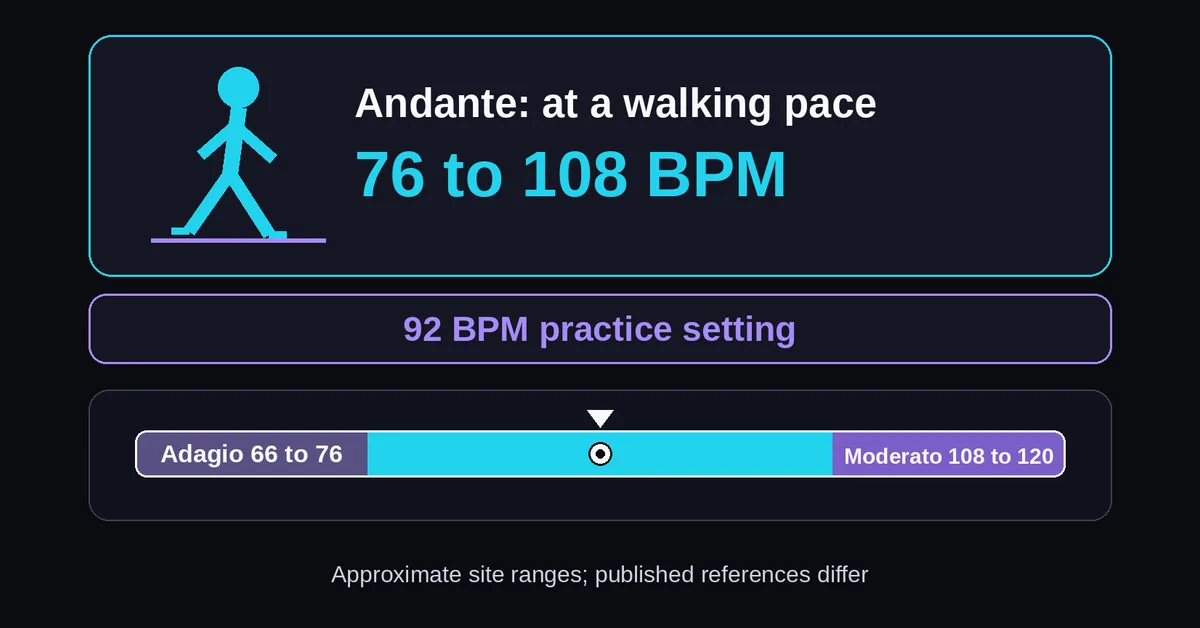
Andante comes from the Italian verb andare, to go or to walk. As a tempo marking it describes music that moves forward steadily, neither rushing nor stopping to linger. The image is a calm walk, so the pulse should feel continuous even when the melody holds long notes.
The marking spread through the eighteenth century and became the standard heading for lyrical slow movements in the Classical style. Haydn, Mozart and Beethoven used it for movements that sing rather than grieve: slower and gentler than the outer fast movements, but never heavy.
Like Allegro and Adagio, the word can also act as a noun. "The Andante" in a program usually means the slow movement of a symphony, concerto or sonata. In that sense it names a section of the work, not a precise number on a metronome.
What BPM Is Andante?
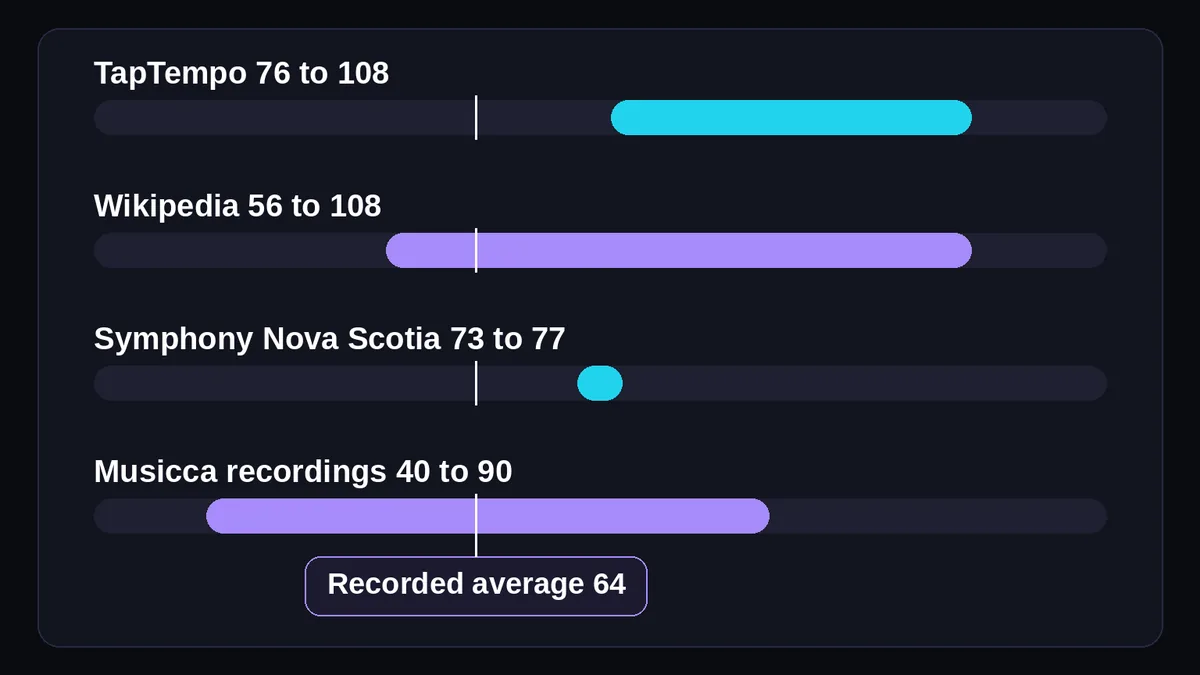
This site places Andante at 76 to 108 BPM, counting quarter notes, with 92 BPM as the midpoint practice setting. Other references disagree widely. Wikipedia's list now gives 56 to 108 BPM, and orchestra and recording based figures sit lower still.
| Source | Andante figure | What kind of figure it is |
|---|---|---|
| TapTempo tempo chart | 76 to 108 BPM | Site reference band |
| Wikipedia, Tempo | 56 to 108 BPM | Rough guide for 4/4 time |
| Symphony Nova Scotia | 73 to 77 BPM | Orchestra education reference |
| Musicca | 40 to 90 BPM, average 64 | Measured from 100 recordings |
Every figure here counts quarter notes. Many Andante movements are in 6/8, where the felt beat is a dotted quarter. If a score shows a dotted quarter equal to 60, enter 90 BPM on a quarter note metronome, because one dotted quarter equals one and a half quarter notes.
Why Are Andante Recordings Slower Than the Charts?
Teaching charts and real performances answer different questions. Charts give a tidy band for students, while Musicca analyzed 100 recordings of works marked Andante and found an average of only 64 BPM. That average falls below this site's band and even below Symphony Nova Scotia's narrow 73 to 77.
Several things push recorded Andantes down. Many slow movements have dense ornaments or fast inner notes, so performers choose a slower beat to keep every note clear. Movements in 6/8 or 12/8 are often counted in dotted quarters, which produces a much smaller number than a quarter note count of the same music. Large halls and full orchestras also tend to favor broader speeds.
The word itself adds to the confusion, since a walk can be a stroll or a brisk stride. The safest approach is to treat "walking" as a description of character, the sense of steady motion, rather than a literal step count.
So if a recording you love measures 66 BPM, it is not breaking a rule. It is choosing the slower end of a marking that has always had a wide range in practice.
What Do Con Moto, Cantabile and Other Words Add to Andante?
Composers rarely leave Andante alone. A second word either nudges the speed or colors the character, and reading it correctly matters as much as the main marking. The table gives the usual meanings.
| Marking | Literal meaning | Effect on the performance |
|---|---|---|
| Andante con moto | Walking, with motion | A little more forward movement |
| Andante cantabile | Walking, in a singing style | Long, connected melodic lines |
| Andante sostenuto | Walking, sustained | Held notes, a slightly broader feel |
| Andante ma non troppo | Walking, but not too much | Keep the walk, without overdoing the slowness |
| Andante moderato | Walking, moderately | Lifted toward Moderato |
| Andante grazioso | Walking, gracefully | Light, elegant phrasing |
Più andante and molto andante are the tricky ones. If andante means walking, more walking could mean faster; if it means moderately slow, more could mean slower. Sources and composers have read it both ways, so check the context and any metronome mark before choosing.
Andante con moto heads the slow movements of Mendelssohn's Italian Symphony and Schubert's Unfinished Symphony. Andante cantabile is the title most people know from the second movement of Tchaikovsky's String Quartet No. 1. Both show that the modifier changes the mood more than the number.
How Does Andante Compare With Adagio and Moderato?
On this site's chart Andante sits above Adagio and below Moderato. Adagio is slower and more still; Moderato is steadier and a step quicker. The borders at 76 and 108 BPM are reference choices, so neighboring markings can share a speed and still ask for different moods.
| Marking | Site reference | Character |
|---|---|---|
| Adagio | 66 to 76 BPM | Slow and at ease |
| Andante | 76 to 108 BPM | Walking, flowing |
| Andantino | 80 to 108 BPM | A little Andante, usually lighter |
| Moderato | 108 to 120 BPM | Moderate and steady |
For an Andante versus Adagio test, play one phrase at 71 BPM and again at 92 BPM with the same dynamics. The faster version should feel like motion; the slower one like reflection. Andantino causes the most arguments, because some older sources read it as slower than Andante and most modern charts as faster. Its own page covers that dispute.
How Long Are Notes at 92 BPM?
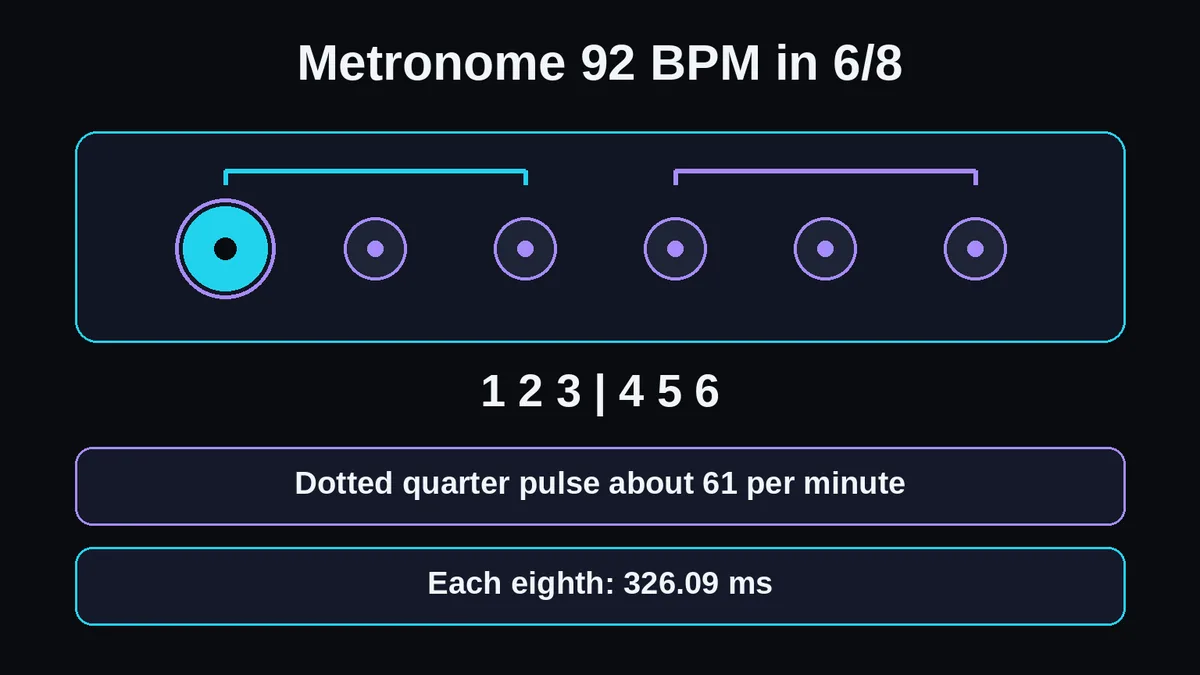
At 92 BPM a quarter note lasts 652.17 milliseconds, an eighth note 326.09 ms and a half note 1,304.35 ms. Knowing those gaps helps you hold long notes to their full value, which is where most Andante performances lose the pulse.
| Note value | Quarter notes | At 76 BPM | At 92 BPM | At 108 BPM |
|---|---|---|---|---|
| Half note | 2 | 1,578.95 ms | 1,304.35 ms | 1,111.11 ms |
| Dotted quarter | 1.5 | 1,184.21 ms | 978.26 ms | 833.33 ms |
| Quarter note | 1 | 789.47 ms | 652.17 ms | 555.56 ms |
| Eighth note | 0.5 | 394.74 ms | 326.09 ms | 277.78 ms |
| Sixteenth note | 0.25 | 197.37 ms | 163.04 ms | 138.89 ms |
For any other setting, the note duration calculator or the BPM to milliseconds converter repeats the math.
Which Famous Movements Are Marked Andante?
Well known examples include the second movement of Haydn's Surprise Symphony, the slow movement of Mozart's Piano Concerto No. 21, and the Andante of Mozart's Symphony No. 40. Each shows the walking pulse in a different texture, so listen for the steady motion rather than a single target BPM.
- Haydn, Symphony No. 94, the Surprise, second movement (Andante). A simple tune played quietly, then a sudden loud chord. The even, almost tiptoeing pulse is a textbook Andante.
- Mozart, Piano Concerto No. 21, K. 467, second movement (Andante). Often called "Elvira Madigan" after a 1967 film. Muted strings and triplet accompaniment carry a long piano melody.
- Mozart, Symphony No. 40, K. 550, second movement (Andante). A gentle movement in 6/8 between two stormy ones, useful for hearing Andante counted in dotted quarters.
- Beethoven, Symphony No. 6, the Pastoral, second movement (Andante molto mosso). The "Scene by the Brook," with flowing water figures and birdcalls near the end. Molto mosso asks for plenty of motion.
How Do You Keep an Andante From Dragging?
Dragging, where long notes sag and the walk slows to a stop, is the classic Andante fault. Practice with subdivisions so the space inside each beat is filled, then remove them and keep the same flow. Set the online metronome to 92 BPM to start.
- Play the melody with quarter note clicks and record one pass. Mark any held note that ends early or any entrance that arrives late.
- Switch to eighth note subdivision. The extra click exposes every place the tempo sagged between beats.
- For movements in 6/8 or 3/4, choose the matching time signature so the accent on beat 1 shapes the phrase. In this metronome's 6/8 mode the BPM counts quarter notes and each eighth note clicks; at 92 BPM the dotted quarter pulse is about 61 per minute.
- Use the speed trainer for control, not speed: raise the tempo by just 1 BPM every 16 bars and keep the line calm as the click tightens.
- Finish with one pass at your chosen performance tempo with quarter note clicks only, then one with the metronome off.
If you are checking a recording, tap the main beat on the tap tempo tool with the spacebar, a letter or a number key. A reading near 180 when you expected 90 usually means you tapped eighth notes; halve it.