
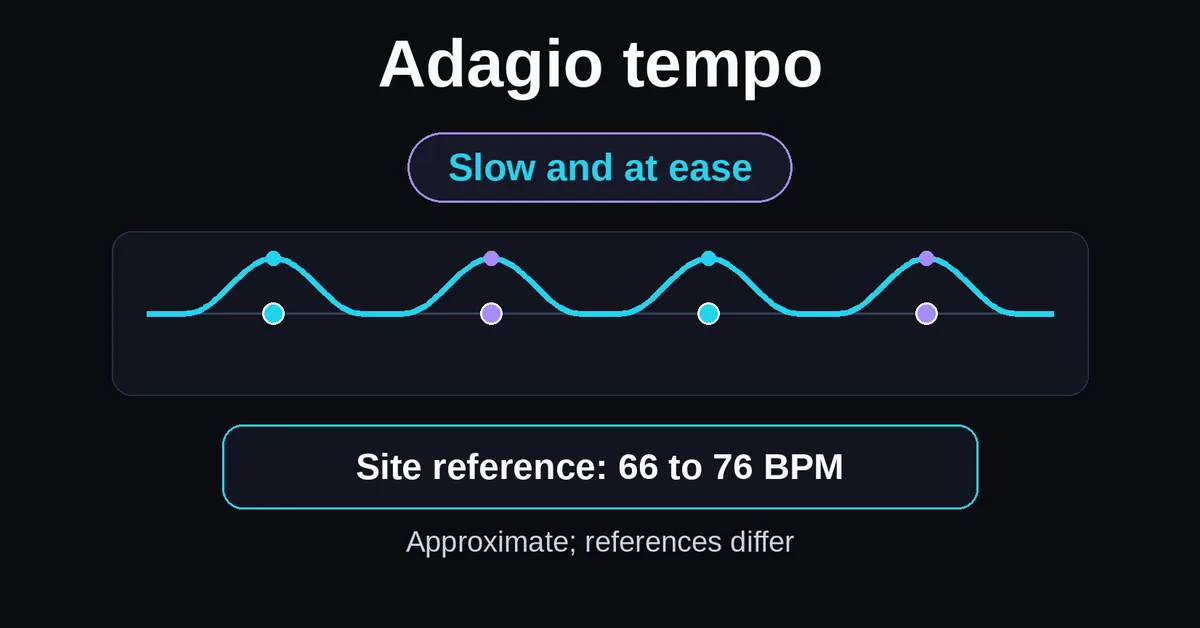
What Does Adagio Mean in Music?
Adagio asks for slow, stately playing with an unhurried character. It comes from the Italian phrase ad agio, meaning at ease, and can also name a slow movement or piece. The word supplies an expressive tempo direction; a numerical metronome mark, when present, specifies the pace. Merriam-Webster.
Read the whole instruction before choosing a setting. Adagio sostenuto adds sustained playing; Adagio cantabile asks for a singing style; Adagio molto or molto adagio means very slowly. None supplies a fixed number to subtract from a BPM setting.
Try this phrase exercise: at 71 BPM, play a melody once while counting aloud, then again while singing its contour internally. Keep the entrances in place while shaping the sound between them. On piano, listen for a melody note disappearing beneath the accompaniment; on violin, listen through the bow change.
What BPM Is Adagio?
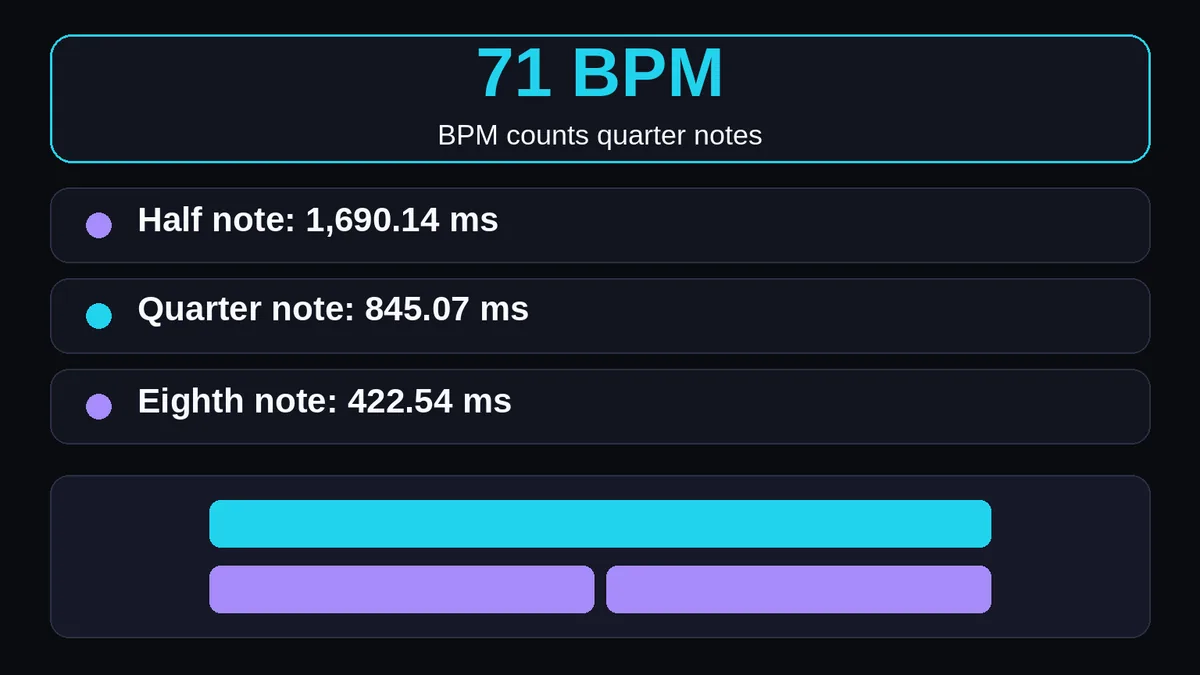
Use 66 to 76 BPM as this site's approximate Adagio reference band, with 71 BPM as its midpoint practice setting. Published sources give different bands, so a chart cannot prescribe every performance. Follow a numerical mark and its printed note value before applying a generic range.
Every Adagio figure on this page, 71 BPM included, counts quarter notes.
| Source | Adagio reference range | What the source supplies |
|---|---|---|
| TapTempo chart | 66 to 76 BPM | Approximate site reference |
| Tunable | 66 to 76 BPM | Selected preset of 71 BPM |
| Classical-Music.com | 66 to 76 BPM | Barber's Adagio for Strings example |
| HelloMusicTheory | 44 to 68 BPM | Its dedicated Adagio lesson's published band |
| Symphony Nova Scotia | 55 to 65 BPM | Separate published reference |
| LibreTexts music appreciation | 55 to 65 BPM | Beethoven's Pathétique Sonata, second movement, as its listening example |
| Dolmetsch Online | 58 to 97 BPM | Principal band, with other ranges and individual presets separately listed |
Dolmetsch also lists 54 BPM for a 1950 metronome and 70 BPM for a modern electronic metronome. Those individual settings do not form a 54 to 70 BPM range or explain why references differ. At 60 BPM, an Adagio can therefore agree with one source while falling below this site's band.
The 71 BPM preset matches Tunable's selected setting. It is a convenient midpoint, not a measured average of recordings. For a piece with no numerical mark, test whether its busiest passage and longest held note both work at that pace before settling on it.
How Do You Set a Metronome for Adagio?
Start with 71 BPM and select the score's time signature. In 4/4, choose quarter note clicks first, then add eighth notes if you lose track inside long beats. Compare the same short phrase at 66, 71 and 76 BPM by entering each setting manually in the online metronome.
Use those as Lower reference, Midpoint and Upper reference settings, rather than performance limits. The metronome supports 20 to 360 BPM, five sounds, an accent on beat 1, and quarter, eighth, triplet and sixteenth subdivisions. Choose a sound you can hear underneath your instrument without masking the melody. You can also open the 70 BPM metronome and enter 71 manually.
Check the beat unit before entering a score's number. A dotted quarter contains three eighth notes, or 1.5 quarter notes, as explained in Open Music Theory's rhythmic values lesson. An Adagio in 6/8 marked dotted quarter equals 46 therefore needs a quarter note setting of 69 BPM, which lands inside this site's 66 to 76 band.
In this metronome's 6/8 mode, BPM still counts quarter notes and the base clicks mark eighth notes. Set 90 BPM with the normal subdivision setting for that example. Count the six clicks as two groups of three; only the first click of the bar is accented. See time signatures and BPM for the counting distinction.
How Long Are Notes at 71 BPM?
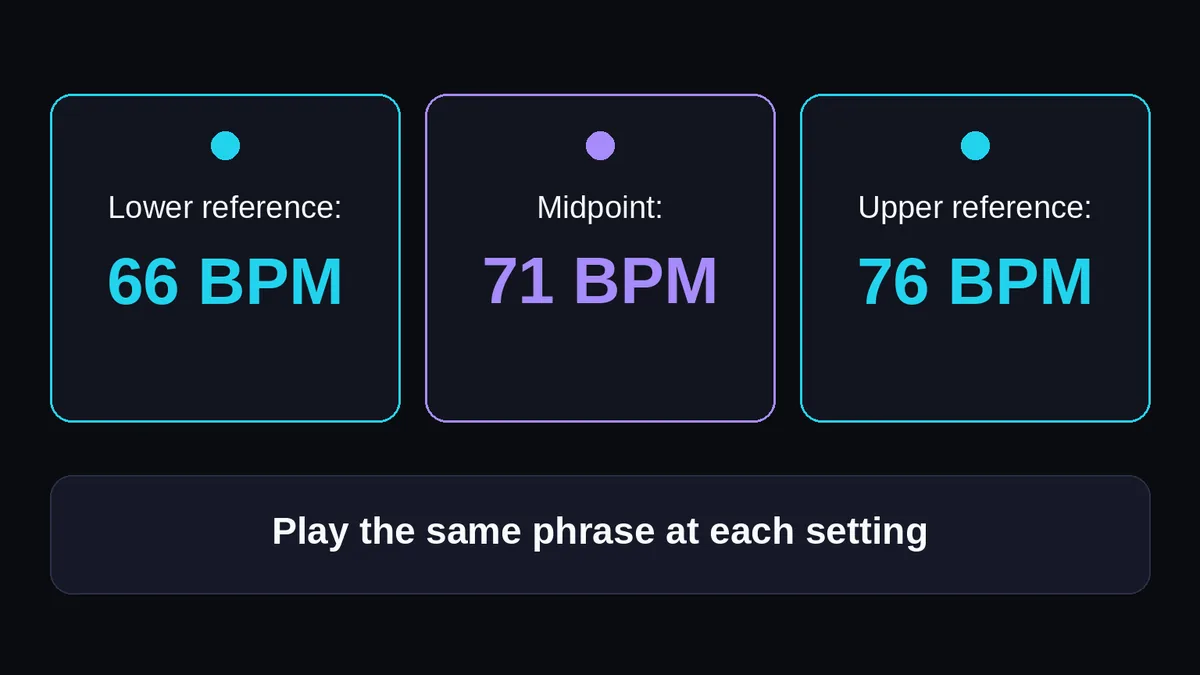
At 71 BPM, a quarter note lasts 845.07 ms and a half note lasts 1,690.14 ms, about 1,690 ms. Two evenly spaced eighth notes divide each quarter into 422.54 ms intervals. These calculated durations make it easier to locate an early release or an uneven entrance during slow practice.
Note divisions and dotted durations follow Open Music Theory; the figures below are calculated from the selected practice tempo.
| Note value at 71 BPM | Quarter note multiple | Duration |
|---|---|---|
| Half note | 2 | 1,690.14 ms |
| Dotted quarter note | 1.5 | 1,267.61 ms |
| Quarter note | 1 | 845.07 ms |
| Eighth note | 0.5 | 422.54 ms |
| Sixteenth note | 0.25 | 211.27 ms |
For a constructed 4/4 exercise, hold a half note from beat 1 until beat 3. Count the intervening beat 2 without repeating the note. Then place an eighth note entrance halfway between beats 3 and 4. Use the note duration calculator to repeat the calculation at your chosen setting.
How Does Adagio Compare With Other Slow Markings?
Adagio sits above Largo and below Andante in this site's reference bands, while Adagietto overlaps it. The comparison describes approximate pace and character, rather than a set of exclusive categories. A shared BPM does not erase the score's instruction or turn one marking into another automatically.
| Marking | Site reference in BPM | Character cue |
|---|---|---|
| Grave | 20 to 40 | Slow and solemn |
| Largo | 40 to 60 | Broad and very slow |
| Lento | 45 to 60 | Slowly |
| Larghetto | 60 to 66 | A little Largo |
| Adagio | 66 to 76 | Slow and at ease |
| Adagietto | 70 to 80 | A little Adagio, generally less slow |
| Andante | 76 to 108 | Walking pace |
For the adagio vs andante comparison, try the same phrase at 71 and 84 BPM. Keep articulation and dynamics consistent so you hear the speed difference. At the shared boundary of 76 BPM, read the written marking rather than choosing a name solely from the number.
Which Famous Pieces Are Marked Adagio?
Examples include Barber's Adagio for Strings, the Adagio sostenuto opening Beethoven's Moonlight Sonata, Giazotto's Adagio in G minor on a theme of Albinoni, and the second movement of Mozart's Clarinet Concerto. Use these to hear different textures at slow tempos, without assigning every recording the 71 BPM practice setting.
- Barber, Adagio for Strings: drawn from the slow movement of his String Quartet, Op. 11. Follow the stepwise line toward its climax and the withdrawal afterward. Tunable's examples and Classical-Music.com's Adagio lesson both feature it. Listen for how a long line continues across individual beats.
- Beethoven, Piano Sonata No. 14, Moonlight, first movement: Adagio sostenuto. Its continuous triplets and sustaining pedal contribute to the texture described by Tunable. For a separate rhythm drill, use triplet subdivision while holding one melody note; avoid accenting every accompaniment note equally.
- Remo Giazotto, Adagio in G minor on a theme of Albinoni: the Ricordi edition credits Giazotto. His claimed Albinoni fragment is not an established surviving source; this musicological study discusses that uncertainty. Check the composer credit when choosing an edition.
- Mozart, Clarinet Concerto, second movement: an Adagio with a singing clarinet line over strings. HelloMusicTheory's concerto guide identifies its Adagio movement. Listen through the soloist's phrase endings and follow the accompaniment when the clarinet rests.
Mahler's Symphony No. 5, fourth movement, is marked Adagietto. Classical-Music.com includes it alongside Adagio while identifying it as a faster little Adagio. Keep that distinction when labeling a playlist or practice excerpt.
How Do You Practice Adagio Without Losing the Pulse?
Practice a short passage with audible subdivisions, then remove them while keeping its entrances and releases in place. At 71 BPM, quarter note onsets are about 845 ms apart. Eighth clicks divide that interval in half; use triplets instead when your exercise divides the beat into three equal parts.
Try this constructed routine in 4/4:
- Set 76 BPM with eighth subdivisions. Play four bars, counting the beats through every rest. Mark any release that happens before its counted destination.
- Change manually to 71 BPM. Repeat those four bars with eighth clicks, then repeat with quarter clicks only. Keep the phrase ending at the same counted place.
- Change manually to 66 BPM. Play two four bar passes, adding subdivisions again if needed. The longer space tests control of sustained notes and rests.
- Return to your intended performance setting. Play once with quarter clicks and once with the metronome stopped. Record using a separate device or recording app to compare the phrase endings.
Count bars yourself; the metronome has no practice timer. For a pianist, isolate the accompaniment if the melody enters late. For a clarinetist, mark a breathing point before repeating the phrase. For a string player, decide where the bow change falls within the counted beat.
If a recording seems much faster, check what you tapped. Tapping every eighth in a quarter note passage at 71 BPM produces 142 taps per minute. Use tap tempo on the intended pulse, or follow how to find a song's BPM before comparing readings.