
What Is Cut Time in Music?
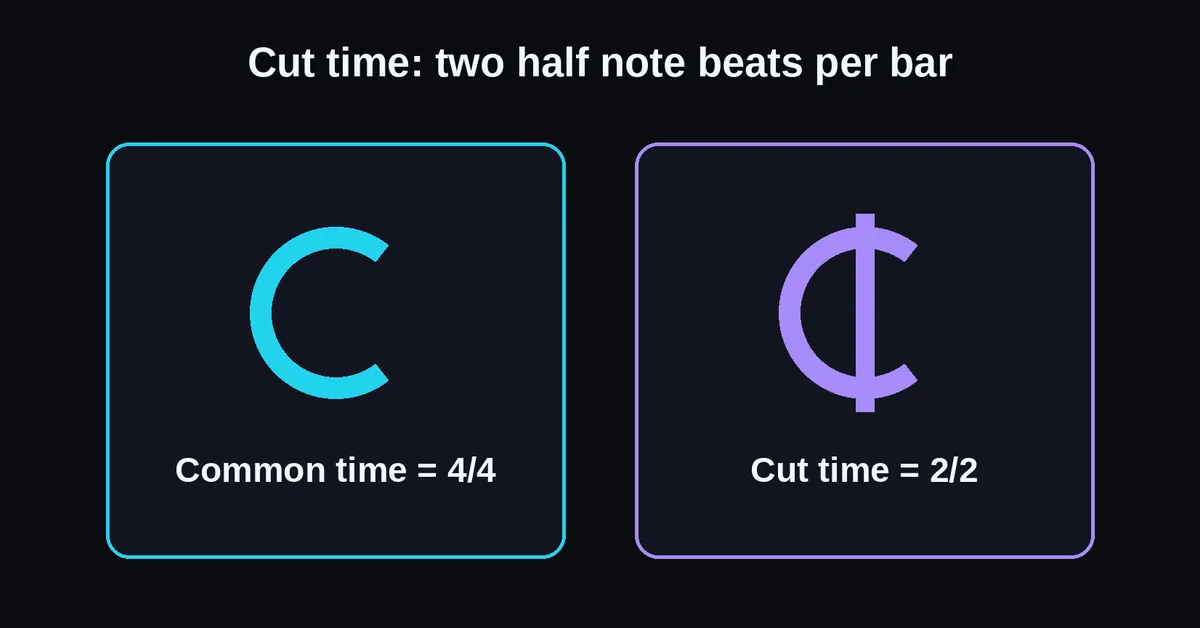
Cut time is a simple duple meter with a half note pulse. Simple means each beat divides into two equal parts, here two quarter notes. Duple means two beats per bar. So in cut time you feel "1, 2" in every bar, and each of those beats lasts a half note.
The name comes from the symbol. Common time, 4/4, is written as a C. Draw a line through that C and you have "cut" common time, which halves the number of beats you count while keeping the same amount of music in the bar.
Wikipedia lists cut time, cut common time and alla breve as names for the same meter. The terms are interchangeable in modern use. Whichever one you see, read it as 2/2.
Where Does the Cut Time Symbol Come From?
The C and the cut C are older than modern time signatures. They come from mensural notation, used before about 1600, when circles and broken circles described how long notes were relative to each other. A full circle meant triple time; a broken circle, the ancestor of today's C, meant duple time.
Alla breve is Italian for "on the breve," the double whole note. In that older system, a line through the sign told singers to count the beat on the longer breve instead of the semibreve, roughly doubling the speed of the pulse. Today's cut C keeps that idea: the beat moves to a longer note value.
Wikipedia adds two cautions. The stroke did not always mean exactly alla breve in older music, and at least one famous case, Bach's Fugue in E major, BWV 878, uses the symbol for 4/2. In modern scores, though, you can safely read it as 2/2.
How Do You Count Cut Time?
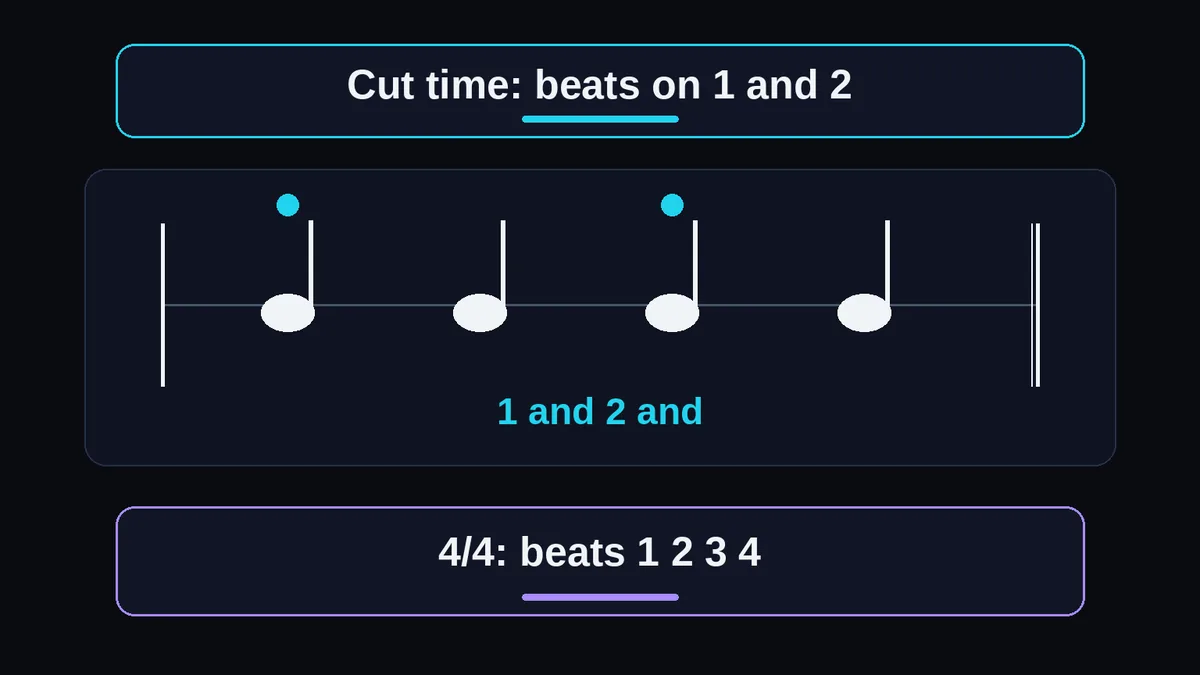
Count two beats per bar, "1, 2," with one count on each half note. When quarter notes appear, they become the "and": "1 and 2 and." Eighth notes are counted "1 e and a 2 e and a." The numbers always mark half notes, so the count sounds the same as 2/4 even though the notes look bigger.
| Notes in one bar of cut time | Spoken count | Notes per bar |
|---|---|---|
| Half notes | 1, 2 | 2 |
| Quarter notes | 1 and 2 and | 4 |
| Eighth notes | 1 e and a 2 e and a | 8 |
| Whole note | 1 (hold) 2 | 1 |
The common mistake is counting cut time in four out of habit, because the bar looks like 4/4. That makes fast passages feel frantic. Practice saying only "1, 2" while playing quarter notes, so each spoken number covers two of them.
How Is Cut Time Different From 4/4 and 2/4?
Cut time and 4/4 hold exactly the same notes per bar; the difference is the beat. 4/4 has four quarter note beats, cut time has two half note beats. Cut time and 2/4 share the same two beat feel, but 2/4 uses quarter note beats, so the same music needs smaller note values and twice as many bar lines.
| Meter | Beats per bar | Beat unit | Symbol | Feel |
|---|---|---|---|---|
| Cut time (2/2) | 2 | Half note | C with a line | Two broad beats |
| 4/4 | 4 | Quarter note | C (common time) | Four beats |
| 2/4 | 2 | Quarter note | 2 over 4 | Two short beats |
Why choose cut time over 4/4? Wikipedia notes that writing the same fast music in 4/4 needs many more eighth and sixteenth notes, which is one reason 2/2 is easier to read at quick tempos. Fewer, larger note values and a two beat pulse make fast marches and overtures far less cluttered.
How Do You Convert a Cut Time BPM?
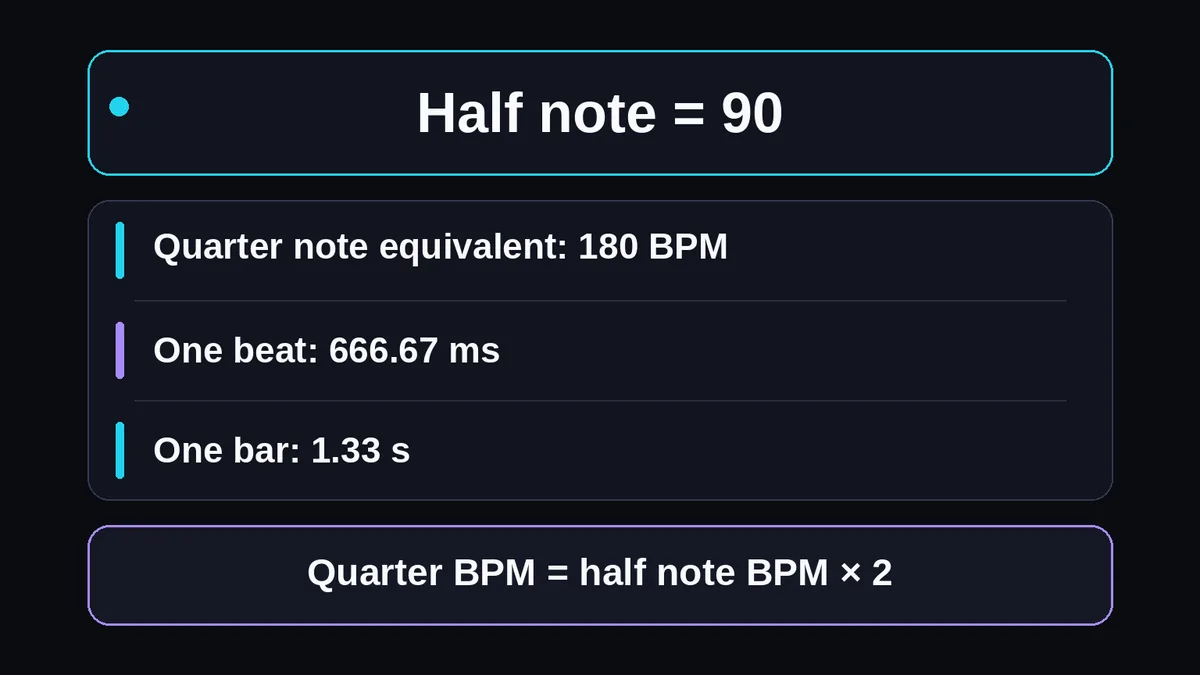
In cut time a metronome mark usually counts half notes. To convert it for a metronome that counts quarter notes, multiply by 2. A mark of half note = 90 equals 180 quarter notes per minute. To go the other way, divide a quarter note BPM by 2 to find the cut time pulse.
| Half note pulse | Quarter note equivalent | One beat | One bar |
|---|---|---|---|
| 60 | 120 BPM | 1,000 ms | 2.00 s |
| 72 | 144 BPM | 833.33 ms | 1.67 s |
| 90 | 180 BPM | 666.67 ms | 1.33 s |
| 108 | 216 BPM | 555.56 ms | 1.11 s |
| 120 | 240 BPM | 500 ms | 1.00 s |
This is where song databases and tap tempo readings disagree. A march felt at 120 half notes per minute might be listed as 120 or 240 BPM. Both describe the same speed; they count different notes. The tempo markings chart uses quarter notes, so convert first before comparing.
Is Cut Time the Same as Half Time?
No. Cut time is a written meter, 2/2. Half time is a feel, usually in pop, rock and electronic music, where the drums play as if the tempo were halved, often moving the snare from beats 2 and 4 to beat 3, while the written meter and BPM stay the same.
The confusion is understandable because both make music feel broader. The difference is on paper: cut time changes the time signature and beat unit, while half time keeps 4/4 and changes only the groove. For half time feels and the BPM math behind them, see the half time BPM calculator and half time vs double time.
Where Is Cut Time Used?
Cut time is standard for marches, many fast orchestral movements and plenty of Broadway and show music. Wikipedia notes that it is used frequently for military marches, and that it usually suggests a fairly quick tempo today, although between about 1600 and 1900 its tempo meaning varied.
- Marches. John Philip Sousa's The Stars and Stripes Forever is a famous march written in cut time, felt firmly in two steps per bar.
- Fast classical movements and fugues. Baroque and Classical composers often marked quick movements alla breve so performers would feel a broader pulse.
- Musical theater and swing era charts. Up tempo show tunes are commonly notated in cut time to keep the page readable.
- Older church music. Renaissance and Baroque vocal works use the cut C for a half note or whole note pulse, so check an edition's notes before assuming speed.
Because the tempo meaning varied historically, cut time in an older score does not automatically mean fast. Look for a tempo word or metronome mark, and see the Allegro tempo guide for how marks interact with beat units.
How Do You Set a Metronome for Cut Time?
The online metronome counts quarter notes, so there are two easy ways to set up cut time. Either choose 2/4 and enter the half note pulse as the BPM, treating each click as a half note, or choose 4/4 and enter double the half note pulse, so you hear every quarter note.
- Read the half note pulse from the score, for example half note = 90.
- For a two click bar, select 2/4 and set 90 BPM. Each click is now one half note beat, with the accent on beat 1.
- For a busier grid while learning, select 4/4 and set 180 BPM. You hear four clicks per bar; feel only clicks 1 and 3 as beats.
- Practice the switch: play a passage with the 180 BPM grid, then move to the 90 BPM two click setting and keep the same speed.
- Use the speed trainer to build tempo gradually, raising a few BPM every 8 bars.
To check a recording, tap the half note beat on the tap tempo tool with the spacebar, a letter or a number key. If the reading looks twice as fast as you expected, you were tapping quarter notes; divide by two.