
What Does 2/4 Mean in Music?
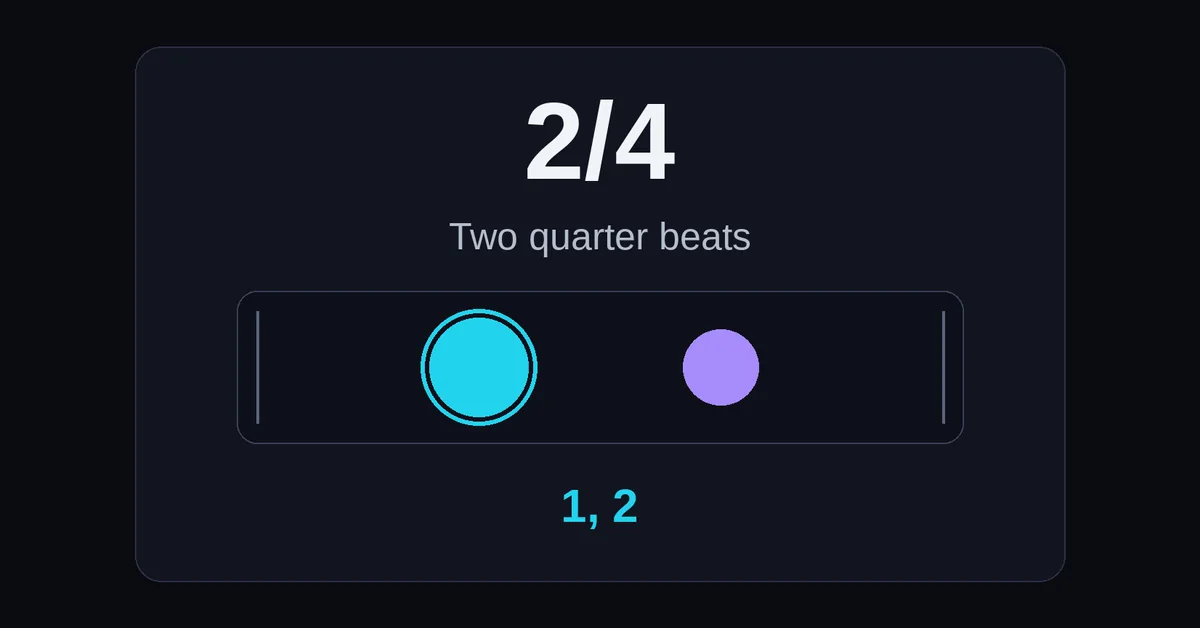
In 2/4, the top number gives two beats per bar and the bottom number makes a quarter note the beat unit. A full bar can contain any notes and rests totaling two quarters. Beat 1 begins the repeating measure and usually carries more metric weight than beat 2, even when performers add other accents.
Open Music Theory's simple meter chapter explains beats, divisions and the strong first beat. A bar need not contain exactly two note attacks: one sustained half note or four even eighths can occupy the same measure.
Try tapping "ONE, two, ONE, two" with equal time between taps. Give ONE a little emphasis without lengthening it. Then play four eighths while your foot keeps the two quarter beats. Your hand makes four attacks, but your foot still marks only two main beats.
The main beat normally divides in two here. Compare simple and compound division in 3/4 and 6/8 for a change in how beats divide.
How Do You Count and Fill a 2/4 Bar?
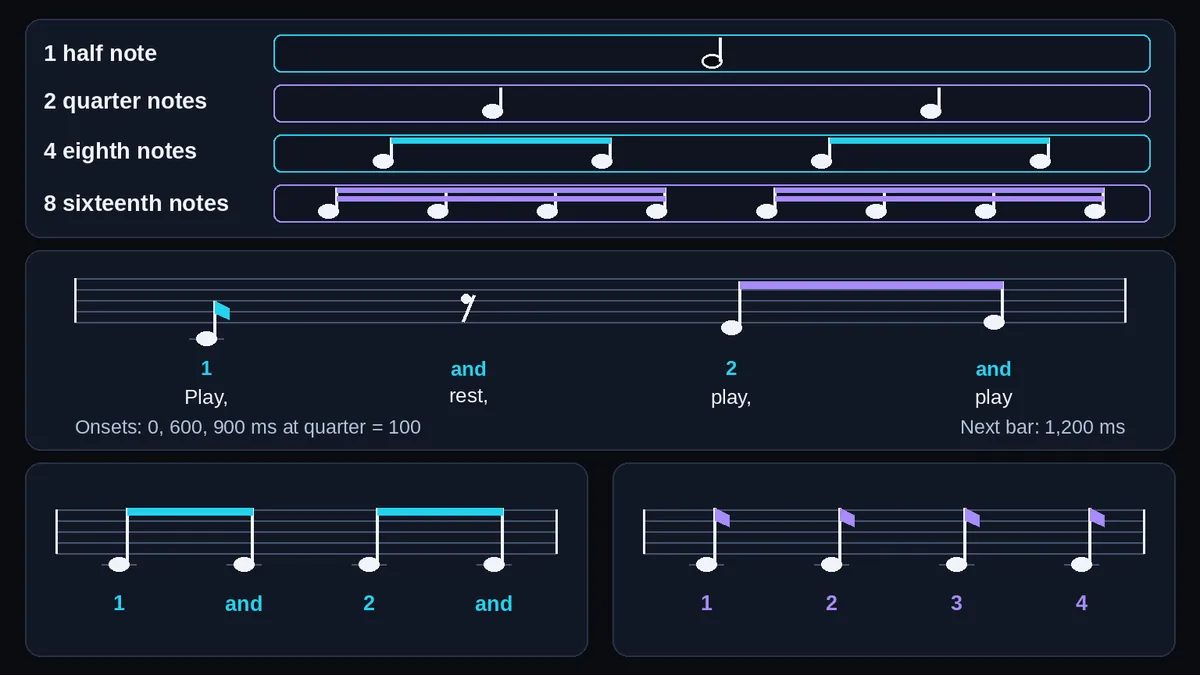
Count quarter notes as "1, 2" and eighth notes as "1 and 2 and." Keep the beat numbers equally spaced. Continue counting when a note lasts across the next count or when a rest replaces a sound, so the second beat and the next bar arrive at the same steady pace.
Note value assumption: BPM counts quarter notes. This table uses 100 BPM, giving a 600 ms quarter and a 1,200 ms bar. Since 2/4 is simple duple, the quarter is also the written beat and no conversion is needed.
| One full 2/4 bar | Quarter note total | Duration at quarter = 100 |
|---|---|---|
| One half note | 2 | 1,200 ms |
| Two quarter notes | 2 | 1,200 ms |
| Four eighth notes | 4 × 0.5 = 2 | 1,200 ms |
| Eight sixteenth notes | 8 × 0.25 = 2 | 1,200 ms |
| Dotted quarter plus eighth | 1.5 + 0.5 = 2 | 900 ms + 300 ms |
Original exercise: count "1 and 2 and" while clapping on 1 and the final "and." Those onsets make a dotted quarter followed by an eighth. Keep speaking beat 2 while the dotted quarter's counted time continues. On a sustaining instrument, hold the first note through beat 2, then play the eighth. To measure the pulse of a recording in 2/4, the guide to counting BPM walks through it.
For sixteenths, say "1 e and a, 2 e and a," as in Open Music Theory's counting system. At 100 BPM, each syllable takes 600 ÷ 4 = 150 ms. An original mixed bar could use four sixteenths on beat 1 and two eighths on beat 2. Its six attacks begin at 0, 150, 300, 450, 600 and 900 ms. The next bar still starts at 1,200 ms.
A useful bar check is to convert everything into eighth note units. A quarter takes two units, an eighth takes one, and a sixteenth takes half a unit. The total must be four. A dotted quarter plus two eighths gives 3 + 1 + 1 = 5 units, so it overfills a full 2/4 bar by one eighth.
Triplets are an exception to ordinary two part division. Three eighth note triplets fill one quarter beat, as explained in Open Music Theory's tuplet lesson. At quarter equals 100, each lasts 600 ÷ 3 = 200 ms. Six such notes fill the 1,200 ms bar. Their triplet marks change the division without changing the time signature.
How Do Rests, Ties and Pickups Work in 2/4?
Rests occupy counted time, ties sustain a pitch without another attack, and a pickup is an incomplete opening measure. None of these requires you to abandon the two beat framework. Find each sound's position within the count before playing, including silent positions and beats that pass while a note continues sounding.
Open Music Theory's notation chapter explains rest values and ties between notes of the same pitch. Do not replay the second note of a tied pair.
Rest reading exercise: play C4 as an eighth on "1," leave an eighth rest on "and," then play D4 and E4 as eighths on "2 and." Answer: attacks on 1, 2 and the final and; silence on the first and. At quarter equals 100, the onsets are 0, 600 and 900 ms, and the next bar begins at 1,200 ms.
For a tie across a bar line, play a quarter rest on beat 1, then C4 as a quarter on beat 2 tied to a C4 quarter on the following beat 1. Finish that second bar with a quarter rest. The sound begins at 600 ms and lasts 1,200 ms, ending at 1,800 ms. The bar line passes at 1,200 ms without a new attack. Each written bar still totals two beats.
A pickup, also called an anacrusis, starts before the first full measure; Steps to Music Theory explains this incomplete opening. For an original one eighth pickup, count "1 and 2 and" silently and enter only on the last "and." The following note lands on the next bar's 1. Calling the pickup "1" would shift your count away from the written downbeat.
How Does 2/4 Compare With 4/4 and 2/2?
2/4 has two quarter beats, 4/4 has four quarter beats, and 2/2 has two half note beats. Both two beat meters can be counted "1, 2," but their written beat units differ. Cut time means 2/2. Compare tempo marks as well as signatures before deciding how long the bars should last.
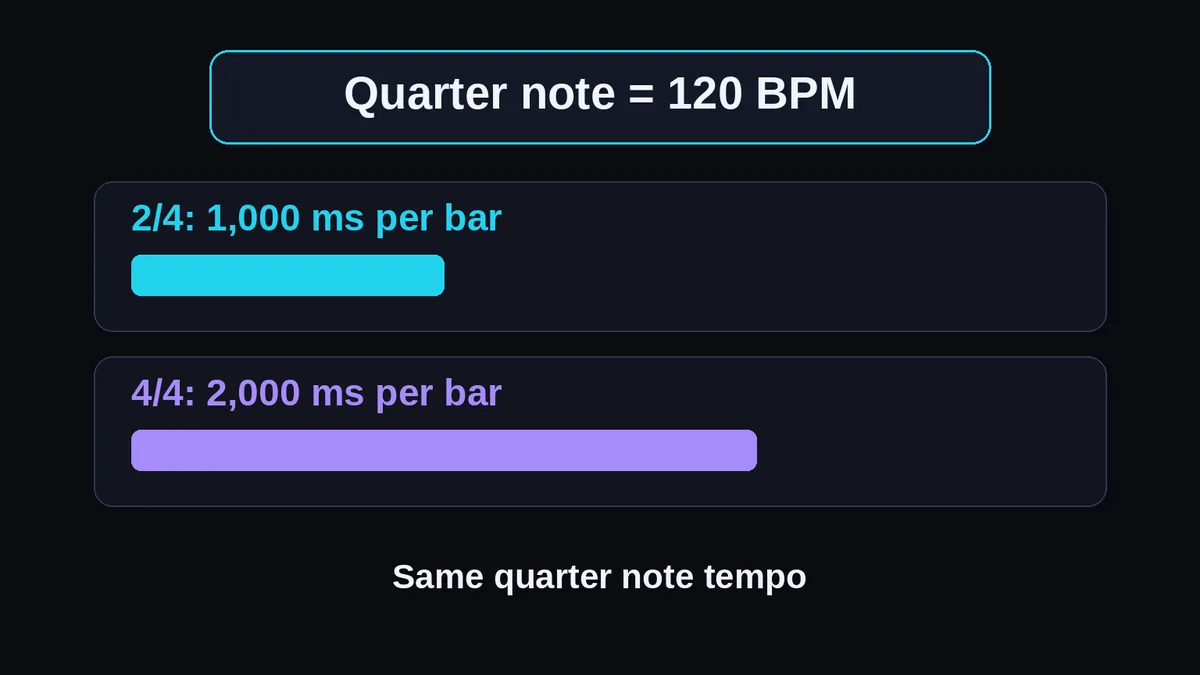
The classification and beat unit distinction follow Open Music Theory. At a shared quarter note tempo of 120 BPM, a 2/4 bar lasts 1,000 ms and a 4/4 bar lasts 2,000 ms.
For 2/2 marked half note equals 120, each half note lasts 500 ms and the two beat bar lasts 1,000 ms. A 2/2 bar and a 2/4 bar can therefore last equally long when their respective beat units share the same BPM. The note values inside them are still different.
Watch the unit when using a quarter note BPM tool. Half note equals 120 corresponds to quarter note equals 240, since each half contains two quarters. Entering 120 as quarter BPM instead would make that 2/2 bar last 2,000 ms, twice the intended duration.
What about 4/8? Both a 2/4 bar and a 4/8 bar contain four eighth note units. An ordinary 2/4 reading groups them as two quarter beats, with eighths paired within each beat. A four beat 4/8 reading counts each eighth as a beat. Notation and phrasing matter when choosing between them; Ultimate Music Theory's comparison demonstrates the distinction. Use the time signature overview for beat units and classification.
What Music Can You Practice in 2/4?
Choose a score marked 2/4, then practice its two beat cycle before adding subdivisions. Offenbach's Can Can is the example used in the Piano and Keyboard All-in-One lesson linked below. Treat it as that lesson's example, since another arrangement may present the same tune with different bar lines or notation.
The Dummies counting lesson identifies its Can Can demonstration as 2/4. Check your own arrangement rather than assuming every march or dance uses this signature.
For an original practice pattern, select 2/4 at 100 BPM on the online metronome. Use the base quarter clicks, with the accent on beat 1. Speak eighths over the clicks, clap four even eighths for one bar, and hold one half note for the next. Both bars last 1,200 ms.
Turn that into a four bar reading exercise: four eighths, one half note, the rest pattern above, then a dotted quarter plus eighth. Repeat without stopping at the bar lines. Four bars occupy 4 × 1,200 = 4,800 ms; the second pass begins at 4.8 seconds. If the rest bar comes out short, keep speaking its silent "and" before trying again.
For piano, play a low C on beat 1 and a higher C on beat 2 while the other hand tries the rhythm. A guitarist can tap both quarter beats while clapping the pattern before transferring it to strings. These are coordination exercises, not prescribed accompaniments for the named piece.
For another practice speed, check the note duration calculator. Tempo controls the rate while the signature organizes the bar.
Does 12/4 Mean the Same Thing?
12/4 is a different time signature, normally read as compound quadruple with four dotted half note beats. Each of those beats contains three quarters, giving twelve quarter note units per bar. It is distinct from both this page's two quarter beat meter and 12/8, whose four main beats are dotted quarters.
The compound meter table in Open Music Theory includes 12/4. If your score shows twelve eighth note divisions, use the 12/8 guide. If it shows 12/4, preserve that beat unit rather than treating the notation as a typo.