
What Is a Hemiola in Music?
The word comes from the Greek hemiolios, meaning containing one and a half. Wikipedia defines rhythmic hemiola as three beats of equal value in the time normally occupied by two beats. Its Latin counterpart is sesquialtera, a term you may meet in older theory books and organ stop names.
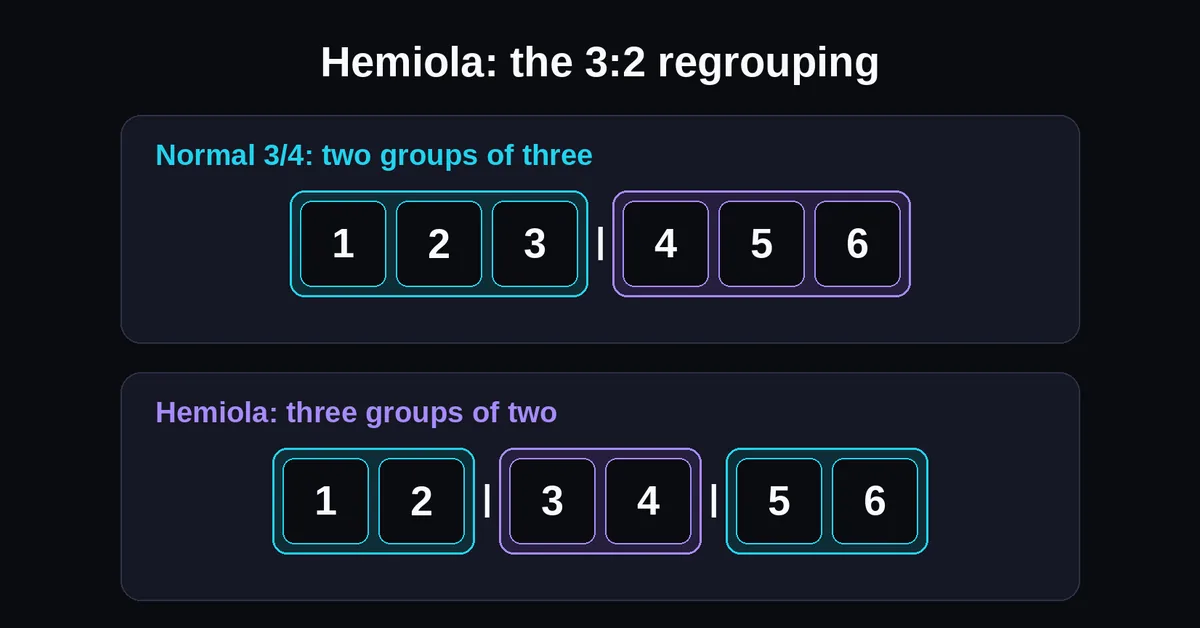
In practice, a hemiola works by changing where the strong accents fall. Six small units, such as six quarter notes across two bars of 3/4, can be heard as two groups of three or three groups of two. Normal 3/4 groups them in threes; a hemiola groups them in twos for a moment.
That ambiguity is built into the numbers. Six divides evenly by both two and three, so any music with six equal units can tip between the two feels. Composers exploit that to add tension, energy or a sense of arrival.
How Does a Hemiola Work Across Two Bars?
Take two bars of 3/4, six quarter note beats. Normally the accents fall on beats 1 and 4 of the six, the start of each bar. In a hemiola, the music accents beats 1, 3 and 5 instead, often with half notes, so the two bars feel like three bars of two beats.
| Counting six quarter notes | Accents | Feel |
|---|---|---|
| Normal two bars of 3/4 | ONE two three FOUR five six | Two groups of three |
| Hemiola across the two bars | ONE two THREE four FIVE six | Three groups of two |
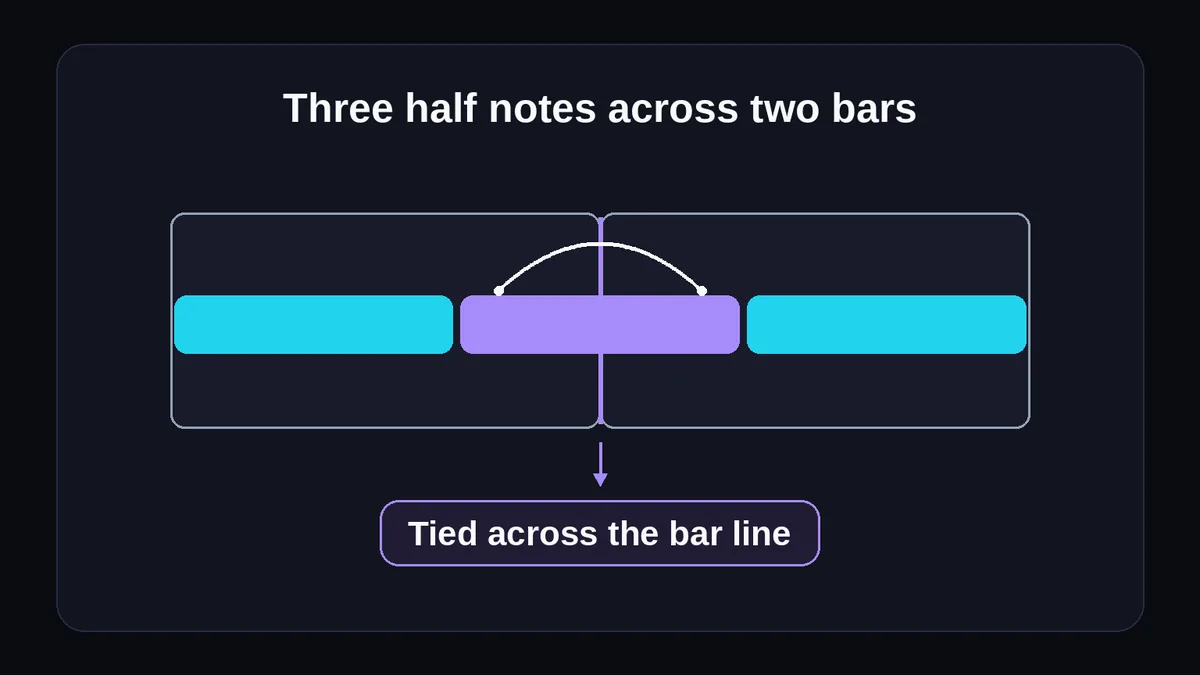
In notation, the most common sign is three half notes spread across two bars of 3/4, with the middle half note tied across the bar line. The bar lines stay where they are; your ear simply follows the half notes. When the next bar arrives, normal 3/4 returns.
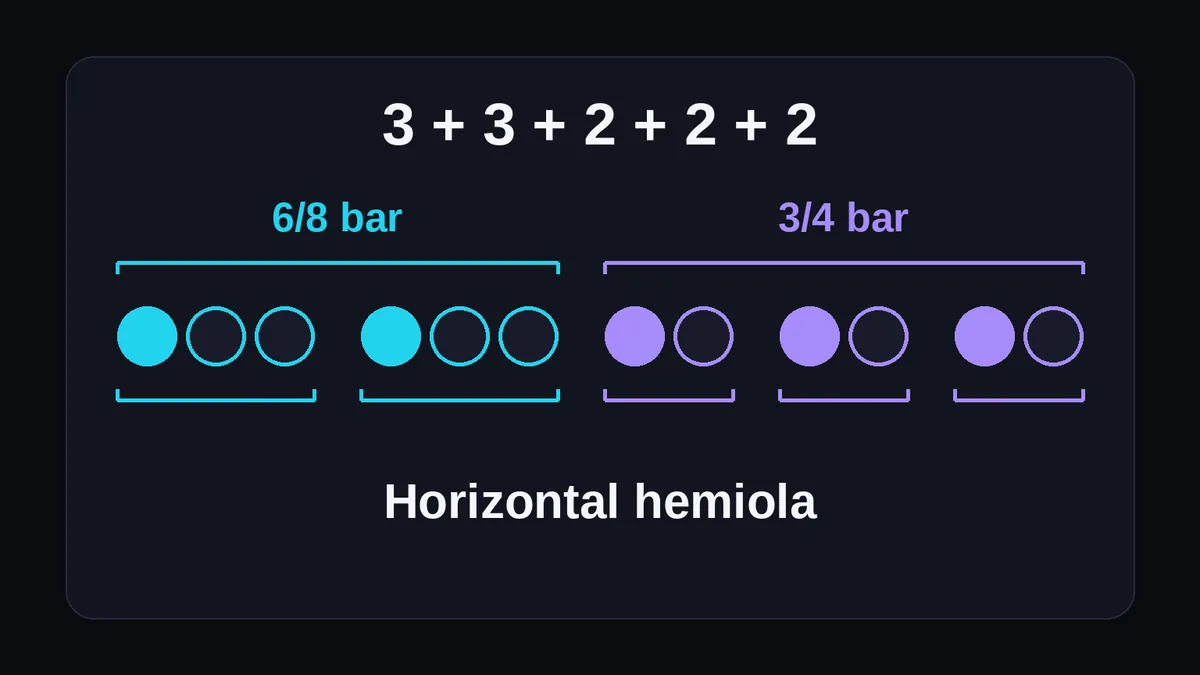
The same idea works inside a single bar of six eighth notes. Grouped 3 + 3, the bar is 6/8; grouped 2 + 2 + 2, it is 3/4. Switching between those two groupings is the most common hemiola of all.
What Is the Difference Between Horizontal and Vertical Hemiola?
A horizontal hemiola changes the grouping over time: first threes, then twos, one after the other. A vertical hemiola stacks them: one part plays three while another plays two at the same moment. Wikipedia notes that when a vertical hemiola repeats continuously it becomes a polyrhythm or cross rhythm.
| Type | What happens | Typical example |
|---|---|---|
| Horizontal hemiola | Grouping switches from threes to twos in sequence | A 6/8 bar followed by a 3/4 bar |
| Vertical hemiola | Three and two sound at the same time | Melody in 3/4 against an accompaniment in 6/8 |
| Repeated vertical hemiola | The 3:2 layer continues | A cross rhythm or polyrhythm |
Wikipedia quotes the ethnomusicologist Peter Manuel describing a twelve beat pattern built from a 6/8 bar followed by a 3/4 bar, a 3 + 3 + 2 + 2 + 2 grouping he calls a cliché of various Spanish and Latin American musics. It is also a common African bell pattern. That single pattern shows both meters back to back.
Why Do Hemiolas Appear at Cadences?
In Baroque dances in triple meter, hemiolas very often appear just before a cadence, the musical equivalent of a sentence ending. Regrouping the last two bars into broader twos slows the felt pulse without changing the tempo, which makes the ending sound more emphatic and final.
Wikipedia notes that hemiola was commonly used in Baroque music, especially in dances such as the courante and the minuet. It points to the minuet from Bach's Partita No. 5, where the music moves in groups that are really in 6/8 time, and the written 3/4 is restored only at the cadences.
If you play Baroque minuets, look at the bar or two before each double bar. A run of half notes, or a half note tied across the bar line, is usually a hemiola. Shaping it as three broad beats instead of six fussy ones is one of the quickest ways to make a minuet sound stylish.
How Do You Count a Hemiola?
Keep the smallest pulse steady and change only where you place the accents. For a hemiola across two bars of 3/4, count all six quarter notes aloud and stress 1, 3 and 5 instead of 1 and 4. The spoken count stays even; the stress pattern changes.
- Count "1 2 3 4 5 6" evenly, stressing 1 and 4. That is normal 3/4 over two bars.
- Keep the same speed and stress 1, 3 and 5. That is the hemiola.
- Alternate the two versions every two bars until the switch feels easy.
- Clap the stressed numbers only while saying all six. The claps should feel like they slow down in the hemiola version, even though the count does not.
- Apply it to the music: find the tied half notes before a cadence and count them the same way.
In 6/8 versus 3/4, use eighth notes instead: count "1 2 3 4 5 6" and stress 1 and 4 for 6/8, then 1, 3 and 5 for 3/4. The 6/8 vs 3/4 page explains those two groupings in detail.
Where Can You Hear Hemiola?
Hemiola appears from Renaissance songs to Broadway. Wikipedia lists examples from Dowland and Bach through Beethoven, Brahms, Tchaikovsky and Ravel, and points to the main motif of Bernstein's "America" from West Side Story as a horizontal hemiola that switches between 6/8 and 3/4.
- Bernstein, "America," West Side Story. The famous rhythm alternates a duple and a triple grouping, the 6/8 to 3/4 switch in its most recognizable form.
- Bach, Partita No. 5, Minuet. Music that moves like 6/8 inside written 3/4, with 3/4 restored at the cadences.
- Beethoven, String Quartet Op. 18 No. 6, Scherzo. Constant shifts between 3/4 and 6/8 feels, with off beat accents that Wikipedia says must have sounded disconcerting at the time.
- Brahms, Symphony No. 3. Wikipedia notes that its 6/4 meter can be heard as 3/2, a hemiola that creates ambiguity from the opening motto.
- Tchaikovsky waltzes. Wikipedia notes he frequently used hemiolas in his waltzes, briefly tipping the three beat swing into twos.
How Is Hemiola Different From Syncopation and Polyrhythm?
Hemiola regroups equal beats in a 3:2 ratio. Syncopation shifts accents off the strong beats without necessarily regrouping them. Polyrhythm keeps two different groupings going together for a sustained stretch. A single hemiola is short; a polyrhythm is ongoing.
| Idea | What changes | Length |
|---|---|---|
| Hemiola | Beats regroup from threes to twos, or the reverse | Usually a bar or two |
| Syncopation | Accents move off strong beats | Any length |
| Polyrhythm | Two groupings sound together | Sustained |
The terms overlap, which is why textbooks sometimes disagree. Wikipedia even notes that a cadence hemiola often lands a strong harmony on a weak beat, which also counts as syncopation. When in doubt, ask whether the beats are being regrouped in threes and twos; if so, hemiola is the most precise name.
How Do You Practice Hemiola With a Metronome?
Use the metronome to hold the smallest pulse while you move the accents. Set the online metronome to 3/4 at about 90 BPM so each click is a quarter note and the accent marks every bar line. Then practice placing three even half notes across two bars without letting the clicks pull you back.
- Play or clap quarter notes for two bars, following the accent on each beat 1.
- Play three half notes across the next two bars: on beats 1 and 3 of the first bar and beat 2 of the second. Keep listening to the clicks.
- Switch the metronome to 6/8 at a quarter note setting of 90 BPM. You now hear six eighth note clicks per bar with an accent on the first.
- Clap groups of three over the clicks, then groups of two, alternating every bar. That is the 6/8 and 3/4 hemiola at a steady pulse.
- Raise the tempo a few BPM at a time with the speed trainer until the switch stays clean at performance speed.
If you want to hear three against two as a continuous layer, try the polyrhythm metronome, which plays both pulses at once.