
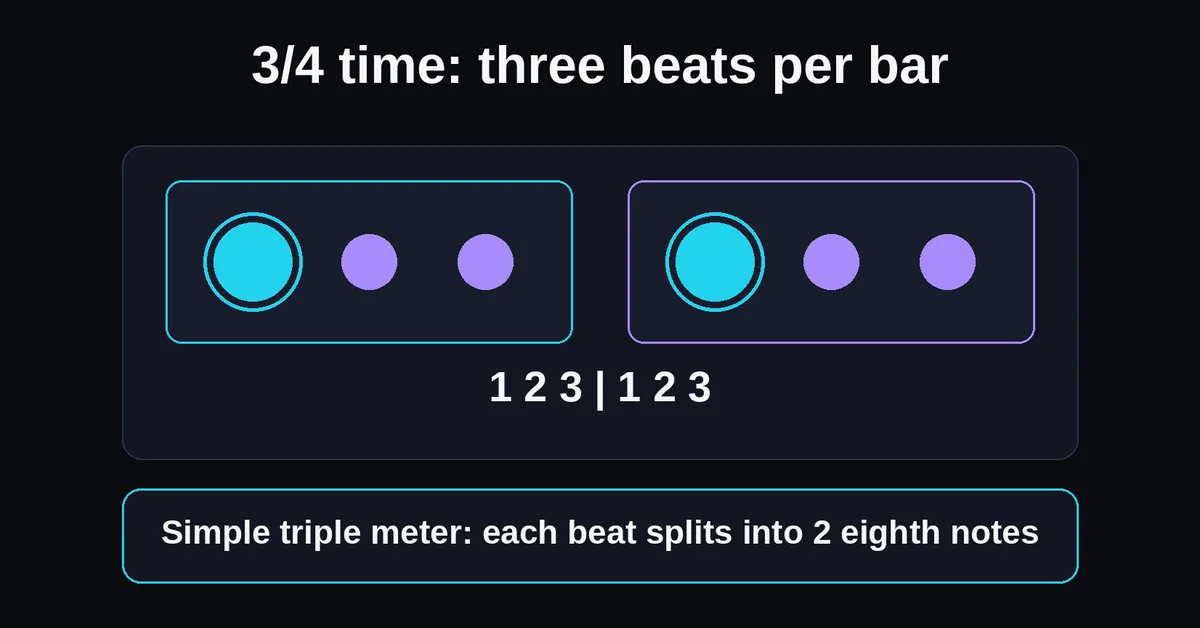
What Does the 3/4 Time Signature Mean?
The top number, 3, tells you how many beats are in each bar. The bottom number, 4, tells you which note gets one beat: a quarter note. So a full bar of 3/4 holds three quarter notes, or any combination of notes and rests that adds up to the same length.
The meter is called simple because each beat divides naturally into two equal parts, two eighth notes. It is called triple because there are three beats per bar. That combination gives 3/4 its familiar strong, weak, weak pattern.
Wikipedia's time signature article lists 3/4 as the meter for waltzes, minuets, scherzi, polonaises, mazurkas, and country and western ballads, as well as some R&B and pop. Those are mostly dance forms, which is no accident: a repeating group of three steps fits the pattern naturally.

How Do You Count 3/4 Time?
Count the three beats aloud as "1, 2, 3" and lean slightly on beat 1. When the music uses eighth notes, add "and" between the numbers. For sixteenth notes, use "1 e and a." The count changes with the subdivision, but the three main beats stay the same.
| Rhythm level | Spoken count for one bar | Notes per bar |
|---|---|---|
| Quarter notes | 1, 2, 3 | 3 |
| Eighth notes | 1 and 2 and 3 and | 6 |
| Eighth note triplets | 1 trip let 2 trip let 3 trip let | 9 |
| Sixteenth notes | 1 e and a 2 e and a 3 e and a | 12 |
Here are three common ways the weight can fall inside a bar of 3/4:
- Strong, weak, weak: the standard pattern, with beat 1 clearly marked.
- Beat 3 as a lead in: beat 3 is felt as a pickup that pushes toward the next downbeat, common in lyrical melodies.
- Accent on beat 2 or 3: typical of the mazurka, a Polish dance that gives 3/4 a distinctive lilt.
A useful exercise is to clap beat 1 only while counting all three numbers aloud. Then clap beats 2 and 3 only. The second version shows how the "oom pah pah" accompaniment of a waltz feels from the inside.
Why Does 3/4 Feel Like a Dance?
Three beats create a circular motion: step, step, step, then back to a fresh downbeat. That loop matches turning dances, which is why the waltz, minuet and mazurka grew up in 3/4. Even without dancers, the meter tends to sound graceful and rocking rather than marching.
Compare it with 4/4, where two strong points (beats 1 and 3) give a square, walking feel. In 3/4 there is only one strong point per bar, so the bar seems to lift and land. The 4/4 time signature guide covers that contrast from the other side.
Accompaniment patterns reinforce the feel. A typical waltz bass plays a low note on beat 1 and chords on beats 2 and 3. Wikipedia's article on The Blue Danube describes the Viennese waltz beat as accentuated at the end of each three note phrase, a reminder that the weight within a bar can shift by style.
How Fast Is a Waltz in 3/4?
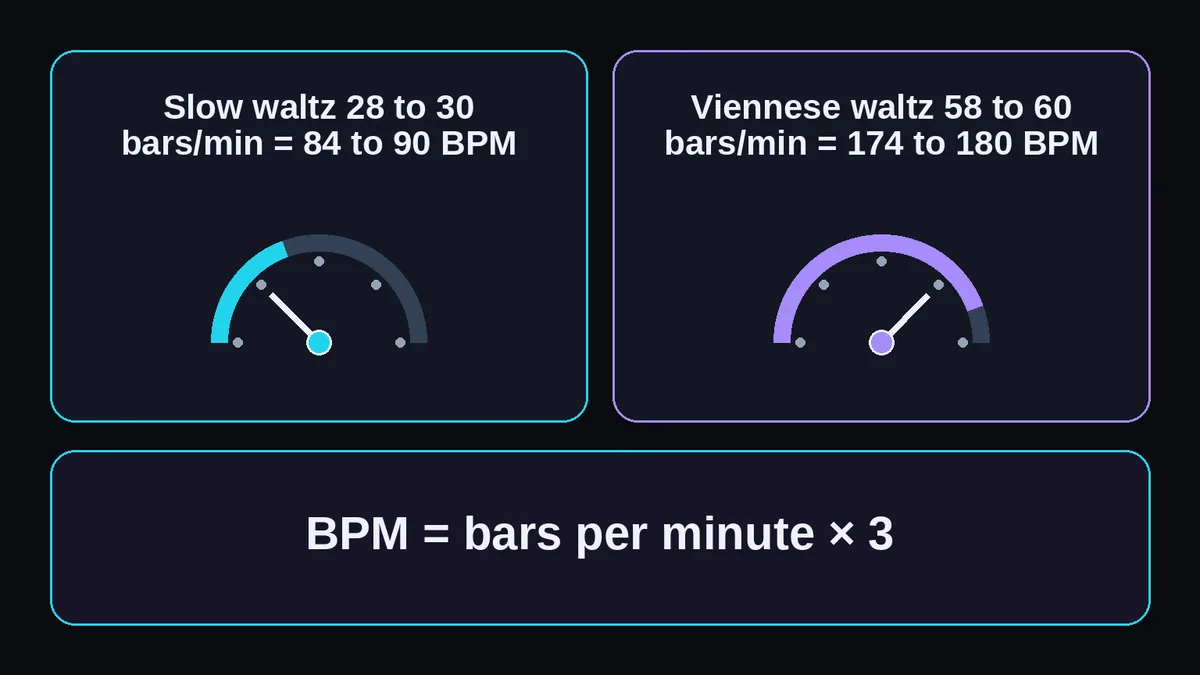
Ballroom dance measures waltz tempo in bars per minute. The slow waltz is danced at about 28 to 30 bars per minute, which is 84 to 90 BPM. The Viennese waltz runs at about 58 to 60 bars per minute, around 174 to 180 BPM, roughly twice as fast.
| Waltz style | Bars per minute | Beats per minute (3 per bar) | Source |
|---|---|---|---|
| Slow waltz (English, International Standard) | 28 to 30 | 84 to 90 BPM | Wikipedia, Slow waltz, citing WDSF and WDC rules |
| Viennese waltz | 58 to 60 | 174 to 180 BPM | Wikipedia, Viennese waltz |
At Viennese waltz speed, dancers and musicians often feel one beat per bar rather than three. That "one to a bar" feel is common in fast 3/4 scherzos too. If a fast 3/4 piece feels frantic when counted in three, try counting only the downbeats.
How Long Is a Bar of 3/4 at Common Tempos?
One bar of 3/4 lasts three beats, so its length is three times the beat length. At 120 BPM a beat lasts 500 milliseconds and a bar lasts 1.5 seconds. At 60 BPM a bar takes exactly 3 seconds.
| Tempo | One beat | One bar of 3/4 | Bars per minute |
|---|---|---|---|
| 60 BPM | 1,000 ms | 3.00 s | 20 |
| 90 BPM | 666.67 ms | 2.00 s | 30 |
| 120 BPM | 500 ms | 1.50 s | 40 |
| 150 BPM | 400 ms | 1.20 s | 50 |
| 180 BPM | 333.33 ms | 1.00 s | 60 |
Video editors and producers can use the same math: 16 bars of 3/4 at 120 BPM take 24 seconds. For other values, the BPM to milliseconds converter and the note duration calculator do the arithmetic.
Which Pieces and Songs Are in 3/4?
Clear examples include the Minuet in G major long credited to Bach, Johann Strauss II's The Blue Danube, and the waltzes of Chopin. Each shows triple meter in a different setting: a keyboard dance, an orchestral waltz and solo piano.
- Minuet in G major, BWV Anh. 114. Wikipedia notes it is in 3/4 with 32 measures. It appears in the 1725 Notebook for Anna Magdalena Bach, but modern scholarship credits it to Christian Petzold, not Bach.
- Johann Strauss II, The Blue Danube (1866). The most famous Viennese waltz, written for orchestra.
- Frédéric Chopin, waltzes for solo piano. Concert waltzes that keep the triple meter while bending the tempo expressively.
- Tchaikovsky, Waltz of the Flowers from The Nutcracker. A ballet waltz with a long, sweeping melody.
One famous song is often listed as 3/4 when its source says otherwise. Billy Joel's "Piano Man" is widely called a waltz, but its Wikipedia article describes it as a 6/8 fast waltz. Song transcriptions differ, so check a published score before relying on any list.
Which Notes Fill a Bar of 3/4, and How Do Pickups Work?
A bar of 3/4 must add up to three quarter notes. A dotted half note fills it alone, as does a half note plus a quarter, or six eighth notes. Two half notes do not fit, because they add up to four beats. Checking these sums is the fastest way to catch a counting mistake.
| Notes in one bar | Beats | Fits 3/4? |
|---|---|---|
| Dotted half note | 3 | Yes |
| Half note + quarter note | 2 + 1 = 3 | Yes |
| Three quarter notes | 3 | Yes |
| Six eighth notes | 6 × 0.5 = 3 | Yes |
| Two half notes | 2 + 2 = 4 | No |
Many 3/4 melodies begin with a pickup, also called an anacrusis: one or two notes before the first full bar. Happy Birthday is a familiar case. To count in, say the full bar before it, "1, 2, 3," and start the pickup where it falls, usually on beat 3. The last bar of the piece is often shortened by the same amount, so the two partial bars add up to one full bar.
Conductors beat 3/4 in a triangle: down on beat 1, out to the right on beat 2, and up on beat 3. At fast tempos they switch to one beat per bar, the same "in one" feel used for a Viennese waltz.
Is It 3/4 or 6/8? A Quick Check
Both meters hold six eighth notes per bar, so they can look alike. The quick test is grouping: 3/4 groups the eighths in pairs, three beats of two, while 6/8 groups them in threes, two beats of three. Tap your foot to the music; three taps per bar suggests 3/4.
Beaming in the score helps too. In 3/4, eighth notes are usually beamed in pairs or across the whole bar; in 6/8, they are beamed in groups of three. For listening tests, matched timing and edge cases such as triplets in 3/4, see 6/8 vs 3/4. For 6/8 by itself, see the 6/8 time signature guide.
How Do You Set a Metronome to 3/4?
Choose 3/4 in the online metronome, set the BPM to the quarter note beat, and the accent will fall on beat 1 of every bar. Start slowly, around 80 BPM, then add eighth note subdivision if you need to place notes between beats.
- Select 3/4. The accent on the first click marks each downbeat.
- Set the tempo. For a slow waltz, try 87 BPM, the middle of the ballroom range; for a minuet, try a moderate 100 to 112 BPM.
- Add eighth note subdivision to practice even pairs, or triplets for a jazz waltz feel.
- Count aloud with the clicks for four bars before playing, so the strong, weak, weak pattern is in your body first.
- For fast pieces, set the BPM so each bar matches your target bars per minute. At 180 BPM in 3/4, you get exactly 60 bars per minute.
The metronome supports 20 to 360 BPM, five sounds and a speed trainer that raises the tempo after a set number of bars. To find the tempo of a waltz recording, tap the quarter note beat on the tap tempo tool with the spacebar, a letter or a number key. If you tap only downbeats, multiply the result by three.