
How Do You Read These Drum Grids?
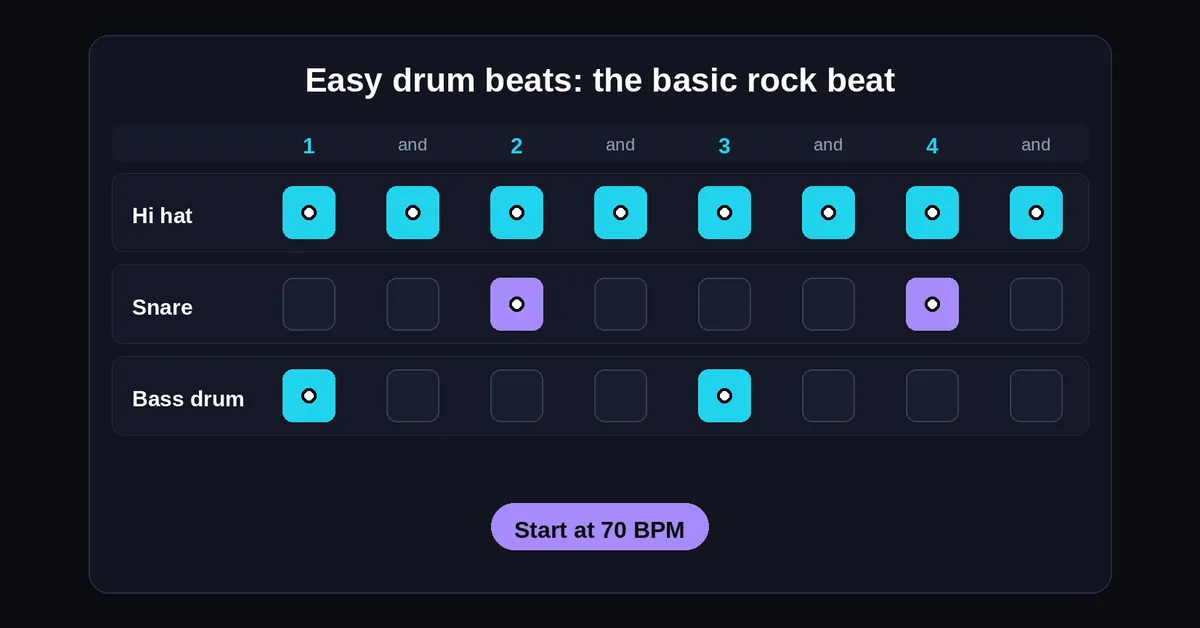
Each grid shows one bar of 4/4 counted in eighth notes: "1 and 2 and 3 and 4 and." An X means play that drum on that count; an empty cell means rest. Read across each row for one drum, and down each column to see what hits together.
| Count | 1 | and | 2 | and | 3 | and | 4 | and |
|---|---|---|---|---|---|---|---|---|
| Hi hat (HH) | X | X | X | X | X | X | X | X |
| Snare (SN) | X | X | ||||||
| Bass drum (BD) | X | X |
That grid is the basic rock beat. Most kits are set up with the hi hat played by the right hand, the snare by the left, and the bass drum by the right foot, reversed for left handed players. If you count aloud while playing, the grid becomes easy: every number and every "and" gets a hi hat.
New to counting? The how to count music page explains "1 and 2 and," and the downbeat guide explains why the snare on 2 and 4 is called the backbeat.
What Is the Easiest Drum Beat to Learn?
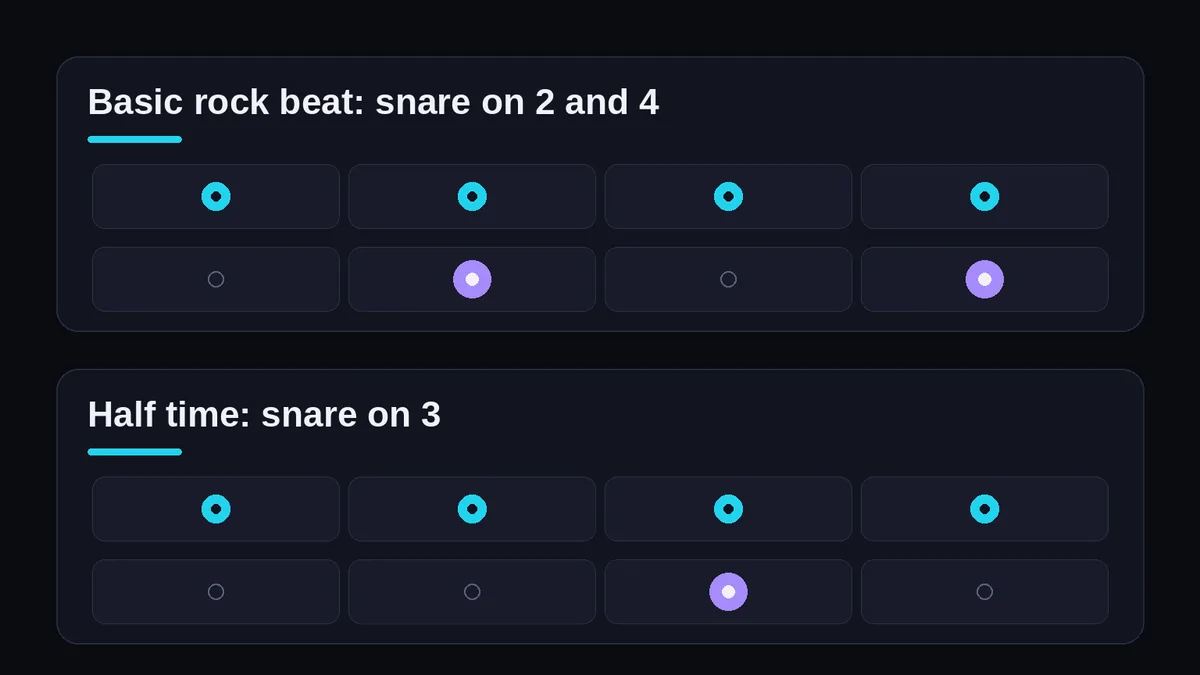
Beat 1, the basic rock beat, is the place to start. It uses only three drums, repeats every bar, and fits a huge amount of rock, pop and country music. Once your hands and foot coordinate on it, almost every other beginner pattern is a small change.
Learn it in layers so your limbs do not overload:
- Play eighth notes on the hi hat alone, counting aloud, for eight bars.
- Add the snare on 2 and 4 while the hi hat continues.
- Add the bass drum on 1 and 3.
- Play the full beat for 16 bars without stopping.
- Close your eyes and play it again, listening for even hi hats.
The most common beginner problem is the hi hat stopping or flamming when the snare or bass drum joins. Slow down until all three limbs line up exactly on the shared counts.
Which Beats Should You Learn Next?
After the basic rock beat, learn variations that move one bass drum note. Each changes the feel while keeping the hi hat and snare the same, so you only have one new thing to think about. Beats 2 and 3 below are the most useful first variations.
Beat 2, extra bass drum on the "and" of 3:
| Count | 1 | and | 2 | and | 3 | and | 4 | and |
|---|---|---|---|---|---|---|---|---|
| HH | X | X | X | X | X | X | X | X |
| SN | X | X | ||||||
| BD | X | X | X |
Beat 3, bass drum on 1, "and" of 2, and 3:
| Count | 1 | and | 2 | and | 3 | and | 4 | and |
|---|---|---|---|---|---|---|---|---|
| HH | X | X | X | X | X | X | X | X |
| SN | X | X | ||||||
| BD | X | X | X |
Beat 3 is harder because the bass drum lands right after a snare stroke. Play it very slowly at first. These off beat bass drum notes are a gentle introduction to syncopation, explained on the syncopation page.
How Do You Play Four on the Floor?
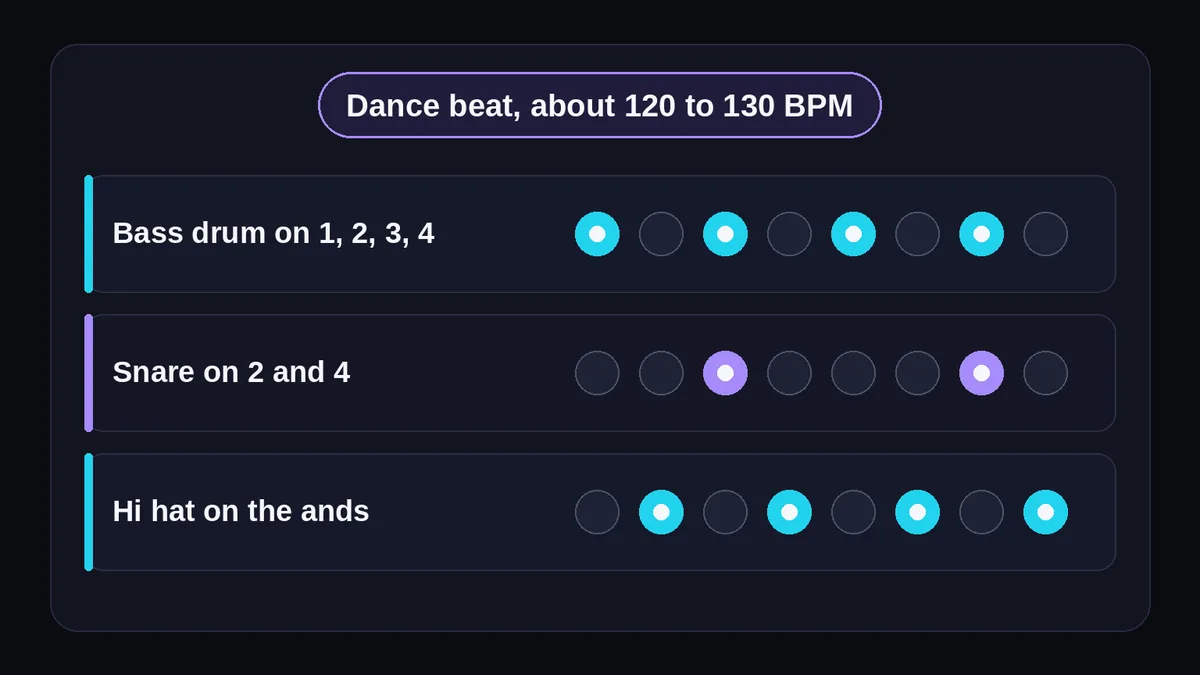
Four on the floor puts the bass drum on every beat: 1, 2, 3 and 4. Add the snare or a clap on 2 and 4 and an open or closed hi hat on the "ands," and you have the basic dance beat used in disco, house and much pop music.
Beat 4, four on the floor with off beat hi hats:
| Count | 1 | and | 2 | and | 3 | and | 4 | and |
|---|---|---|---|---|---|---|---|---|
| HH | X | X | X | X | ||||
| SN | X | X | ||||||
| BD | X | X | X | X |
The hi hat on the "and" between kicks is what makes this beat bounce. If the off beats feel tricky, first play the hi hat on every eighth, then drop the ones that fall on the numbers. House music usually sits around 120 to 130 BPM; see the house BPM guide for the range.
What Is a Half Time Beat?
A half time beat moves the snare from 2 and 4 to beat 3 only, so the groove feels half as fast while the hi hats keep the same speed. It is a simple way to make a song feel heavier or more spacious, and it is common in rock ballads, hip hop and trap.
Beat 5, half time:
| Count | 1 | and | 2 | and | 3 | and | 4 | and |
|---|---|---|---|---|---|---|---|---|
| HH | X | X | X | X | X | X | X | X |
| SN | X | |||||||
| BD | X | X |
Notice how the same tempo can feel completely different. Play Beat 1 for four bars, then Beat 5 for four bars without changing the metronome. The half time vs double time guide explains why tempo apps sometimes read this kind of beat at half its real BPM.
How Do You Add Sixteenth Notes and Open Hi Hats?
Once eighth note beats are solid, add detail. Beat 6 doubles the hi hat to sixteenth notes, Beat 7 opens the hi hat on the "and" of 4, and Beat 8 replaces the hi hat with the ride cymbal. Each adds texture without changing the core pattern.
Beat 6, sixteenth note hi hats, counted "1 e and a":
| Count | 1 | e | and | a | 2 | e | and | a | 3 | e | and | a | 4 | e | and | a |
|---|---|---|---|---|---|---|---|---|---|---|---|---|---|---|---|---|
| HH | X | X | X | X | X | X | X | X | X | X | X | X | X | X | X | X |
| SN | X | X | ||||||||||||||
| BD | X | X |
| Beat | Change from Beat 1 | What it adds |
|---|---|---|
| Beat 7, open hi hat | Open the hi hat on the "and" of 4, close it on 1 | A splash that pushes into the next bar |
| Beat 8, ride cymbal | Play the eighth notes on the ride instead of the hi hat | A washier sound for choruses |
Sixteenth hi hats are usually played with one hand at slower tempos and with alternating hands at faster ones. Start one handed at around 70 BPM; if your hand tires, slow down rather than tensing up.
What Tempo Should a Beginner Practice At?
Start most beats between 60 and 80 BPM, slow enough that every limb lands exactly together. Raise the tempo only after the beat is clean for several bars. Real songs often run faster, but speed comes from accuracy, not the other way round.
| Beat | Starting tempo | Typical song tempo to aim for |
|---|---|---|
| 1, basic rock beat | 70 BPM | 100 to 130 BPM |
| 2 and 3, bass drum variations | 65 BPM | 90 to 120 BPM |
| 4, four on the floor | 80 BPM | 115 to 130 BPM |
| 5, half time | 70 BPM | 130 to 160 BPM (felt at half) |
| 6, sixteenth hi hats | 60 BPM | 80 to 100 BPM |
The target ranges are approximate and vary by song. To find the tempo of a song you want to play along with, tap the beat on the tap tempo tool with the spacebar, a letter or a number key.
How Do You Practice Drum Beats With a Metronome?
Use the metronome as your band. Set the online metronome to 4/4 at your starting tempo with the accent on beat 1, choose a loud click such as rimshot or woodblock, and play each beat for four bars at a time with a bar of rest between.
- Set 70 BPM in 4/4 and play Beat 1 for four bars, counting aloud.
- Rest for one bar while the click continues, then come back in exactly on beat 1.
- When four bars in a row are clean, raise the tempo by 4 BPM.
- Use the speed trainer to add 2 BPM every 8 bars for a longer session.
- Switch beats every few minutes so you practice changing patterns in time.
The rest bar is important: it trains you to find beat 1 again, a skill you need in every song. For deeper drummer routines, including practicing with the click on 2 and 4, see the metronome for drums guide.